

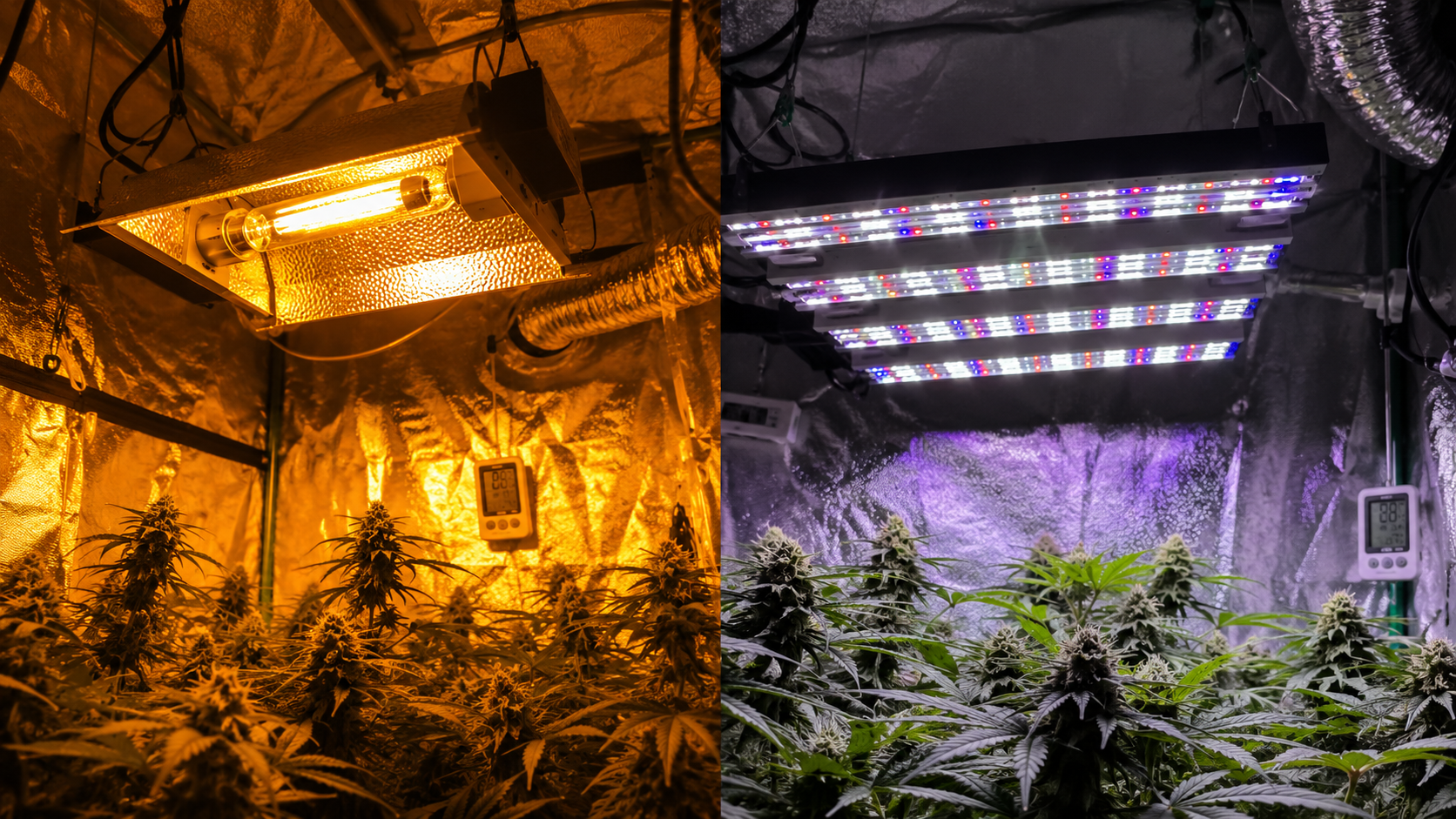
Somebody in every grow forum eventually posts a version of the same question: “My buddy gave me his old 1000W HPS, should I use it or just buy an LED?” And half the replies are dead certain LED wins, no discussion needed. That confidence is usually not backed by anything — just repeated opinion.
The honest answer is more interesting than “LED always wins.” Grow With Hydroponics has tested and compared both technologies across tents and small grow rooms, and the LED vs HPS grow light decision actually depends on your budget, your electricity rate, and what you’re already running. Below is the real comparison — efficiency numbers, cost math, spectrum differences, and a checklist for your specific situation, not just a marketing verdict.
Quick answer: LED grow lights are generally more efficient than HPS, using less electricity per unit of usable light and lasting roughly twice as long. However, the very best HPS fixtures can match mid-range LED efficiency, so the winner depends on your fixture quality, electricity cost, and how long you plan to run the system.
What’s the real difference between LED and HPS grow lights?
HPS (high-pressure sodium) is a high-intensity discharge (HID) lamp that produces light by passing electricity through vaporized sodium, while LED (light-emitting diode) grow lights generate light through semiconductor diodes tuned to specific wavelengths. That’s the mechanical difference — but the practical difference is about spectrum and heat.
HPS light leans heavily orange-yellow, with a documented output split of roughly 40% red, 50% green-yellow, 5% blue, and 5% far-red, plus a substantial amount of infrared radiation, which shows up as heat rather than usable light. LED fixtures can be tuned much closer to what plants actually use for photosynthesis, mixing red, blue, and white diodes without the same infrared penalty. If you want the full rundown of every light type on the market, not just these two, our best grow lights buying guide covers T5, CMH, and both of these side by side.
Why this matters beyond “which light looks brighter”
A grower switching from HPS to LED for the first time is often thrown off because the room looks dimmer under LED, even when PAR output is equal or higher. That’s a human-eye problem, not a plant problem — our eyes are far more sensitive to yellow-green light than plants are, so an HPS room “looks” more intense than it is.
How efficient are LED grow lights compared to HPS?
Efficiency in horticultural lighting is measured as PPE (photosynthetic photon efficacy) — how many micromoles of usable light a fixture produces per joule of electricity, written as μmol/J. Higher PPE means more usable light per watt of power drawn.
Here’s where the nuance most articles skip comes in. A peer-reviewed economic analysis of greenhouse fixtures found that the two most efficient LED fixtures and the two most efficient double-ended HPS fixtures had nearly identical efficiencies, at 1.66 to 1.70 μmol/J. That’s a real head-to-head tie at the top end. The gap shows up against older technology: those top fixtures represented a dramatic improvement over the roughly 1.02 μmol/J efficiency of the mogul-base HPS fixtures still in common use.
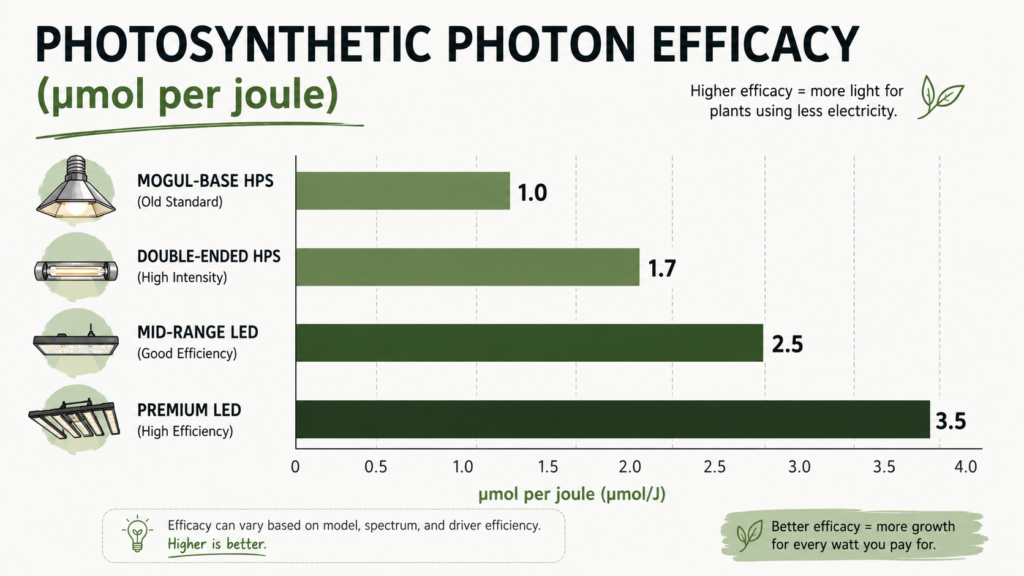
Separately, trade research on standard fixtures puts a 400W single-ended HPS lamp with a magnetic ballast around 0.9 μmol/J, while a 1,000W double-ended HPS lamp with an electronic ballast reaches roughly 1.7 μmol/J, and many current LED fixtures now exceed 2.0 μmol/J, with the theoretical ceiling for LED efficiency sitting around 4.6 to 5.1 μmol/J.
In plain terms: a cheap, old-style HPS fixture loses badly to LED. A premium double-ended HPS system is much closer competitive than most marketing copy admits — the real gap opens up in fixture quality, not necessarily technology alone. If you want fixtures already vetted for high PPE, our most efficient LED grow lights list only includes ones that clear that bar.
| Fixture type | Typical PPE (μmol/J) | Typical lifespan |
|---|---|---|
| Mogul-base HPS (older, common) | ~1.0 | 10,000–20,000 hrs |
| Double-ended HPS (electronic ballast) | ~1.7 | 10,000–20,000 hrs |
| Mid-range LED | ~1.7–2.0 | 30,000–50,000+ hrs |
| Premium LED | 2.0–2.5+ | 50,000+ hrs |
Which produces better yields, LED or HPS?
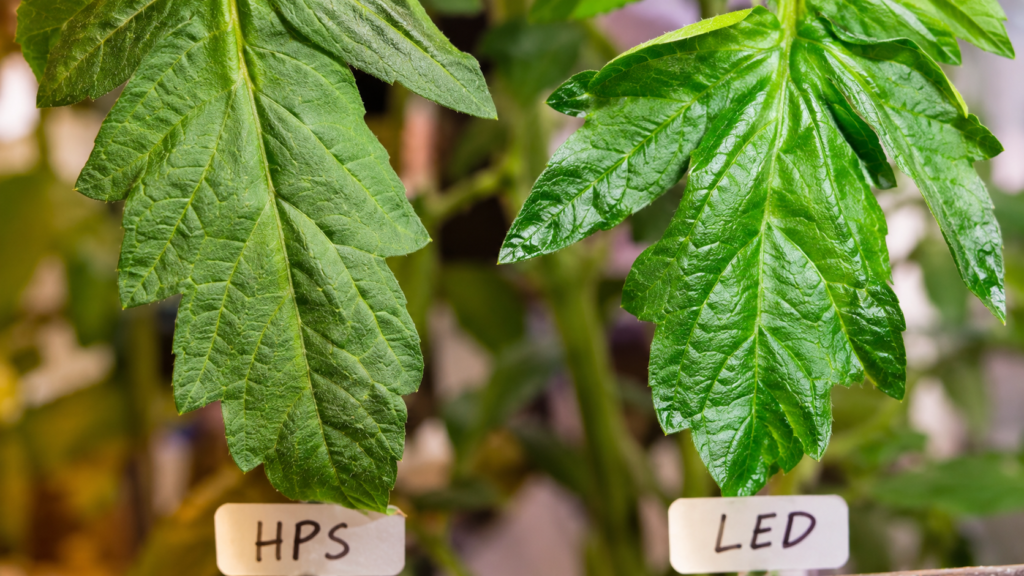
Yield differences come down more to light spectrum and plant response than raw photon count. A peer-reviewed study on tomato plants found that plants grown under LED (95% red, 5% blue) showed lower leaf temperature and higher stomatal density, stomatal conductance, and transpiration rate than plants grown under HPS — meaning the LED plants were physically responding differently to the light environment, not just receiving a different quantity of it.
That said, greenhouse research on basil found real gains too: an economic analysis reported that combining LED toplighting with interlighting produced a more favorable economic outcome, with production value up to 32.55% higher than HPS toplighting alone. The catch is that result came from a combination lighting strategy, not simply swapping bulb types — worth remembering before assuming any single LED fixture automatically beats any single HPS fixture on yield.
What experienced growers actually watch for
Growers who’ve run both systems tend to judge yield less by the bulb type and more by whether PPFD (the light intensity actually reaching the canopy) and DLI (daily light integral) targets are being hit consistently. If you’re unsure what those numbers should look like for your crop stage, our PAR explainer and grow light calculator guide walk through it in more depth than fits here.
How much do LED vs HPS grow lights cost to run?
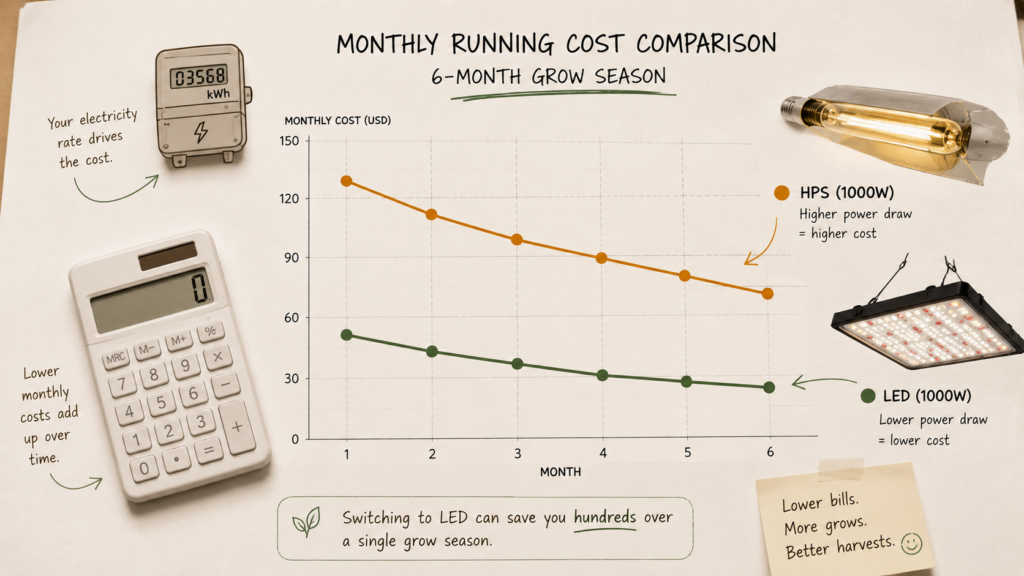
LEDs almost always win here, mainly because of wattage draw and lifespan, not because electricity rates change. Industry data on greenhouse retrofits shows LEDs saving 40% to 60% in energy versus HPS while lasting more than twice as long.
Run the math on a small tent: a 600W-equivalent HPS system pulling roughly 600W versus an LED drawing 400W for similar output, at 12 hours a day, adds up over a season. The exact dollar figure depends entirely on your local electricity rate and run schedule — our dedicated grow light electricity cost breakdown has the full formula and a plug-in-your-numbers example.
Upfront cost is the flip side that competitor articles often gloss over. A peer-reviewed fixture analysis found that the initial capital cost per photon delivered from LED fixtures is five to ten times higher than from HPS fixtures. That gap is narrowing every year as LED manufacturing scales, but it’s real, and it’s why a budget-limited grower with an existing HPS setup isn’t automatically making a mistake by sticking with it for one more season.
Shop smart: if you’re pricing out a new fixture rather than retrofitting, check current wattage-to-coverage ratios before buying on price alone — a “1000W equivalent” LED drawing only 150W actual wattage is a red flag, not a bargain. Our LED grow light buyer’s guide breaks down exactly which specs to check before checkout.
Ready to Upgrade Your Lighting?
If the efficiency numbers above have you leaning toward LED, don’t grab the first “1000W equivalent” listing you see — actual wattage and PPE matter more than the marketing number on the box.


What about heat, lifespan, and spectrum control?
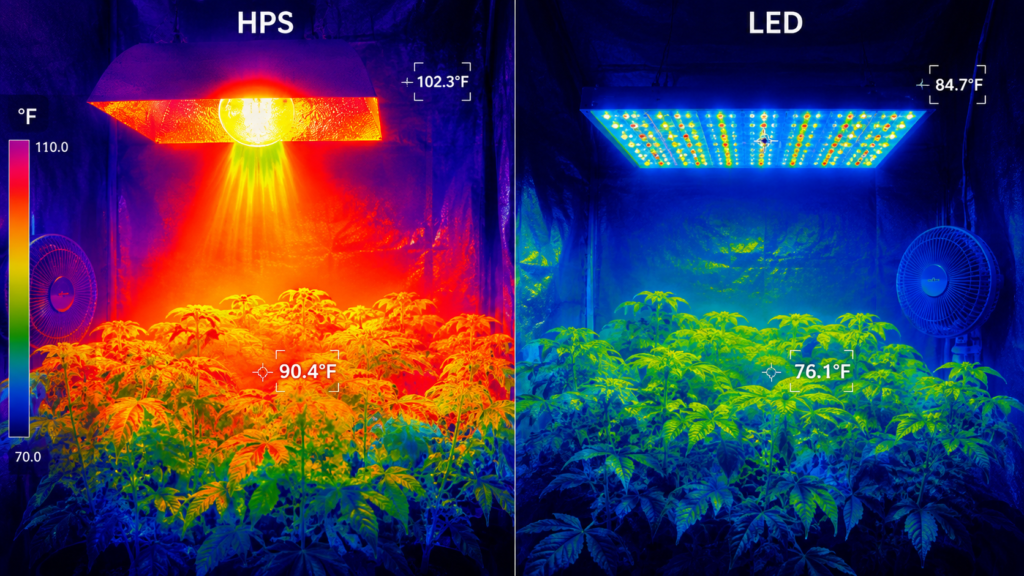
HPS bulbs run hot and lose intensity as they age. Manufacturer data shows HPS bulbs typically lasting around 10,000 to 20,000 hours while gradually losing intensity over time, which means more frequent replacement compared to LEDs. That heat isn’t just a bulb-life issue — it changes how you manage the whole tent.
Heat management differences
A grow room running HPS usually needs more aggressive exhaust and cooling just to keep temperatures in range, which adds to both electricity cost and equipment complexity. LED fixtures run cooler at the diode level, though drivers still generate some heat that needs airflow. If light burn or canopy heat stress has been a recurring issue, our light burn symptoms and prevention guide covers how to tell heat stress apart from actual light intensity problems.
Spectrum flexibility
HPS spectrum is fixed by the chemistry of the lamp — you get what you get. LED fixtures can be built or adjusted toward different red-blue-white ratios for vegetative versus flowering stages, which is a real practical advantage for growers running mixed crops or chasing specific morphology (compact vs. stretchy growth). If you’re deciding between a full-spectrum LED panel and an older-style red/blue “blurple” board, our full spectrum vs red/blue grow lights comparison goes deeper on that specific choice.
Keep Your Grow Room Cool
Whichever fixture you run, airflow makes or breaks your results — especially if you’re sticking with HPS a while longer and need to manage that extra heat.


Common mistakes when switching from HPS to LED
- Keeping the same hanging height. LED fixtures often need to sit closer to canopy than an HPS bulb did, since perceived brightness and actual PPFD don’t scale the same way between technologies.
- Judging by wattage instead of PPFD. A 300W LED can outperform a 400W HPS in usable light — comparing wattage alone compares the wrong number.
- Ignoring the “looks dimmer” effect. New LED growers sometimes add unnecessary supplemental lighting because the room looks less intense to the eye, even when PAR output is fine.
- Skipping a transition period. Plants that matured entirely under HPS’s red-heavy spectrum can show a short adjustment period under a bluer LED spectrum — not a fixture failure, just an acclimation curve.
LED vs HPS decision checklist
Instead of a flat verdict, run through this before buying anything:
- Already own a working double-ended HPS system? Keep using it until it fails — the efficiency gap at that tier is small enough that an early LED swap rarely pays for itself fast.
- Running an older mogul-base HPS or magnetic ballast? Prioritize an LED upgrade — this is where the efficiency and heat gap is largest.
- Tight budget, one-time grow? HPS upfront cost is still lower; the payback period on LED may not arrive before the project ends.
- Running lights 12+ hours daily for multiple seasons a year? LED’s lower running cost and longer lifespan compound quickly — this is where LED usually wins outright.
- Struggling with tent heat or cooling costs? LED reduces the cooling burden, which often matters as much as the light-fixture bill itself.
Nobody at Grow With Hydroponics tells beginners to rip out a functioning HPS system just because LED is trendier — the math has to actually work for your setup.
Frequently Asked Questions
Is LED really better than HPS for growing plants? LED is generally more efficient and runs cooler than HPS, but the very best HPS fixtures can match mid-range LED efficiency. “Better” depends on your budget, electricity rate, and whether you’re starting fresh or already have a working HPS system.
Do LED grow lights use less electricity than HPS? Yes — LED fixtures typically use less wattage for comparable light output and can cut energy costs significantly compared to HPS. The exact savings depend on your specific fixtures and local electricity rate; our grow light electricity cost guide walks through the full calculation.
Can I use my old HPS bulb with an LED setup? No — HPS and LED are different lighting technologies with separate fixtures, ballasts, and reflectors, so you can’t mix a bulb from one system into the other. You would need a complete LED fixture to switch technologies.
How long do LED grow lights last compared to HPS? LED fixtures commonly run 30,000 to 50,000+ hours before significant output decline, while HPS bulbs typically need replacement around 10,000 to 20,000 hours as they lose intensity with age. That’s roughly two to three times the usable lifespan for LED.
Do plants grow faster under LED or HPS? Growth rate depends more on hitting the right PPFD and DLI targets for the crop stage than on the bulb technology itself. Research shows LED and HPS can produce comparable results when light intensity is matched, though spectrum differences affect plant morphology and water use.
Efficiency numbers aside, this decision usually comes down to what you already own and how long you plan to keep growing. If you’re starting from scratch, spend some time with the Ultimate LED Grow Light Guide before buying anything — Grow With Hydroponics built it specifically to walk beginners through fixture shopping without the marketing noise. Whichever side you land on, run the actual numbers for your tent before deciding; the grow light calculator linked above makes that a five-minute job instead of a guessing game.
