

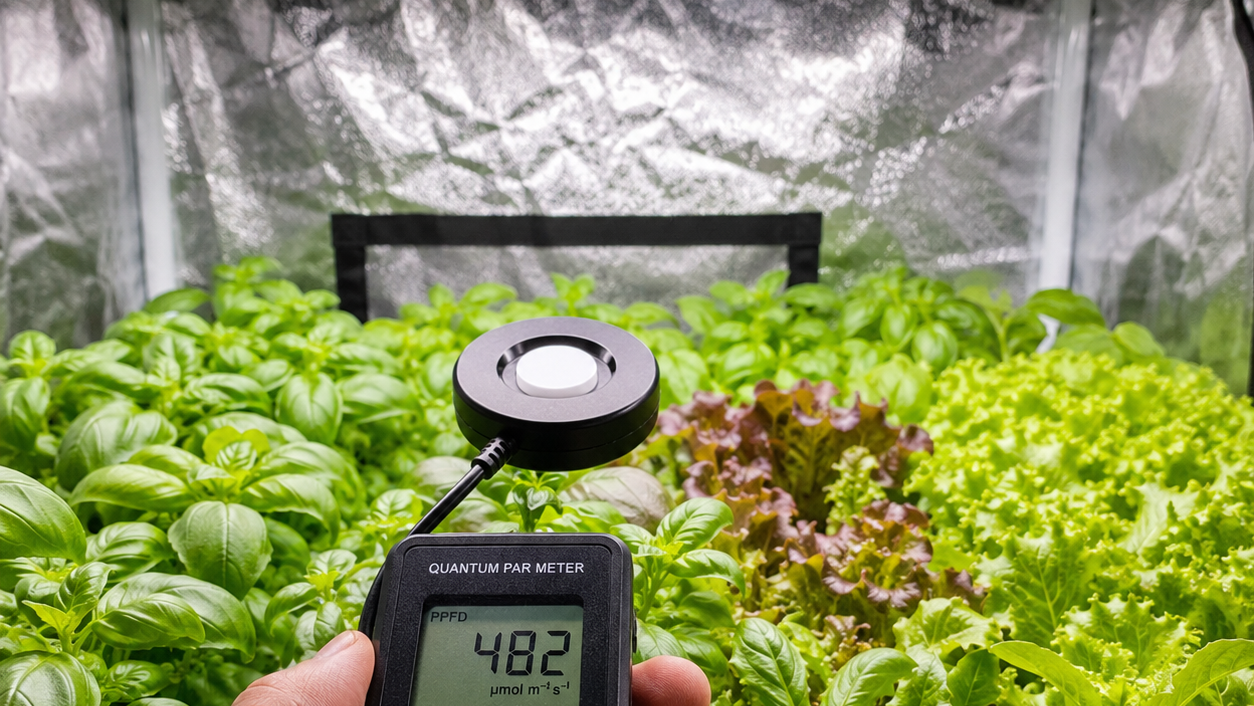
You’ve probably seen it on grow light spec sheets, in hydroponic forums, and scattered across product listings: PAR. Maybe you nodded along. Maybe you made a mental note to look it up and never did. Either way, if you’re growing plants indoors without understanding PAR, you’re making lighting decisions with one eye closed.
Here’s the thing—PAR isn’t complicated. But it gets bundled with enough jargon (PPFD, PPF, µmol, and quantum sensors) that most growers gloss over it and go back to guessing by wattage. That guess costs them yield, energy, and sometimes entire crops.
At Grow With Hydroponics, PAR comes up constantly — in lighting questions, in tool builds, in every conversation about why plants aren’t performing as expected. This guide explains what PAR light actually is, why it matters more than lumens or watts, how it connects to the metrics you see on spec sheets, and what it means practically for your grow.
Quick Answer — What Is PAR Light?
PAR, or Photosynthetically Active Radiation, is the range of light wavelengths between 400 and 700 nanometers (nm) that plants can use to drive photosynthesis. It’s not a measurement — it’s a description of which part of the light spectrum actually matters for plant growth. Lumens and lux measure brightness for human eyes; PAR defines the light that feeds your plants. Everything that follows — PPFD, PPF, DLI — is built on this foundation.
What Is PAR Light, Exactly?
PAR, or Photosynthetically Active Radiation, is the portion of the electromagnetic spectrum—specifically 400 to 700 nanometers—that photosynthetic organisms, including plants, algae, and cyanobacteria, can absorb and use for photosynthesis.
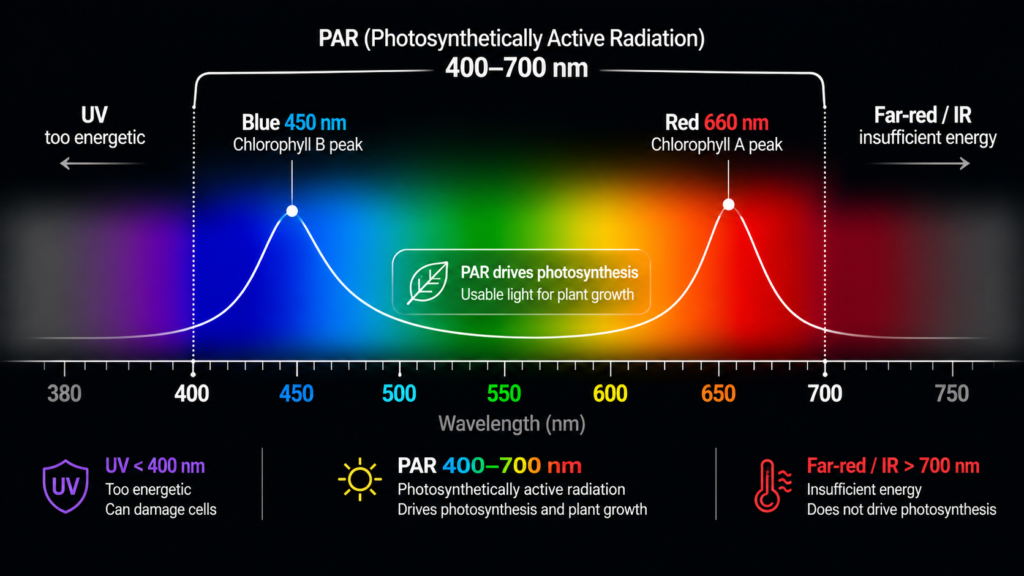
That range roughly corresponds to visible light. Violet and blue sit at the low end (around 400–500 nm). Green and yellow occupy the middle. Orange and red fill out the upper range, up to 700 nm. Beyond each boundary, the light becomes either too energetic (UV, below 400 nm) or too weak (infrared, above 700 nm) to drive the photosynthetic reactions plants rely on.
Why Does PAR Stop at 700 nm?
Photons below 400 nm carry so much energy they can damage plant cells and tissues. Fortunately, most of that UV radiation gets filtered out by the atmosphere before it reaches the ground. On the other end, photons above 700 nm simply don’t carry enough energy to power the biochemical reactions inside a chloroplast. So plants have evolved to make the most of that middle band—and that’s the band PAR describes.
Worth flagging: recent research, particularly work by Dr. Bruce Bugbee at Utah State University, has started to push this boundary slightly—suggesting that far-red light (700–750 nm) contributes more to photosynthesis than originally understood through what’s called the Emerson Enhancement Effect. Some newer sensor standards now reference an “ePAR” range of 400–750 nm. For most practical purposes, the classic 400–700 nm definition still applies—but it’s a moving target at the edges.
Why PAR for Plants Matters More Than Lumens or Lux
Lumens are for humans. PAR is for plants. That’s the simplest way to say it.
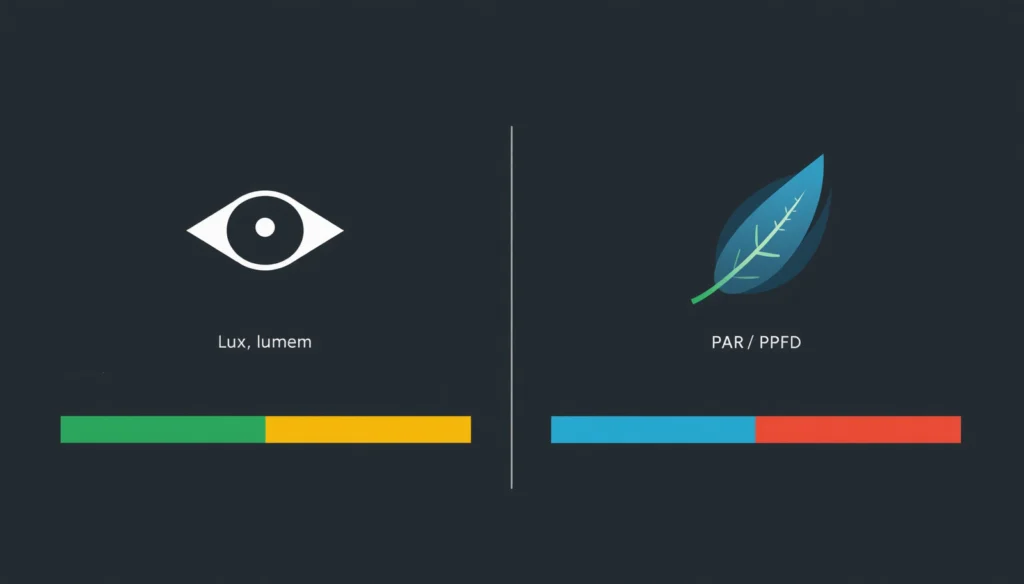
Lumens measure light intensity as the human eye perceives it. Our eyes are most sensitive to green and yellow wavelengths—around 555 nm—so a light that pumps out a lot of green light will score a high lumen rating. But green light is actually the least useful part of the spectrum for plant photosynthesis. Plants reflect it (which is why leaves look green). A lamp that blasts green light looks brilliant to your eyes and does comparatively little for your canopy.
The Problem With Lux Meters in a Grow Room
Lux is just lumens per square metre. So it inherits all the same problems. A lux meter is calibrated to the human visual response—it over-reports green and yellow and under-reports red and blue. If you’re trying to evaluate whether your grow light is delivering useful photons for photosynthesis, a lux meter gives you actively misleading data. A 50,000 lux reading sounds intense. But if that light skews heavily toward the middle of the spectrum, your plants may be getting a fraction of the PAR that number implies.
That’s why quantum PAR meters exist—sensors specifically calibrated to measure photons in the 400–700 nm range without the human-eye weighting bias. If you’re serious about optimising your indoor grow, a quantum PAR meter is the one measurement tool that actually tells you what’s happening at the canopy.
What Wavelengths Within the PAR Range Matter Most?
Not all wavelengths within the 400–700 nm PAR range are equal. Plants absorb and use them at different efficiencies, depending on the pigments involved.
Blue Light (400–500 nm)
Blue light, particularly around 430–453 nm, aligns closely with the absorption peaks of both chlorophyll A and chlorophyll B. It drives compact, structured vegetative growth—promoting thicker leaves, shorter internodes, and better stomatal regulation. In practice, blue-dominant light during veg tends to produce denser, more manageable plants.
Red Light (600–700 nm)
Red light — especially around 660–680 nm — is where most photosynthetic action happens. Chlorophyll A absorbs strongly at 662 nm, and this is the primary driver of the biochemical reactions that convert light into plant-usable energy. During flowering and fruiting stages, red-weighted light is closely linked to higher yields and faster flower development.
Green and Yellow (500–600 nm)
Green light does contribute to photosynthesis, but less efficiently than red or blue — and a significant portion bounces straight off the leaf surface. That said, green photons penetrate deeper into the canopy than red or blue, so in dense canopies they can reach lower leaves that redder light never hits. It’s not useless; it’s just not the priority.
Where Does This Leave “Full Spectrum”?
A genuinely useful grow light delivers a broad base of PAR wavelengths — typically via high-quality white LEDs — with targeted additions of deep red. This covers the full 400–700 nm range reasonably well across all growth stages. The old blurple lights (just red and blue LEDs in a harsh purple combination) hit the absorption peaks but miss the broader spectrum benefits and make it nearly impossible to spot plant health issues visually. Most serious growers have moved on from them, and rightly so.
PAR vs PPFD vs PPF — How They Connect
This is where growers often get tangled, so here’s a clean breakdown.
PAR is not a number. It’s a definition — the light wavelength range that counts (400–700 nm).
PPF (Photosynthetic Photon Flux) is a number: the total photons within the PAR range a fixture emits per second, measured in µmol/s. It’s a fixture-level spec—the raw output of the light source itself, measured before any distance or spread is factored in.
PPFD (Photosynthetic Photon Flux Density) is the number your plants actually experience: how many PAR photons land on one square metre of canopy per second (µmol/m²/s). This accounts for fixture distance, beam angle, and spread. It’s the most directly plant-relevant measurement.
DLI (Daily Light Integral) ties it all together: the total PAR photons received over a full day (mol/m²/day), combining your PPFD and your photoperiod.
Think of it this way: PAR defines the fuel type. PPF is the size of the fuel tank. PPFD is how much fuel actually reaches each plant. DLI is the total fuel consumed across the whole day.
How to Measure PAR Light in Your Grow Space
You can’t see PAR any more usefully than you can see radio waves. The light might look bright and the plants might look healthy—for a while. But without measuring actual PAR delivery at canopy height, you’re guessing.
Use a Quantum PAR Meter
A quantum PAR meter (also called a quantum sensor) is the correct tool. It measures photons specifically in the 400–700 nm range and reads out in PPFD (µmol/m²/s)—giving you a real-time, plant-relevant number at any point in your canopy.
How to take a useful PAR reading:
- Set the sensor at canopy height—where the uppermost leaves are, not where you think the canopy will be in two weeks
- Take readings at a minimum of five to nine points across the growing area (a grid)
- Note the hanging height of the fixture at the time of measurement
- Average the grid readings—the spread matters as much as the peak
A single centre reading is not your canopy PPFD. It’s the best-case number, and your edge plants aren’t living in the best-case position. Uniformity across the whole grid is what drives even, productive growth.
PAR Light Reference Table — Common PAR Targets by Crop and Stage
| Crop / Stage | PPFD Target (µmol/m²/s) | DLI Target (mol/m²/day) | Notes |
|---|---|---|---|
| Seedlings (all crops) | 100–300 | 6–12 | Err low; increase as roots develop |
| Leafy greens (lettuce, spinach) | 200–400 | 12–20 | Most live their full cycle here |
| Herbs (basil, cilantro, mint) | 200–400 | 14–22 | Consistent moderate PAR = better flavour |
| Fruiting vegetables—vegetative | 400–600 | 18–28 | Tomatoes, peppers, cucumbers |
| Fruiting vegetables—flowering | 600–900+ | 25–40 | More PAR = more fruit set |
| High-light crops (w/ CO₂) | 900–1,200 | 35–50 | Only viable with CO₂ supplementation |
Our recommendations for PPFD for plants: The Complete Hydroponics Lighting Guide.
Common PAR Mistakes That Quietly Hurt Your Yields
Trusting wattage instead of PAR data. Wattage tells you how much electricity a fixture consumes. It tells you nothing about how much of that power becomes plant-usable PAR at canopy level. Two 400W fixtures can deliver wildly different PAR, depending on diode quality, driver efficiency, and optical design.
Using a lux meter to check PAR. As covered earlier, lux meters are calibrated for human vision, not plant response. They over-weight green wavelengths and can give you a confidently wrong answer. A quantum PAR meter is not optional if you want accurate data.
Ignoring edge uniformity. It’s tempting to hang the light, check the centre reading, and call it done. But a 900 µmol/m²/s reading dead centre with 200 µmol/m²/s at the edges isn’t 900 PAR across your crop. It’s a hotspot with struggling periphery.
Running the same PAR from seedling to harvest. Seedlings getting 800+ µmol/m²/s don’t thrive—they stress, bleach, or stall. PAR needs to be managed across growth stages, not set once and forgotten. Good dimmable fixtures exist precisely for this reason.
Forgetting that PAR changes with canopy height. As plants grow toward the fixture, PPFD increases — sometimes past the saturation point. Keep adjusting fixture height as the growth progresses, not just at setup.
What About Far-Red and UV—Do They Count as PAR?
Strictly speaking, UV (below 400 nm) and far-red / infrared (above 700 nm) fall outside the classic PAR definition. But neither is irrelevant.
UV light at very low doses can enhance certain secondary metabolite production—terpenes, flavonoids, and some pigmentation responses. Too much UV causes cell damage. Most quality grow lights don’t deliver meaningful UV, which is generally fine for food crops.
Far-red (700–750 nm) is where things get more interesting. The Emerson Enhancement effect—well-documented in plant physiology—shows that pairing far-red with red light can produce more photosynthesis than either alone. Some modern LED fixtures now include far-red diodes specifically to exploit this. As mentioned, Apogee Instruments has introduced quantum sensors capable of measuring this extended range (ePAR: 400–750 nm) in response to Dr. Bugbee’s research. For most home growers, standard PAR management still takes priority. But far-red supplementation is a legitimate tool in advanced setups.
Putting PAR to Work: Start With the Right Calculator
Understanding PAR conceptually is one thing. Translating it into actual fixture height, photoperiod, and daily light dose for your specific crop is where the maths starts to matter.
Our Grow Light Calculator lets you input your fixture specs, canopy size, and target crop—and outputs a PPFD estimate alongside DLI projections for different photoperiods. It takes the guesswork out of that first setup step.
Shop Smart: Grow Lights That Deliver Real PAR
Don’t buy a grow light based on wattage or lumen claims. Look for fixtures that publish PPF output, verified PPFD maps at your canopy size, and PPE ratings of 2.5 µmol/J or higher. These numbers tell you whether the light actually delivers PAR efficiently — everything else is marketing.
→ Shop recommended grow lights for hydroponics


FAQ: PAR for Plants — Common Questions Answered
What does PAR stand for in growing?
PAR stands for Photosynthetically Active Radiation. It refers to the range of light wavelengths between 400 and 700 nanometers that plants can absorb and use for photosynthesis. It’s a description of which light is useful to plants, not a unit of measurement on its own.
Is PAR the same as PPFD?
No — PAR and PPFD are related but different. PAR defines the light wavelength range that matters for plant growth (400–700 nm). PPFD (Photosynthetic Photon Flux Density) is the measurement of how many PAR photons land on a given surface area per second (µmol/m²/s). PAR is the category; PPFD is the number.
Can I use a regular light meter to measure PAR?
No. Standard lux meters are calibrated for human vision, which overemphasizes green and yellow light. They give unreliable readings for plant-relevant light. You need a quantum PAR meter—calibrated specifically for the 400–700 nm range—to get accurate PPFD readings for plant-growing decisions.
Why do plants need both red and blue PAR light?
Blue light (around 450 nm) promotes compact vegetative growth, chlorophyll synthesis, and stomatal function. Red light (around 660–680 nm) is the primary driver of photosynthetic efficiency and is closely linked to flower and fruit development. Plants use both together across the growth cycle, though the balance shifts between vegetative and reproductive stages.
What is a good PAR level for hydroponic plants?
It depends on the crop and growth stage. Leafy greens and herbs do well at 200–400 µmol/m²/s PPFD. Fruiting crops in veg need 400–600, rising to 600–900+ at peak flowering. Seedlings should be kept lower — around 100–300 µmol/m²/s — to avoid light stress before root systems are fully established.
The Clearest Lens on Indoor Lighting
PAR is the foundation everything else in indoor lighting is built on. Get this right—understand what it is, measure it properly, and match it to your crop’s needs—and every other lighting decision becomes more straightforward.
Wattage comparisons stop being meaningful. Lumen claims stop being confusing. You know what you’re actually trying to deliver, and you have the right tools to check whether you’re delivering it.
Grow With Hydroponics has guides, calculators, and hands-on resources to help you take this further—from dialling in PPFD by crop and stage to choosing fixtures that deliver honest, verified PAR output. The goal is always fewer guesses and more consistent results.
Start with a real measurement. Everything builds from there.
