

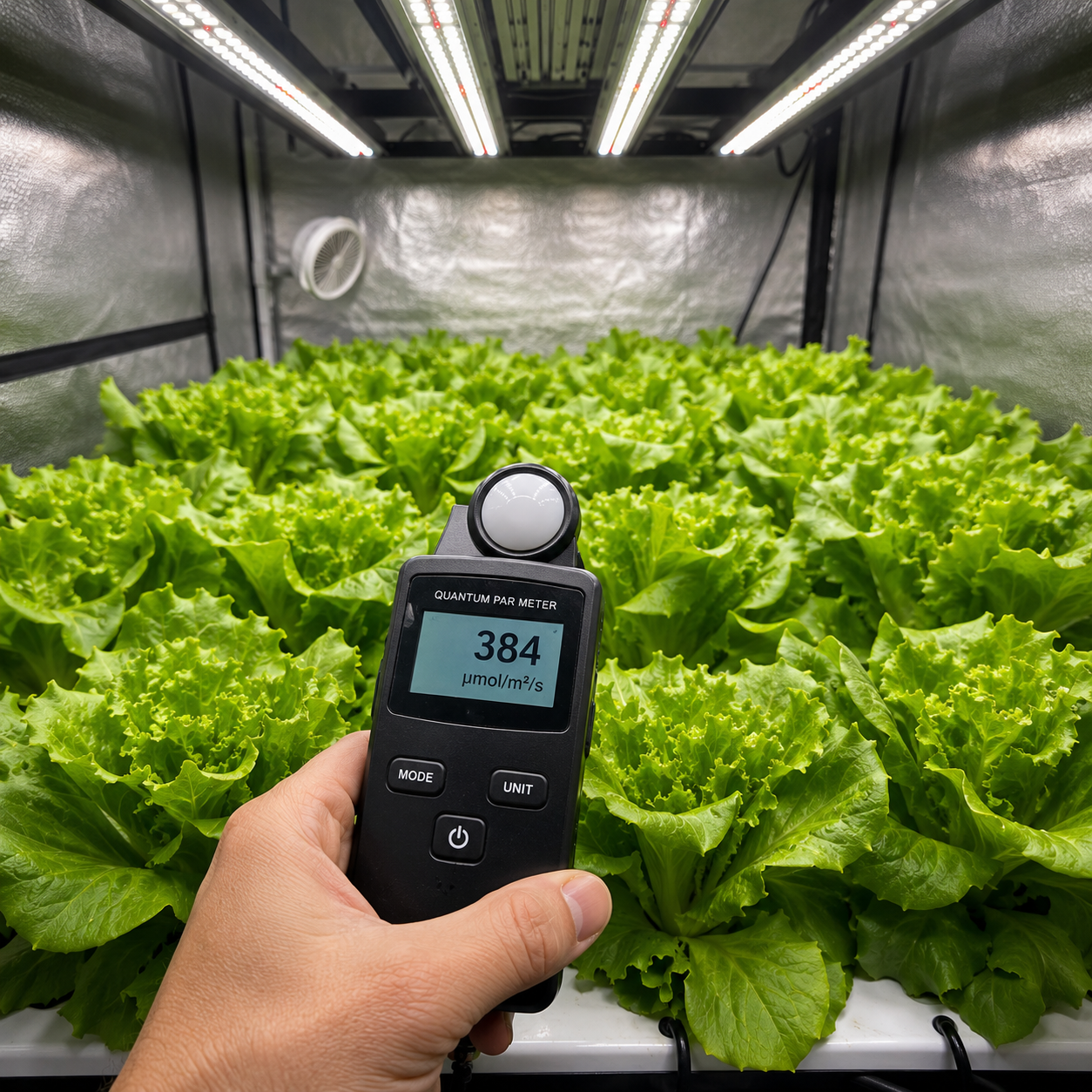
You spent real money on a grow light. You hung it over your system, flipped it on, and assumed your plants were sorted. Then, six weeks later, you’re staring at leggy basil, pale lettuce, or flowering plants that just won’t push the way they should. The light looks bright. But looks and actual photon delivery to your plant canopy are two very different things.
That’s where PPFD comes in — and understanding it properly is one of the fastest ways to close the gap between mediocre harvests and genuinely impressive ones. At Grow With Hydroponics, we see lighting questions come up constantly, and almost all of them trace back to the same root issue: growers don’t know what PPFD is, can’t measure it, and have no idea what number they’re actually shooting for.
This guide fixes that. You’ll learn what PPFD means, how it connects to PAR and DLI, what levels different plants actually need at each growth stage, how to measure it properly, and the most common mistakes that quietly kill indoor yields.
Quick Answer — PPFD for Plants at a Glance
PPFD (Photosynthetic Photon Flux Density) measures how many usable light photons land on your plant canopy per second, expressed in micromoles per square meter per second (µmol/m²/s). It’s the most practical and accurate way to evaluate whether your plants are getting enough light for photosynthesis. Seedlings generally need 100–300 µmol/m²/s, vegetative plants 300–600 µmol/m²/s, and flowering or fruiting crops 600–900+ µmol/m²/s. Wattage alone tells you almost nothing useful — PPFD is the number that actually matters.
What Is PPFD for Plants — And Why Does It Matter More Than Watts?
PPFD, or Photosynthetic Photon Flux Density, is the number of photosynthetically active photons that land on a specific surface area—typically one square meter—every second. It’s measured in micromoles per square meter per second (µmol/m²/s).
That’s the definition. Here’s what it means in practice: wattage tells you how much electricity your light pulls from the wall. PPFD tells you how much of that energy actually reaches your plants in a form they can use. The difference matters. A lot.
I’ve seen 600-watt fixtures outperform 1,000-watt lights from five years ago because the newer design delivered more photons efficiently to the canopy. Wattage comparisons, on their own, are almost meaningless for predicting plant performance.
PAR, PPF, PPFD — What’s the Difference?
These three terms get used almost interchangeably online, and it causes endless confusion. They’re related, but they’re not the same thing.
PAR (Photosynthetically Active Radiation) is not a measurement at all — it’s a description of the light wavelength range that plants can use for photosynthesis: 400 to 700 nanometers. Think of it as defining which part of the light spectrum counts.
PPF (Photosynthetic Photon Flux) measures the total number of photons a light source emits per second across that PAR range. It’s a fixture-level number — measured at the light itself, in µmol/s. It tells you the total output of the light, but not how much actually hits your canopy.
PPFD is where it gets real. PPFD measures how many of those photons land on a defined area at a specific point — usually at canopy height. It accounts for distance, angle, and spread. Two fixtures with identical PPF can deliver very different PPFD depending on how the light is distributed and how far away the canopy sits.
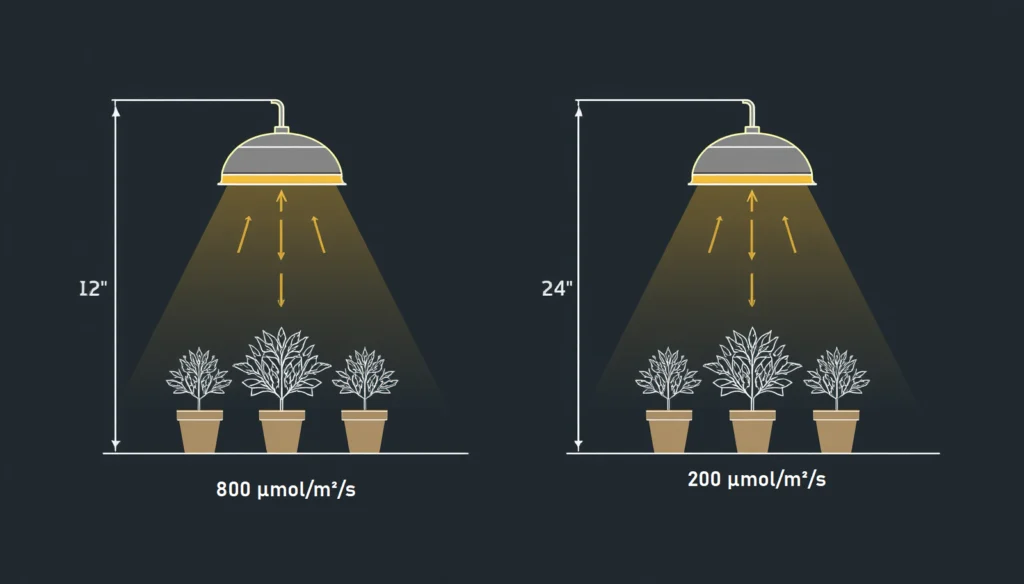
That last point is critical. PPFD follows the inverse square law: double the distance between your light and canopy, and your PPFD drops to roughly a quarter of what it was. A two-inch adjustment in fixture height can meaningfully change what your plants receive.
What Is DLI — And How Does It Relate to PPFD?
DLI, or Daily Light Integral, represents the total amount of PAR light a plant receives over a full 24-hour period. It’s measured in moles per square meter per day (mol/m²/day).
Here’s the simple relationship: PPFD tells you the intensity of light at any given moment. DLI tells you the cumulative light dose across the whole day. Both matter. A plant under very high PPFD for two hours might get the same DLI as a plant under moderate PPFD for eight hours — but they’ll respond differently, because plants aren’t just counting photons, they’re also processing them over time.
To calculate DLI:
DLI = PPFD × (3,600 × photoperiod in hours) ÷ 1,000,000
For example: 400 µmol/m²/s × (3,600 × 16 hours) ÷ 1,000,000 = approximately 23 mol/m²/day.
As a starting reference: leafy greens like lettuce typically target a DLI of 12–20 mol/m²/day, while fruiting crops like tomatoes and peppers benefit from 20–40+ mol/m²/day. Getting PPFD right matters, but so does your photoperiod.
What PPFD Do Plants Need at Each Growth Stage?
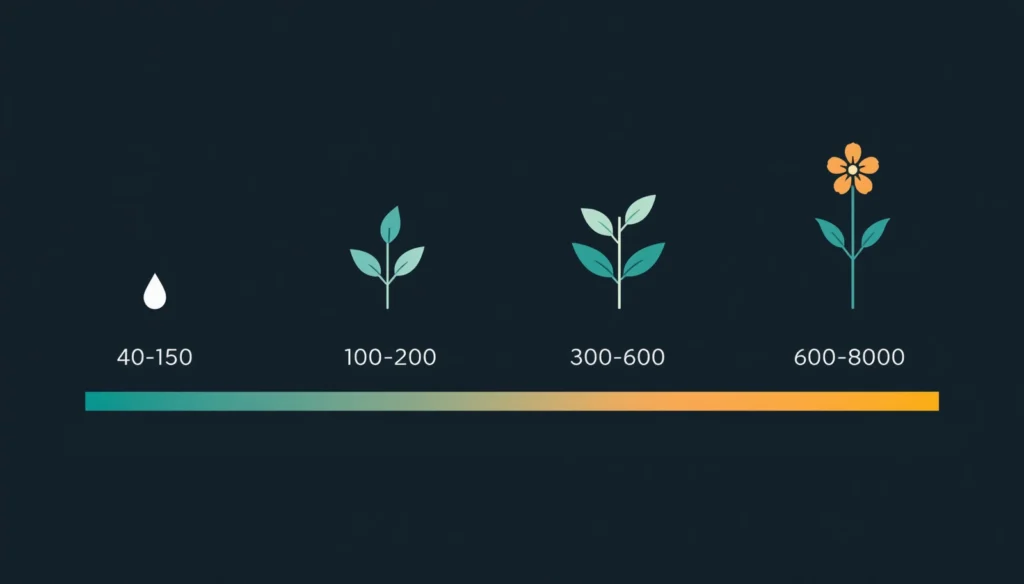
Different growth stages have genuinely different light needs, and running full intensity from germination to harvest isn’t just wasteful—it actively damages young plants. Seedlings exposed to high-intensity light before their root systems and leaf structure are developed will show stress, bleaching, or excessive stretching as they try to escape the intensity.
Here are the broadly accepted PPFD targets by stage:
Germination (Seeds)
Target PPFD: 40–150 µmol/m²/s
Seeds don’t need much. At this stage, light plays almost no direct role in germination itself — what you’re doing is providing low-level light to support the very earliest seedling development once the seed coat cracks. Too much light early on can actually inhibit germination and cause heat stress in a propagation dome. Keep it gentle.
Seedling Stage
Target PPFD: 100–300 µmol/m²/s
Once seedlings are above the media and showing their first true leaves, they need more light — but still far less than mature plants. This is the stage where most beginners accidentally cause harm. They hang the same light too close, or don’t dim it down, and young seedlings either bleach out, get light burn, or produce thick, stunted growth. Give them brightness, not intensity.
Vegetative Stage
Target PPFD: 300–600 µmol/m²/s
Vegetative growth is where PPFD starts making a visible difference in speed and leaf development. Most leafy greens — lettuce, spinach, kale, herbs — live their entire growing lives in this range. For crops like basil or cilantro that you’re growing for leaves rather than fruit, this is your sweet spot. University of Delaware research published in Frontiers in Plant Science found that increasing fixed PPFD from 150 to 350 µmol/m²/s increased lettuce fresh mass by 69% and dry mass by 84% — which gives you a sense of how meaningful these numbers are when you get them right.
Flowering and Fruiting Stage
Target PPFD: 600–900+ µmol/m²/s
This is where fruiting crops need real light. Tomatoes, peppers, cucumbers, and similar plants are pulling energy for flower development and fruit production simultaneously. Dropping PPFD here is one of the most common reasons indoor tomatoes produce small or sparse fruit despite looking healthy. For high-light crops running CO₂ enrichment, some growers push PPFD toward 1,000–1,200 µmol/m²/s — but without elevated CO₂, that level of intensity can trigger photoinhibition rather than boost growth.
PPFD Requirements by Crop Type
| Crop | Growth Stage | Recommended PPFD (µmol/m²/s) | Notes |
|---|---|---|---|
| Lettuce | Seedling → Veg | 150–350 | Research supports ~350 for max yield |
| Herbs (basil, mint) | Veg | 200–400 | Low-to-mid range is sufficient |
| Spinach / Kale | Veg | 200–400 | Avoid high end to prevent bolting |
| Tomatoes | Veg | 400–600 | Increase as plant matures |
| Tomatoes | Flowering | 600–900 | More light = more fruit set |
| Peppers / Chili | Veg → Flower | 400–700 | Fruiting crops need the high range |
| Cannabis | Vegetative | 300–600 | Start lower, increase gradually |
| Cannabis | Flowering | 600–1,000+ | Can push higher with CO₂ |
| Seedlings (all crops) | Propagation | 100–300 | Err low; dial up as roots develop |
How to Measure PPFD for Plants — What You Actually Need
You cannot reliably estimate PPFD by looking at your light, reading the manufacturer’s coverage chart, or guessing based on wattage. The only way to know your actual canopy PPFD is to measure it.
Use a Quantum PAR Meter
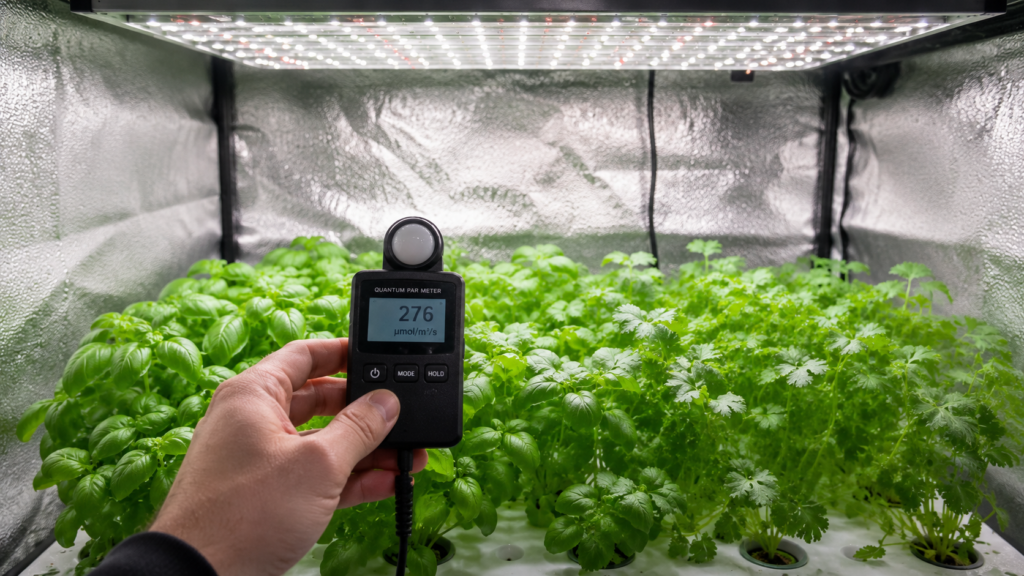
A quantum PAR meter (also called a quantum sensor or PAR meter) measures photosynthetically active radiation in the 400–700 nm range and gives you a real-time PPFD reading at canopy level. These are the only instruments that give you an accurate, plant-relevant number. A standard lux meter measures brightness as the human eye perceives it—not how plants experience light—and gives you a meaningless reading for growing purposes.
Try our Grow Light Calculator—Advanced PPFD Grid, DLI and Crop Optimizer.
Entry-level quantum meters from brands like Apogee Instruments are the grower standard. If you’re serious about dialling in your grow, it’s worth owning one. If your budget is tight, some grow light retailers offer rental options or PAR grid data for their specific fixtures that’s reasonably reliable — but take those specs with some skepticism, since they’re typically measured in ideal lab conditions.
How to take a proper PPFD reading:
- Place the sensor at canopy height — where the leaves are, not where you think they are
- Take readings at multiple points across the growing area (at least 5–9 points in a grid)
- Average those readings — you want to understand the spread, not just the peak
- Note the light-to-canopy distance and record it alongside the reading
The multiple-point measurement matters more than most beginners realise. A cheap or poorly designed light might show 800 µmol/m²/s dead centre and drop to 200 at the edges. That’s not 800 PPFD for your crop—it’s a hotspot with struggling edges.
Shop Smart: Grow Lights That Actually Deliver PPFD
Not all grow lights are created equal — and wattage claims are especially misleading in budget LED territory. When shopping for LED grow lights for hydroponics, check for:
- Verified PPF output (µmol/s), not just watts
- Efficiency rating (µmol/J) — look for 2.5+ for modern quality LEDs
- Independent third-party PPFD maps, not just manufacturer-provided grids
- Dimmability — essential for matching PPFD to different growth stages
→ Shop Smart: Browse our recommended grow lights for hydroponic growers.
Also explore our LED Grow Lights Guide: How to Choose, Use, and Optimize for Indoor Growing (2026).
Common PPFD Mistakes That Quietly Wreck Your Yields
Hanging the Light Too High and Never Checking
This is probably the most widespread issue, particularly for growers transitioning from HID to LED. Old habits from high-heat HID lighting meant hanging fixtures well above the canopy. LEDs produce dramatically less radiant heat, which means you can safely run them much closer. Keep your old HID hanging height and you may be delivering a fraction of the PPFD your plants need, even with a powerful fixture.
Trusting Wattage Instead of Measuring PPFD
“1000-watt LED” sounds impressive. In practice, a lot of those lights draw 200–300 actual watts and deliver genuinely mediocre PPFD at canopy level. The number on the box is usually an HPS equivalent claim — and even that’s often optimistic. Check actual draw, check PPF output, and if you can, verify with a meter.
Running Full Intensity from Day One
Seedlings don’t need 900 µmol/m²/s. Running your light at full power over young plants stresses them, causes bleaching, and in leafy greens can trigger early bolting. Most quality LEDs are dimmable now — use that feature. Start at 30–50% intensity for seedlings and ramp up as plants develop.
Ignoring Uniformity Across the Canopy
I’ve seen growers obsess over the centre reading and ignore the edges entirely. Plants at the perimeter of a grow tray under a single point-source fixture can receive dramatically less PPFD than those in the middle. The result is uneven growth, inconsistent harvest size, and predictable frustration. Multiple fixtures, diffuse designs, or bar-style LED layouts tend to give more even spread.
Forgetting That Canopy Height Changes
Your plants grow. What was the right PPFD at week two may be wildly different at week six as the canopy rises toward the fixture. Experienced growers adjust light height throughout the grow cycle — not just once at setup.
Advanced: PPFD, CO₂, and Light Saturation Points
Once your PPFD is dialled in, the next conversation is about the light saturation point—the PPFD level beyond which adding more light doesn’t produce more photosynthesis. Most crops hit their light saturation point somewhere between 800 and 1,200 µmol/m²/s under normal CO₂ conditions (around 400 ppm ambient).
Push PPFD above that threshold without supplemental CO₂ and you’re not getting more growth—you’re potentially getting photoinhibition, where excess light actually reduces photosynthetic efficiency. Plants literally downregulate their photosystems to protect themselves.
Elevating CO₂ to 800–1,200 ppm raises that saturation point, allowing plants to use higher PPFD levels more efficiently. But that’s a more advanced intervention that requires controlling your full environment — temperature, humidity, and ventilation all need to be properly managed before CO₂ supplementation is worth pursuing.
For most growers, staying in the 400–900 µmol/m²/s range based on crop and growth stage is the right play, without CO₂ supplementation. Push beyond that sensibly only when the rest of your environment is solid.
Pair your PPFD data with a DLI calculation to optimise photoperiod length—our DLI Calculator makes this straightforward and takes less than a minute to run.
FAQ: PPFD for Plants — Common Questions Answered
What is a good PPFD for hydroponic lettuce?
For hydroponic lettuce, a PPFD of 200–400 µmol/m²/s is generally recommended during the vegetative stage. Research from the University of Delaware found that lettuce grown at 350 µmol/m²/s produced significantly more fresh and dry mass than lettuce at 150 µmol/m²/s — so aiming for the middle-to-high end of that range pays off. For seedling stages, keep it closer to 100–200 µmol/m²/s and increase as plants establish.
Is higher PPFD always better for plant growth?
No — and this is a common mistake. Plants have a light saturation point beyond which additional PPFD stops increasing photosynthesis and can actually cause damage. Without CO₂ supplementation, most crops reach that point somewhere between 800–1,200 µmol/m²/s. Above that threshold, you risk photoinhibition and leaf bleaching rather than improved growth.
How do I know if my PPFD is too low?
The clearest signs of insufficient PPFD are slow growth, pale or yellowing leaves (not from nutrient deficiency), and elongated, leggy stems — especially in seedlings reaching toward the light. If your basil is growing tall and thin rather than bushy and compact, low PPFD is a likely culprit. Measuring with a quantum PAR meter is the only reliable confirmation.
Can I use a lux meter to measure PPFD?
Not accurately. A lux meter measures perceived brightness as the human eye registers it, not the photosynthetically useful photon range plants rely on. A reading in lux doesn’t translate reliably to µmol/m²/s because different light spectrums affect humans and plants very differently. For plant-relevant measurements, you need a quantum sensor designed for PAR measurement.
Does PPFD decrease with distance from the grow light?
Yes — significantly. Light intensity follows the inverse square law, meaning that doubling the distance between your light and canopy reduces PPFD to roughly a quarter of its original value. This is why fixture height is so critical and why a two-inch change in hanging height can visibly change plant response within a few days.
Putting It All Together
PPFD isn’t a piece of jargon to memorise and ignore. It’s the most direct indicator of whether your plants are getting what they need from your lighting setup—and getting it wrong in either direction costs you yield, quality, and money.
Start by understanding your target PPFD range for the specific crop and growth stage you’re working with. Measure it with a real quantum PAR meter rather than guessing. Adjust fixture height, dimmer settings, and photoperiod until your numbers line up. Then check again as your plants grow, because the canopy rises and conditions change.
Gardening doesn’t reward guesswork, but it responds well to consistent measurement. That’s a principle that applies to nutrients, pH, VPD—and light.
Grow With Hydroponics has a full range of guides and free tools to help you optimise your lighting setup beyond PPFD—from DLI targets by crop to full grow light selection guides. The goal is always the same: fewer variables left to chance, and more control over your results. If you want to understand exactly what a PPFD map shows and how to read a full 9×9 grid, this PPFD map guide covers it in detail.
Recommended LED Grow Lights for Hydroponics
Getting your PPFD dialled in starts with choosing a light that actually delivers verified photon output—not inflated watt claims.
Our curated selection focuses on fixtures with independently verified PPFD maps, good efficiency ratings, and dimmability for all growth stages.


