

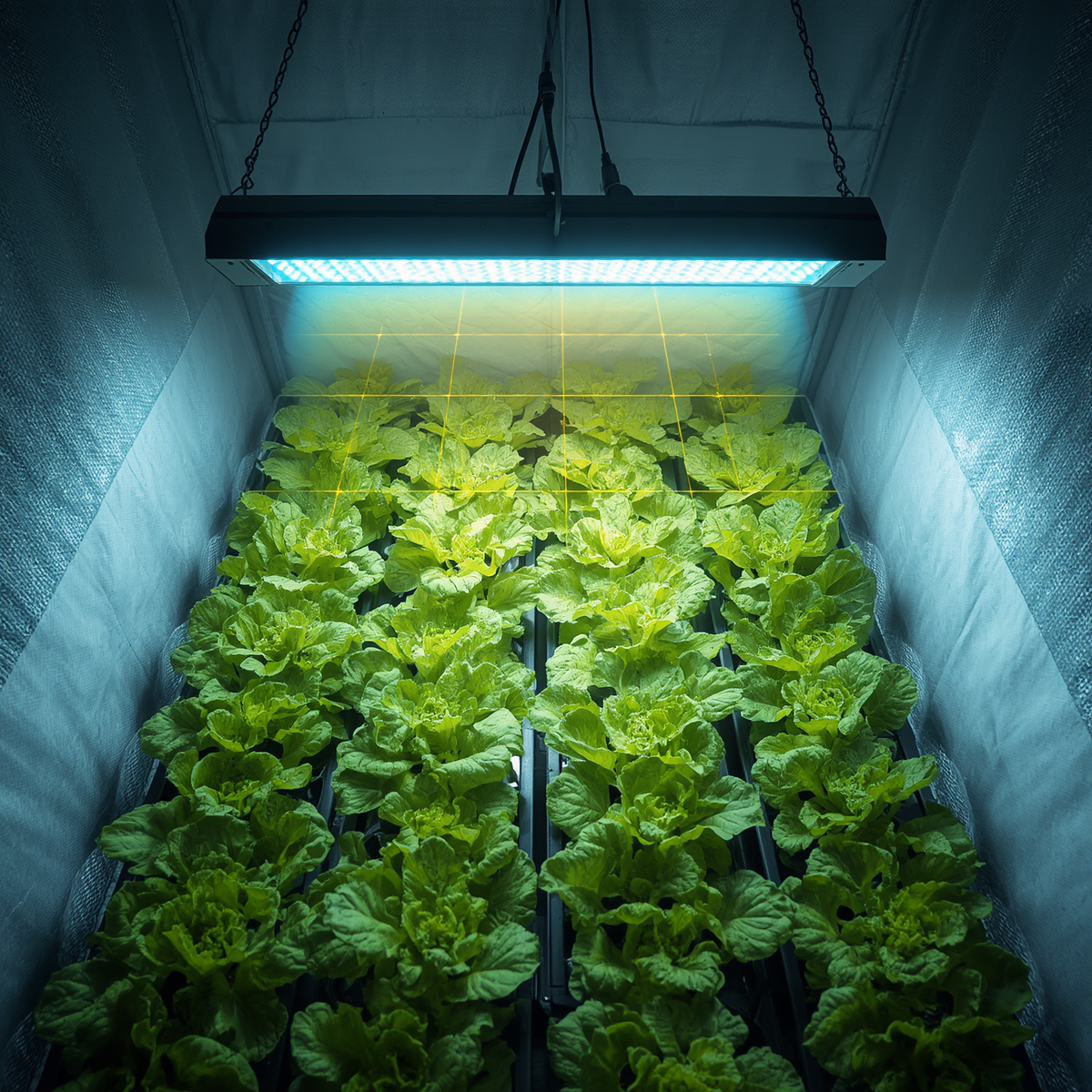
Most growers don’t lose yields because they bought a bad light. They lose them because they never actually measured what that light is doing at canopy level.
The wattage on the box is marketing. The lumens rating measures brightness your eyes can see—not the wavelengths your plants can use.
And that impressive-sounding “full spectrum” LED hanging in your tent? Without knowing the PPFD it delivers at your specific canopy height, over your specific grow area, for your specific crop—it’s an expensive guess.
That’s where a grow light calculator changes everything. Here at Grow With Hydroponics, we’ve built one of the most comprehensive free tools available: the Grow Light Calculator with PPFD Grid, DLI & Crop Optimizer. It combines a real 9×9 photon grid model, 44 crop-specific DLI targets, uniformity scoring, and energy cost projections—all in one place; no sign-up required.
This guide explains the science behind the tool, how to use it properly, and why growers who skip this step are leaving yield on the table.
Why Does the Grow Light Calculator Matter More Than the Wattage Label?
Wattage tells you how much electricity a fixture consumes. It says nothing about how much usable light actually reaches your plant canopy. The metric that matters is PPFD—Photosynthetic Photon Flux Density—measured in µmol/m²/s.
PPFD measures the number of photosynthetically active photons (wavelengths between 400 and 700 nm) hitting one square metre of canopy every second. It’s the real-world equivalent of asking: “How much food is actually landing on my plant’s plate right now?”
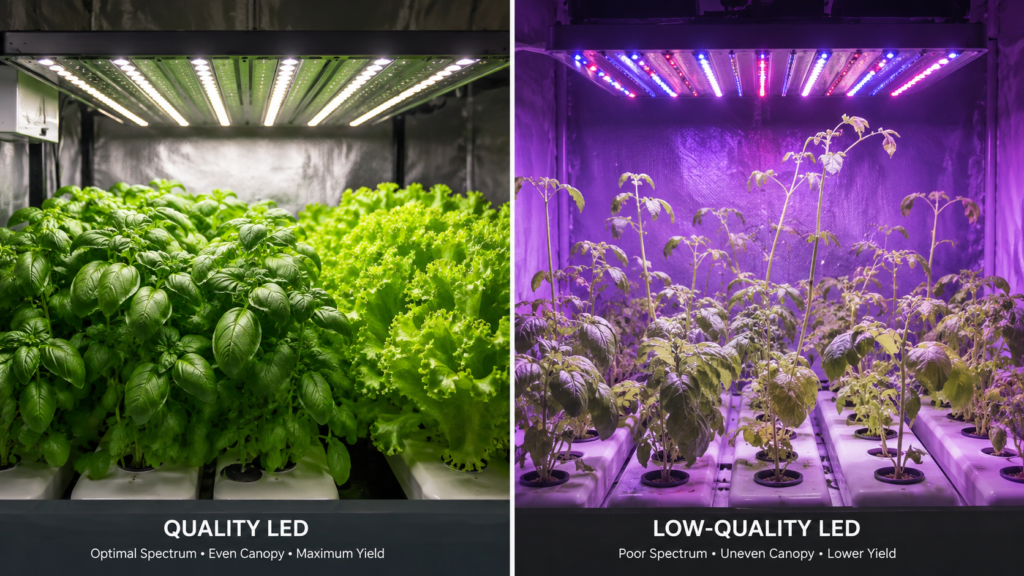
A cheap 1000W “blurple” LED might draw 110W from the wall and deliver 180 µmol/m²/s at canopy level. A quality 240W full-spectrum board might deliver 600 µmol/m²/s at the same height. Same watts claimed on the box. Wildly different results in the tent.
Without a grow light calculator—or a PAR meter—you’re working blind.
The Inverse Square Law: Why Mounting Height Destroys Your Numbers
This is the physics most growers learn the hard way. Light intensity doesn’t decrease gradually as you raise your fixture—it drops by the square of the distance. Double the mounting height, and PPFD drops to roughly one-quarter of what it was. Halve it, and intensity quadruples.
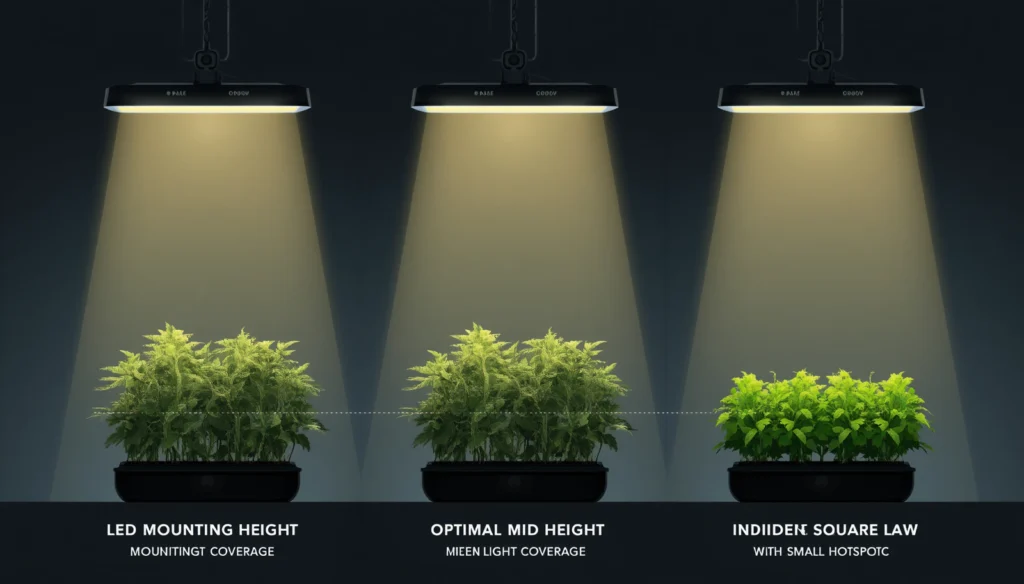
In practice: raising a fixture from 30 cm to 60 cm above the canopy can slash your PPFD by 75%. That’s the difference between lettuce that grows and lettuce that barely survives. A good grow light calculator accounts for this automatically, which is exactly why the Grow Light Calculator asks for mounting height as a required input, not an afterthought.
What Is DLI and Why Your Grow Light Calculator Must Include It
DLI — Daily Light Integral — is arguably more important for planning than instantaneous PPFD. It measures the total number of photons delivered to your canopy over a full 24-hour period, expressed in mol/m²/day.
The formula is straightforward:
DLI = PPFD × Photoperiod (hours) × 3600 ÷ 1,000,000
So if your fixture delivers 400 µmol/m²/s and your lights run for 18 hours a day: DLI = 400 × 18 × 3600 ÷ 1,000,000 = 25.9 mol/m²/day.
That number tells you far more than PPFD alone. Two growers could both achieve 400 µmol/m²/s—but one runs 12-hour photoperiods (DLI 17.3) and the other runs 18-hour cycles (DLI 25.9). Those plants are receiving dramatically different total light budgets.
Crop-Specific DLI Targets: Why One Number Doesn’t Fit All
Different crops have different light appetites—and the range is wide. Lettuce thrives between 12–17 mol/m²/day. Push it higher and you may trigger tip burn. Flowering tomatoes need 25–35 mol/m²/day to set fruit properly. Cannabis in full flower can handle 35–65 mol/m²/day with CO₂ supplementation.
This is why a grow light calculator that only spits out a single PPFD number isn’t enough. You need crop-specific DLI targets matched to growth stage, which is precisely what the 44-crop optimizer in the Grow With Hydroponics tool provides.
How to Use the Grow Light Calculator: Step-by-Step
The tool is designed to remove guesswork, but you need to feed it accurate inputs. Here’s how to get reliable results.
Step 1: Enter Your True Wattage — Not the Claimed Equivalent
Always use the actual wall-draw wattage—the number you’d see on a plug-in energy monitor, not the inflated “equivalent” figure printed on packaging. A light marketed as “1000W equivalent” might actually draw 120W. Enter 120W. Using the inflated figure will produce meaningless results.
Step 2: Set Fixture Type and Photon Efficacy
The calculator accepts multiple fixture types: quantum boards, COB LEDs, bar fixtures, strip LEDs, and commercial units. Each has different beam angles and spatial distribution characteristics. Alongside fixture type, enter your photon efficacy in µmol/J. Budget LEDs typically sit between 1.5–2.2 µmol/J. Mid-range quality boards reach 2.2–2.8 µmol/J. Premium fixtures exceed 2.8 µmol/J.
If you don’t know your fixture’s efficacy, check the manufacturer spec sheet—not the Amazon listing description.
Step 3: Enter Mounting Height and Grow Area Dimensions
Measure from the bottom of the fixture to the top of your canopy — not to the floor. Enter your grow area width and length. These inputs feed the 9×9 PPFD grid model, which maps light distribution across 81 individual canopy points rather than assuming an average.
That grid distinction matters. An average PPFD across a 1.2m × 1.2m space might look acceptable. But if the centre is receiving 700 µmol/m²/s and the corners are receiving 250 µmol/m²/s, the plants along the edges are chronically underlit—and your yields will show it.
Step 4: Select Reflective Wall Type
Don’t skip this. Mylar achieves approximately 97% reflectance. Flat white paint reaches around 85%. Bare or dark walls might reflect as little as 20%. Reflective walls can increase effective PPFD at canopy edges by 15–30%, and the calculator adjusts its model accordingly.
This is one of the highest-ROI upgrades available in an enclosed grow tent — and one of the most consistently underestimated.
Step 5: Set Photoperiod, Crop Type, and Growth Stage
Select your hours of light per day, then choose from 44 crops spanning leafy greens, culinary herbs, fruiting crops, berries, microgreens, and specialty crops. Growth stage matters too — a seedling needs 100–300 µmol/m²/s; a flowering tomato plant needs 600–900 µmol/m²/s. The tool matches your inputs to crop-specific DLI optima and generates a suitability score.
Common Grow Light Calculator Mistakes That Distort Your Results
Using Claimed Wattage Instead of True Draw
Every budget LED manufacturer inflates their numbers. “600W LED” that draws 65W from the wall is the most common trap. Run that through a calculator with 600W entered and you’ll believe your canopy is receiving three times more light than it actually is. Buy a cheap plug-in watt meter — they cost less than £10 and immediately expose the truth.
Measuring the Room Instead of the Canopy Footprint
Your grow room might be 1.5m × 1.5m, but your actual plant canopy occupies 0.9m × 0.9m. Enter the room dimensions and you’re modelling light over floor space that contains no plants. Enter the canopy dimensions and you get accurate data. This single mistake causes most beginners to underlight their plants while believing they’re running adequate intensity.
Ignoring Uniformity and Chasing Peak PPFD
A fixture that delivers 900 µmol/m²/s dead centre but 200 µmol/m²/s at the edges isn’t a good light — it’s a spotlight. Canopy uniformity, expressed as the ratio of minimum to average PPFD across the grid, should sit above 75% for acceptable results and above 85% for consistent commercial-quality production. The ASABE S640 standard (used in the calculator’s uniformity score) provides that benchmark. Chase uniformity alongside peak intensity, not instead of it.
Forgetting to Adjust for Growth Stage
Running seedlings at flowering PPFD causes bleaching and stress. Keeping mature fruiting plants on seedling-level light budgets stunts development and delays harvest. Your grow light calculator should be revisited at every major stage transition—not just set once and forgotten.
What the 9×9 PPFD Grid Model Actually Tells You
Most simple calculators output a single average PPFD number. That’s useful but incomplete. The Grow With Hydroponics tool models 81 individual canopy points across a 9×9 grid using physics-based cosine irradiance modeling—the same methodology used in controlled environment agriculture facilities.
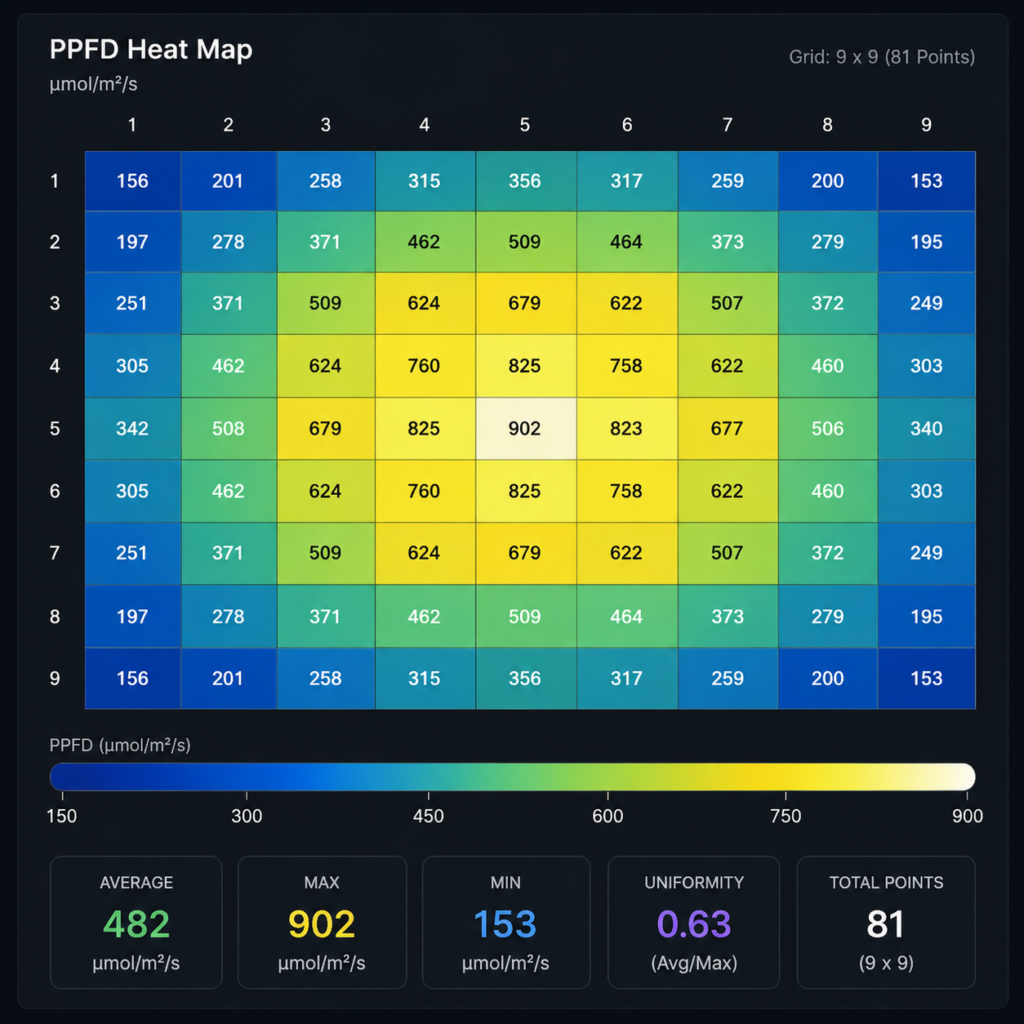
What this reveals in practice:
- Hotspots directly beneath fixture centres where light burn risk is elevated
- Edge falloff where peripheral plants receive significantly less light
- Uniformity ratio (Umin/Uavg) against the ASABE S640 standard
- Whether adding a second fixture improves the situation—or whether adjusting mounting height is the better fix
A beginner might look at a single average PPFD of 450 µmol/m²/s and feel confident. The 9×9 grid might reveal that 20 of those 81 points are below 200 µmol/m²/s—meaning almost a quarter of the canopy is chronically underlit.
Grow Light Comparison: PPFD Requirements by Crop and Stage
| Crop | Growth Stage | Target PPFD (µmol/m²/s) | DLI Target (mol/m²/day) | Notes |
|---|---|---|---|---|
| Lettuce | Vegetative | 150–300 | 12–17 | Higher DLI risks tip burn |
| Basil / Herbs | Vegetative | 200–400 | 14–20 | Responds well to 18hr photoperiod |
| Spinach / Kale | Vegetative | 150–350 | 12–18 | Bolt-sensitive under excess DLI |
| Tomato | Vegetative | 400–600 | 20–30 | Strong root zone needed at these levels |
| Tomato | Flowering | 600–900 | 25–35 | CO₂ supplementation advised above 600 |
| Strawberry | Fruiting | 300–500 | 16–25 | DLI precision critical for flavour |
| Cannabis | Vegetative | 400–600 | 18–25 | 18hr photoperiod standard |
| Cannabis | Flowering | 800–1200 | 35–65 | Only achievable with premium efficacy fixtures |
| Microgreens | All stages | 100–300 | 6–12 | Short crop cycle, forgiving range |
Use this table as a starting point. The crop optimizer within the calculator refines these targets against your specific setup inputs and outputs a suitability score from 0 to 100.
Buying the Right Grow Light: What the Calculator Tells You Before You Spend
The grow light calculator isn’t just a diagnostic tool for what you already own. It’s a buying guide for what you should purchase next.
Run your intended grow space dimensions, target crop, and desired PPFD through the tool before opening your wallet. If a 240W quantum board at 45 cm mounting height delivers your target DLI with a uniformity score above 80%, you have your answer. If the numbers fall short, you know you need either a higher-wattage unit, a more efficient fixture, or a second light.
Key buying considerations the calculator surfaces:
- Wattage required to hit target PPFD for your area and crop
- Efficacy threshold (aim for ≥2.5 µmol/J for reasonable running costs)
- Number of fixtures needed for your footprint
- Annual energy cost so you can calculate ROI before purchase
For a shortlist of quality-tested options across wattage ranges, check out our Shop Smart page — every product listed has been vetted against real grower use cases. Explore LED Grow Lights Guide: How to Choose, Use and Optimise for Indoor Growing (2026).
Energy Costs: The Metric Beginners Always Forget
Lights are your single largest ongoing operating cost in indoor hydroponics. The grow light calculator projects daily, monthly, and annual electricity costs based on your wattage and local rate, plus a cost-per-mol figure that lets you compare fixtures on efficiency rather than price tag alone.
A 600W fixture at 2.0 µmol/J running 18 hours a day is more expensive to operate — per unit of plant-usable light — than a 400W fixture at 3.0 µmol/J. The calculator makes that comparison transparent. Over a 12-month grow cycle, the difference in operating cost between an average and a premium fixture can easily exceed the price difference between them.
Not glamorous. Very useful.
Here is a comprehensive guide to understand DLI for indoor crops.
FAQ: Grow Light Calculator Questions Growers Actually Ask
What is a good PPFD for growing lettuce indoors?
For lettuce, target between 150 and 300 µmol/m²/s, with a DLI of 12–17 mol/m²/day. Exceeding this range, particularly above 20 DLI, can trigger tip burn even in well-managed hydroponic systems. Running a 16-hour photoperiod at moderate PPFD is generally more reliable than pushing intensity at shorter day lengths.
How do I calculate DLI from my PPFD reading?
Use this formula: DLI = PPFD × photoperiod (hours) × 3600 ÷ 1,000,000. For example, 350 µmol/m²/s over a 16-hour day gives you a DLI of 20.2 mol/m²/day. The Grow Light Calculator handles this automatically and benchmarks the result against your chosen crop’s optimal range.
Does mounting height really matter that much?
More than almost any other variable. Because light follows the inverse square law, doubling your fixture-to-canopy distance reduces PPFD to roughly one-quarter of the original value. Conversely, lowering a fixture from 60 cm to 45 cm can increase PPFD at canopy centre by around 78%. Small adjustments compound fast—two inches makes a visible difference within days.
What photon efficacy should I look for when buying an LED grow light?
For practical home and small commercial use, aim for at least 2.5 µmol/J. Budget fixtures typically fall between 1.5–2.2 µmol/J. Mid-range boards reach 2.2–2.8 µmol/J. Premium fixtures exceed 2.8 µmol/J. The higher the efficacy, the lower your electricity cost per unit of plant-usable light delivered.
Can reflective walls really improve my results?
Yes, meaningfully so. Mylar at 97% reflectance can increase effective PPFD at canopy edges by 15–30% compared to bare walls. In an enclosed grow tent, edge uniformity is where most light is lost. Reflective liners address that loss passively, with no additional electricity cost. The grow light calculator adjusts its PPFD grid model based on which wall type you select.
Stop Running Your Grow on Guesswork
Light is the one input in hydroponics you genuinely cannot guess your way through. Nutrients have visible deficiency symptoms. pH has a meter. Temperature has a thermometer. But under or over-lit plants can look deceptively normal for weeks before the yield data tells the real story.
A proper grow light calculator — one that models PPFD across the full canopy, accounts for mounting height and wall reflectance, matches DLI to your specific crop and growth stage, and projects real energy costs — removes that uncertainty entirely. It turns a critical variable into something measurable, optimisable, and repeatable.
If you haven’t run your current setup through a calculator yet, start there. And if you’re planning a new grow, run your intended setup through the numbers before you buy anything.
The Grow Light Calculator at Grow With Hydroponics is free, requires no account, and takes about two minutes to use. It’s one of the most practical tools we’ve built — and the growers who use it consistently report better uniformity, fewer wasted grows, and lights that actually earn their spot in the tent.
Start calculating. Then start growing.
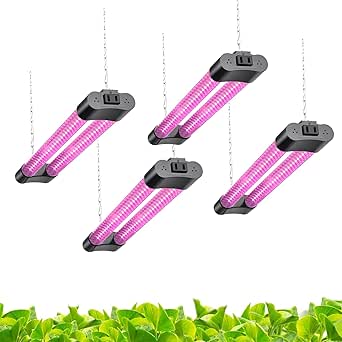
Recommended Grow Lights for Your Setup
Before you buy, run your space through the Grow Light Calculator to confirm wattage and fixture count. Once you know what you need, these vetted options cover most indoor setups.
Quality LEDs that deliver real PPFD — not marketing claims.


Grow Tents That Maximise Light Efficiency
Reflective interiors make a measurable difference to canopy PPFD, especially at the edges. A quality grow tent with Mylar lining is one of the simplest upgrades for improving light uniformity without touching your fixture.


