You upgraded to a quality LED. Your plants are getting 16 hours of light a day. Nutrients are dialled in. And yet the lettuce is pale, the tomatoes are setting fewer fruits than expected, and the basil is growing but not quite thriving.
The problem might not be the light fixture. It might be the dose.
Most growers obsess over PPFD — how intense the light is at the canopy. That matters. But PPFD only tells you how bright the light is at any given moment. It doesn’t tell you how much usable light your plants actually accumulate in a full day. That number is called daily light integral (DLI), and it’s one of the most important metrics in indoor growing. Here at Grow With Hydroponics, the DLI Calculator exists specifically because getting this number right is the difference between plants that survive and plants that actually produce.
This guide covers what DLI is, why it matters more than most growers realise, how to calculate it, what targets to aim for by crop, and the most common mistakes that quietly cost yield.
What Is Daily Light Integral (DLI) and Why Does It Matter?
Daily light integral is the total quantity of photosynthetically useful light—PAR, or photosynthetically active radiation—delivered to your plants over a full 24-hour period. It’s expressed in mol/m²/day (moles of photons per square metre per day).
Think of it this way: PPFD is how hard it’s raining. DLI is how much water fell all day. Your plants don’t care about one dramatic downpour at noon. They care about the total accumulation.
Iowa State University Extension describes DLI as “the amount of light useful for plants delivered over an area in a 24-hour period” and notes that it “basically tells you how much photosynthesis can occur.” That framing captures it well. DLI isn’t a theoretical number — it’s a practical prediction of photosynthetic capacity. Exceed it and you’re wasting electricity and potentially stressing plants. Fall short of it and growth slows regardless of how good everything else looks.
This is why two growers running identical lights at identical heights can get very different yields: one is hitting 14 mol/m²/day, the other is at 9. The gap is invisible unless you measure it.
What Is PPFD and How Is It Different From DLI?
Before calculating DLI, you need to understand the component parts.
PPFD (Photosynthetic Photon Flux Density) measures the intensity of PAR light reaching the plant canopy at a specific moment in time. It’s expressed in µmol/m²/s—micromoles of photons per square metre per second.
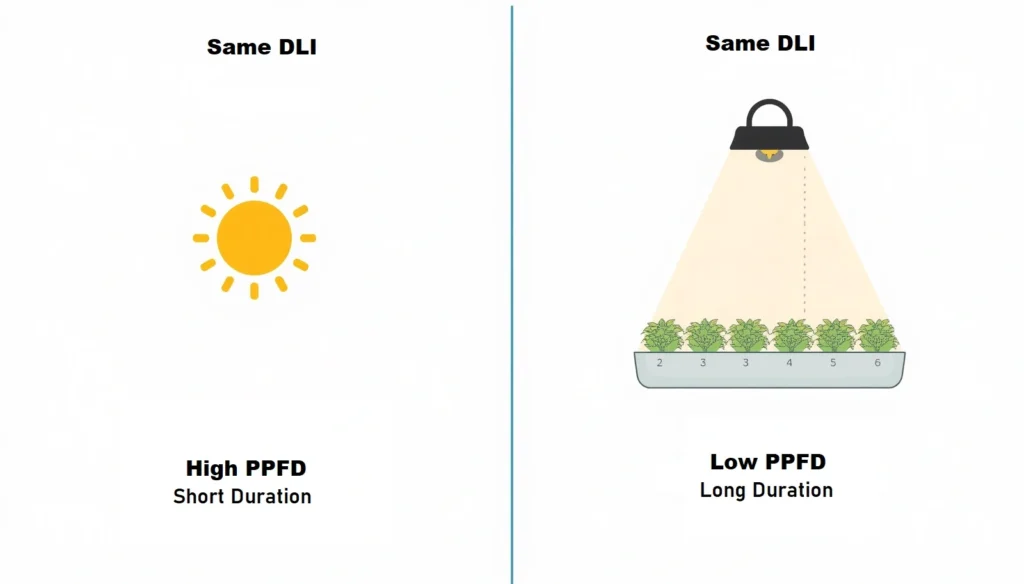
PPFD tells you the rate at which photons are arriving. DLI tells you the total accumulated over the day. Both matter, and neither one alone gives you the full picture.
A quick example makes this concrete:
- Grower A runs 600 µmol/m²/s PPFD for 8 hours → DLI of 17.3 mol/m²/day
- Grower B runs 300 µmol/m²/s PPFD for 16 hours → DLI of 17.3 mol/m²/day
Same DLI. Very different setups. And for some crops — particularly lettuce and leafy greens — research suggests the lower-PPFD, longer-photoperiod approach can actually be more energy-efficient. The University of Missouri Extension notes that knowing how to trade off intensity against photoperiod is a core lighting strategy skill in CEA.
But here’s the trap beginners fall into: they see a PPFD reading that looks reasonable and assume everything is fine. Without calculating DLI, they have no idea whether the total daily dose is meeting the crop’s requirement.
How to Calculate Daily Light Integral
The formula is straightforward:
DLI = PPFD × Photoperiod (hours) × 3600 ÷ 1,000,000
Where:
- PPFD = light intensity at canopy in µmol/m²/s
- Photoperiod = daily hours of light
- 3600 = seconds per hour
- 1,000,000 = conversion from micromoles to moles
Manual Calculation Example
Your LED runs at 400 µmol/m²/s PPFD for 14 hours per day:
400 × 14 × 3600 ÷ 1,000,000 = 20.16 mol/m²/day
For leafy greens, that’s a good number. For fruiting tomatoes, it’s on the lower end.
The manual maths isn’t difficult, but growers who work with multiple crops, multiple growth stages, or variable PPFD across a canopy will save significant time using a dedicated calculator. The DLI Calculator handles the conversion instantly—input your PPFD and photoperiod, select your crop type, and it returns your DLI alongside whether you’re hitting the target range for that crop. It also flags energy cost implications if you enter your grow area and electricity rate, which is useful when comparing light timing strategies.
What DLI Does Your Crop Actually Need?
This is where DLI becomes genuinely practical. Different crops have dramatically different requirements, and these targets come from real research — not guesswork.
Seedlings and Propagation
Young plants need enough light to establish without stress. Most seedlings and cuttings perform well in the range of 6–10 mol/m²/day. Lower than 6 and you’ll get etiolated, stretchy growth as they search for more light. Higher than 12 in the early propagation stage and you risk stressing tender tissue before the root system is established.
Leafy Greens (Lettuce, Spinach, Arugula, Kale)
Leafy greens are moderate light consumers. Research conducted in controlled environments and reviewed in scientific literature places the optimal DLI for lettuce at approximately 12–17 mol/m²/day. A study published in Scientific Reports found that lettuce shoot fresh weight increased substantially as DLI rose from 8.64 to 11.5 mol/m²/day — but that pushing above 14.4 mol/m²/day had a negative impact on fresh weight, dry weight, and leaf area.
The practical takeaway: more light isn’t always better. For lettuce especially, exceeding the optimal range can actually reduce yield and trigger tip burn in sensitive varieties like butterhead.
Herbs (Basil, Mint, Cilantro, Parsley)
Herbs generally tolerate and benefit from slightly higher DLI than leafy greens—typically 14–20 mol/m²/day depending on species. Basil performs well around 16–18 mol/m²/day. Adequate DLI directly drives essential oil concentration in herbs, which affects flavour intensity. Under-lit basil tastes mild. It’s worth the extra light for the quality difference.
Fruiting Crops (Tomatoes, Peppers, Cucumbers)
Fruiting crops are genuinely hungry. Commercial tomato production typically targets 20–30 mol/m²/day, with some high-production greenhouse operations pushing toward 35. Peppers and cucumbers sit in a similar range.
As noted by Hort Americas, citing research from Cornell University’s CEA group, insufficient DLI is one of the leading causes of reduced fruit set and low Brix in hydroponic tomatoes. In winter greenhouse production in northern climates, natural outdoor DLI can fall to 3–5 mol/m²/day—far below what fruiting crops need. Supplemental lighting isn’t optional for year-round commercial production of these crops.
One thing to keep in mind: fruiting crops require at least 4–6 hours of darkness per day to avoid physiological disorders. Extending photoperiod indefinitely to chase higher DLI creates its own problems.
Microgreens
Microgreens are fast-turnover crops with modest light requirements. Most species perform well at 8–14 mol/m²/day. Because the harvest window is so short — typically 7–14 days from seeding — hitting a consistent daily target matters more than pushing maximum intensity.
Daily Light Integral Targets by Crop: Reference Table
| Crop Type | Target DLI (mol/m²/day) | Typical PPFD Range | Notes |
|---|---|---|---|
| Seedlings/Propagation | 6–10 | 100–200 µmol/m²/s | Keep low to avoid early stress |
| Lettuce & leafy greens | 12–17 | 200–300 µmol/m²/s | Don’t exceed tip burn risk above 20 |
| Herbs (basil, mint) | 14–20 | 200–350 µmol/m²/s | Higher DLI improves essential oil content |
| Microgreens | 8–14 | 150–250 µmol/m²/s | Consistency matters more than peak |
| Tomatoes | 20–30+ | 400–600 µmol/m²/s | Minimum 4–6 hrs darkness required |
| Peppers | 18–25 | 350–500 µmol/m²/s | Consistent DLI reduces flower drop |
| Cucumbers | 18–28 | 350–550 µmol/m²/s | Canopy shading creates uneven DLI |
| Strawberries | 12–18 | 200–350 µmol/m²/s | Stage-dependent; fruiting needs more |
How to Measure PPFD Accurately Before Calculating DLI
A DLI calculation is only as reliable as the PPFD number you put into it. This is where many growers hit a wall.
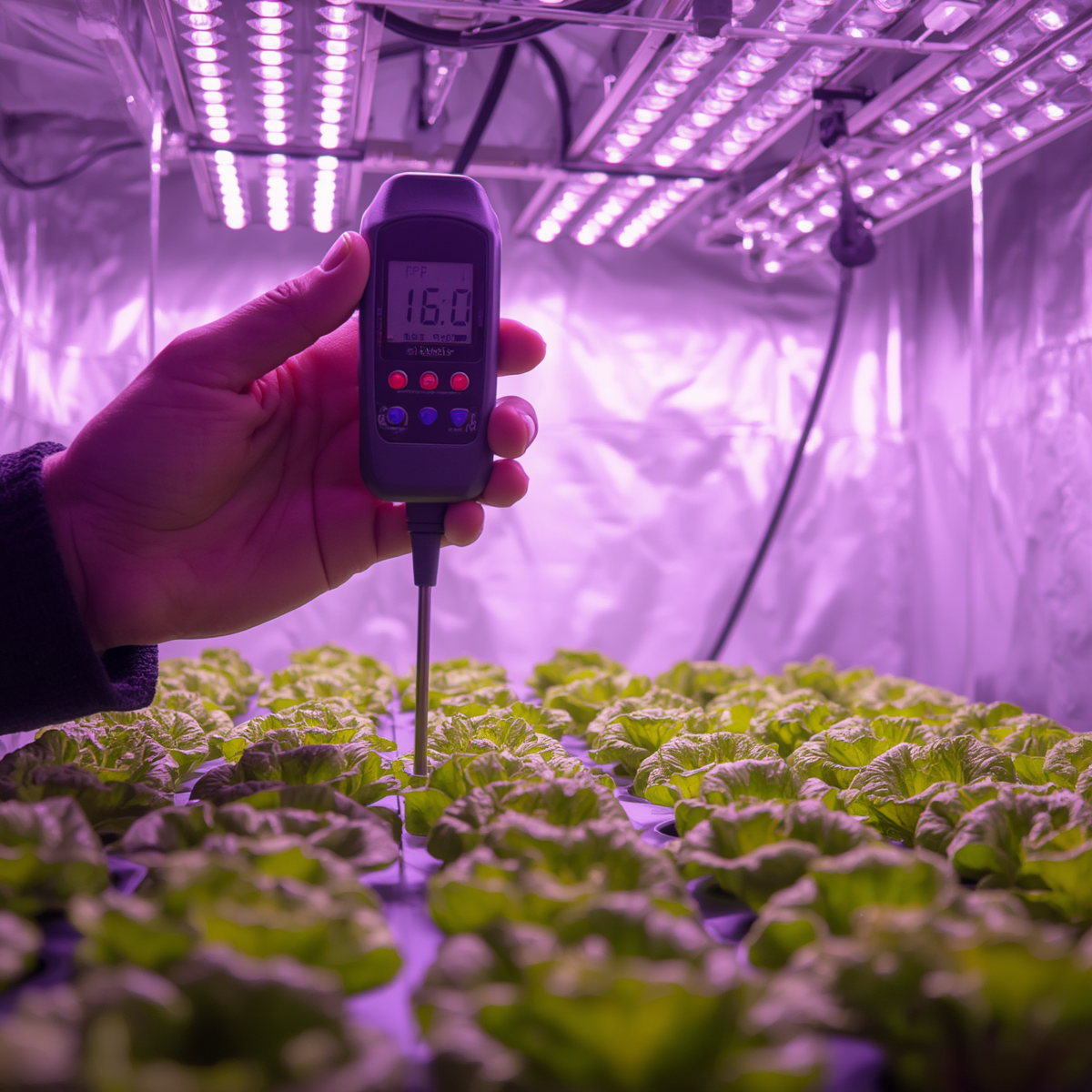
Option 1: Use a PAR meter (quantum sensor). This is the accurate route. A dedicated quantum sensor measures actual photon flux at the canopy surface. Take readings at multiple points — the centre, corners, and midpoints of your grow area—and average them. Light intensity falls off significantly toward the edges of most grow lights.
Option 2: Use the manufacturer’s PPFD map. Most quality LED fixtures come with PPFD maps showing light intensity at various heights and distances. These are generated in controlled conditions and are reasonably accurate, but your actual canopy readings will vary based on reflective walls, canopy height, and whether you’ve dimmed the fixture.
Option 3: Use your fixture’s spec sheet with caution. Some manufacturers list a peak PPFD value from the centre of the light at a fixed hanging height. That number is not your average canopy PPFD. It’s the best-case spot reading. Using it for DLI calculation will give you an optimistically inflated result.
Frankly, the most common reason growers believe they’re hitting a DLI target when they’re not is over-relying on manufacturer peak specs. A PAR meter is an investment that pays for itself in accurate diagnosis and better yields. Browse our recommended options at Shop Smart to find quantum sensors and lighting gear suited to hydroponic setups.
Common DLI Mistakes Hydroponic Growers Make
Running the same photoperiod for every crop. A 16-hour photoperiod might be perfect for basil but excessive for lettuce at the same PPFD. DLI requirements are crop-specific, and photoperiod is one of the levers you control.
Ignoring light uniformity. A single PPFD reading taken at the canopy centre doesn’t represent the whole grow area. Edge plants can receive 30–40% less light than plants directly under the fixture — a difference that shows up in uneven growth and yield inconsistency.
Pushing PPFD without supporting the environment. Higher PPFD means faster photosynthesis, which means more CO₂ demand, higher transpiration, and greater nutrient uptake. Increase PPFD without adjusting CO₂, airflow, and EC and the extra light produces diminishing returns quickly.
Using lumens or lux to estimate DLI. Lumens and lux measure light as human eyes perceive it, not as plants use it. A warm-white lamp can measure high in lumens but deliver very little usable PAR. PAR meters and PPFD values are the only measurements that translate meaningfully to DLI.
Overlit seedlings. New growers routinely burn seedlings by running the same light schedule they use for mature plants. Seedlings at 6–8 mol/m²/day establish faster and more consistently than those pushed into 15+ mol/m²/day before their root system can support it.
DLI, Photoperiod, and Energy: How to Hit Your Target Efficiently
Once you know your target DLI, you can reach it through different combinations of PPFD and photoperiod. The trade-off has real practical implications.
Higher PPFD, shorter photoperiod: More intense light for fewer hours. Lower electricity use per day if the fixture is efficient. Better for crops with a clear photoperiodic response (where darkness timing matters).
Lower PPFD, longer photoperiod: Gentler, more extended light exposure. Research on lettuce and basil suggests this approach can be more energy-efficient at equivalent DLI because plants use lower-intensity light more efficiently—fewer photons are dissipated as heat rather than used for photosynthesis.
Practical example: Targeting 17 mol/m²/day for leafy greens:
- Option A: 400 µmol/m²/s for 11.8 hours
- Option B: 250 µmol/m²/s for 18.9 hours
Option B may cost less in electricity and produce slightly better light use efficiency in lettuce. Option A may suit your schedule better. The DLI Calculator lets you model both scenarios in seconds before making any equipment changes.
LED Grow Lights That Deliver Accurate, Consistent PPFD
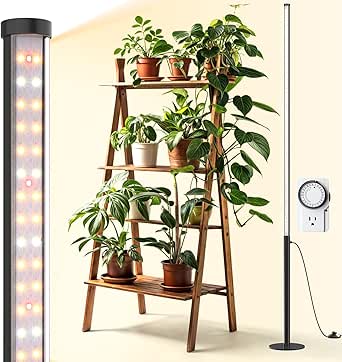
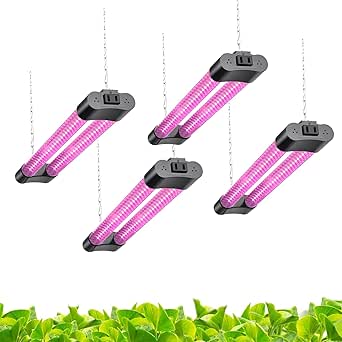
Hitting your DLI targets starts with a grow light that delivers consistent, measurable PPFD across the canopy. Not all fixtures perform equally once you measure them — and the spec sheet isn’t always the whole story. Browse our curated selection of grow lights tested for real-world performance at Shop Smart.



Frequently Asked Questions About Daily Light Integral
Q: What happens when DLI is too low for my crop?
Photosynthesis slows and plants redirect energy to survival rather than growth. You’ll see pale, stretched tissue, reduced branching, delayed flowering in fruiting crops, and lower yields overall. The plant isn’t lazy — it’s underfunded. Increase PPFD, extend the photoperiod, or both.
Q: Can DLI be too high?
Yes. Excessive DLI causes photoinhibition — the light-harvesting system becomes overwhelmed, and photons are dissipated as heat rather than used productively. In sensitive crops like lettuce, high DLI above roughly 20 mol/m²/day triggers tip burn and quality decline. Higher PPFD without adequate CO₂ supplementation also stresses plants regardless of DLI. More light is only better up to a crop-specific ceiling.
Q: Is 12 hours of light enough for hydroponic lettuce?
It depends on your PPFD. At 300 µmol/m²/s for 12 hours, your DLI is 12.96 mol/m²/day — in the lower half of the optimal range for lettuce. Bump PPFD to 350 µmol/m²/s or extend to 14 hours and you’ll hit 14–15 mol/m²/day, which is a more productive target. Always calculate the resulting DLI rather than assuming a photoperiod number alone is sufficient.
Q: Does natural light count toward DLI in a greenhouse or mixed system?
Absolutely. Total DLI is the sum of all PAR received — from both natural and artificial sources. In supplemental lighting setups, the goal is to identify how much natural DLI the crop is receiving and supplement only the deficit. This is where sensor-based light management systems add genuine value, adjusting supplemental output based on real-time natural light levels.
Q: What’s the difference between PAR, PPFD, PPF, and DLI?
PAR is the wavelength range (400–700 nm) that plants use for photosynthesis. PPFD measures PAR intensity at the canopy surface at a point in time (µmol/m²/s). PPF is the total PAR output of the entire fixture (µmol/s)—a fixture spec, not a plant-level measurement. DLI is the total PAR accumulated at the canopy over a full day (mol/m²/day). For growers making practical lighting decisions, PPFD and DLI are the most directly actionable numbers.
Stop Guessing and Start Measuring
Most indoor growers are making lighting decisions based on hours alone. Twelve hours sounds like a lot. Sixteen hours sounds thorough. But without knowing your PPFD and calculating the resulting DLI, you don’t actually know whether your plants are getting what they need.
The formula is simple. The targets are well-researched. And the difference between a crop running at 9 mol/m²/day and one running at 15 mol/m²/day is visible within a single growing cycle.
Know your crop’s DLI requirement. Measure your actual PPFD. Adjust photoperiod or intensity to hit the target. Then check energy cost implications. That’s the entire process — and Grow With Hydroponics has every tool you need to run it properly. Start with the DLI Calculator to see exactly where your current setup stands.
Light is one of the few inputs in hydroponics you can dial in with real precision. Use that precision.


Optimise Your Growing Foundation
The environment inside your grow space directly affects how efficiently your plants use light. A well-sealed, reflective grow tent maximises PPFD uniformity and helps every watt of lighting reach the canopy rather than the walls. Pair the right enclosure with your DLI-dialled lighting setup for consistent results.