

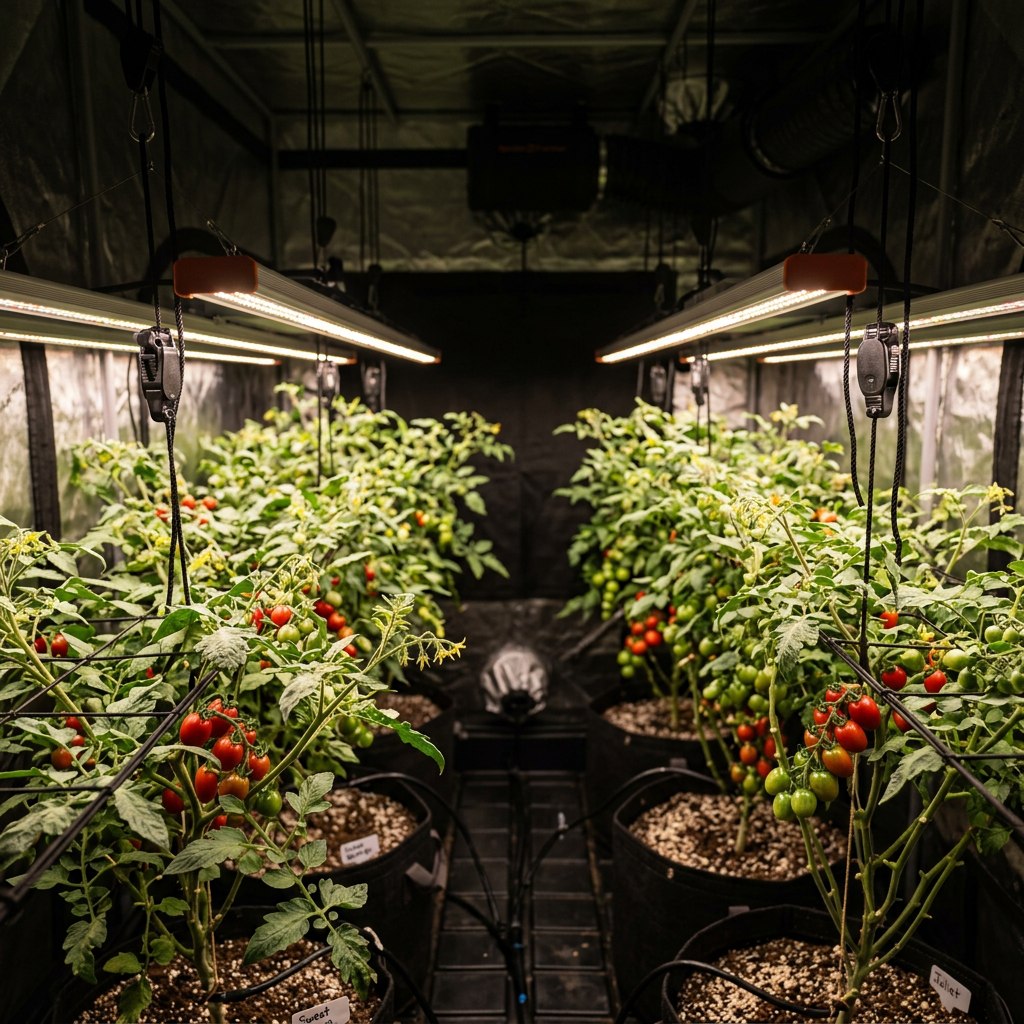
Most growers don’t waste money because they bought the wrong brand. They waste it because they bought the wrong type of light—for the wrong space, at the wrong intensity—without ever looking at a single number that actually matters to their plants.
The best LED grow lights in 2026 are defined by three things: how many usable photons they push per second, how efficiently they do it, and whether their spectrum matches your plants at every stage of growth. Everything else is packaging. Here at Grow With Hydroponics, we’ve pulled the specs, stripped away the marketing noise, and built a practical guide that tells you exactly what to look for, what to avoid, and how to match your light to your grow before you spend a dollar.
By the end of this, you’ll know why lumens are useless, why your blurple panel is probably holding you back, how to read a PPFD map like someone who actually grows plants, and how to calculate the real cost difference between a cheap light and a good one.
Why Most Growers Buy the Wrong LED Grow Light
The honest answer: they search for “best LED grow light,” find a list built around affiliate commissions, and buy based on wattage claims and star ratings. Wattage tells you how much electricity a fixture draws. It does not tell you how much light your plants receive. Those are two completely different numbers.
A legacy 1,000W blurple panel from five years ago and a modern 400W full-spectrum bar light aimed at the same 4×4 canopy? The 400W fixture wins on almost every metric that matters. Not because it’s more powerful in raw electricity terms, but because it converts that electricity into plant-usable photons far more efficiently.
The Wattage Myth That Wastes Your Money
The spec that actually tells you what you’re getting is efficacy—measured in µmol/J (micromoles per joule). It tells you how many photosynthetically active photons you get per watt of electricity consumed. A light with 3.0 µmol/J efficacy will give you more growth, with less heat and a lower electricity bill, than a 1.5 µmol/J light of the same wattage. This single number separates equipment from electricity bills. If a manufacturer doesn’t display it prominently, treat that as a warning.
What Do the Best LED Grow Lights Actually Measure?
Skip lumens entirely. Lumens measure how bright light appears to a human eye. Your plants don’t have eyes. Every metric worth tracking lives in the PAR zone—400 to 700 nanometers, the range plants actually use for photosynthesis.
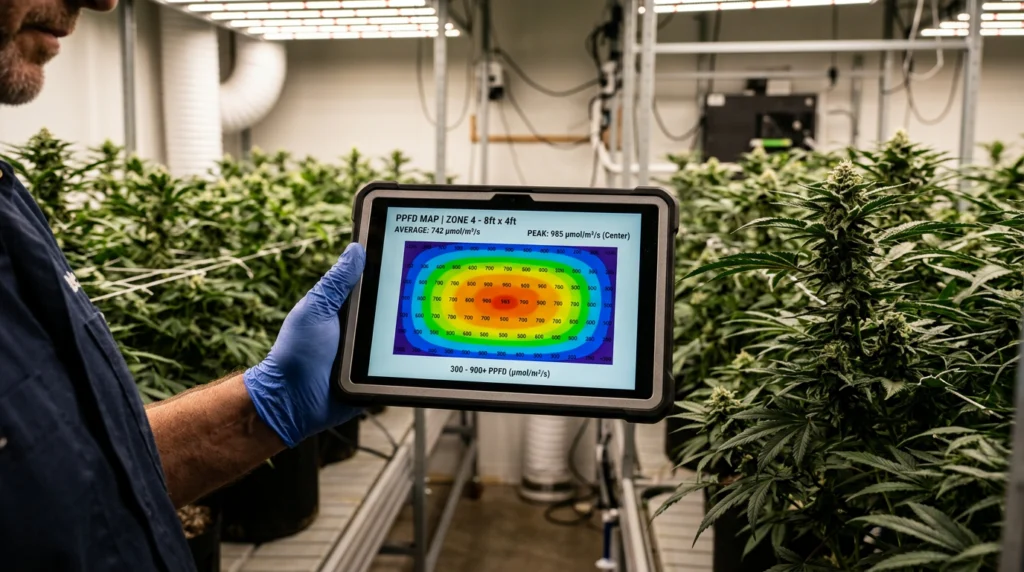
PPFD — Your Instantaneous Light Intensity
PPFD (Photosynthetic Photon Flux Density) is the crucial measure. It tells you how many photosynthetically active photons are hitting a specific spot on your canopy every second. Think of it as rainfall intensity—not how much rain fell this week, but how hard it’s hitting right now at this exact location.
During the vegetative stage, aim for 400–600 µmol/m²/s. For flowering and fruiting, target 600–1,000 µmol/m²/s, with some high-light crops like tomatoes and peppers approaching the upper end. Seedlings and clones need far less—100–150 µmol/m²/s to start. Push full flowering intensity onto fresh seedlings and you’re not accelerating growth; you’re burning them.
The word that separates good lights from expensive disappointments is uniformity. A fixture that blasts 1,500 µmol/m²/s in the center while corners receive 200 is a recipe for lopsided, stressed plants. Half the canopy stretches toward light. Half bleaches under it. A top-rated LED grow light delivers even coverage from edge to edge—and the PPFD map proves it. Never trust a manufacturer’s center-only PPFD claim. Demand the full uniformity map. No map, no buy.
DLI — The Number That Actually Drives Yields
PPFD is the rate. DLI—Daily Light Integral—is the total. It’s the accumulated sum of every photon your plant receives across a full photoperiod, and it’s the number that separates growers who get repeatable results from those who keep guessing.
DLI is calculated from PPFD × light hours × 3,600 ÷ 1,000,000. Plants have a total DLI requirement you can achieve either with high PPFD over fewer hours, or lower PPFD over more hours. This is why your timer isn’t optional—it’s how you hit your DLI target without babysitting the lights. Lettuce thrives at a moderate DLI. Fruiting peppers want 30–40 mol/m²/day or higher. A shade herb might be content at 8–12.
Use the free DLI Calculator to convert your PPFD reading and daily light hours into a precise daily light budget. It takes thirty seconds and removes all the guesswork.
PPF vs. PPE — Why Most Buyers Confuse These Two
PPF (Photosynthetic Photon Flux) measures the total photon output of a fixture per second, in µmol/s. It’s the whole-fixture number. PPFD is what lands on a specific point of your canopy. PPE (Photosynthetic Photon Efficacy) is the efficiency ratio—µmol/J—that tells you how much of the electricity you’re paying for actually converts into plant-usable photons. Early LEDs struggled to hit 2.0 µmol/J. Today’s premium fixtures push 2.9+. That difference isn’t just technical. It shows up directly on your utility bill and in your yield per cycle.
Does Spectrum Still Matter With LED Grow Lights in 2026?
Yes—but the answer is simpler than most manufacturers want you to believe.
Full Spectrum vs. Blurple: The War Is Over
The blurple panel era is over. Full spectrum won. Modern LED grow lights use a blend of high-CRI white diodes—typically a mix of 3000K and 5000K—to mimic the sun’s broad output. The green wavelengths they emit, once wrongly dismissed as useless, are now understood to drive photosynthesis in lower, shaded leaves, improving whole-canopy efficiency. A blurple panel gives you peaks in blue and red. Plants grow under it. But full-spectrum white LEDs deliver a more complete photon diet that reaches deeper into a canopy and supports every growth stage without fixture swaps.
The Role of UV-A and Far-Red (730nm)
The best 2026 fixtures offer supplemental channels for UV-A and far-red. UV-A can stimulate protective secondary metabolite production—relevant for growers focused on flavor, aroma, or potency. Far-red at 730 nm influences stem stretch and flowering timing through the Emerson Effect. These aren’t gimmicks when used correctly. The key word is “supplemental.” They are tools for fine-tuning a mature, optimized grow—not features you need on day one. For most growers, a well-specced full-spectrum white LED handles everything.
How to Match the Best LED Grow Lights to Your Grow Space
This is where almost every beginner goes wrong, and it’s the most expensive mistake to make. You can’t buy a light for a vague idea of a garden. Buy for your largest ambition, not your simplest plant. Ask yourself two questions before you buy anything:
- What is the exact footprint of your grow space? Measure it now.
- What is the most light-hungry plant I’ll ever grow there? That crop sets your PPFD requirement.
A compact 2×2 ft herb shelf and a 4×4 ft flowering tent are completely different problems. Throwing a 700W bar light over a tray of microgreens is like using a flamethrower to toast a marshmallow—inefficient, unnecessary, and expensive. Underpowering a fruiting canopy is the single most common reason home growers get disappointing harvests.
Small Spaces: 2×2 ft to 3×3 ft Setups
Quality quantum board-style LEDs drawing 100–200 true watts cover this footprint well. These are the workhorses of the hobby market—lightweight, easy to hang, simple to dim for seedlings. Target 2.5+ µmol/J efficacy at this tier; anything below means you’re paying more per photon than you should be.
Mid-Range: 4×4 ft Grow Tents
This is the most popular home grower footprint. A ~400W fixture with an average PPFD around 750 µmol/m²/s across the full 4×4 footprint is suitable for full-cycle growth. Bar-style LEDs work well here, spreading the light source and reducing hot spots. Proven options include the Spider Farmer SF-4000, Mars Hydro FC-E4800, and ViparSpectra KS5000—all deliver high uniformity and strong efficacy ratings for this footprint. Target 2.8+ µmol/J.
Large Setups: 5×5 ft and Beyond
Running a larger setup requires either a high-output single fixture or multiple bars in a coordinated array. Look for fixtures supporting daisy-chaining, external controller compatibility, and passive cooling. For true watts, efficacy, and real coverage data for high-output configurations, see our 1000W LED Grow Light Coverage Guide.
Shelves, Countertops, and Windowsill Gardens
Don’t overcomplicate small-scale growing. Full-spectrum LED strips or T5 LED bars (like the Monios-L T5) are ideal for seed-starting shelves or multi-tier racks. For single-plant windowsill setups, screw-in E26 full-spectrum bulbs from brands like GE or SANSI 15W work well and fit standard fixtures. The goal here isn’t maximum PPFD—it’s adequate, consistent, full-spectrum light without burning a countertop herb.
Commercial vs. Home Grower Needs
Commercial facilities live by uniformity, reliability, and uptime. They require IP65-rated fixtures (safe from moisture and dust ingress), daisy-chain connectivity for multi-light arrays, and external controllers for precise program scheduling. A detachable driver is increasingly standard—mounting the driver outside your grow space drops interior tent temperatures by 3–5°F, which meaningfully improves VPD management without additional HVAC investment. Home growers targeting a 4×4 or 5×5 tent should prioritize the 400–650W sweet spot. Over-light a small enclosed space and you’ll battle CO₂ limitations and light stress simultaneously.
Best LED Grow Lights for Each Growth Stage
Light requirements are not static across a plant’s life. Treating them as static is one of the most common and costly mistakes in indoor growing.
Seedlings and Clones
Start low—100–150 µmol/m²/s for germination—and ramp up slowly as true leaves appear. A dimmable fixture isn’t just a convenience here. It’s a biological necessity. Seedlings under full-power flowering intensity don’t grow faster. They stress, bleach, and stall. Gradually increasing intensity as plants mature ensures a smooth transition without shock. Start at 24–30 inches of hanging height at 25–40% power.
Vegetative Growth
Blue-weighted spectrums earn their reputation here. Aim for 400–600 µmol/m²/s and extend your photoperiod to 16–18 hours to hit your DLI target. For veg-specific fixtures, the HLG 300L B-Spec is purpose-built for this stage. Most leafy crops and herbs reach their full light requirement during vegetative growth and don’t need more.
Flowering and Fruiting
This is the most demanding stage. Boost intensity to 600–1,000 µmol/m²/s depending on the crop. Consider supplemental far-red if you’re running fruiting vegetables or want to influence flowering timing. Reduce photoperiod to 12 hours for photoperiod-sensitive crops. For crops like tomatoes and peppers, high-DLI environments (30–40+ mol/m²/day) consistently outperform lower-light setups in both yield and fruit quality.
| Growth Stage | Ideal Spectrum | Target PPFD | Recommended Type |
|---|---|---|---|
| Seedling | Balanced white/blue | 100–150 µmol/m²/s | Low-intensity panel or dimmed QB |
| Vegetative | Blue-dominant (400–500nm) | 400–600 µmol/m²/s | Full-spectrum or veg LED |
| Flowering/Fruiting | Red-enriched (600–700nm) + far-red | 600–1,000 µmol/m²/s | Bloom or dual-channel bar LED |
The Efficiency Number That Pays Your Electricity Bill
PPE Explained: Why Efficiency Equals Profit
Efficacy—µmol/J—is the single most important long-term operating cost number. It tells you how many usable photons you get per watt consumed. Commercial-grade fixtures pushing over 2.8 µmol/J are now available at hobbyist price points. Two years ago, anything above 2.5 µmol/J was impressive. Standards have moved fast. If a manufacturer doesn’t display this number clearly, treat it as a warning sign.
ROI Breakdown: What Cheap Lights Actually Cost
The “bargain” light that underperforms its specs is the most expensive light you’ll ever buy. Here’s the math on a direct comparison:
| Metric | Legacy 1100W HPS | Modern 650W LED (2.9 µmol/J) |
|---|---|---|
| Daily electricity (12hr @ $0.15/kWh) | ~$1.98 | ~$1.17 |
| Annual electricity cost (365 days) | ~$723 | ~$427 |
| Savings per light per year | — | ~$296 |
| Heat load (cooling overhead) | High | Low |
| Spectrum quality | Fixed | Full-spectrum, tuneable |
| Lifespan | ~20,000 hrs | 50,000+ hrs |
That ~$296 annual saving per fixture doesn’t include reduced cooling costs or the yield differential from better spectrum uniformity. A premium LED typically recovers its cost premium within one to two grow cycles.
Hanging Height: The Setup Mistake Nobody Talks About Enough
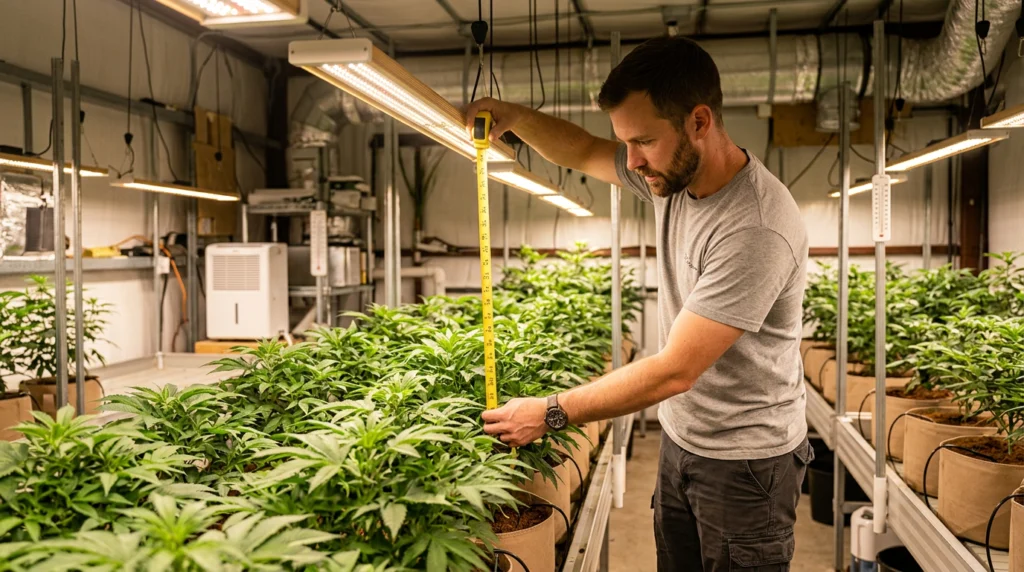
You can buy the best LED grow light on the market and still get poor results by hanging it at the wrong height. Too high and PPFD drops—intensity falls with distance according to the inverse square law. Too low and you risk light burn, bleaching, and uneven coverage.
| Growth Stage | Recommended Hanging Height |
|---|---|
| Germination/Seedlings | 24–36 inches |
| Vegetative | 18–24 inches |
| Flowering | 12–18 inches |
Start high and dim, then lower and increase intensity as plants acclimate. If canopy temperature exceeds 85°F, raise the fixture 2 inches or reduce to 80% power. Canopy temperature is your real-time feedback system. Trust it.
The VPD Connection — Why Light Intensity and Climate Are Linked
Here’s something most guides skip: as you increase light intensity, you increase transpiration rate. Higher transpiration means you need to adjust your vapor pressure deficit (VPD) accordingly—otherwise plants close stomata to conserve moisture and slow growth, exactly the opposite of what you want. Use the VPD Calculator to dial in temperature and humidity as you ramp up intensity. Lighting doesn’t work in isolation.
LED Grow Light Comparison: Key Specs at a Glance
| Grow Space | True Wattage | Target PPFD (Flowering) | Min. Efficacy | Fixture Style | Named Pick |
|---|---|---|---|---|---|
| 2×2 ft | 100–150W | 400–600 µmol/m²/s | 2.5+ µmol/J | Quantum board | ViparSpectra XS1500 Pro |
| 3×3 ft | 150–250W | 500–700 µmol/m²/s | 2.7+ µmol/J | QB or bar | Mars Hydro TS3000 |
| 4×4 ft | 300–450W | 700–900 µmol/m²/s | 2.8+ µmol/J | Bar-style LED | Spider Farmer SF-4000 |
| 5×5 ft+ | 500–750W+ | 800–1,000+ µmol/m²/s | 2.8–3.0+ µmol/J | Multi-bar / commercial | Mars Hydro FC-E4800 |
Do You Need a Waterproof LED Grow Light?
If you’re running a hydroponic system—especially one with open reservoirs, flood-and-drain tables, or aeroponics—moisture and splashing are unavoidable. A standard grow light near a reservoir isn’t failing because it’s weak. It’s failing because it isn’t rated for the environment it’s operating in.
Look for IP65 or higher ratings for any fixture used directly above or adjacent to water sources. Options like the Barrina Waterproof LED Bar and Roleadro Waterproof Panel are designed specifically for humid grow rooms and resist both moisture ingress and corrosion. For flexible, multi-arm setups in unusually shaped spaces, the EZORKAS 9-Head is worth considering. Waterproof fixtures cost marginally more upfront. They cost significantly less than replacing a non-waterproof fixture that failed six months in.
The Future of LED Grow Lights
The next significant development isn’t a brighter diode—it’s integration. We’re moving from set-and-forget fixtures to responsive lighting systems: lights that simulate dawn-to-dusk cycles, adjust spectrum via app, or sync automatically to environmental sensors. Some commercial setups already use light management systems tied to CO₂, temperature, and humidity readings to create fully automated, data-driven environments.
For home growers, the immediate practical win is the detachable driver trend. Mounting the driver (the heat-generating power supply) outside your tent is already available on several 2026 models, and it meaningfully reduces grow space temperatures—often 3–5°F—without touching your ventilation setup. That alone can bring a stressed summer grow back into a productive VPD range.
A Practical Buying Checklist for the Best LED Grow Light
This is what actually separates a purchase you’ll regret from one you won’t.
- Define the exact footprint. Not “a shelf”—a measured 4×4 ft tent or 3×3 ft rack. Know the number.
- Identify your most light-hungry crop. That plant sets your PPFD ceiling for the entire setup.
- Demand the full PPFD map. Coverage claims are marketing copy. The map shows truth. Center-only numbers hide edge fall-off. No map, no buy.
- Check efficacy in µmol/J. Anything below 2.5 µmol/J is outdated technology at 2026 prices.
- Confirm 0–100% dimming. Non-negotiable for seedling management and growth-stage transitions.
- Check driver and diode specs. Mean Well drivers and Samsung LM301H, LM301B, or Bridgelux diodes are reliable industry standards. They run cooler and last longer.
- Prefer fanless passive cooling. No moving parts means no fan failure, quieter operation, and easier maintenance.
- Check safety certifications. UL or ETL listing, not just CE. CE is a self-declaration; UL/ETL is independently tested.
- Require a 3–5 year warranty minimum. A manufacturer confident in their product doesn’t hide behind a one-year policy.
- Consider IP rating if your grow involves open water, high humidity, or reservoir proximity. IP65 minimum for hydroponic environments.
- Look for a detachable driver option if you’re running a sealed tent in a warm climate—it buys you 3–5°F without touching your ventilation.
Shop Smart: Browse curated, spec-verified LED grow lights organized by grow space size and efficacy rating at Shop Smart—so you’re comparing real specs, not marketing language.
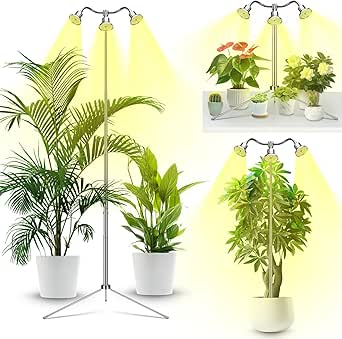
Top-Rated LED Grow Lights — Shop by Space
These are hand-selected for efficacy, PPFD uniformity, and long-term reliability across all major grow footprints.


FAQ: Best LED Grow Lights
What is the most important spec when buying an LED grow light?
Efficacy in µmol/J—how many usable photons you get per watt of electricity. It determines your running costs and your photon delivery. Anything under 2.5 µmol/J is outdated at 2026 prices.
What PPFD do I need for flowering plants?
For most fruiting crops and flowering plants, target 600–1,000 µmol/m²/s at canopy level. High-light crops like tomatoes and peppers can benefit from intensity approaching the upper end of that range, provided CO₂ and VPD are properly managed.
How many watts of LED do I need for a 4×4 grow tent?
Roughly 300–450 true watts (measured at the wall, not “equivalent” watts). Focus on fixtures with a documented average PPFD of 700–900 µmol/m²/s across the full 4×4 footprint, not just the center point.
Is Spider Farmer or Mars Hydro better for a 4×4?
Both are solid options in the same performance tier. The Spider Farmer SF-4000 uses Samsung LM301H EVO diodes with strong uniformity data. The Mars Hydro FC-E4800 offers slightly higher PPF. Your decision should come down to verified PPFD maps, warranty terms, and driver quality rather than brand loyalty.
Do I need UV in my grow light?
Not for most crops. UV-A is most relevant for growers focused on secondary metabolite production—terpenes, anthocyanins, or protective compounds. It’s a fine-tuning tool, not a foundation. Start with a strong full-spectrum white LED and add UV supplementation only once your baseline environment is dialed in.
How long should grow lights run daily?
For most vegetative crops: 16–18 hours per day. For flowering/fruiting plants that are photoperiod-sensitive: 12 hours on, 12 hours off. Use your DLI target—not just a fixed timer—to set the right duration for your PPFD level and crop.
Can I use regular LED bulbs to grow plants?
Standard white LED bulbs won’t cut it for serious growing—they don’t deliver sufficient PAR output or the right spectrum balance. Full-spectrum LED grow bulbs (E26 base, from brands like GE or Briignite) are a workable option for herbs and low-light houseplants, but they’re not a substitute for a purpose-built grow fixture in a tent or dedicated grow room.
Are waterproof LED grow lights worth it for hydroponics?
Yes, particularly for any setup with open reservoirs, nutrient solution splashing, or consistently high humidity. IP65-rated fixtures prevent corrosion and electrical failure in conditions that would degrade a standard fixture within months. The upfront premium is small relative to the replacement and downtime cost.
What certifications should I look for on a grow light?
UL or ETL listing from an independent testing lab. CE certification is a manufacturer’s self-declaration and provides limited safety assurance. For lights running continuously in a humid environment, independent certification matters.
What is a quantum board LED grow light?
A quantum board is a flat circuit board populated with many small, high-efficiency diodes spread across a wide surface area—rather than a few large, concentrated COB chips. The wide diode distribution produces excellent light uniformity and runs at lower temperatures per diode, which extends lifespan and improves efficacy. Most of the top-rated hobbyist fixtures in 2026 use a quantum board or bar-style variant of this design.
The Future of Grow Lighting
Choosing the best LED grow light is not about finding the brightest fixture or the most impressive spec sheet. It’s about matching the right photon delivery system to the right space, the right crop, and the right growth stage—then verifying that match with real data, not marketing copy.
The fundamentals haven’t changed: demand a PPFD map, check efficacy in µmol/J, confirm dimming range, specify your footprint before you browse, and match your intensity to the crop you’re actually growing. Add the ROI thinking—what does this light actually cost per year to run? —and the decision gets clearer fast.
At Grow With Hydroponics, the goal is to help you make that decision with real information, not guesswork. Use the DLI Calculator to confirm your daily light budget. Use the Grow Space Planner to map your coverage before you hang anything. Your plants will show you the difference.
