

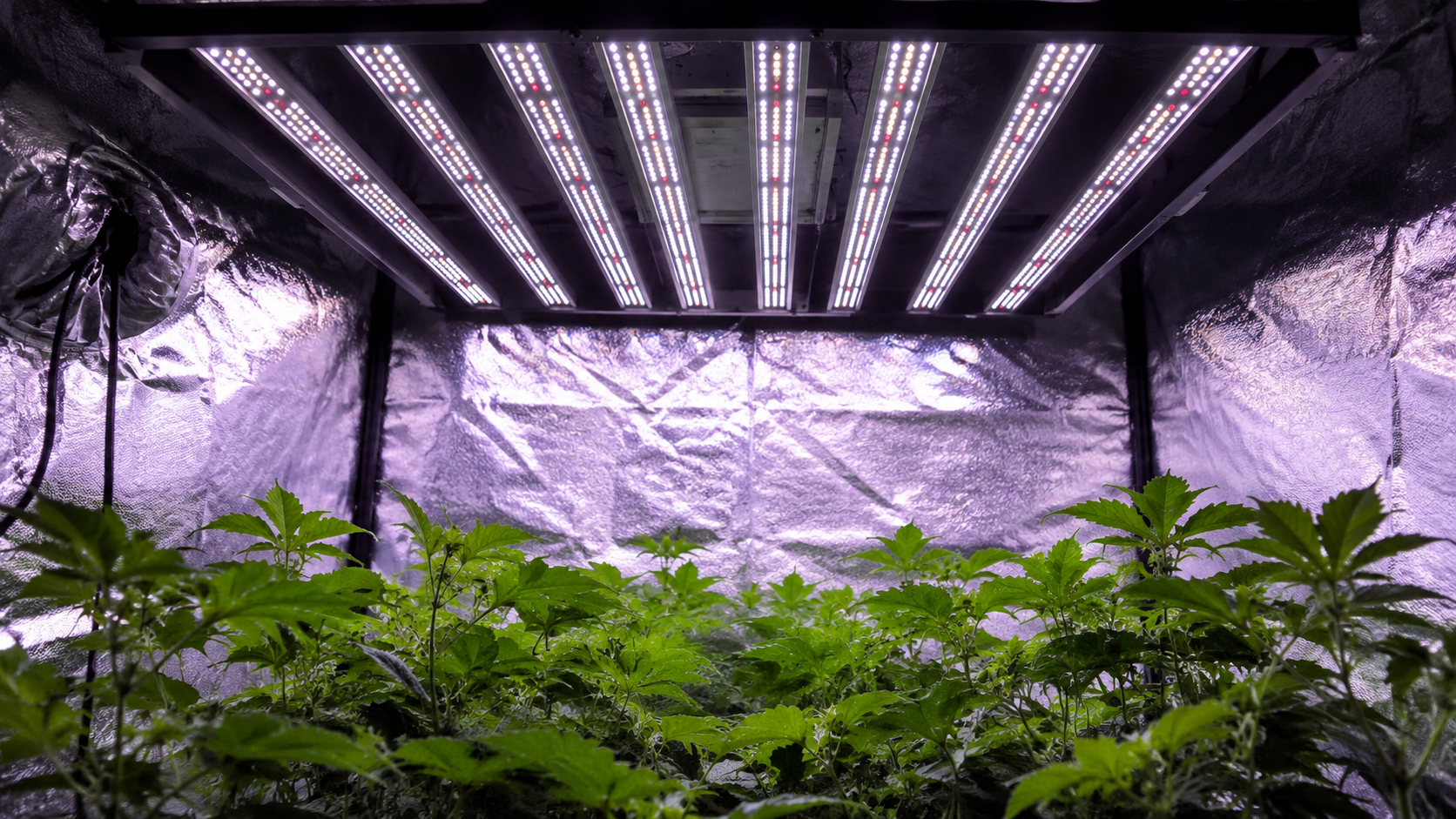
Your electricity bill went up. And you’re pretty sure it’s the grow lights. Maybe you’re running a 4×4 tent, maybe a small herb setup — either way, you’re staring at your utility bill wondering how much of that is coming from your plants. Grow light electricity cost is one of those things growers often underestimate when they’re starting out, then scramble to calculate once the first bill arrives.
Here at Grow With Hydroponics, we get this question constantly. So instead of vague estimates, this post gives you the actual formula, real numbers for common light sizes, a comparison of light types, and practical ways to reduce what you’re spending—without sacrificing your yields.
Quick Answer Grow light electricity cost depends on three variables: wattage, daily run hours, and your local electricity rate. The formula is: (Watts ÷ 1,000) × Hours/Day × Days × $/kWh = Total Cost. A 400W LED running 18 hours a day at the current US average of around $0.18/kWh costs roughly $38–$40/month. A 600W light under the same conditions runs closer to $58–$60/month. Switching from HPS to LED typically cuts that cost by 40–60%.
Explore Ultimate Guide to Grow Light Systems: Choose the Perfect Setup for Bigger, Healthier Indoor Plants.
Why Grow Light Electricity Cost Catches Growers Off Guard
Most beginners calculate the price of the light itself and call it a day. They forget that a grow light isn’t a one-time purchase — it’s a recurring operating cost that runs for 12 to 20 hours every single day, for weeks or months at a stretch.
US electricity rates have risen 17% over four years, climbing from 15.04¢/kWh in 2022 to around 17.65¢/kWh in early 2026. That trend isn’t reversing soon. So a setup that felt affordable two years ago may be noticeably more expensive now — same lights, same schedule, higher bill.
The other thing that trips people up is wattage labelling. A “1000W” label on a budget LED is often marketing terminology rather than actual power draw. Most “1000W” LED grow lights actually consume 150–250 watts from the wall. Always check the actual wattage or power draw in the spec sheet — not the equivalent or “replaces X watts” number.
How to Calculate Grow Light Electricity Cost (The Formula)
Grow light electricity cost calculation is simple once you know the three inputs. You do not need any special tool to do this.
To calculate the monthly electricity cost of a grow light, you need three pieces of information: the light’s wattage (W), the number of hours it runs each day, and your local electricity rate ($/kWh). Use the following formula:
Monthly Cost = (Watts ÷ 1,000) × Hours/Day × 30 × $/kWh
That’s it. Let’s run through it concretely.
Step-by-Step Example
Say you’re running a 600W LED for 16 hours per day and your electricity rate is $0.18/kWh (close to the current US residential average):
- Convert watts to kilowatts: 600 ÷ 1,000 = 0.6 kW
- Daily energy use: 0.6 × 16 hours = 9.6 kWh/day
- Monthly energy use: 9.6 × 30 = 288 kWh/month
- Monthly cost: 288 × $0.18 = $51.84/month
That’s one light. If you’re running two, double it. Add fans, pumps, and a dehumidifier, and your total grow room bill starts adding up fast.
Where to Find Your Electricity Rate
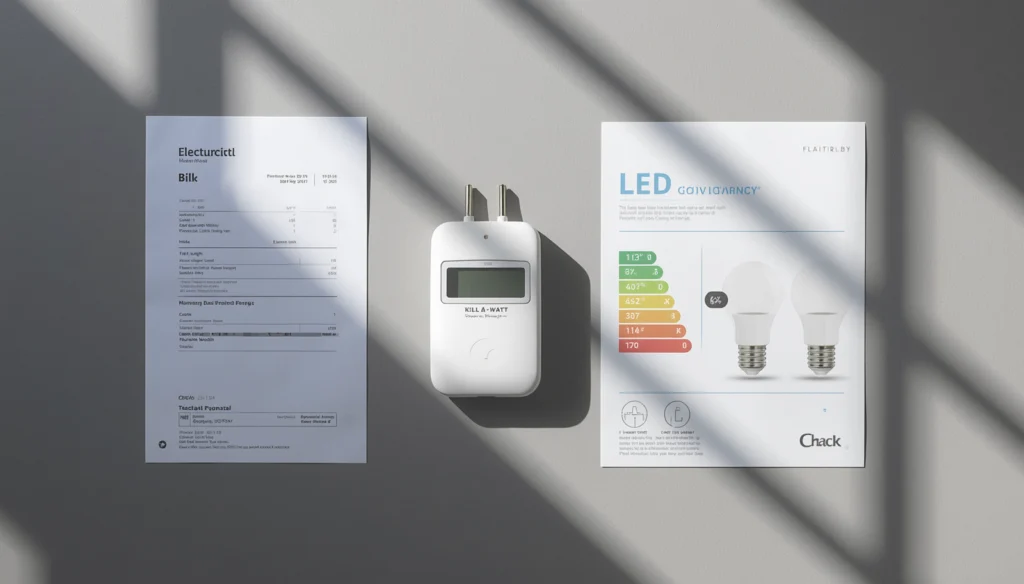
Check your utility bill—look for a line showing ¢/kWh or cents per kilowatt-hour. According to recent EIA data, the average electricity rate in the United States is around 18.83 cents per kilowatt-hour, though this varies enormously by state — from as low as 11.95¢/kWh in North Dakota to as high as 42.23¢/kWh in Hawaii. Your actual rate matters a lot. Running the same 600W light in Louisiana costs less than half what it would in California.
Want to skip the math entirely? Use our Grow Light Calculator—Advanced PPFD Grid, DLI & Crop Optimizer—to model your setup, including light intensity, coverage, and operating costs.
Real Grow Light Electricity Costs by Wattage
Here’s a practical reference table using $0.18/kWh (current US average) and 18 hours/day (typical veg schedule):
Actual Wattage | Daily kWh | Monthly Cost (18h/day) | Monthly Cost (12h/day) |
100W | 1.8 kWh | ~$9.72 | ~$6.48 |
200W | 3.6 kWh | ~$19.44 | ~$12.96 |
400W | 7.2 kWh | ~$38.88 | ~$25.92 |
600W | 10.8 kWh | ~$58.32 | ~$38.88 |
800W | 14.4 kWh | ~$77.76 | ~$51.84 |
1,000W | 18.0 kWh | ~$97.20 | ~$64.80 |
Based on $0.18/kWh US residential average, 2026. Adjust for your actual rate.
These numbers assume actual wall draw—not the “equivalent” wattage printed on some budget lights. If your 600W LED actually draws 280W from the wall, your real cost is less than half the 600W row above.
LED vs HPS vs CFL: Does Light Type Affect Grow Light Electricity Cost?
Yes, dramatically. This is the main reason modern growers switched to LED years ago.
High-intensity discharge (HID) lighting — which includes metal halide and high-pressure sodium lamps — were the industry standard for decades. But they convert only 30–40% of electrical energy into usable light and generate significant heat, often requiring additional cooling.
Quality LED systems convert up to 90% of their energy into usable light for plants. Modern LED grow lights use 50–70% less power than HID for equivalent light output. Premium LED systems achieve efficiency ratings of 2.7–3.0+ µmol/J, while budget alternatives may deliver only 1.5–2.0 µmol/J.
Light Type Comparison
Light Type | Efficiency | Heat Output | Lifespan | Monthly Cost (600W equiv.) |
HPS/MH (HID) | 30–40% usable light | Very high | 10,000–24,000 hrs | ~$75–$90 |
CFL | Moderate | Low-medium | 8,000–15,000 hrs | ~$35–$50 |
Quality LED | Up to 90% usable light | Low | 50,000–100,000 hrs | ~$30–$52 |
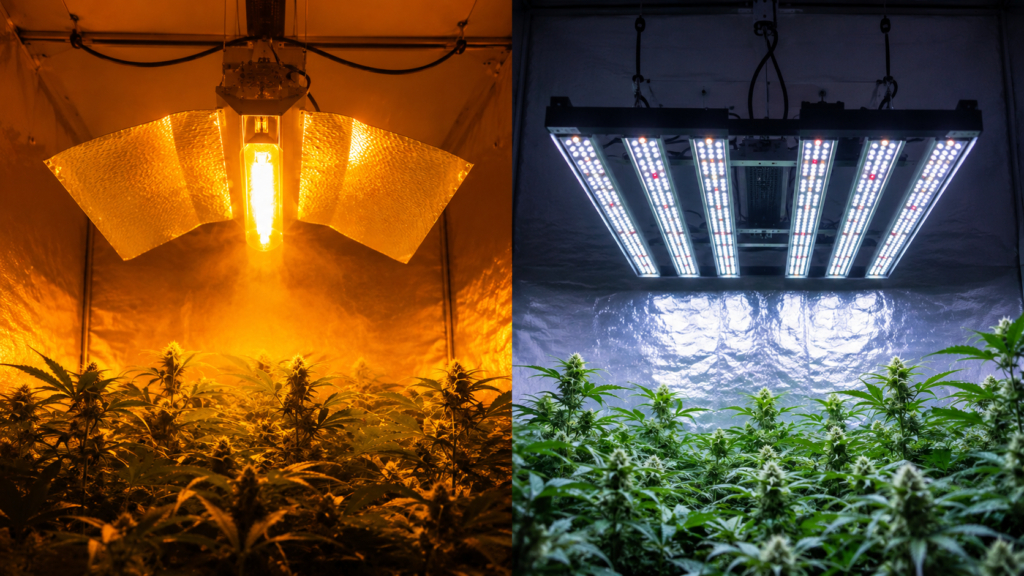
The LED column assumes a quality fixture with good µmol/J ratings — not a $40 bargain panel that claims 1,000W but draws 90W with half the diodes functioning. Cheap LEDs exist in a grey zone: they save electricity but don’t grow much, so you end up running more of them.
For a popular LED model like the Spider Farmer SF4000, which consumes 404 actual watts, running for 12 hours a day at the US average rate would cost roughly $18–$19 per month. An 800W HPS running the same hours for equivalent coverage costs approximately $37 per month—more than double.
What Else Is Running in Your Grow Room?
Grow light electricity cost is the biggest single factor—but it’s not the only thing on your bill. Grow lights typically account for 50–70% of total electricity in a grow room. HVAC (air conditioners and dehumidifiers) is usually the second-largest load at 20–35%. Fans, CO₂ equipment, and pumps make up the rest.
Typical Full Setup: 4×4 Tent
A typical 4×4 grow tent with a 400W LED, fans, and a dehumidifier uses roughly 10–14 kWh per day, or $35–$55 per month at $0.13/kWh. At today’s higher US average of $0.18/kWh, that same setup would run closer to $54–$76/month all-in.
Add a second light and a proper HVAC setup, and you can push past $150/month without blinking. That’s the number that surprises most growers who only budgeted for the light itself.
If you’re planning a larger space, the Grow Space Planner can help you estimate full equipment loads before you commit to a setup.
Keep Your Room Cool Without Blowing Your Budget
Every high-wattage light generates heat. Efficient ventilation reduces your cooling load and keeps your VPD in range — which matters more than most new growers realize.


How to Reduce Grow Light Electricity Cost Without Hurting Your Plants
You don’t have to spend less — you just have to spend smarter.
Use Actual Wattage, Not Equivalent Claims
Before anything else, find out what your light actually draws at the wall. Plug in a Kill A Watt meter (they cost around $20) and run your light at full power. You may be surprised — pleasantly or otherwise.
Match Light Schedule to Crop Needs
Seedlings and leafy greens often don’t need 20-hour cycles. Most herbs and lettuce do well at 14–16 hours. Flowering crops need 12 hours of darkness but don’t benefit from running lights longer than they need during veg either. Shaving two hours off an 18-hour schedule across a 600W light saves roughly $6–$8/month. Across a full growing year, that’s real money.
Run Lights During Off-Peak Hours
Some utilities charge less during overnight hours or off-peak windows. If your electricity provider offers time-of-use rates, scheduling lights to run from 10 PM to noon instead of noon to midnight can meaningfully cut your bill. Check your provider — this isn’t available everywhere, but where it is, it’s worth setting up.
Upgrade Efficiency Before Adding More Lights
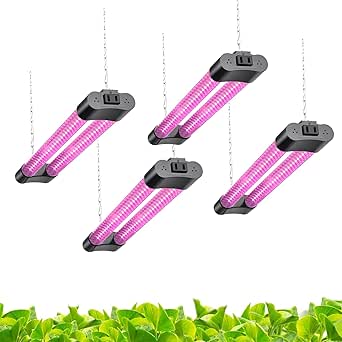
Compared to traditional HID systems, modern LED grow lights can reduce energy consumption by 40–60%, and also reduce cooling costs by 30–50%. If you’re still running HPS, the switch pays for itself. And if you’re running cheap, old LEDs, upgrading to a high-efficiency bar-style LED will likely reduce your wattage draw while increasing your actual PPFD — which means better yields per dollar spent on electricity.
Dim During Low-Demand Stages
Most quality LED fixtures support dimming. Seedlings and clones don’t need full intensity. Running your light at 60–70% during early veg not only saves electricity — it also reduces heat stress risk and often improves early root development. You’re not wasting light your plants can’t use yet.
Ready to Upgrade Your Grow Lights?
Efficient lighting is the single biggest lever you have on your electricity bill. Whether you’re replacing an HPS setup or adding coverage to a new space, choosing the right LED makes a measurable difference from day one.
Shop Smart: Browse our Grow Lights & Accessories page for curated LED options across different budgets and tent sizes.



Common Grow Light Electricity Cost Mistakes
Using manufacturer wattage instead of actual draw. Always check the real wall draw. The difference can be 50–60% on some budget lights.
Forgetting ancillary equipment. The dehumidifier that runs 8 hours overnight, the inline fan, and the water pump cycling every 15 minutes—it all adds up. Budget for your full room, not just the lights.
Not adjusting for light schedule by stage. Running 18-hour veg light schedules during a seedling stage that only needs 14–16 hours is pure waste.
Ignoring electricity rate variation. A grower in Louisiana and a grower in California running identical setups can pay nearly three times the difference per month. Know your rate.
Grow Light Electricity Cost: FAQ
How much does it cost to run a grow light per month?
Monthly cost depends on three factors: wattage, daily hours, and your electricity rate. A 600W LED running 12 hours a day at $0.12/kWh costs approximately $25.92 per month. At the current US average of $0.18/kWh, that same light on the same schedule costs closer to $38–$39/month. Adjust the formula for your actual numbers.
Do LED grow lights use a lot of electricity compared to HPS?
No — significantly less. Modern LED grow lights use 50–70% less power than HID lighting for equivalent growing results. The switch from HPS to quality LED typically cuts lighting electricity costs by 40–60% while also reducing cooling loads because LEDs produce far less heat.
What is the grow light electricity cost formula?
The formula is: (Watts ÷ 1,000) × Hours Per Day × Days × Electricity Rate ($/kWh) = Total Cost. For example, a 400W LED running 12 hours per day at $0.1283/kWh costs about $0.616 per day, or roughly $18.48 per month. At today’s higher average rates, that same setup costs closer to $26/month.
Will grow lights significantly raise my electricity bill?
It depends on your setup size. A substantial home growing setup consuming 500 watts for 16 hours daily adds roughly $29/month at $0.12/kWh—comparable to running a window air conditioner for 4–5 hours daily. Small to medium setups with efficient LEDs typically add $15–$50/month—noticeable, but manageable.
How does light efficiency rating (µmol/J) affect electricity cost?
Efficiency rating — measured in micromoles per joule (µmol/J) — tells you how much usable plant light you get per watt consumed. Premium LED systems achieve 2.7–3.0+ µmol/J, while budget alternatives may deliver only 1.5–2.0 µmol/J. A more efficient light delivers the same PPFD at the canopy using fewer watts, which directly reduces your electricity cost per unit of plant-usable light.
Grow Tents That Work With Your Lights
Good light containment and reflective walls mean more usable light from fewer watts. A properly sized tent makes your lighting dollars go further.


Grow light electricity costs don’t have to be a mystery or a nasty surprise. The formula is simple, the variables are within your control, and the biggest wins come from three things: knowing your actual wattage (not the marketing number), matching your light schedule tightly to your crop’s needs, and — if you haven’t already — switching to a quality LED if you’re still on HPS.
Run the numbers before you buy your next light. An efficient fixture that costs more upfront often pays for itself in electricity savings within the first growing season. And if you want to dig deeper into light coverage, intensity planning, and DLI targets for different crops, Grow With Hydroponics has you covered — from beginner guides to the tools that help experienced growers plan their setups with real precision.
Start with the numbers. The plants take care of the rest.
