

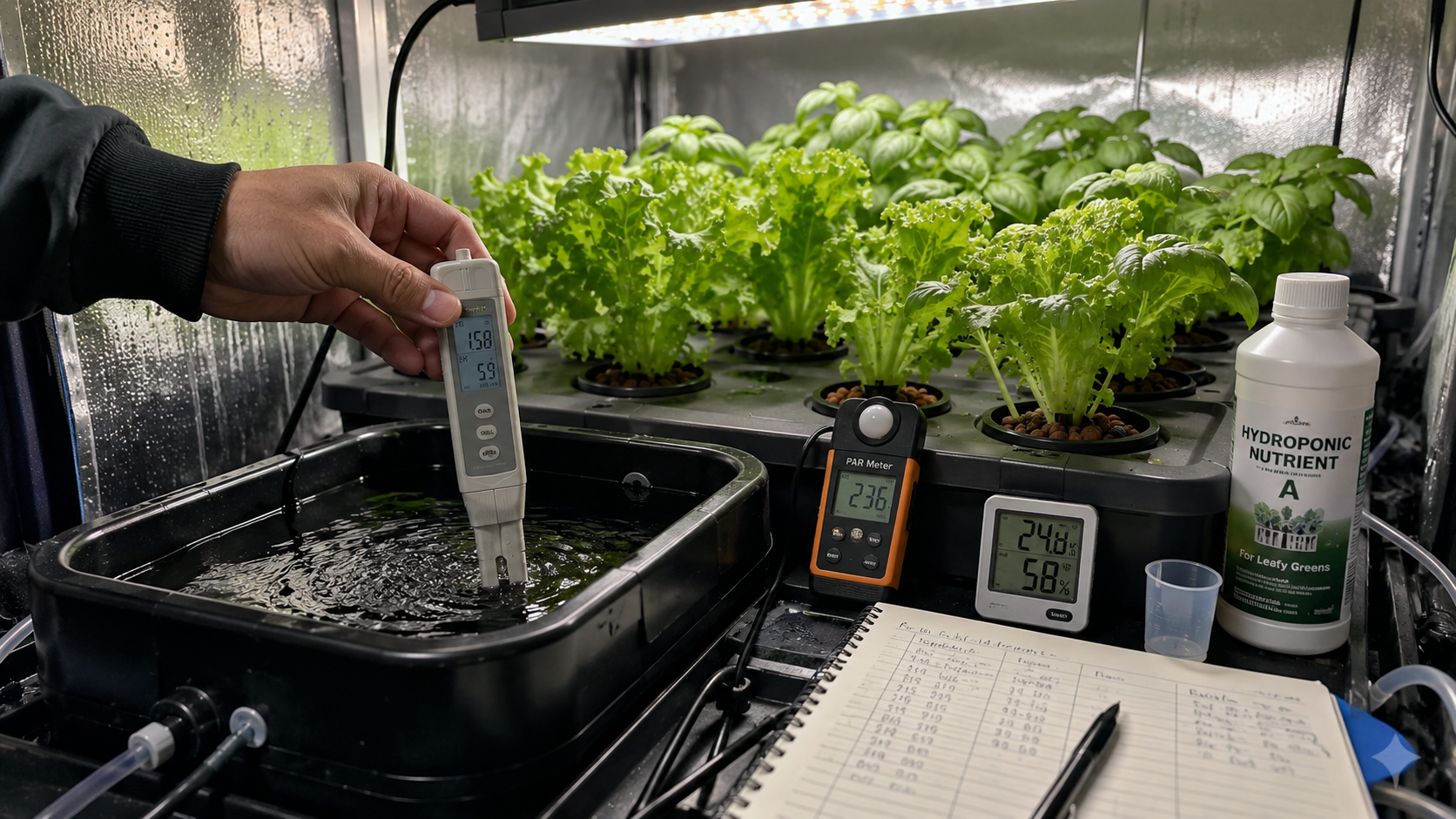
Every hydroponic grower hits this wall eventually: you’re reading a feeding chart or a grow light spec sheet, and it’s suddenly full of letters that mean nothing to you. EC, PPM, DLI, VPD, PPFD — read enough forum posts and you’ll start to feel like you need a chemistry degree just to water a lettuce plant. You don’t. Most of these terms describe one of four things: what’s in your water, how much light is hitting your plants, how thirsty your air is, or what kind of system you’re running.
This hydroponics glossary at Grow With Hydroponics breaks down the terms that actually matter, grouped by what they measure instead of dumped alphabetically, so you can find what you need fast. Where a term needs more than a quick definition — EC, VPD, DLI, and a few others — we link to the full breakdown already on the site.
Quick Answer: A hydroponics glossary is a reference for the acronyms and technical terms growers run into most often — EC (nutrient concentration), PPM (parts per million, a way of expressing EC), DLI (total daily light), VPD (how “thirsty” the air is), and PPFD (light intensity per second). Each has a specific unit, a typical target range, and a meter or sensor used to measure it.
Water & Nutrient Chemistry Terms
This is the vocabulary you’ll use almost daily — it’s what tells you whether your nutrient solution is strong enough, weak enough, or at the right acidity for your plants to actually absorb what’s in it.
pH is a measure of how acidic or alkaline your nutrient solution is, on a 0–14 scale, with 7 being neutral. Most hydroponic crops want a solution between roughly 5.5 and 6.5, because nutrients become chemically locked out of reach at the wrong pH even when they’re technically present in the water. You check it with a digital pH pen or pH test strips, and it drifts on its own over days as plants take up nutrients unevenly — so it needs regular monitoring, not a one-time check.
EC (Electrical Conductivity) measures how well your nutrient solution conducts electricity, which correlates directly with how many dissolved mineral salts are in it — read with an EC meter, in units of mS/cm or µS/cm. EC provides a general measure of total dissolved salts rather than identifying which specific nutrients are present, which is exactly why it’s the standard the industry has settled on for daily dosing decisions. Our EC guide covers target ranges by crop and growth stage in detail.
PPM (Parts Per Million) is a unit of concentration — one milligram of a dissolved substance per liter of water represents one part per million. In hydroponics, PPM is usually a converted reading from an EC meter rather than a direct measurement, and the conversion factor used (commonly 500, 640, or 700) changes what number your meter displays for the exact same solution. This is the single most common source of “why do our nutrient charts disagree” confusion between growers, and it’s genuinely too nuanced to compress here — our EC to PPM conversion guide walks through all three scales with a working example.
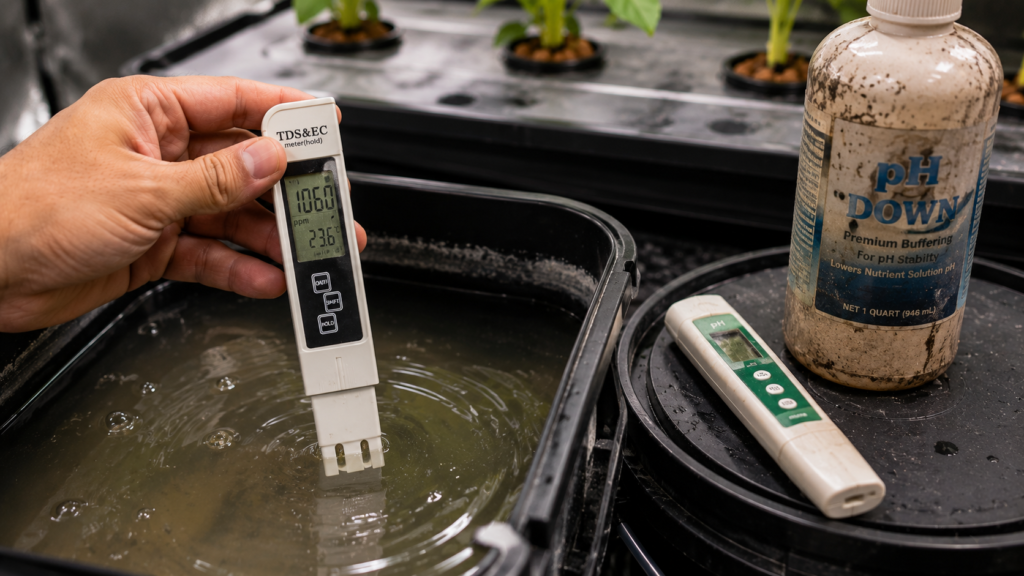
TDS (Total Dissolved Solids) is closely related to PPM — it’s the broader category of “everything dissolved in the water,” of which your nutrient salts are one part. A TDS meter doesn’t actually count particles directly; it estimates dissolved solids by measuring the water’s electrical conductivity, the same underlying mechanism as an EC meter, just displayed in a different unit.
Nutrient Lockout happens when a nutrient is physically present in the reservoir but chemically unavailable to the plant, almost always because pH has drifted outside the ideal range for that element. Beginners often mistake lockout for a deficiency and add more nutrient — which usually makes the underlying pH problem worse, not better.
Reverse Osmosis (RO) Water is tap or well water that’s been pushed through a semi-permeable membrane to strip out nearly all dissolved minerals, giving growers a clean, near-zero-PPM starting point before nutrients are added. It’s not mandatory for every setup, but it matters more in areas with hard tap water, where uncontrolled background minerals can throw off your EC readings before you’ve added a single drop of nutrient.
Light Measurement Terms
Light terminology is where most beginners get lost, mainly because there are four different measurements (PAR, PPF, PPFD, and DLI) that all describe light but answer completely different questions.
PAR (Photosynthetically Active Radiation) refers to the specific band of light wavelengths, roughly 400–700 nanometers, that plants can actually use for photosynthesis. It’s a range, not a single number — you can’t “measure PAR” the way you measure a temperature. Our PAR explainer covers the wavelength science in full.
PPFD (Photosynthetic Photon Flux Density) is the intensity number growers actually watch day to day: how much PAR light lands on a square meter of crop canopy each second, measured in µmol·m⁻²·s⁻¹ with a quantum PAR meter. It changes with light distance and dims toward the edges of a tent, which is why a single center reading can be misleading — see our PPFD guide for stage-by-stage targets.
DLI (Daily Light Integral) is PPFD’s cumulative cousin: it represents the total amount of photosynthetic light a plant gets over the course of a single day, expressed in mol·m⁻²·day⁻¹. Two grow rooms can show the exact same PPFD reading and still deliver very different DLI totals if their photoperiods differ — an 8-hour photoperiod and an 18-hour one at identical intensity are not remotely the same amount of light. Full crop-by-crop DLI targets are in our DLI guide.
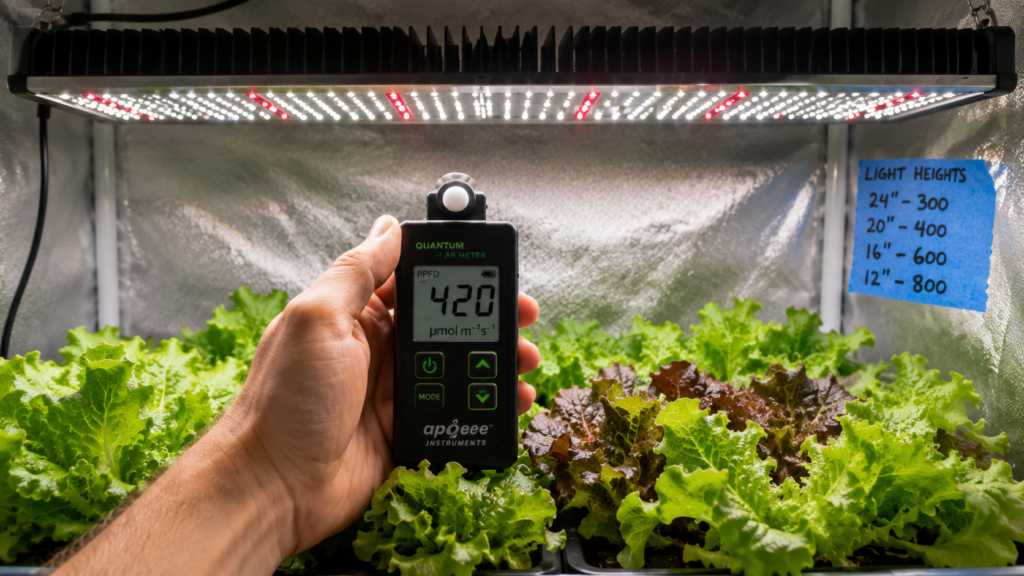
PPF (Photosynthetic Photon Flux) is a fixture spec, not a canopy measurement — it’s the total light output a grow light produces, measured in µmol/s, before distance or spread are factored in. Manufacturers use it to compare raw output between fixtures; it won’t tell you what’s actually reaching your plants, which is what PPFD is for.
Photoperiod is simply how many hours of light your plants receive per day, and it’s one of the two inputs (along with PPFD) needed to calculate DLI. What beginners commonly misunderstand is treating photoperiod as fixed by species — in reality it’s also a grower choice tied to photoperiod-sensitive flowering triggers in some crops, not just a light-hours setting.
Lux and Lumens, borrowed from human lighting design, measure brightness as the human eye perceives it — not how usable that light is for photosynthesis. A lux meter will happily give you a strong reading under a green-heavy light that plants barely use, which is exactly why growers moved away from lux toward PAR-based measurements like PPFD.
Air & Environment Terms
VPD (Vapor Pressure Deficit) measures the gap between how much moisture the air is currently holding and how much it could hold if fully saturated, expressed in kilopascals (kPa). VPD becomes a crop production issue mainly at extremes — too low and pathogen pressure rises along with reduced nutrient uptake, too high and water loss accelerates enough to slow photosynthesis in some crops. It’s read using a temperature and humidity sensor combined with a VPD chart or calculator, and it matters more than relative humidity alone because it accounts for temperature’s effect on the air’s actual drying power. Full growth-stage VPD targets live in our VPD guide and VPD chart.
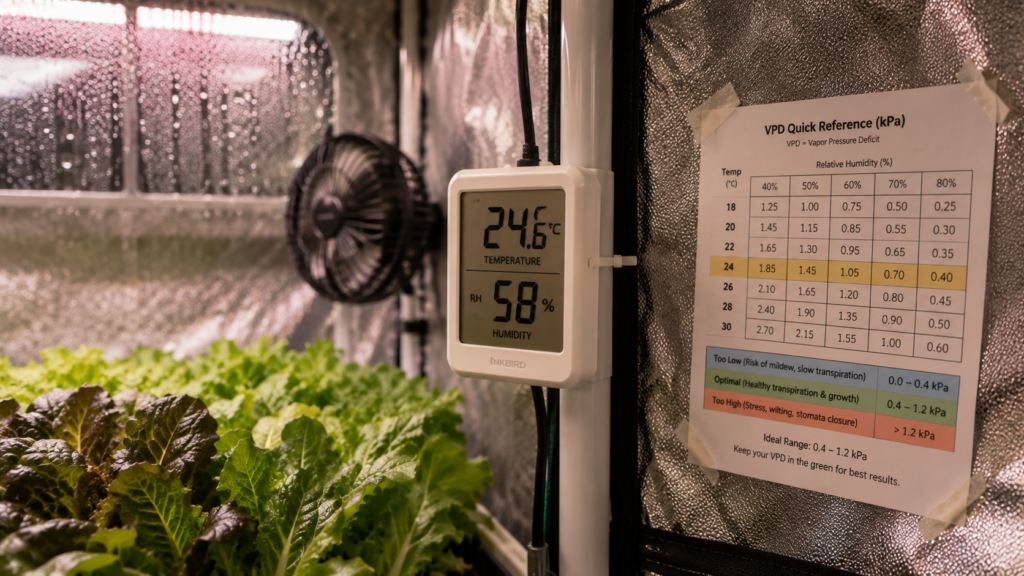
Relative Humidity (RH) is the percentage of moisture the air currently holds relative to its maximum capacity at that specific temperature. RH alone is misleading because the same percentage means something completely different at 65°F versus 85°F — which is exactly the gap VPD was designed to close.
CO2 (Carbon Dioxide) enrichment refers to deliberately raising CO2 concentration in a sealed grow space above the ambient outdoor level (roughly 420 ppm) to support faster photosynthesis under high light. This only helps when light and nutrients aren’t already the limiting factor — pumping CO2 into a dim, underfed grow room wastes gas and money. Our CO2 grow room guide covers safe target ranges and delivery methods.
Hydroponic System Terms
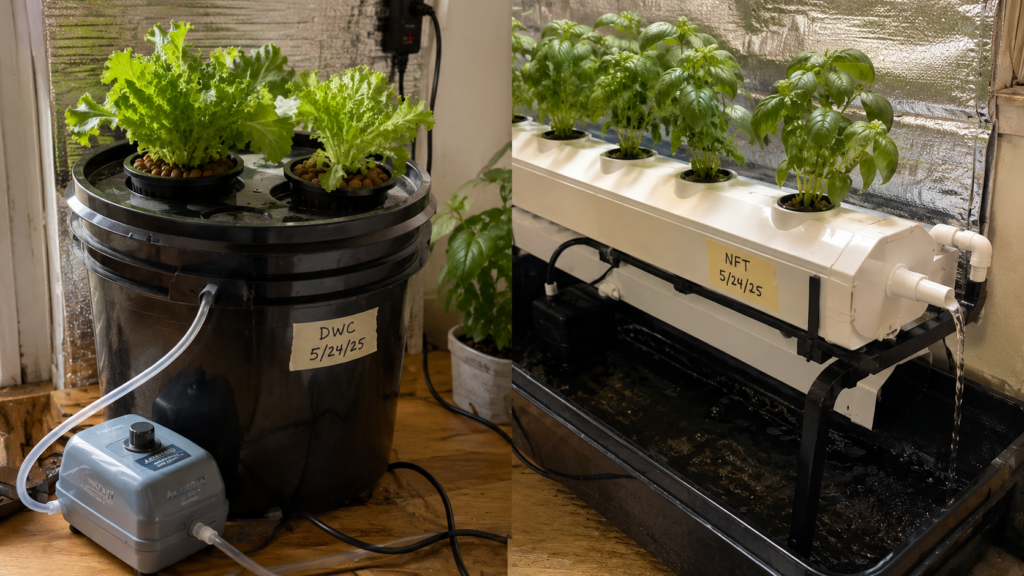
DWC (Deep Water Culture) suspends plant roots directly in an oxygenated nutrient reservoir, with an air pump and air stone providing dissolved oxygen. It’s one of the simplest systems to build and a common starting point for beginners growing lettuce or herbs.
NFT (Nutrient Film Technique) runs a thin, continuously flowing film of nutrient solution across the base of a sloped channel, with roots exposed to both the film and the air above it.
Ebb and Flow (Flood and Drain) periodically floods a tray of growing medium with nutrient solution on a timer, then drains it back to a reservoir — feeding and aerating the root zone in cycles rather than continuously.
Kratky Method is a passive, non-circulating system where plants start with roots partly submerged in a static nutrient reservoir; as the plant drinks the solution down, an air gap opens up that oxygenates the remaining roots without any pump at all.
Aeroponics suspends roots in an enclosed chamber and periodically mists them with nutrient solution rather than submerging them, which maximizes root oxygenation but leaves almost no margin for pump failure before roots dry out.
Growing Medium is the inert material — typically rockwool, clay pebbles, coco coir, or perlite — that anchors plant roots and, in some system types, helps regulate moisture around them, since hydroponics by definition skips soil entirely.


Comparison Table
| Term | What It Measures | Unit | Typical Instrument |
|---|---|---|---|
| pH | Acidity/alkalinity of solution | 0–14 scale | pH pen or strips |
| EC | Nutrient concentration | mS/cm, µS/cm | EC meter |
| PPM | Nutrient concentration (converted) | ppm | TDS/PPM meter |
| PPFD | Light intensity at canopy, per second | µmol·m⁻²·s⁻¹ | Quantum PAR meter |
| DLI | Total light delivered per day | mol·m⁻²·day⁻¹ | Calculated from PPFD × photoperiod |
| VPD | Air’s drying power | kPa | Temp/humidity sensor + calculator |
Decision Guide: Which Term Do You Actually Need Right Now?
Since most of the confusion around this vocabulary is situational rather than academic, here’s a quick troubleshooting path:
- Plants look stunted or discolored, and you suspect a feeding issue → check EC/PPM first, then pH, since a wrong pH can mimic a deficiency.
- Plants are stretching, pale, or leggy under lights → check PPFD and DLI, not just “is the light on.”
- Leaves are curling, crisping at the edges, or you’re seeing mold → check VPD, not just humidity percentage alone.
- You’re choosing a system for the first time → the vocabulary that matters is DWC, NFT, ebb and flow, or Kratky, based on how hands-on you want daily maintenance to be.
This decision path is the kind of quick troubleshooting reference most glossary pages skip entirely — most competitors stop at definitions and leave you to figure out which term applies to your actual symptom.
Common Mistakes with These Terms
Beginners commonly average or mix these terms up: raising EC to fix a deficiency that’s actually a pH lockout, judging light adequacy by how bright a grow space looks to the eye instead of checking PPFD, and managing humidity percentage instead of VPD. Experienced growers tend to check the more diagnostic metric first (pH before EC, VPD before humidity, PPFD before “does it look bright enough”) rather than reacting to symptoms alone.
Frequently Asked Questions
What’s the difference between EC and PPM? EC measures a solution’s electrical conductivity directly in mS/cm or µS/cm, while PPM is a converted number derived from that EC reading using one of several conversion scales (500, 640, or 700). The same solution can show different PPM numbers on different meters even though the EC — the actual measurement — hasn’t changed.
Is DLI more important than PPFD? Neither is “more important” — they answer different questions. PPFD tells you light intensity at a single moment, while DLI tells you the total light dose delivered across the whole day, which correlates more directly with plant growth and yield over time.
Why use VPD instead of just watching humidity? Relative humidity alone doesn’t account for temperature, so the same RH percentage can represent very different actual “drying power” in the air depending on how warm the room is. VPD combines both factors into one number that more accurately predicts transpiration stress.
Do I need to memorize all of these terms to grow hydroponically? No — most home growers lean heavily on just three day-to-day: pH, EC/PPM, and either PPFD or DLI for their lighting. The rest become useful once you’re troubleshooting a specific problem or upgrading equipment.
What’s the fastest way to check if my nutrient solution is in range? Test EC or PPM with a handheld meter directly in the reservoir, then confirm pH separately — the two require different instruments and drift independently of each other, so checking only one won’t catch every problem.
Glossaries like this one work best as a living reference, not a one-time read — bookmark it and come back whenever a new acronym shows up on a nutrient bottle or light spec sheet. If you’re just getting your feeding numbers dialed in, the EC to PPM Converter and DLI Calculator on Grow With Hydroponics turn most of these definitions into an actual number for your setup in a few seconds.
