

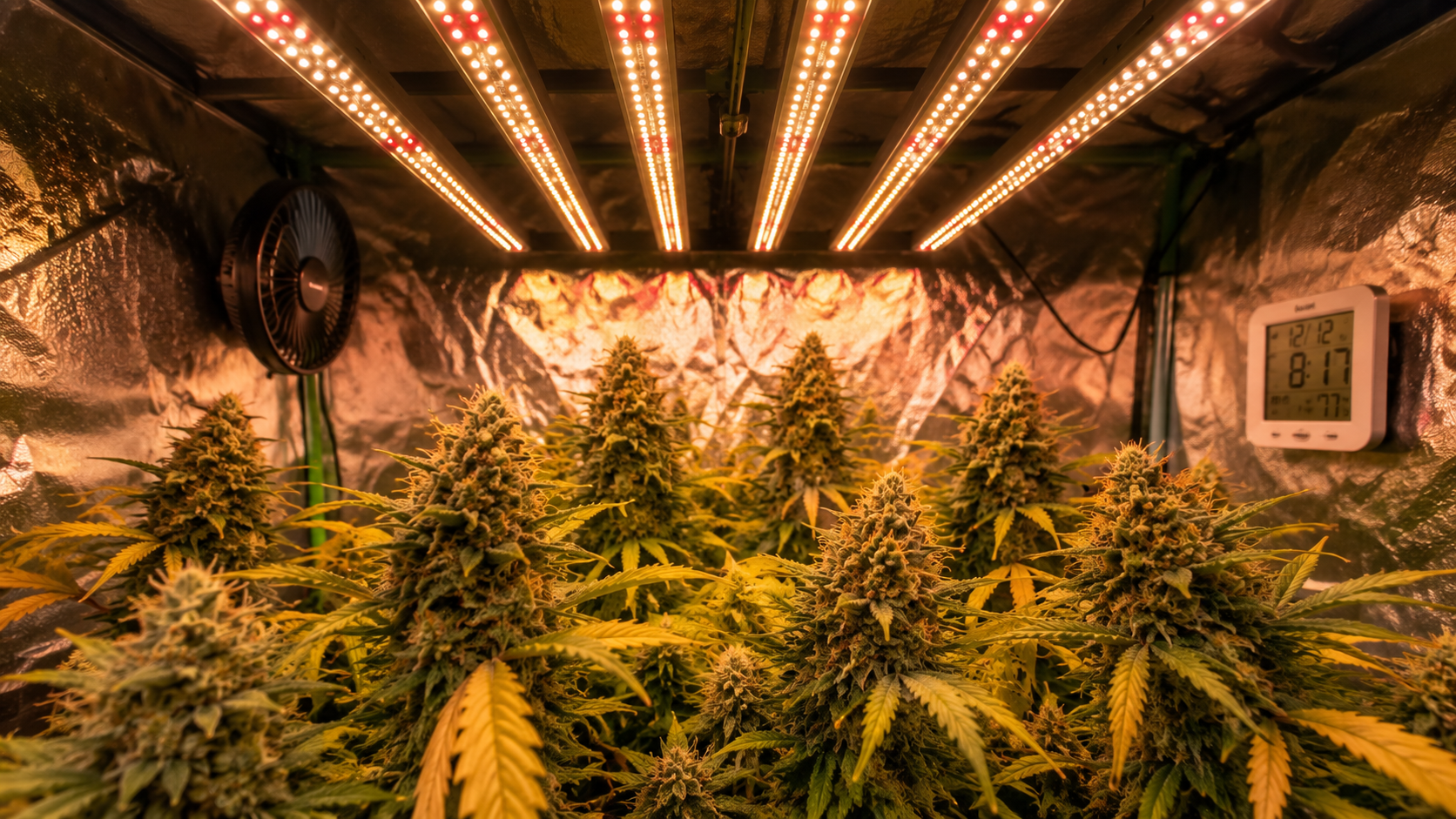
Switch your photoperiod plants to a 12/12 light schedule and something changes fast. The stretch starts. Pre-flowers appear. And suddenly everything that felt comfortable in veg — your light height, your intensity setting, your dimmer position — needs to be reconsidered. Flowering is the most light-hungry phase of a plant’s life, and if your grow light setup doesn’t match what the plant is trying to do, you won’t get the yield those stems are promising.
Getting flowering stage grow lights right isn’t about buying the most expensive fixture. It’s about understanding what your plants need in terms of intensity, spectrum, and daily light duration — and then delivering that consistently from flip to harvest. At Grow With Hydroponics, we’ve broken this down stage by stage so you can stop guessing and start dialling in a setup that actually produces.
Quick Answer: Flowering Stage Grow Lights at a Glance
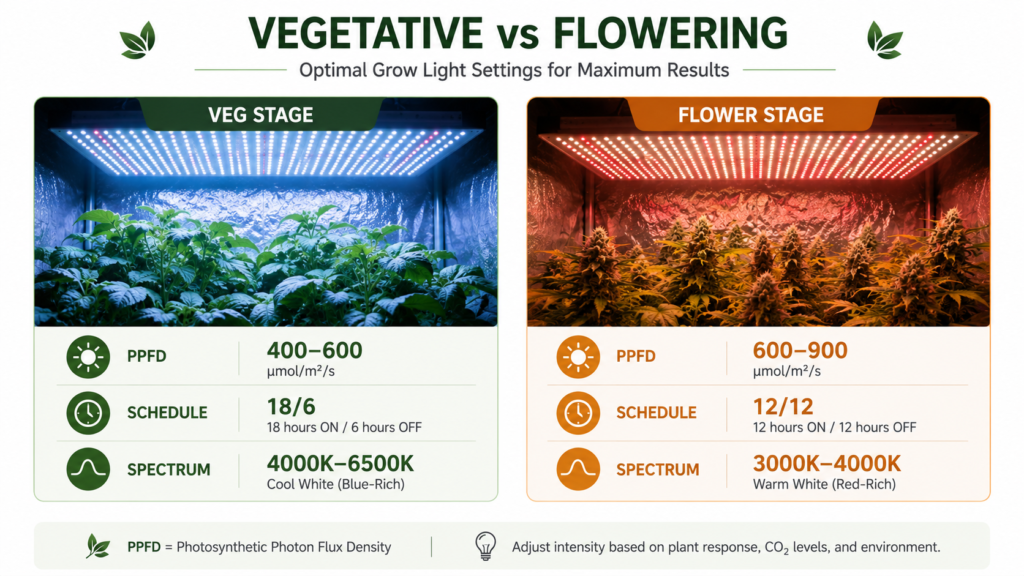
Flowering stage grow lights should deliver 600–900 µmol/m²/s PPFD at canopy level — the highest light intensity across the entire grow cycle. Run a red-dominant or full-spectrum LED (3000K–4000K) on a 12 hours on / 12 hours off schedule for photoperiod plants. Aim for a Daily Light Integral (DLI) of 30–45 mol/m²/day to support flower development and maximum yield.
If you want the full picture on how grow lights work across every stage — from spectrum science to fixture types — our Ultimate Guide to Grow Lights covers it all in one place.
What PPFD Do Flowering Stage Grow Lights Actually Need?
PPFD — Photosynthetic Photon Flux Density — measures how many photosynthetically active photons land on a square metre of canopy per second, expressed in µmol/m²/s. During flowering, plants are running at their highest metabolic demand, and the light intensity needs to match.
The target range for most flowering crops is 600–900 µmol/m²/s. High-light fruiting plants like tomatoes and peppers can push toward 1000 µmol/m²/s — especially with CO₂ supplementation. Go below 600 and you’ll see less bud development, longer internodal spacing on flower sites, and reduced overall yield. The plant will finish, but it won’t perform.
How Flowering PPFD Differs From Veg
During the vegetative stage, most plants are satisfied with 400–600 µmol/m²/s. Flowering asks for meaningfully more because flower production is physiologically expensive — pollen formation, ovary development, resin production, fruit set. All of that requires photosynthetic energy, and light is the source. Think of veg PPFD as building the frame; flowering PPFD as doing the actual construction work.
DLI for Flowering — Why It’s Not Just About Intensity
DLI, or Daily Light Integral, is the cumulative light dose a plant receives over a full day, measured in mol/m²/day. Under a 12/12 schedule, you have fewer hours to deliver photons than during veg. So to hit a target DLI of 30–45 mol/m²/day in just 12 hours, your PPFD needs to be higher than what you ran during the 18-hour veg cycle.
That’s the maths that catches growers out. Dropping to 12 hours of light and keeping the same dimmer setting you used for veg means your plants are getting roughly a third less total daily light. Gradually increasing PPFD as you transition into flower isn’t optional — it’s how you maintain momentum through the most critical growth phase. The Daily Light Integral guide here covers how to calculate your actual DLI from PPFD and photoperiod, which is worth doing before you flip.
What Spectrum Is Best for Flowering Stage Grow Lights?
Spectrum — the actual wavelengths of light your fixture produces — has a direct impact on how plants flower. And during the flowering stage, the right spectrum shifts meaningfully compared to veg.
Red Light (600–700 nm) Is the Primary Driver of Flower Development
Red light, particularly around 660 nm, is the most efficient wavelength for driving photosynthesis and the key spectral signal for flower development. It stimulates the phytochrome proteins that regulate flowering responses, promotes bud formation, and supports overall biomass accumulation during this phase. Plants in flower genuinely respond to a red-heavy spectrum — tighter bud sites, faster flower development, better dry weight at harvest.
Colour temperature tells the story here. For flowering, you want grow lights in the 3000K–4000K range — warm white LEDs that are naturally biased toward red and orange wavelengths. That’s the opposite of the 5000K–6500K blue-heavy light you want during veg.
Far-Red Light (700–750 nm) — The Advanced Variable
Far-red light, in the 700–750 nm range, sits just outside the traditional PAR window but plays a real role in flowering outcomes. The Emerson Effect, first documented by researcher Robert Emerson, describes how photosynthetic efficiency increases more than additively when plants receive both deep red (~660 nm) and far-red (~730 nm) simultaneously — because the two photosystems are being excited together rather than separately.
For growers running high-intensity setups above 800 µmol/m²/s, adding far-red can meaningfully improve light-use efficiency during flowering. A short far-red pulse of 15–30 minutes at the end of the photoperiod — sometimes called an End-of-Day (EOD) pulse — also helps accelerate phytochrome conversion, which some growers use to tighten up the plant’s flower timing signal. It’s not a feature beginners need to worry about on day one, but it’s a real lever worth understanding as you refine your setup.
Do You Still Need Blue Light During Flowering?
Yes, but less of it. Some blue light during flowering helps maintain stomatal function, chlorophyll production, and general plant health. Most quality full-spectrum LEDs running at 3000K–3500K still include around 10–20% blue photons in their output — that’s enough. What you don’t want is a blue-dominant spectrum during flower. It keeps the plant in a more vegetative state and can push internode elongation when you want tight, dense bud development instead.
What Light Schedule Should You Run for Flowering?
The standard flowering light schedule for photoperiod plants is 12 hours of light and 12 hours of uninterrupted darkness (12/12). The dark period is what triggers and maintains the flowering response in photoperiod-sensitive plants — any light leaks during that dark window can stress the plant, delay flowering, or cause re-vegging.
So yes — that means checking your tent seams. And your ventilation ports. And the small LED on your timer. One leak doesn’t ruin a crop, but persistent light interruptions during dark periods absolutely cause problems that growers often misattribute to nutrients or pH.
Does the Timing of the Dark Period Matter?
Broadly, no. Plants respond to the total length of unbroken darkness rather than the time of day it happens. Running lights-on during the night and lights-off during the day is a common strategy to reduce grow room temperatures during the hottest hours — and it works well. What matters is consistency and continuity of that 12-hour dark block, not when it starts.
Autoflowering Plants and the Light Schedule Question
Autoflowering varieties don’t depend on photoperiod to trigger flowering — they flower based on age, not day length. Most autoflower growers run 18/6 or 20/4 schedules throughout the entire life cycle to maximise total daily light. There’s no need to switch to 12/12 for autos, and doing so unnecessarily reduces the DLI they receive during their (often short) flowering window. If you’re running autos alongside photoperiod plants, a separate tent or space is the practical solution — their light requirements genuinely differ.
Common Mistakes With Flowering Stage Grow Lights
These are the errors that cost real yields — not theoretical ones.
- Not increasing PPFD when flipping from veg. Many growers flip to 12/12 and keep the light at the same dimmer setting. But you’ve just cut your photoperiod by a third. If you don’t increase intensity to compensate for the shorter day, your DLI drops significantly right at the moment the plant needs more, not less.
- Hanging the light too high to “play it safe.” Light falls off with distance. Doubling the distance from canopy to fixture roughly quarters the PPFD reaching the plant. I’ve seen growers with a perfectly capable LED producing under 400 µmol/m²/s at canopy because they were nervous about light burn — which is a real concern, but the answer is measurement, not excessive distance.
- Light leaks during the dark period. Even brief light exposure during the 12-hour dark window can slow or disrupt the flowering response in photoperiod plants. Check every potential source: tent zips, fan ports, the indicator light on your timer unit, and any ambient light around door frames if the tent is in a shared space.
- Ignoring canopy uniformity. A single reading of 800 µmol/m²/s in the centre of the tent means nothing if the edges sit at 300 µmol/m²/s. Yield across the canopy reflects that disparity — centre colas excel while outer branches underperform. Canopy training that keeps plant height even, combined with a light that has genuine edge-to-edge coverage, addresses this properly.
- Dropping light intensity too early in late flower. Some growers dim their lights in the final two weeks thinking the plant is “done.” Unless you’re running a specific late-finish protocol, maintaining intensity through harvest generally produces better-developed flowers and denser final weight.
Choosing the Best Grow Light for the Flowering Stage
| Light Type | Flowering PPFD | Red Spectrum Quality | Heat Output | Best Use Case |
|---|---|---|---|---|
| Full-Spectrum LED (3000K–3500K) | High | Excellent | Low–Medium | Home & professional flowering |
| LED Bar (LM301 + 660nm diodes) | Very High | Excellent | Low | Large flowering canopies |
| HPS (High-Pressure Sodium) | Very High | Good — orange/red bias | Very High | Legacy setups, large rooms |
| CMH / LEC 3100K | Medium–High | Very Good — broad spectrum | Medium | Small-medium flowering rooms |
| MH (Metal Halide) | High | Poor for flower (too blue) | Very High | Not recommended for flowering |
| CMH / LEC 4200K | Medium | Adequate but not optimal | Medium | Better suited to veg than flower |
Honestly, full-spectrum LED panels with high red content and good PPFD uniformity are the sensible choice for most growers in 2026. HPS still produces quality results, but the heat management requirements in a sealed or semi-sealed tent are a genuine headache — especially in warmer months. The running costs add up too.
If you’re sizing a flowering light for a specific space, the Grow Light Calculator maps estimated PPFD coverage across your canopy dimensions, which gives you a clearer picture than relying on manufacturer coverage claims alone.
Compare Flowering Stage Grow Lights
Getting the right flowering light means checking PPFD maps — not wattage equivalents. A quality 3000K–3500K full-spectrum LED with verified output data will consistently outperform a higher-wattage fixture with poor uniformity. Use the tool link above to check your space, then compare real options below.


Advanced Strategies for Maximising Yield with Flowering Stage Lighting
Canopy Management and Light Penetration
Light in a grow tent doesn’t penetrate the canopy the way sunlight penetrates an outdoor plant. In a dense flowering canopy, the lower bud sites receive a fraction of the PPFD hitting the top layer. Low-stress training (LST), SCROG (screen of green) setups, and strategic defoliation all help open the canopy so that more bud sites receive usable light intensity. A PPFD of 700 µmol/m²/s at the top means very little if the bud sites two nodes below are getting 150 µmol/m²/s through dense leaf cover.
CO₂ and Flowering Light Intensity
CO₂ supplementation is the most reliable way to justify pushing PPFD above the 600–900 µmol/m²/s standard range during flowering. At ambient CO₂ levels, most crops hit photosynthetic saturation somewhere around 800–1000 µmol/m²/s — pushing harder just produces heat stress and light burn without additional photosynthetic output. With CO₂ at 1000–1200 ppm, that saturation point shifts upward meaningfully. But CO₂ enrichment only pays off when temperature, humidity, and nutrient supply are all keeping pace — otherwise you’re just spending money on gas. Check out the full breakdown in the CO₂ grow room guide before investing in a supplementation system.
VPD During Flowering — Slightly Different Targets
Vapour pressure deficit during flowering should sit slightly higher than during veg — typically 1.0–1.5 kPa for most crops. Higher VPD encourages transpiration, which drives nutrient uptake and keeps the dense flower canopy from holding too much moisture near bud sites — a condition that invites mould in late flower. Higher light intensity increases leaf temperature and therefore increases transpiration demand, so your VPD target and your lighting decisions are genuinely linked.
Feed Your Flowering Plants Right
Higher PPFD during flowering means higher nutrient demand — especially for phosphorus and potassium during peak flower development. A bloom-focused nutrient formula matched to your light intensity prevents deficiencies from limiting the yield your lights are working hard to produce.



Flowering Stage Grow Lights vs. Vegetative Stage — Side-by-Side
| Parameter | Vegetative Stage | Flowering Stage |
|---|---|---|
| PPFD Target | 400–600 µmol/m²/s | 600–900 µmol/m²/s |
| Light Schedule | 18/6 | 12/12 (photoperiod) |
| DLI Target | 20–35 mol/m²/day | 30–45 mol/m²/day |
| Ideal Spectrum | Blue-dominant (4000K–6500K) | Red-dominant (3000K–4000K) |
| Light Hang Height | 18–24 inches | 12–18 inches |
| Dark Period Sensitivity | Low | High (light leaks matter) |
Frequently Asked Questions: Flowering Stage Grow Lights
What PPFD do I need for the flowering stage?
Most flowering crops need 600–900 µmol/m²/s PPFD at canopy level. High-light fruiting crops like tomatoes and cannabis can push toward 1000 µmol/m²/s with CO₂ supplementation. Stay below 600 µmol/m²/s and flower development slows noticeably — smaller bud sites, reduced density, lower final yield.
Why does spectrum change for flowering stage grow lights?
Red light in the 600–700 nm range drives both photosynthesis and the phytochrome responses that trigger and maintain flowering. A red-dominant spectrum (3000K–4000K) signals to the plant that it’s in autumn-like conditions — which is precisely the cue flowering crops need. Blue-dominant light works against this, encouraging more vegetative-style growth when you want flower development instead.
Can light leaks during the dark period ruin a flowering crop?
Even brief, low-intensity light exposure during the 12-hour dark window can interrupt the flowering signal in photoperiod plants. Repeated light leaks slow flowering, reduce bud density, and can cause partial re-vegging. Check your tent for light leaks before the flip — not after problems appear.
What is the best light schedule for autoflowering plants during flowering?
Autoflowering varieties don’t need a 12/12 schedule to trigger flowering. Most auto growers maintain an 18/6 or 20/4 schedule throughout the entire life cycle — including flowering — to maximise total daily light and DLI during the short flowering window.
How far should a grow light hang during the flowering stage?
For most full-spectrum LEDs, the target hang height during flowering is 12–18 inches (30–45 cm) above the canopy. This delivers higher PPFD than the veg height while staying within safe range for most fixtures. Always check manufacturer PPFD maps and adjust based on what the canopy tells you — bleached or taco-curling leaves at the tops mean the light is too close.
Getting Your Flowering Light Setup Right
Flowering is where the investment you’ve made in genetics, nutrients, and system design either pays off or doesn’t. And more often than not, it’s the light that decides. Get the PPFD in the right range, shift toward a warm red-dominant spectrum, protect the dark period like it matters — because it does — and keep canopy height consistent so every bud site gets a fair share of the photons your fixture is producing.
The parameters aren’t complicated. Hitting them consistently is where most home growers find the real challenge, and that’s where measuring rather than assuming makes the biggest difference. Grow With Hydroponics has the tools to help — from PPFD calculators to full guides on every variable covered here. Use them before you flip, not after you’ve already lost two weeks of flower development to a setup you could have dialled in earlier.
