

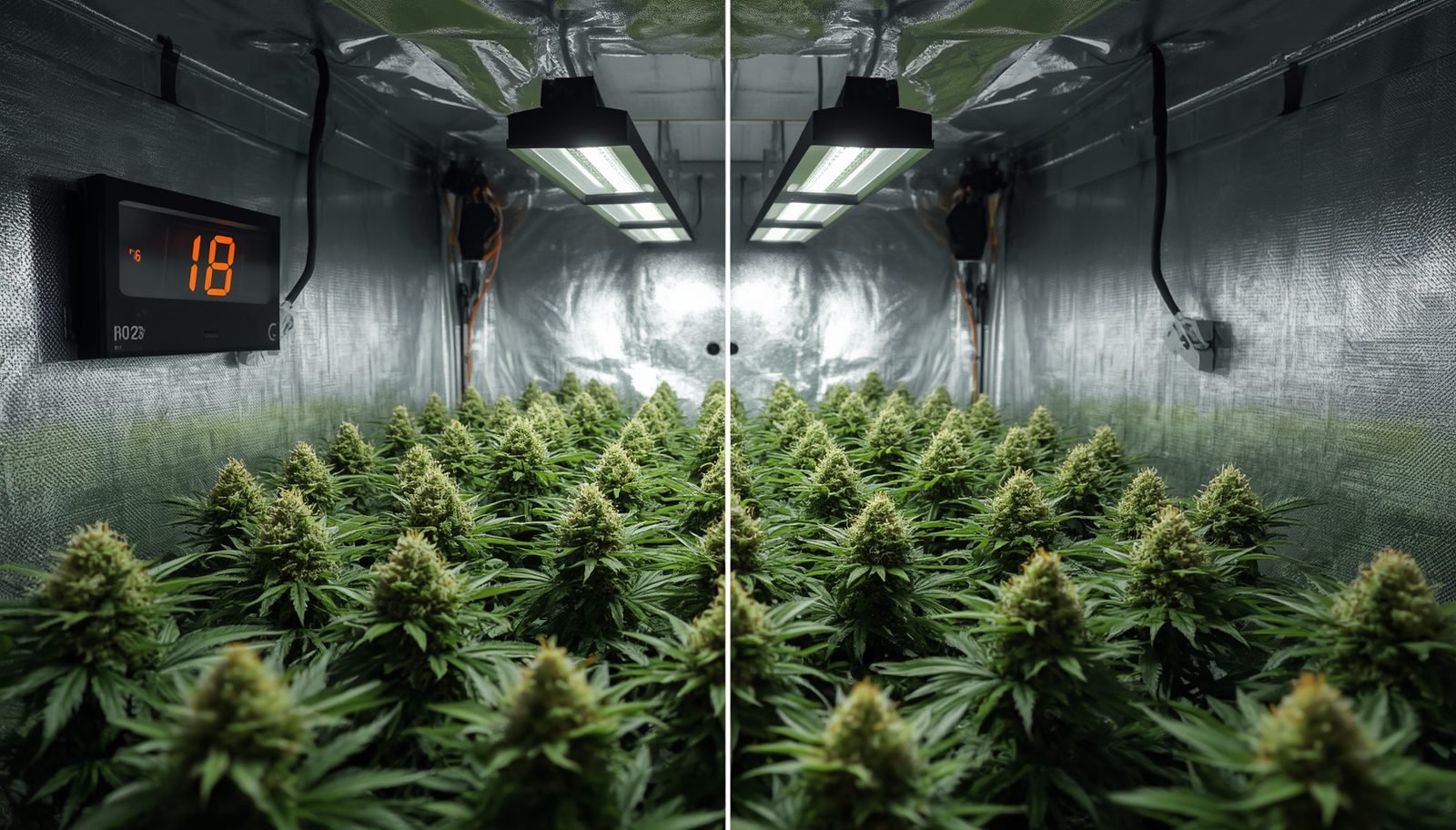
Pick up any grow light timer, and the instructions say something like “set your hours and go.” Simple enough. But what hours? And why those hours? And what happens if you run the wrong schedule for three weeks without realising it?
A grow light schedule isn’t just an on/off timer setting—it’s the primary signal your plants use to understand what season they’re in, what life stage to be in, and whether to focus energy on growing leaves or producing fruit and flowers. Get the schedule right and your plants do exactly what you want them to do. Run the wrong one, and you can end up with vegetables that refuse to fruit, herbs that bolt to seed too early, or fruiting crops that won’t push past vegetative growth no matter how healthy everything else looks.
At Grow With Hydroponics, photoperiod questions are among the most common we hear—and the confusion almost always traces back to the same gap: growers understand that 18/6 and 12/12 exist, but they’re not sure which applies to their crops or what the numbers actually mean for plant behaviour. This guide closes that gap completely.
Quick Answer — 18/6 vs 12/12: Which Grow Light Schedule Should You Use?
Use an 18/6 schedule (18 hours light, 6 hours dark) for vegetative growth — it suits most leafy greens, herbs, seedlings, and fruiting crops in their pre-flower stage. Use 12/12 (12 hours light, 12 hours dark) to trigger flowering in photoperiod-sensitive plants like some fruiting crops and certain flowers. Day-neutral crops such as lettuce and basil don’t require 12/12 to flower and do well on 14–18 hours throughout their cycle. The right schedule depends on your crop type, growth stage, and target DLI — not a universal rule.
What Is a Grow Light Schedule — and Why Does It Matter?
A grow light schedule is the daily pattern of light-on and light-off periods your plants experience. It’s typically written as a ratio: 18/6 means 18 hours of light followed by 6 hours of darkness. 12/12 means equal time in each.
Plants use light duration — known as photoperiod — as a seasonal cue. In the natural world, longer days signal summer growth; shorter days signal that autumn is coming and it’s time to flower, set seed, and reproduce. Indoor growers control this cue completely, which is one of the most powerful things about growing under artificial light. You decide what season your plants are in.
The Three Photoperiod Plant Types
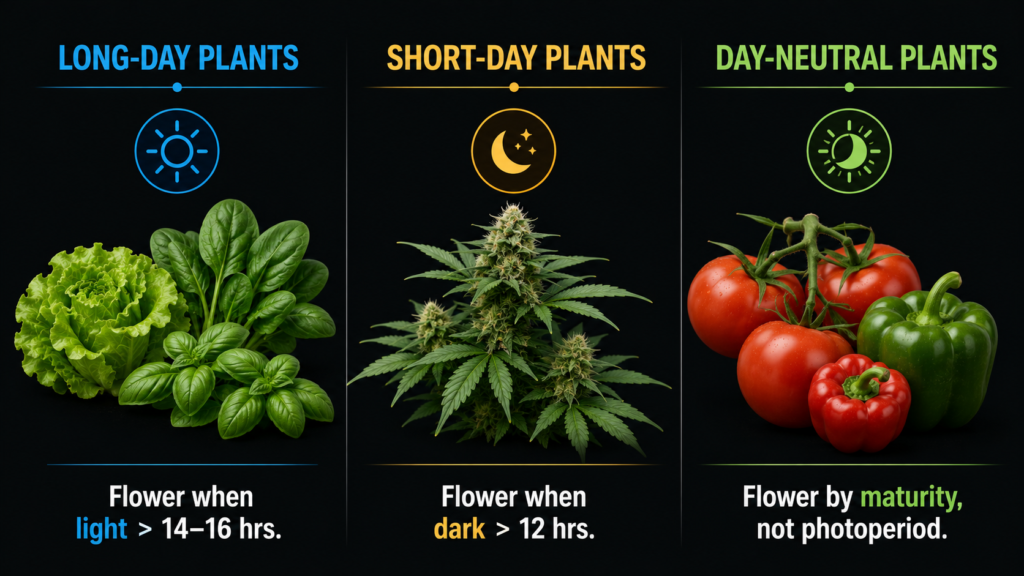
Not all plants respond to photoperiod the same way. This is the most important piece of context for choosing a grow light schedule:
- Long-day plants flower when light periods exceed a threshold—typically above 14–16 hours. Lettuce, spinach, and many herbs are long-day plants. They actually bolt to seed faster under very long photoperiods.
- Short-day plants flower when the dark period is long enough—typically 12 or more consecutive hours of darkness. Many cannabis strains and some flowers fall into this category.
- Day-neutral plants flower based on age and maturity, not photoperiod. Tomatoes, cucumbers, peppers, and most fruiting vegetables grown in hydroponics are day-neutral. They don’t need 12/12 to flower — they’ll flower when they’re ready, regardless of light hours.
This distinction is critical. Running 12/12 on a day-neutral tomato doesn’t trigger flowering any faster. It just reduces the DLI your plant receives, which slows everything down.
When Should You Use an 18/6 Grow Light Schedule?
Use an 18/6 as your default grow light schedule for most vegetative growth, seedlings, and day-neutral crops throughout their entire life cycle.
The 18/6 light cycle during the vegetative stage is the standard indoor schedule — it mimics long summer days, giving plants ample energy to develop healthy leaves, branches, and root systems.
Why 18/6 Works So Well for Veg
At 18 hours of light, most plants have enough daily photon exposure to sustain strong vegetative growth. The six-hour dark period isn’t wasted time. Roots grow and develop most actively during darkness. Plants also use the dark period to transport sugars produced during photosynthesis, complete basic metabolic processes, and prepare cellular structure for the next light period.
Running 24 hours of continuous light doesn’t consistently outperform 18/6. Cannabis is a C3 plant that can absorb carbon dioxide during the day and doesn’t technically require a dark cycle to complete photosynthesis—but the benefits of 24/0 lighting over 18/6 are minor and may not be worth the additional electricity costs. For most crops, including all common hydroponic vegetables, the energy savings from 18/6 versus 24/0 are significant while growth results remain comparable or better.
Crops That Thrive on 18/6
- Leafy greens in vegetative growth (lettuce, spinach, kale, chard)
- Most herbs during active leaf production (basil, cilantro, mint, parsley)
- Fruiting crops during vegetative development (tomatoes, peppers, cucumbers before flowering)
- Seedlings and transplants in the early establishment phase
- Autoflowering plants throughout their entire life cycle
Explore detailed PPFD for Plants: The Complete Hydroponics Lighting Guide.
When Should You Use a 12/12 Grow Light Schedule?
Use 12/12 specifically to trigger flowering in photoperiod-sensitive plants—particularly photoperiod cannabis strains and certain short-day flowering crops. It’s not a universal flowering trigger for all plants.
When ready to initiate flowering in photoperiod plants, adjusting the light cycle from 18/6 to 12/12 signals the plant that shorter days have arrived—triggering the transition from vegetative to reproductive growth.
What 12/12 Actually Does Physiologically
The mechanism behind 12/12 is the dark period, not the light period. Photoperiod-sensitive plants detect the length of uninterrupted darkness using a photoreceptor protein called phytochrome. When darkness exceeds a critical threshold—typically around 12 consecutive hours—phytochrome triggers a hormonal cascade that initiates flowering.
This is why light leaks during the dark period matter so much for photoperiod crops. Even a brief flash of light during the 12-hour dark window can interrupt the phytochrome response and delay or prevent flowering. A grow tent that’s truly light-sealed is non-negotiable when running 12/12 for photoperiod-sensitive plants.
Who Actually Needs 12/12?
Honestly, for most hydroponic home growers — those running lettuce, herbs, tomatoes, peppers, cucumbers, or strawberries — 12/12 is rarely the right schedule. For fruiting day-neutral crops like tomatoes and peppers, 14–16 hours of light is a solid starting point; reducing photoperiod slightly can encourage flowering while keeping enough DLI for fruit set.
The main use case for 12/12 in hydroponics is:
- Photoperiod cannabis (switching from veg to flower)
- Certain flower varieties that are genuinely short-day sensitive
- Strawberries, where some cultivars need shorter days to initiate flowering
Grow Light Schedule by Crop Type: The Practical Reference
Understanding your crop’s photoperiod category is the foundation of successful indoor hydroponics—long-day plants, short-day plants, and day-neutral crops all have different light schedule requirements.
| Crop | Recommended Schedule | Notes |
|---|---|---|
| Lettuce / Spinach | 14–18 hrs (e.g. 16/8) | Long-day plant; longer photoperiod boosts yield without triggering bolt |
| Basil / Herbs | 14–16 hrs (e.g. 16/8) | Blue-heavy spectrum + 16 hrs keeps growth compact and leafy |
| Tomatoes | 14–16 hrs vegetative; 14/10 flower | Day-neutral; doesn’t need 12/12 to flower |
| Peppers / Chili | 14–16 hrs throughout | Day-neutral; longer photoperiod improves yield |
| Cucumbers | 16–18 hrs vegetative; 14/10 fruiting | High DLI needed; don’t drop below 14 hrs |
| Strawberries | 16/8 veg; 12/12 to trigger flowering | Photoperiod-sensitive; cultivar-dependent |
| Microgreens | 12–16 hrs | Lower DLI acceptable; 14/10 works well |
| Photoperiod cannabis | 18/6 veg → 12/12 flower | Classic flip; dark period must be uninterrupted |
| Autoflowering cannabis | 18–20 hrs throughout | Flowers by age, not photoperiod |
| Seedlings (all crops) | 14–16 hrs | Consistent schedule; dark period aids root development |
How Grow Light Schedule Connects to DLI
Choosing a schedule isn’t just about hours—it’s about the Daily Light Integral (DLI) your plants accumulate across the day.
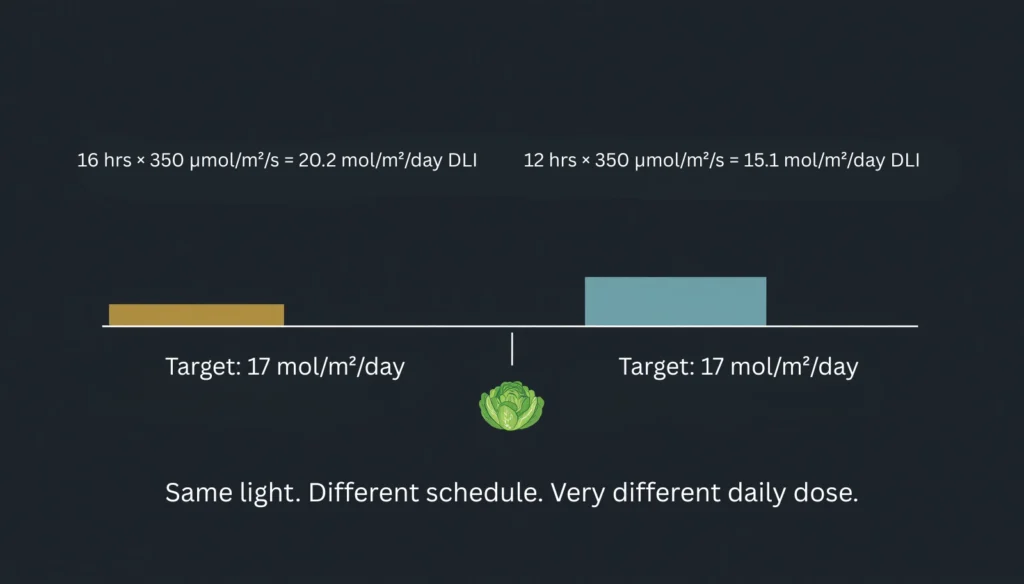
DLI, or Daily Light Integral, is the total number of plant-usable photons received over a 24-hour period, measured in mol/m²/day. It combines your PPFD (light intensity at the canopy) with your photoperiod length. Change either variable and you change your DLI.
Why This Matters for Schedule Decisions
Here’s the practical implication: you can hit the same DLI target with different combinations of intensity and hours. Research on lettuce found that at a DLI of 15.6 mol/m²/day, plants grown under a 24-hour photoperiod had 11–27% greater fresh and dry mass than those grown under 16- or 20-hour photoperiods—suggesting that extending photoperiod with lower PPFD can actually outperform higher intensity over shorter periods at equivalent DLI.
This means that if your fixture doesn’t quite deliver the intensity you need, extending your photoperiod — rather than buying a new light — can sometimes close the DLI gap effectively.
To calculate DLI:
DLI = PPFD (µmol/m²/s) × photoperiod (hours) × 3,600 ÷ 1,000,000
Example: 350 µmol/m²/s × 16 hours × 3,600 ÷ 1,000,000 = 20.2 mol/m²/day
The DLI Calculator handles this calculation instantly—input your PPFD and photoperiod, and it returns your daily dose alongside whether you’re hitting the target for your crop.
DLI Targets by Crop Type
| Crop | Target DLI (mol/m²/day) | Typical Schedule to Hit It |
|---|---|---|
| Lettuce / Spinach | 12–17 | 300–400 µmol at 14–16 hrs |
| Basil / Herbs | 14–20 | 300–400 µmol at 16 hrs |
| Tomatoes (veg) | 18–25 | 400–500 µmol at 14–16 hrs |
| Tomatoes (fruiting) | 25–35 | 500–700 µmol at 14–16 hrs |
| Peppers | 18–28 | 400–600 µmol at 14–16 hrs |
| Microgreens | 8–14 | 200–300 µmol at 12–14 hrs |
| Cannabis (veg) | 20–30 | 500–700 µmol at 18 hrs |
| Cannabis (flower) | 30–45 | 700–900 µmol at 12 hrs |
Common Grow Light Schedule Mistakes
Running 12/12 on Day-Neutral Crops
This happens more than it should. Growers read that 12/12 triggers flowering, assume it applies to their tomatoes, and cut their photoperiod in half. The result is a dramatically lower DLI — tomatoes that were getting 25 mol/m²/day on 16 hours suddenly drop to around 18 mol/m²/day on 12 hours at the same intensity. Growth slows. Fruit set suffers. The schedule change didn’t help; it hurt.
Tomatoes, peppers, and cucumbers don’t need 12/12 to flower. They flower when they’re mature. Keep them on 14–16 hours throughout.
Inconsistent Timing
Plants respond to photoperiod rhythms that stay the same every day. Changing the timer schedule mid-grow, running the lights manually, or allowing seasonal changes to disrupt a consistent cycle all introduce stress that manifests as uneven growth and, in photoperiod-sensitive plants, partial or delayed flowering responses. Set a timer. Leave it alone.
Ignoring the Dark Period for Photoperiod Crops
Cannabis plants start flowering when given long, uninterrupted nights — 12 hours of uninterrupted darkness every day. Any light leak during that dark window—a phone screen, a gap in the tent zipper, or an indicator LED on a power strip—can interrupt the phytochrome response. For photoperiod crops on 12/12, seal every light source out of the grow space during the dark period.
Conflating Schedule With Intensity
A 16-hour schedule with weak intensity delivers low DLI. An 18-hour schedule with good intensity delivers high DLI. Hours matter, but they only tell part of the story. Light burn can still happen at longer schedules if intensity is too high—photoperiod and PPFD work together, not independently.
Shop Smart: Timers and Grow Lights for Schedule Control
The most reliable grow light schedule starts with a programmable digital timer—not a mechanical dial timer. Digital timers hold their setting through power cuts, allow exact minute-level precision, and don’t drift over time the way mechanical units can.
For the fixture itself, a dimmable full-spectrum LED lets you adjust both intensity and schedule independently—giving you two levers to dial in DLI precisely without replacing equipment.
→ Browse grow lights and accessories for hydroponics


How to Switch From 18/6 to 12/12: Step-by-Step
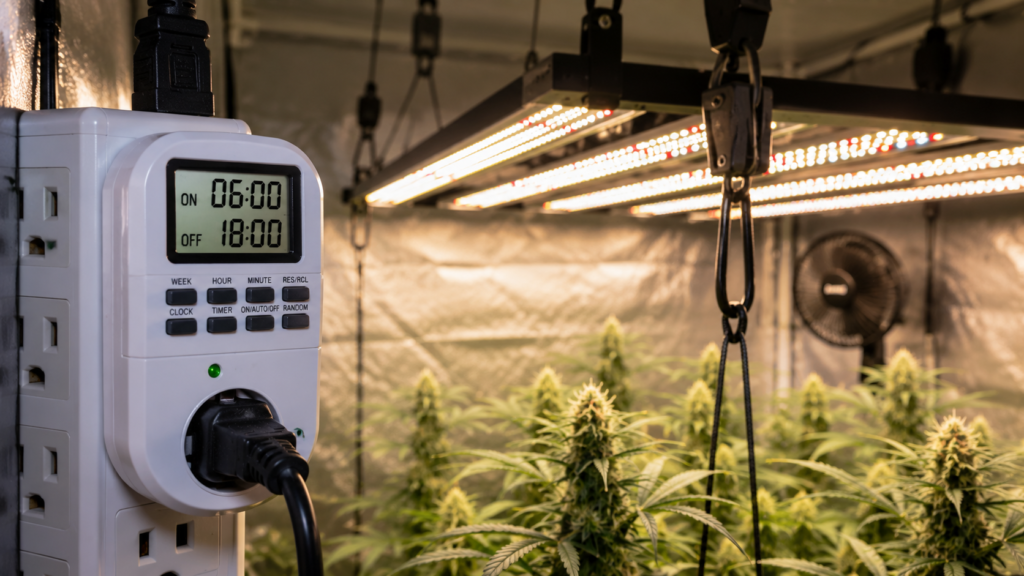
For photoperiod-sensitive plants that need the flip—primarily photoperiod cannabis—here’s how to transition cleanly:
- Confirm the plant is ready. Most photoperiod plants benefit from 4–8 weeks of vegetative growth before the flip. Switching too early reduces final yield potential.
- Change the timer at the start of a dark cycle, not mid-light period. Beginning the extended dark period first is cleaner for the plant’s phytochrome response.
- Seal all light leaks in the grow tent before the first 12-hour dark period. Check zipper gaps, exhaust port edges, and any cables entering through the tent wall.
- Adjust nutrient ratios alongside the schedule change. Flowering stage plants have different nitrogen-to-phosphorus needs than vegetative stage plants—the schedule flip is the cue to adjust feeding too.
- Monitor for pre-flowers within 1–2 weeks. If you’re not seeing signs of flowering within two weeks of flipping to 12/12, double-check for light leaks before concluding there’s a plant issue.
FAQ: Grow Light Schedule — Common Questions Answered
Can I run 18/6 for the entire grow with tomatoes?
Yes — and for most hydroponic tomatoes, 16/8 or 14/10 is actually better than 18/6 for the fruiting stage. Tomatoes are day-neutral plants and don’t need a reduced photoperiod to flower. Running 14–16 hours throughout the grow, adjusting intensity as plants mature, is the most effective approach for maximising DLI at both the vegetative and fruiting stages.
What happens if I accidentally run 12/12 during vegetative growth?
For day-neutral crops, very little happens directly — they won’t suddenly flower just because the photoperiod dropped. But their DLI will drop significantly, slowing growth. For photoperiod-sensitive crops like cannabis, prolonged exposure to 12/12 during the intended veg will begin to trigger flowering earlier than planned. If caught early (within a few days), returning to 18/6 can interrupt the process — but the longer the 12/12 runs, the more committed the plant becomes to flowering.
Does the time of day I run my grow lights matter?
Mostly for practical reasons rather than plant biology. Running lights during cooler nighttime hours helps keep grow space temperatures lower during the “off” period, which is useful in warm climates. Consistency is what matters most — plants adapt to whatever consistent schedule you set, whether it starts at 6am or 10pm.
Is 20/4 better than 18/6 for vegetative growth?
Some growers opt for 20/4, but it’s not a magic booster—if your microclimate is off, extra hours won’t fix it. The marginal gain in DLI from two additional light hours is real but modest, and the increased electricity cost and heat output need to be factored in. For most home growers, 18/6 is the better practical choice for vegetative growth.
Can I mix crops with different schedules in the same grow space?
Not easily. A 16/8 lettuce cycle and a 12/12 strawberry cycle cannot run in the same room under the same lights—the solution is to divide your grow space into two zones with separate timers and lights, or pick compatible crops. Trying to run photoperiod-sensitive and day-neutral crops on the same timer will compromise one or the other.
Get the Schedule Right First
A grow light schedule is one of those things that are easy to set once and never revisit. That’s where growers lose time — running a generic 12/12 on crops that don’t need it, or running 18/6 on photoperiod plants they need to flower. Understanding what the numbers mean and what each crop actually requires is the difference between a schedule that works and one that just runs.
The fundamentals are straightforward: 18/6 for vegetative growth and most day-neutral crops, 12/12 for photoperiod-sensitive plants that need to flower, and always connect your schedule decision to DLI so you know your plants are getting the total daily light dose they need.
Grow With Hydroponics has free tools—including the DLI Calculator—to help you verify whether your schedule and intensity are hitting the right daily light dose before problems show up rather than after. Start there, set your timer, and let the plants tell you the rest.
