

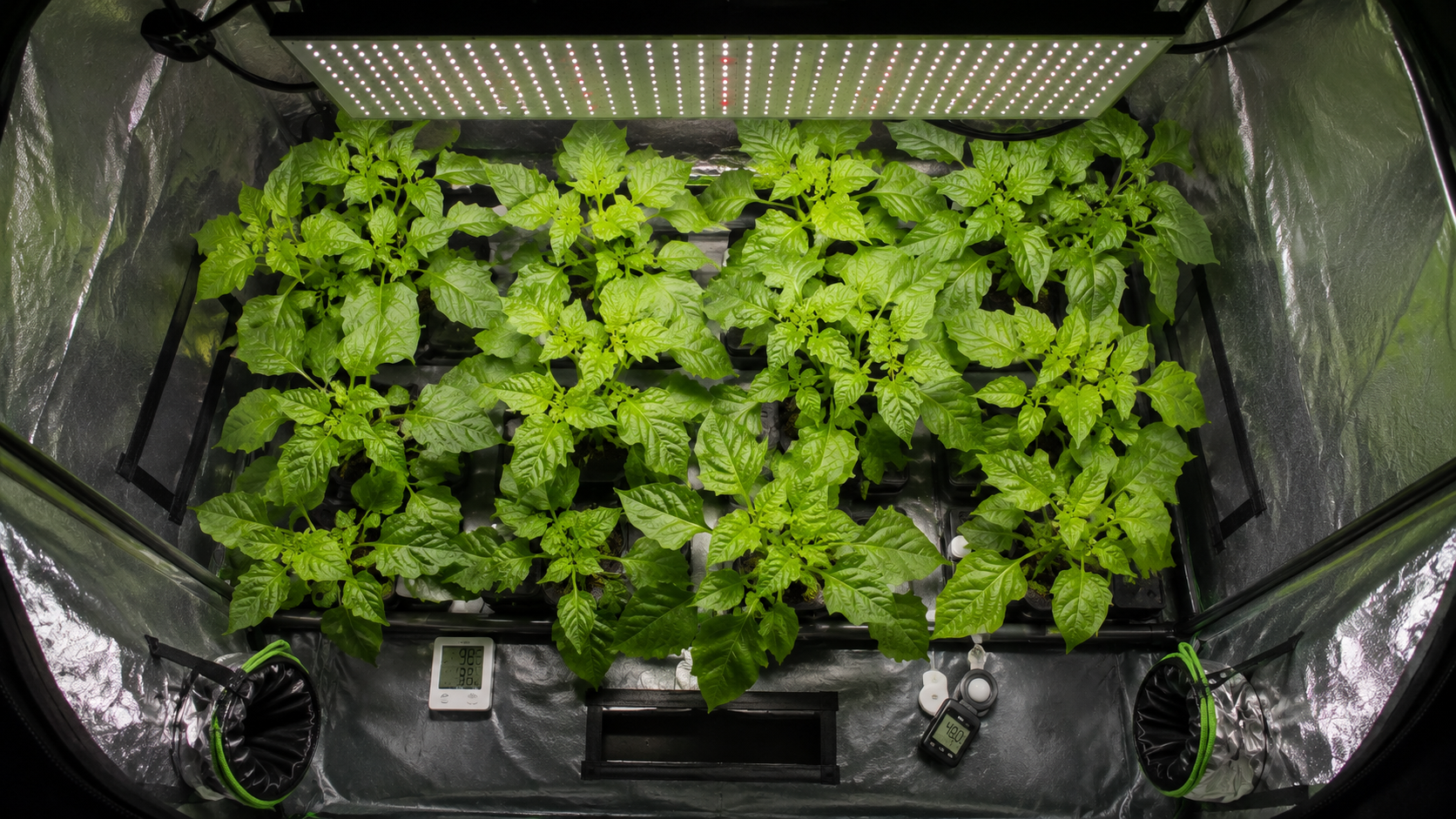
You can spend a lot of money on a quality LED panel and still get slow, leggy plants during veg. Nine times out of ten, it’s not a bad light — it’s a mismatched setup. Wrong intensity. Wrong spectrum bias. Wrong hours. Plants in the vegetative stage have specific light requirements, and if any one of those three variables is off, growth stalls or stretches in ways that cost you weeks of recovery time.
At Grow With Hydroponics, we’ve put together this guide to help you get veg right — covering the PPFD targets your plants actually need, why spectrum matters more than most beginners think, and how to build a light schedule that drives real, compact, healthy growth without burning your plants or wasting energy.
Quick Answer: Vegetative Stage Grow Lights at a Glance
Vegetative stage grow lights should deliver 400–600 µmol/m²/s PPFD at canopy level. Run a blue-dominant or full-spectrum LED at a colour temperature of 4000K–6500K. The standard light schedule for veg is 18 hours on / 6 hours off, which produces a Daily Light Integral (DLI) of roughly 25–35 mol/m²/day — enough to drive vigorous growth without stressing most plants.
Explore Ultimate Guide to Grow Light Systems: Choose the Perfect Setup for Bigger, Healthier Indoor Plants.
What Is the Right PPFD for the Vegetative Stage?
PPFD, or Photosynthetic Photon Flux Density, measures the number of photosynthetically active photons hitting one square metre of canopy every second, expressed in µmol/m²/s. For vegetative growth, the target range is 400–600 µmol/m²/s at canopy level.
That said, not all plants need the same intensity. Leafy greens like lettuce and spinach grow well at the lower end — closer to 200–400 µmol/m²/s. Fruiting crops like tomatoes and peppers thrive toward the higher end. Pushing past 600 µmol/m²/s during veg doesn’t usually accelerate growth unless you’re also running elevated CO₂. Without it, you just risk light stress before flowering even starts.
PPFD vs. DLI — What’s the Difference?
DLI, or Daily Light Integral, is the cumulative amount of PAR light a plant receives over a full day, measured in mol/m²/day. Think of PPFD as the rate of light delivery and DLI as the total daily dose. For most crops in the vegetative stage under an 18/6 schedule, a DLI of 20–35 mol/m²/day hits the sweet spot.
If you want to check your specific setup, the DLI guide on this site walks through how to calculate your daily light total from your PPFD reading and your hours — far more useful than guessing from a light manufacturer’s coverage chart.
How Far Should You Hang Your Vegetative Stage Grow Light?
Hanging height directly controls PPFD at the canopy. Most LED quantum boards and bar lights at full power reach the 400–600 µmol/m²/s range when hung 18–24 inches (45–60 cm) above the canopy during veg. Start at 24 inches, measure PPFD if you have a meter, then bring it down gradually. If plants look pale or have slightly cupped leaves, the light is probably too close. If they’re stretching upward with long gaps between nodes, it’s too far — that’s the gap between what the plant needs and what it’s actually getting.
Why Spectrum Matters for Vegetative Stage Grow Lights
Not all light drives the same response. The wavelengths — the actual colours within the light — trigger specific physiological processes, and during the vegetative stage, one part of the spectrum matters most.
Blue Light (400–500 nm) for Compact, Healthy Veg Growth
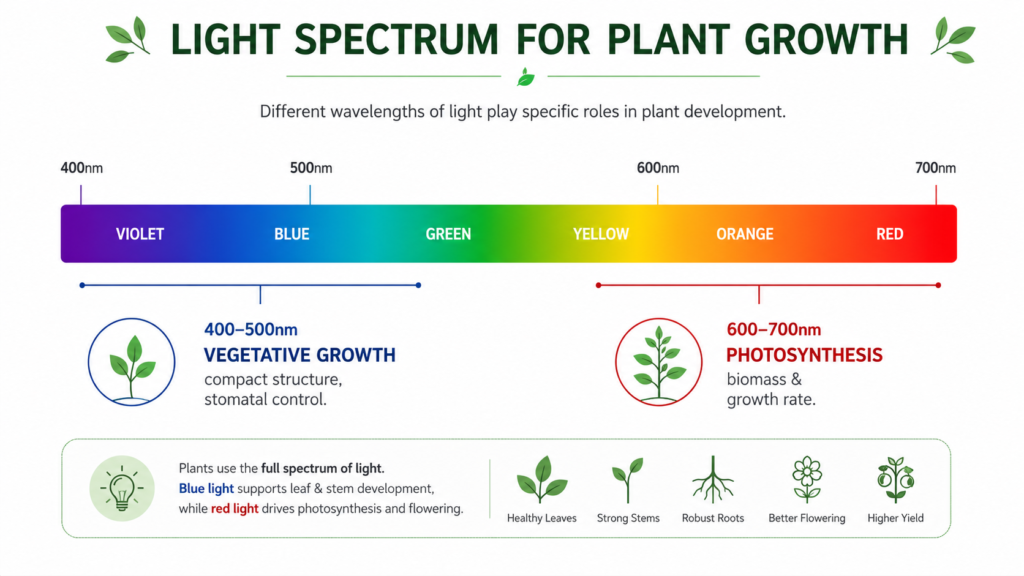
Blue light, in the 400–500 nm wavelength range, is the key driver of compact vegetative structure. Research from Michigan State University’s floriculture department confirms that blue light regulates phototropism, promotes stomatal opening, and drives chlorophyll production. Plants that receive adequate blue light develop shorter internodes, thicker stems, and broader leaves. That’s exactly what you want during veg — structure that can eventually support a productive canopy.
Practically, this means choosing a grow light with meaningful blue content. Full-spectrum LEDs rated at 4000K–6500K colour temperature are blue-heavy by design. Some fixtures include a “veg mode” that boosts blue output — that’s actually useful here, not just marketing language.
Red Light (600–700 nm) During Veg — Don’t Skip It
Red light isn’t just for flowering. It’s the primary driver of photosynthetic activity and total biomass — leaves, stem length, overall plant size. Running a purely blue light during veg won’t produce the growth rate you want. A balanced full-spectrum light that includes strong red output alongside blue gives you compact structure from the blue wavelengths and genuine growth rate from the red. Most quality full-spectrum LEDs provide a 3:1 to 4:1 red-to-blue ratio by photon count, and that balance works well across most crops.
Do You Need a “Veg-Specific” Light or Is Full Spectrum Fine?
Full spectrum is fine for the overwhelming majority of growers. A quality full-spectrum LED handles both veg and flower without swapping fixtures. Veg-specific lights with adjustable spectrum are useful in commercial or dual-tent setups, but for home growers they’re an unnecessary cost. What matters far more than a dedicated veg fixture is whether your light’s PPFD data is accurate and whether it delivers consistent output across your canopy — not just at the centre.
What Light Schedule Should You Run During the Vegetative Stage?
The standard vegetative stage light schedule is 18 hours on and 6 hours off (18/6). This photoperiod keeps photoperiod-sensitive plants locked in vegetative growth while providing a consistent dark window for metabolic recovery and cellular processes.
Some growers run 20/4 to push slightly faster veg development, and it works. But the gains over 18/6 are modest and come with higher electricity costs. Running 24/0 — no dark period at all — stresses many strains, and unless you have a specific reason for it, it’s not worth the risk or the bill.
What Happens If You Run Too Few Hours?
For photoperiod-sensitive plants, dropping below roughly 13 hours of daily light risks triggering early flowering signals. That’s a problem if your plants haven’t built the canopy structure they need. But even before that, inconsistent hours — changing your schedule every few days — confuses the plant’s internal clock and slows vegetative growth even when PPFD is perfectly dialled in. Set it, leave it, and observe. Stability matters.
Light Schedule for Leafy Greens and Herbs in Hydroponics
Leafy greens and herbs are less photoperiod-sensitive than fruiting crops. Many hydroponic lettuce and basil growers use 16/8 schedules to reduce electricity costs without meaningfully slowing growth. If you’re growing basil hydroponically, a 16–18 hour photoperiod with PPFD in the 250–400 µmol/m²/s range produces consistently excellent results. No need to push it harder than that.
Common Mistakes With Vegetative Stage Grow Lights
Frankly, this is where most beginners go wrong — not in the fixture they choose, but in the setup decisions around it.
- Running full power from day one. Young transplants and seedlings should start at 150–300 µmol/m²/s and ramp up over the first 7–10 days. Blasting full-intensity light over freshly transplanted seedlings can cause bleaching and stress before roots have even spread into the medium.
- Trusting wattage labels instead of PPFD data. A fixture sold as “600W equivalent” might only produce 240 µmol/m²/s at 24 inches. Always look for third-party PPFD maps or manufacturer PAR data before purchasing — not just wattage claims.
- Uneven canopy coverage. Lights mounted too high to avoid hotspots often drop PPFD below usable levels at the canopy edges. If your meter reads 520 µmol/m²/s in the centre but 180 µmol/m²/s at the tent corners, that’s a coverage problem — not a brightness problem. The plants at the edges will tell you eventually.
- Ignoring heat. High-output LEDs and HID lights in smaller tents raise ambient temperature fast. Canopy temperatures above 28°C (82°F) reduce transpiration efficiency and can produce drought-stress symptoms in a hydroponic system — even when roots are sitting in water. The hum of your inline fan straining at full speed is usually your first sign that heat is the hidden problem.
Choosing the Best Grow Light for the Vegetative Stage
Light Type | PPFD Potential | Spectrum for Veg | Heat Output | Best For |
Full-Spectrum LED (quantum board) | High | Excellent — adjustable or fixed | Low–Medium | Home & commercial veg |
LED Bar (Samsung LM301 series) | Very High | Excellent | Low | Larger veg canopies |
CMH / LEC (315W) | Medium–High | Very Good — natural spectrum | Medium | Small–medium veg rooms |
T5 Fluorescent (6500K) | Low–Medium | Good for seedlings/clones | Very Low | Seedlings, clones, herbs |
Metal Halide (MH) | High | Good — strong blue output | Very High | Legacy setups only |
For most home hydroponic growers, a full-spectrum LED quantum board or bar light hits the right balance of output, efficiency, and heat management during the vegetative stage. Metal Halide was the veg gold standard for decades, but modern full-spectrum LEDs running at 4000K–5500K have largely replaced it in controlled-environment grows — and for good reason.
Compare Top-Rated Vegetative Stage Grow Lights
Shopping for a grow light that delivers the PPFD numbers it actually claims? The right LED makes a measurable difference in how compact and vigorous your veg plants become. Compare fixtures by their PPFD maps and coverage at real-world hanging heights — not the “max coverage” number that often assumes a barely-usable 150 µmol/m²/s.


Not sure if your current light is doing what it claims? The Grow Light Calculator generates a PPFD grid estimate for your grow area so you can check coverage properly.
Advanced Tips for Dialling In Your Vegetative Stage Light Setup
Dimming in Early Veg
Most quality LED drivers are dimmable. Use this feature. Run at 60–70% power during the first week after transplant, then increase by 10–15% every few days as plants establish. Plants that ramp into high PPFD gradually develop more photosynthetic capacity — they handle peak light intensity better than plants exposed to maximum output immediately. It takes an extra week but saves you two if things go wrong.
VPD Links Directly to Light Intensity
Higher PPFD drives faster transpiration. If your VPD — vapour pressure deficit, the difference between how much moisture the air can hold and how much it currently holds — isn’t in the right range, your plants can’t move water and nutrients fast enough to match the photosynthetic rate your light is demanding. For most vegetative crops, target VPD in the 0.8–1.2 kPa range. Managing VPD alongside light intensity is one of the most commonly overlooked variables in indoor veg grows. Get both right simultaneously and growth rate visibly improves.
Does CO₂ Supplementation Affect How Much Light You Can Run?
Yes — and meaningfully so. CO₂ supplementation above ambient levels (currently around 420 ppm outdoors) allows plants to keep photosynthesising efficiently at higher PPFD without hitting their saturation point. If you’re running CO₂ at 800–1200 ppm in your veg space, you can push PPFD toward the top of the 400–600 range — or slightly beyond — without diminishing returns setting in. Without CO₂ enrichment, keeping PPFD in the 400–500 µmol/m²/s range is plenty for most crops and wastes less energy.
Nutrients That Support High-PPFD Vegetative Growth
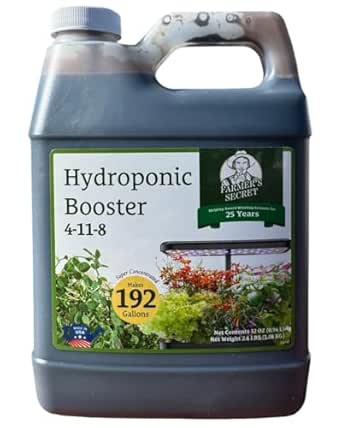
Higher light intensity during veg increases nutrient uptake demand. A nitrogen-forward veg formula with solid calcium and magnesium support keeps pace with what your plants need when the light is working well.



Frequently Asked Questions: Vegetative Stage Grow Lights
What PPFD do I need for the vegetative stage?
Most plants perform well at 400–600 µmol/m²/s PPFD during the vegetative stage. Leafy greens and herbs can thrive at 200–400 µmol/m²/s, while high-light crops benefit from the upper end of the veg range. Always measure PPFD at canopy level — not at the fixture itself.
Is an 18/6 light schedule best for vegetative growth?
Yes, 18 hours on and 6 hours off is the most reliable and widely used vegetative schedule for photoperiod-sensitive plants. It delivers enough daily light for vigorous growth while keeping electricity costs manageable. Some growers use 20/4 with modest gains, but 24/0 can stress certain varieties and isn’t recommended as a default starting point.
What colour spectrum is best for vegetative stage grow lights?
Blue-dominant or full-spectrum light in the 4000K–6500K colour temperature range works best for veg. Blue light (400–500 nm) promotes compact stems and broad leaves. Full-spectrum LEDs that also deliver solid red output (600–700 nm) provide both structural control from the blue and strong photosynthetic rate from the red.
Can I use the same grow light for veg and flower?
Yes — a good full-spectrum LED handles both stages well without switching fixtures. Some fixtures include veg and bloom modes that shift spectral balance, which is genuinely useful. But a fixed full-spectrum light will grow healthy plants through both vegetative and flowering stages without any mode changes required.
How far should a grow light hang during the vegetative stage?
Most full-spectrum LED panels should hang 18–24 inches (45–60 cm) above the canopy during veg. Start at the higher end and adjust based on plant response. Upward stretching means the light is too far; bleached or downward-cupped leaf tips suggest it’s too close.
Getting Your Vegetative Light Setup Right
The vegetative stage sets the foundation for everything that comes next. Plants that receive the right PPFD, a spectrum with strong blue content, and a consistent 18/6 light schedule develop the root mass, canopy structure, and photosynthetic capacity that translates directly into better outcomes at harvest.
The short version: aim for 400–600 µmol/m²/s with a full-spectrum LED, keep your light schedule consistent at 18/6, ramp intensity gradually in early veg, and pair your lighting decisions with proper VPD management. None of this is complicated — but getting all three variables dialled in simultaneously is exactly where serious growers pull ahead.
Grow With Hydroponics has a full toolkit of calculators and guides to help you plan your light setup with real numbers rather than guesswork. If you’re not sure whether your current fixture is actually delivering what it claims, the Grow Light Calculator is a good first stop.
