

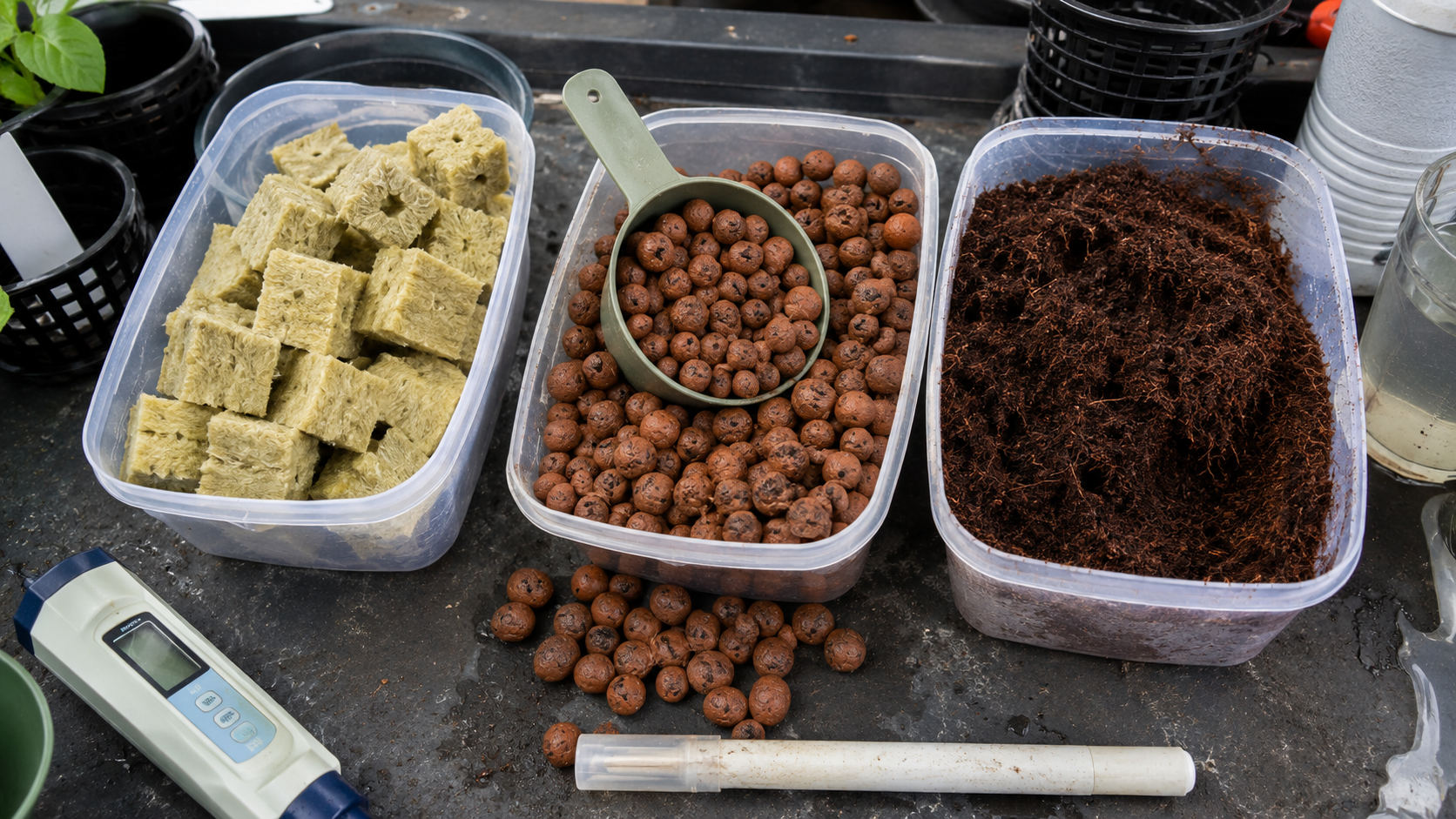
Pick the wrong growing media and you won’t find out for weeks — not until roots start looking waterlogged in a system that drains fine, or a crop that should be thriving stalls out for no obvious reason. Most beginners choose media based on whatever their local shop stocks or whatever a YouTube video used, and that’s honestly not a terrible way to start. But a proper hydroponic grow media comparison saves you that trial-and-error phase entirely. At Grow With Hydroponics we get asked constantly whether rockwool, clay pebbles, or coco coir is “the best” — and the honest answer is that each one wins in a different setup.
This guide compares all three head to head: what they’re made of, where each one shines, where each one fails, and how to actually decide between them for your system.
Quick answer: Rockwool holds the most water and germinates seeds reliably but isn’t reusable or biodegradable. Clay pebbles (LECA) drain fast and are fully reusable but hold very little water on their own. Coco coir sits in between — good water retention, decent aeration, and it’s compostable, but it needs rinsing and can affect your fertilization plan because it actively holds onto nutrients.
What Does a Growing Medium Actually Do?
A growing medium is whatever supports plant roots in a hydroponic system when there’s no soil doing that job. The medium itself typically isn’t feeding the plant — the nutrient solution does that — but its physical structure controls how much water and air reach the roots at any given moment.
Three properties decide almost everything about how a medium behaves. Pore space is the gaps between particles where water and air actually sit — more pore space generally means more water-holding capacity and better aeration, though the two trade off against each other depending on particle size. Cation exchange capacity (CEC) measures whether the medium itself grabs onto nutrient ions and holds them, rather than letting all of it pass straight to the roots via the solution. pH is how acidic or basic the medium starts out, which can shift your reservoir’s pH if you don’t account for it. Get a feel for these three and the rest of this comparison will make a lot more sense.
What Is Rockwool and Where Does It Work Best?
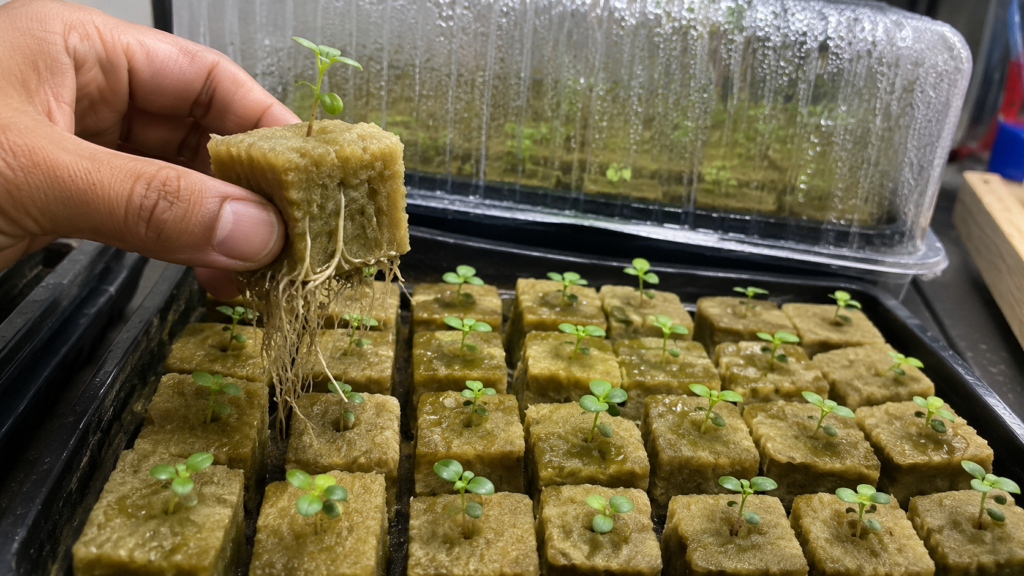
Rockwool is made by melting volcanic rock and chalk at extremely high temperatures and spinning the molten material into fine mineral fibers, which get pressed into cubes, blocks, or slabs. It’s one of the most widely used starter media in commercial hydroponics, and for good reason — it’s consistent from batch to batch in a way natural materials rarely are.
Rockwool’s Strengths and Limitations
Rockwool holds a lot of water relative to its size and provides good aeration when it isn’t oversaturated, which is why it’s such a popular seed-starting and cloning medium. It’s sterile straight out of the bag, so germination rates tend to be reliable. The catch: rockwool runs neutral to slightly basic, generally in the 7–8.5 pH range, and depending on the source may need a pre-soak in acidified water before use to bring it down closer to what most plants prefer. It also has essentially no cation exchange capacity, meaning it doesn’t hold or buffer nutrients at all — everything the plant gets comes directly and immediately from your reservoir.
The bigger long-term issue is disposal. Rockwool isn’t biodegradable, and it can’t be reused between grows, so used blocks and cubes pile up as waste — a real consideration if you’re running multiple crop cycles a year. It’s also prone to algae growth if light reaches the exposed surface, which is why growers typically wrap or cover it.
Best fit: seed starting, cloning, and any system where consistency matters more than sustainability — drip systems and slab-based commercial setups in particular.
What Are Clay Pebbles (LECA) and Where Do They Work Best?
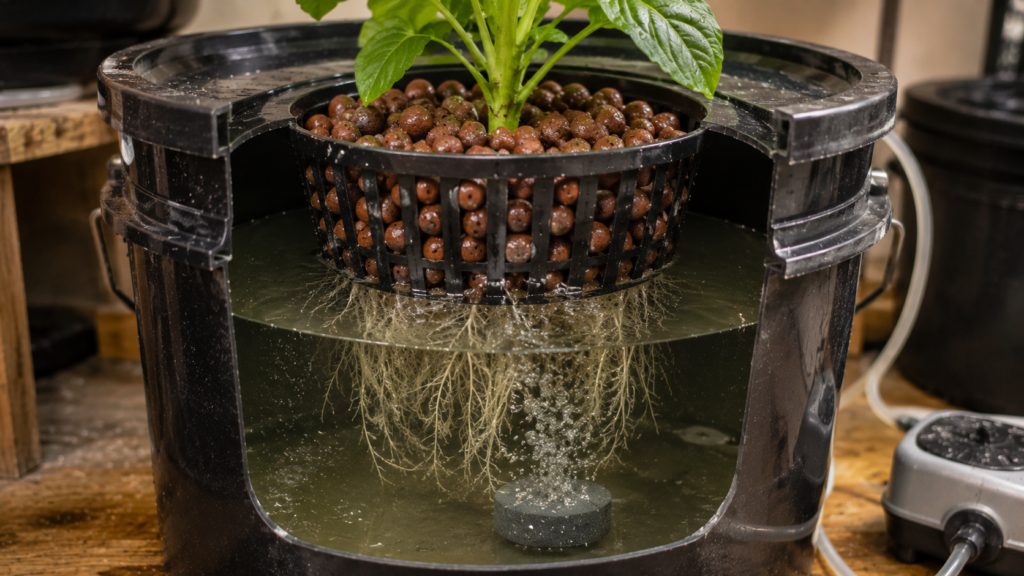
Clay pebbles — also called LECA (lightweight expanded clay aggregate) or grow rocks — are made by heating natural clay to very high temperatures until it expands into lightweight, porous balls. Unlike rockwool, they’re a genuinely reusable medium if you’re willing to sterilize them between crops.
Clay Pebbles’ Strengths and Limitations
This is where a lot of commercial product listings get something wrong, and it’s worth flagging directly: most retail pages describe clay pebbles as simply “pH neutral” and leave it there. University of Florida IFAS Extension’s summary of common hydroponic media actually classifies expanded clay as having high cation exchange capacity, meaning it can store and release nutrients and salts rather than being fully inert. That’s a meaningfully different property than pH, and it matters for fertilization planning — media that holds onto salts can concentrate them over repeated feedings if you’re not flushing periodically.
Clay pebbles offer excellent aeration and drainage thanks to their large air gaps, but that same structure gives them very low water-holding capacity on their own, so they typically need more frequent watering cycles than rockwool or coco coir unless the system keeps them constantly wet, as in deep water culture or ebb-and-flow. On the plus side, they’re fully reusable — wash and sterilize them and they’re good to go again, which makes them one of the more sustainable choices over the long run despite a higher upfront cost per liter than rockwool or coco.
Best fit: deep water culture, flood-and-drain, and Dutch bucket systems where roots stay wet enough that low individual water retention isn’t a problem, plus any grower who wants a reusable medium long-term.
What Is Coco Coir and Where Does It Work Best?
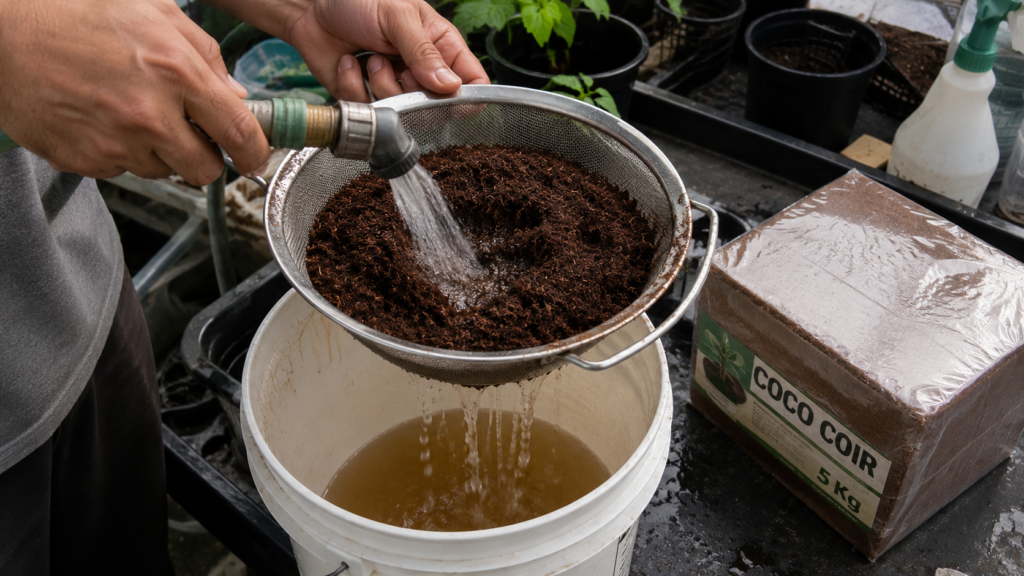
Coco coir is processed coconut husk fiber — once treated as waste from the coconut industry, now repurposed as a growing medium. It’s organic, renewable, and one of the more forgiving media for growers who don’t want to babysit watering schedules constantly.
Coco Coir’s Strengths and Limitations
Coco coir runs near-neutral to slightly acidic, typically in the 5.5–6.8 pH range, which sits comfortably inside what most hydroponic crops prefer without heavy adjustment. It holds water well while still maintaining decent aeration, and unlike rockwool it has real cation exchange capacity — it can hold onto and slowly release nutrients like nitrogen, potassium, and phosphorus. That buffering effect is genuinely useful for beginners, since it smooths out small dosing mistakes rather than letting the plant feel every fluctuation immediately. It’s also compostable, which solves the disposal problem rockwool creates.
The trade-offs: raw coco coir is typically high in naturally occurring salts from where the coconuts were grown, so it needs rinsing or buffering before first use, or you risk feeding your plants an unwanted sodium and potassium load right out of the gate. It also shouldn’t be used loose in recirculating systems, since fine particles can clog pumps and emitters over time. And because it holds onto nutrients rather than passing everything straight through, your fertilization program needs to account for that stored reserve rather than assuming every drop of solution reaches the roots immediately.
Best fit: hand-watered and drip systems, anyone growing organically-adjacent, and beginners who want a more forgiving buffer against dosing mistakes. If you’re growing a specific heavy feeder rather than general crops, it’s worth checking crop-specific data before committing — our coco coir vs rockwool tested results for roses breaks down which medium actually produced bigger blooms in a side-by-side trial.
Rockwool vs Clay Pebbles vs Coco Coir: Full Comparison
| Property | Rockwool | Clay Pebbles (LECA) | Coco Coir |
|---|---|---|---|
| pH range | 7–8.5 (neutral to basic) | Neutral | 5.5–6.8 (slightly acidic) |
| Cation exchange capacity | None | High | Moderate |
| Water-holding capacity | High | Low | High |
| Aeration | Good to fair | Good | Good |
| Reusable | No | Yes, with sterilization | No |
| Biodegradable | No | No (but reusable) | Yes |
| Best systems | Drip, slabs, propagation | DWC, ebb-and-flow, Dutch buckets | Drip, hand-watered, hybrid organic |
| Pre-treatment needed | Often, pH soak | None | Rinse/buffer before use |
Shop Smart: Grow Media for Your System
Once you know which medium fits your setup, quality actually matters — cheap rockwool crumbles, and low-grade coco coir can arrive full of unrinsed salts. These are tested, grower-reviewed options across all three types.


How Do You Choose the Right Grow Media for Your System?
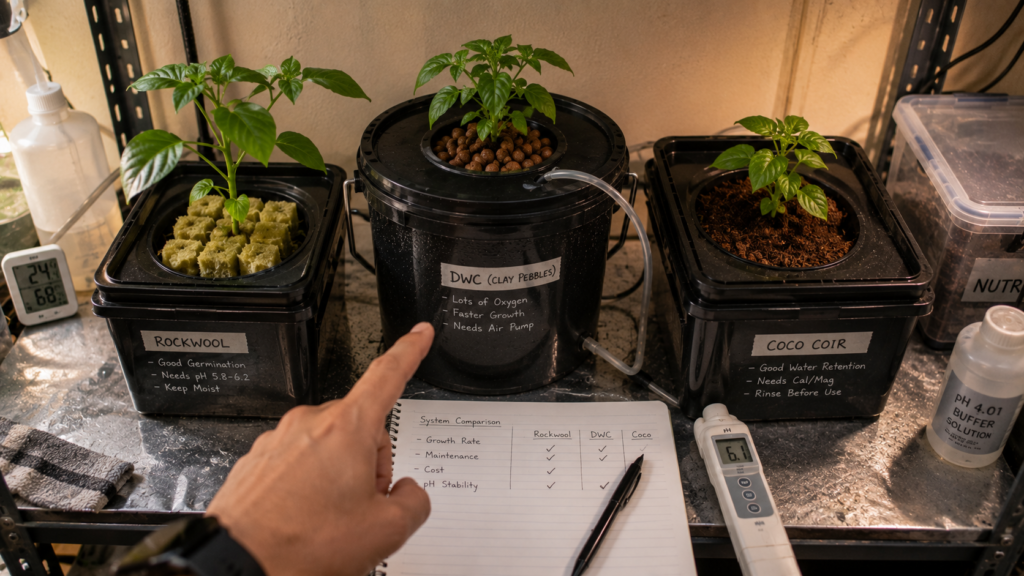
Rather than asking which medium is “best” in the abstract, work through these questions in order:
- What system are you running? DWC or ebb-and-flow → clay pebbles handle constant wetness well. Drip or hand-watered → rockwool or coco coir hold water between cycles better.
- Do you want to reuse media between crops? Yes → clay pebbles are your only fully reusable option among these three. No → rockwool or coco coir are fine as single-use.
- How much dosing precision do you trust yourself with? New to hydroponics → coco coir’s buffering forgives small mistakes. Experienced and dialing in exact EC targets → rockwool’s zero CEC means what you feed is exactly what the roots see.
- Does disposal or sustainability matter to your setup? Coco coir composts; clay pebbles are reusable; rockwool is neither, so factor that into a long-term commitment.
- Are you starting seeds or transplanting an established plant? Rockwool’s sterile, consistent cubes are the standard choice for germination regardless of what medium the plant moves into afterward.
If you’re still narrowing down your overall setup before worrying about media specifically, our complete guide to hydroponic systems walks through how system type shapes almost every other decision, including this one. And if space is the real constraint driving your choice, our small hydroponic systems guide covers how apartment- and counter-sized builds narrow the media question down even further.
Common Grow Media Mistakes
- Skipping the rinse or buffer step with coco coir. Planting directly into unrinsed coir can hit young roots with a salt load they weren’t ready for.
- Assuming clay pebbles alone will hold enough water in a drip system. Their low water-holding capacity means drip cycles often need to run more frequently than growers expect coming from rockwool or coco.
- Not accounting for coco coir’s CEC in the feeding schedule. Because the medium is holding some nutrients back, growers sometimes overcorrect and overfeed trying to chase target EC readings that the medium itself is buffering.
- Leaving rockwool’s surface exposed to light. This is one of the fastest ways to end up with an algae problem in the root zone.
- Trying to reuse rockwool or coco coir like clay pebbles. Sterilizing and reusing organic or fiber media isn’t realistic the way it is with fired clay — treat them as single-cycle materials.
Can You Mix Grow Media Types?
Yes, and many experienced growers do exactly this rather than picking one medium exclusively. A common blend is coco coir with a portion of perlite or clay pebbles mixed in, which improves drainage and aeration in a medium that can otherwise hold too much water for some root systems. Layering also works — clay pebbles at the base of a net pot for structural support and drainage, with a rockwool or coco coir cube holding the seedling above it. There’s no single “correct” blend; the right combination depends on your system’s watering frequency and how much oxygen your specific crop’s roots need.
Frequently Asked Questions
Which grow media is best for beginners? Coco coir is generally the most forgiving starting point because its natural nutrient buffering smooths out small dosing mistakes, and its water-holding capacity gives more margin for error on watering schedules than clay pebbles alone.
Can I reuse rockwool or coco coir? Not realistically. Rockwool isn’t biodegradable but also isn’t practical to sterilize and reuse at a home scale, and coco coir breaks down over time — both are better treated as single-cycle media, unlike clay pebbles which can be washed and sterilized for reuse.
Do clay pebbles affect nutrient solution pH or strength? Clay pebbles run close to pH neutral, but University of Florida IFAS Extension classifies them as having high cation exchange capacity, meaning they can store and release nutrients and salts over time rather than being fully inert — worth accounting for during long grow cycles.
Why does my coco coir need rinsing before I plant in it? Raw coco coir is typically high in naturally occurring salts from the coconut source, and planting directly into unrinsed coir can expose young roots to an unwanted sodium and potassium load before you’ve even started feeding.
Is rockwool bad for the environment? It’s not biodegradable, so used rockwool accumulates as landfill waste rather than breaking down, which is a genuine long-term downside compared to compostable coco coir or reusable clay pebbles — something worth weighing if sustainability factors into your setup.
Final Thoughts
There’s no universal winner between rockwool, clay pebbles, and coco coir — each one is solving the water-versus-air balance differently, and the right choice depends on your system type, how hands-on you want to be, and whether long-term reuse matters to you. Start by matching the medium to your system rather than chasing whichever one is trending, and adjust from there once you see how your specific crop responds. Grow With Hydroponics has deeper guides for each system type if you want to keep narrowing things down, and our Hydroponic Nutrient Calculator can help you dial in a feeding schedule that accounts for whichever medium’s buffering behavior you end up working with.
