

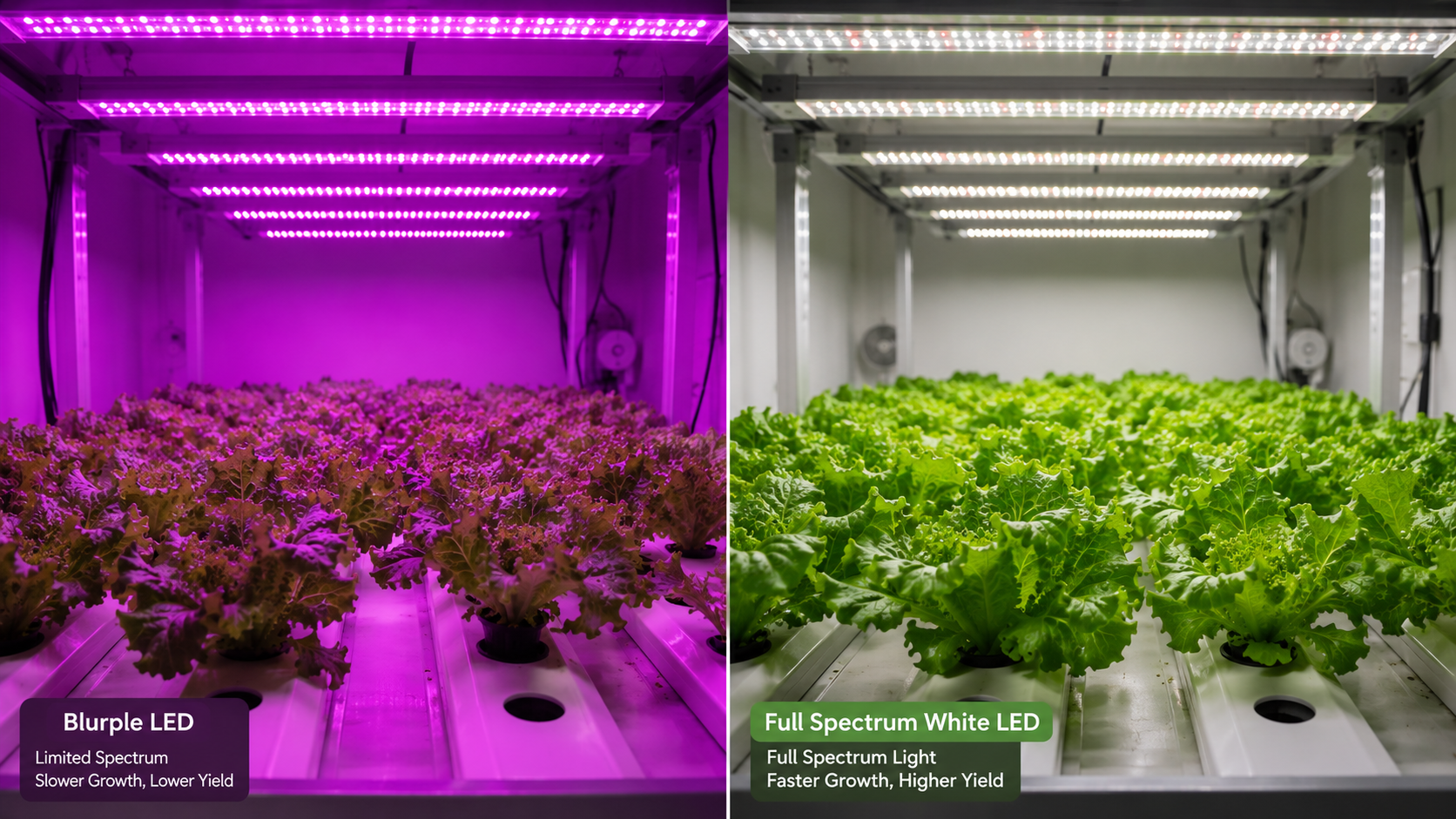
Walk into any grower forum and you’ll find the same argument playing out: blurple versus white, red-blue versus full spectrum, efficiency versus completeness. Most of it generates more heat than light — which is fitting, really, given what we’re arguing about.
Here’s the honest version. Full spectrum vs red & blue grow lights is not a simple better-or-worse question. It’s a context question. The right answer depends on whether you’re running a sole-source indoor system, a greenhouse with natural light backup, what crops you’re growing, and what stage they’re in. Get the context wrong and the “best” light becomes the wrong light. For the full technical breakdown of PAR, PPFD, DLI, and how to read a light map, the Ultimate LED Grow Light Guide covers all of it.
At Grow With Hydroponics, we’ve worked through enough lighting decisions to know where growers go wrong — and it usually starts with choosing a spectrum before understanding what spectrum their plants actually need. This guide covers the real science, the practical trade-offs, and exactly when each spectrum type earns its place.
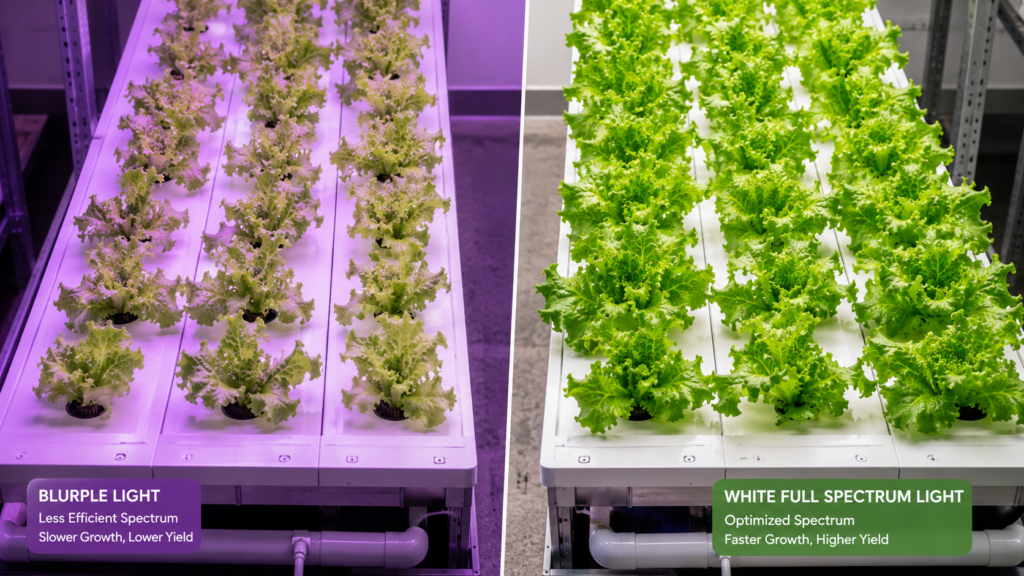
Quick Answer For most sole-source indoor hydroponic grows, full spectrum LED grow lights outperform red & blue (blurple) because plants need more than just the photosynthetic peaks — green, far-red, and white light all contribute to canopy penetration, morphology, and crop quality. Red & blue LEDs still make sense in greenhouse supplemental applications (where sunlight provides the missing wavelengths) and tight budgets growing only leafy greens. For mixed crops, fruiting plants, or all-stage growing, full spectrum wins on quality and practicality.
What Is the Actual Difference Between Full Spectrum and Red & Blue Grow Lights?
The core difference is wavelength coverage. Full spectrum LEDs cover the entire photosynthetically active range broadly; red & blue LEDs concentrate on two narrow peaks where photosynthesis is most efficient.
What “Full Spectrum” Actually Means in 2026
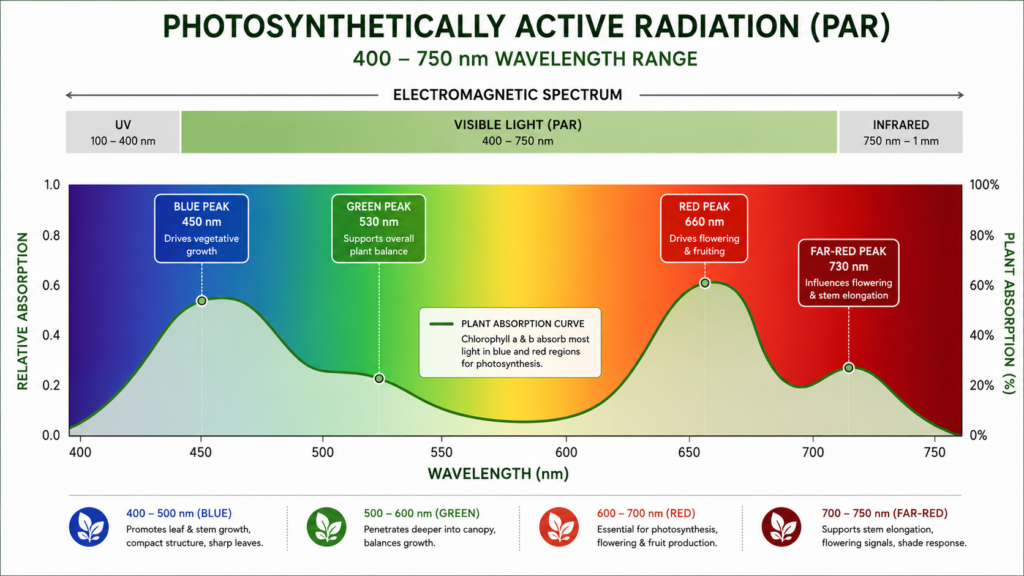
Full spectrum LED grow lights emit a broad, sunlight-like white light spanning the 400–700 nm PAR range, typically with red enhancement (around 660 nm) and often including far-red (700–750 nm). In 2026, the more accurate term used in commercial horticulture is ePAR (extended PAR) — the 400–750 nm range — which acknowledges that far-red light contributes meaningfully to photosynthesis, particularly through a phenomenon called the Emerson Enhancement Effect (more on that shortly). PAR, or photosynthetically active radiation, is the 400–700 nm wavelength range that plants use for photosynthesis — and understanding it is what separates a useful spectrum comparison from a meaningless one.
These lights use broad-spectrum white phosphor diodes — usually Samsung LM301 series or equivalent — that produce a continuous spectral curve across the full visible range, rather than isolated peaks. The result looks white to human eyes, which is a practical advantage: you can actually see your plants clearly, spot deficiencies, and identify early pest damage without squinting under alien purple light.
What Red & Blue (Blurple) Lights Are and Why They Existed
Red & blue LED grow lights — commonly called “blurple” for the pinkish-purple glow they emit — concentrate light output at two wavelengths: blue around 450 nm and red around 660 nm. These are the absorption peaks of chlorophyll a and b, the primary photosynthetic pigments.
The logic was sound when LED technology was young and expensive: why generate light wavelengths plants don’t absorb efficiently? Focus the energy where chlorophyll actually uses it. Early blurple fixtures were genuinely energy-efficient for the output they delivered, and they grew plants. They still do.
But as commercial LED horticulture research expanded through the 2010s and into the 2020s, it became clear that photosynthesis is more complex than two peaks. Green light, far-red, and even UV all contribute — and a fixture that ignores them produces a narrower kind of growth.
Does Green Light Actually Help Plants Grow?
Yes — and this is probably the most important correction in modern grow light science compared to what growers believed a decade ago.
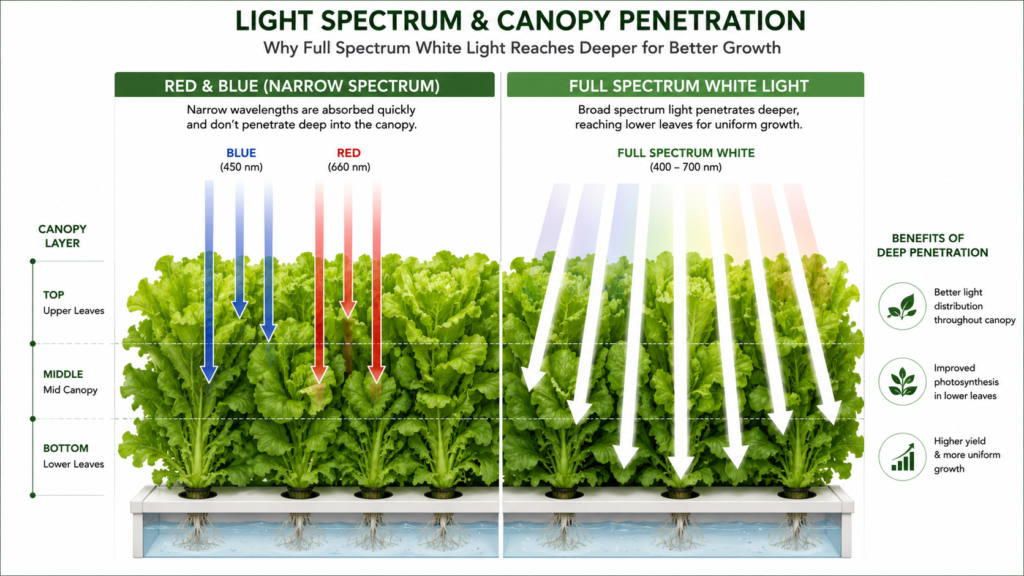
Plants do absorb green light less efficiently than red or blue. That’s true. But green light (500–600 nm) penetrates deeper into the canopy than red or blue because it’s reflected by upper leaves rather than fully absorbed. That reflected green light then reaches middle and lower canopy leaves that the intense red and blue light never reaches directly.
In dense hydroponic canopies — lettuce racks, NFT systems, multi-tier vertical growing — this matters significantly. Lower leaves in a blurple-lit system may receive almost no usable light. Under a full spectrum fixture, they receive reflected green and white light that still drives meaningful photosynthesis at lower intensities. The practical result: more even growth across the whole plant, not just the top.
What Does the Research Actually Say?
Science has moved clearly in one direction over the past decade, though the nuance is important.
Research Supporting Full Spectrum LEDs
A 2015 study published in HortScience found that full spectrum LEDs produced increased leaf area and biomass during the vegetative phase in lettuce compared to narrower-spectrum alternatives. A 2017 paper in Frontiers in Plant Science demonstrated enhanced flower and fruit development in tomato plants under full spectrum LEDs compared to red-heavy alternatives.
The mechanism isn’t mysterious. Full spectrum light supports the full range of plant photoreceptors — not just chlorophyll, but also phytochromes (which regulate stem elongation, flowering, and shade responses) and cryptochromes (which regulate seedling development and circadian rhythms). Red and blue alone activate chlorophyll well but leave other photoreceptor systems underserved.



When Red & Blue Still Makes Scientific Sense
P.L. Light Systems, a commercial horticultural lighting specialist, makes an important distinction: red/blue is best suited for greenhouse applications that already receive sunlight. In a greenhouse where natural solar radiation provides the full spectrum including green, yellow, and far-red, supplemental red & blue LEDs efficiently top up the specific wavelengths that sunlight delivers unevenly — particularly on cloudy days.
In a sole-source indoor system, where the LEDs provide 100% of the plant’s light, that logic inverts. There’s no sunlight filling in the missing wavelengths. The missing green, the absent far-red, the narrow spectrum — all of it shows up in slightly inferior morphology, colour, and nutrient density compared to crops grown under broad-spectrum white light.
A 2019 study in Environmental and Experimental Botany also found that red LED light increased flower number and fruit yield in strawberry plants — supporting the specific use case of high red-ratio lighting during fruiting cycles, not as a replacement for full spectrum but as a stage-specific enhancement.
Full Spectrum vs Red & Blue: Which Is Better for Your Crop?
The answer is genuinely crop- and context-dependent. Here’s the breakdown:
| Crop / Situation | Best Spectrum | Reason |
|---|---|---|
| Leafy greens (lettuce, spinach) — sole source | Full spectrum | Even canopy penetration; no sunlight to fill gaps |
| Herbs (basil, cilantro) — sole source | Full spectrum | Better flavour, essential oil production under broader spectrum |
| Fruiting crops (tomatoes, peppers) — sole source | Full spectrum + red boost | Broad spectrum for structure; red enhancement for fruit set |
| Strawberries — flowering/fruiting stage | Red-dominant or full spectrum + far-red | Research supports red for flowering; far-red for Emerson Effect |
| Microgreens — seed to harvest | Full spectrum or even red/blue | Short cycle, minimal canopy depth; budget matters more here |
| Seedlings / clones | Full spectrum | Balanced light supports compact, healthy early development |
| Greenhouse supplemental (natural light present) | Red & blue | Sun provides missing wavelengths; targeted spectrum is efficient |
| Commercial CEA — mixed crops | Full spectrum | One spectrum, all stages, all crops, easier management |
| Budget limited, leafy greens only | Red & blue | Acceptable trade-off; less quality than full spectrum, but it works |
Far-Red and UV: The Channels Worth Understanding
These are the wavelengths outside the traditional 400–700 nm PAR range, and they’re more useful than many growers realise.
Far-Red Light and the Emerson Enhancement Effect
Far-red light sits between 700–750 nm — beyond what human eyes see as visible red. On its own, far-red drives minimal photosynthesis. But when paired with red light (around 660 nm), something interesting happens: the combined photosynthetic rate exceeds what either wavelength achieves alone. This synergy is called the Emerson Enhancement Effect, named after the researcher who documented it in the 1950s.
Modern full spectrum LED fixtures that include far-red diodes leverage this effect to push slightly higher photosynthetic efficiency than red-only systems at the same PPFD. It also stimulates leaf expansion and stem elongation through phytochrome responses — useful for crops where you want larger leaves or faster early growth. Some high-end fixtures let you dial far-red intensity independently by growth stage, which is a genuinely useful feature if you’re running mixed-stage crops.
UV Light: Useful but Handle With Care
UV light (below 400 nm) triggers plant stress responses — specifically the production of protective compounds including flavonoids, anthocyanins, and in relevant crops, terpenes and essential oils. The practical application: a few hours of UV exposure per day can improve flavour complexity in herbs, enhance pigmentation in leafy greens, and — in appropriate crops — increase secondary metabolite production.
The important caveat is that UV is a stressor. Excessive exposure damages plant tissue and reduces yield rather than improving it. Most growers with UV capability run it for 2–4 hours daily, not continuously. It’s a performance tuning lever for advanced setups, not a baseline requirement.
Which Spectrum Works Best at Each Growth Stage?
Plants have different spectral needs as they develop. Here’s what the research and commercial practice consistently show:
Seedling stage: Balanced full spectrum at low intensity (150–250 µmol/m²/s). Blue wavelengths keep stems compact and prevent etiolation (stretching). High red at this stage causes thin, leggy seedlings — something you see immediately with high red-ratio lights used on clones or new germinants.
Vegetative stage: Full spectrum with moderate blue presence (roughly 20–30% blue ratio). Blue light drives chlorophyll synthesis, keeps internodes tight, and supports dense leaf development. Full spectrum outperforms red/blue here in studies measuring leaf area and biomass at harvest.
Flowering and fruiting stage: Shift toward higher red ratios (660 nm), maintain full spectrum baseline, and add far-red if available. The Emerson Enhancement Effect becomes particularly useful here — far-red paired with red accelerates anthesis (flower opening) and improves fruit set in tomatoes and peppers. Some growers use an “end-of-day far-red” protocol — 15–30 minutes of far-red-only light at the end of the photoperiod — to signal the phytochrome system into flowering mode more consistently.
What to Look For When Buying Full Spectrum Grow Lights
This section absorbs the practical buying guidance most growers need after understanding the spectrum question.
The Fit-First Rule
The best full spectrum LED grow light is the one that matches your actual growing space. Not the most powerful one available. Not the one that dominates the forum. The one that delivers appropriate PPFD uniformly across your canopy footprint without fighting your room’s heat capacity or your electrical circuit.
Determine your canopy size first. Then set your target PPFD based on crop type (200–400 µmol/m²/s for leafy greens, 600–900 µmol/m²/s for fruiting crops). Then find a fixture that hits those numbers at an appropriate mounting height. Use our free Grow Light Calculator — Advanced PPFD Grid, DLI & Crop Optimizer to model this before you spend anything.
Build Quality Signals That Matter
You can assess build quality with your hands before you read a single review. A quality fixture has a heavy, substantial driver — the component that converts mains power to LED-compatible current. Cheap drivers cause inconsistent dimming, premature failure, and output instability. Good thermal mass in the heat sink matters too: cool-running diodes maintain output and lifespan; hot-running ones throttle.
Clean wiring, strain relief on cables, and a frame that doesn’t flex when handled are all signals of engineering intent. These aren’t cosmetic details. They’re proof that the manufacturer thought about what happens when the fixture runs 16 hours a day for five years.
Common Buying Mistakes Worth Avoiding
- Believing “equivalent watt” claims. A “1000W equivalent” fixture that draws 150W actual is not equivalent to anything. Find the real watt draw from the wall. If the manufacturer won’t list it, that’s the answer.
- Buying for peak centre PPFD. A light that delivers 1,200 µmol/m²/s in the centre but 400 at the corners wastes a quarter of your canopy. Ask for the full PPFD map. A uniformity ratio above 0.7 (minimum/average) is the benchmark.
- Cranking intensity to solve environmental problems. More light amplifies every other requirement: CO₂, nutrients, VPD. If your environment isn’t already dialled, adding light intensity makes stress worse, not better.
- Buying the biggest spectrum you can afford without checking IP rating. In hydroponic environments near open reservoirs, you need a minimum IP65-rated fixture. Unlisted IP in a humid grow space is a reliability and safety problem.
Board vs Bar: Which Format for Full Spectrum?
For 2×2 to 3×3 footprints, a quantum board-style full spectrum fixture works well — compact, even light distribution over a square canopy. For 4×4 and larger, bar-style arrays consistently deliver better uniformity because the distributed strips reduce the centre-heavy PPFD concentration of single boards. The format matters less than whether the fixture’s PPFD map actually covers your footprint evenly.
🛍️ Ready to shop by canopy size rather than watt label? Our Shop Smart page organises verified LED grow lights by footprint, spectrum type, and PPE rating.
Frequently Asked Questions About Full Spectrum vs Red & Blue Grow Lights
Are full spectrum grow lights better than red & blue for hydroponics?
For most sole-source indoor hydroponic systems, yes. Full spectrum LEDs provide a complete photosynthetically active range that supports every growth stage without leaving wavelengths that plants use — green, far-red, white balance — absent from the environment. Red & blue LEDs are still a valid choice for greenhouse supplemental lighting (where sunlight fills the gaps) and budget leafy-greens operations.
What wavelength of light is best for photosynthesis?
Both blue (around 450 nm) and red (around 660 nm) are most efficient for direct chlorophyll absorption. However, green light (500–600 nm) penetrates deeper into canopy layers and drives photosynthesis in lower leaves. Far-red (700–750 nm), when combined with red via the Emerson Enhancement Effect, also boosts photosynthetic rate. The most productive systems cover all of these rather than optimising for just one or two.
Can I use red & blue lights for tomatoes and peppers hydroponically?
You can, but results are typically inferior to full spectrum in sole-source systems. Fruiting crops benefit from the complete spectrum for morphology, nutrient density, and consistent fruit set. If budget requires red & blue, supplement with occasional natural light or choose a red-dominant full spectrum fixture rather than pure blurple.
How long should full spectrum grow lights run per day?
For leafy greens and herbs: 14–16 hours per day. For fruiting crops in the vegetative stage: 16–18 hours. For flowering and fruiting stages: 12–14 hours (some crops are photoperiod-sensitive). Seedlings and clones: 18 hours at reduced intensity. Always pair light schedule with a proper dark period — plants use darkness for metabolic processes that light interrupts.
Do I need UV in my full spectrum grow light?
Not for baseline performance. UV light can improve flavour, pigmentation, and secondary metabolite production in appropriate crops — particularly herbs and some fruiting plants — but it’s an advanced optimisation, not a baseline requirement. Most growers achieve excellent results without it. If your fixture includes UV, run it for 2–4 hours daily maximum rather than continuously.
Spectrum Clarity, Better Harvests
The full spectrum vs red & blue question has a clear answer for most indoor hydroponic growers: full spectrum, because sole-source growing demands the complete wavelength range your plants evolved to use. Red & blue has its place — in greenhouses, in tight budgets growing simple leafy crops, and as stage-specific enhancement tools. But as a one-fixture, all-crop, all-stage solution, it’s not the right match for most modern indoor hydroponic setups.
What really separates good lighting decisions from mediocre ones isn’t which camp you fall into on the spectrum debate — it’s whether you match your chosen spectrum to an appropriate PPFD for your actual crop, at your actual growth stage, across your actual canopy footprint.
Grow With Hydroponics has the tools to make that matching process precise rather than guesswork. Use the free DLI Calculator to set your daily light targets before you choose a fixture. Start with the biology. Buy to those numbers.
