

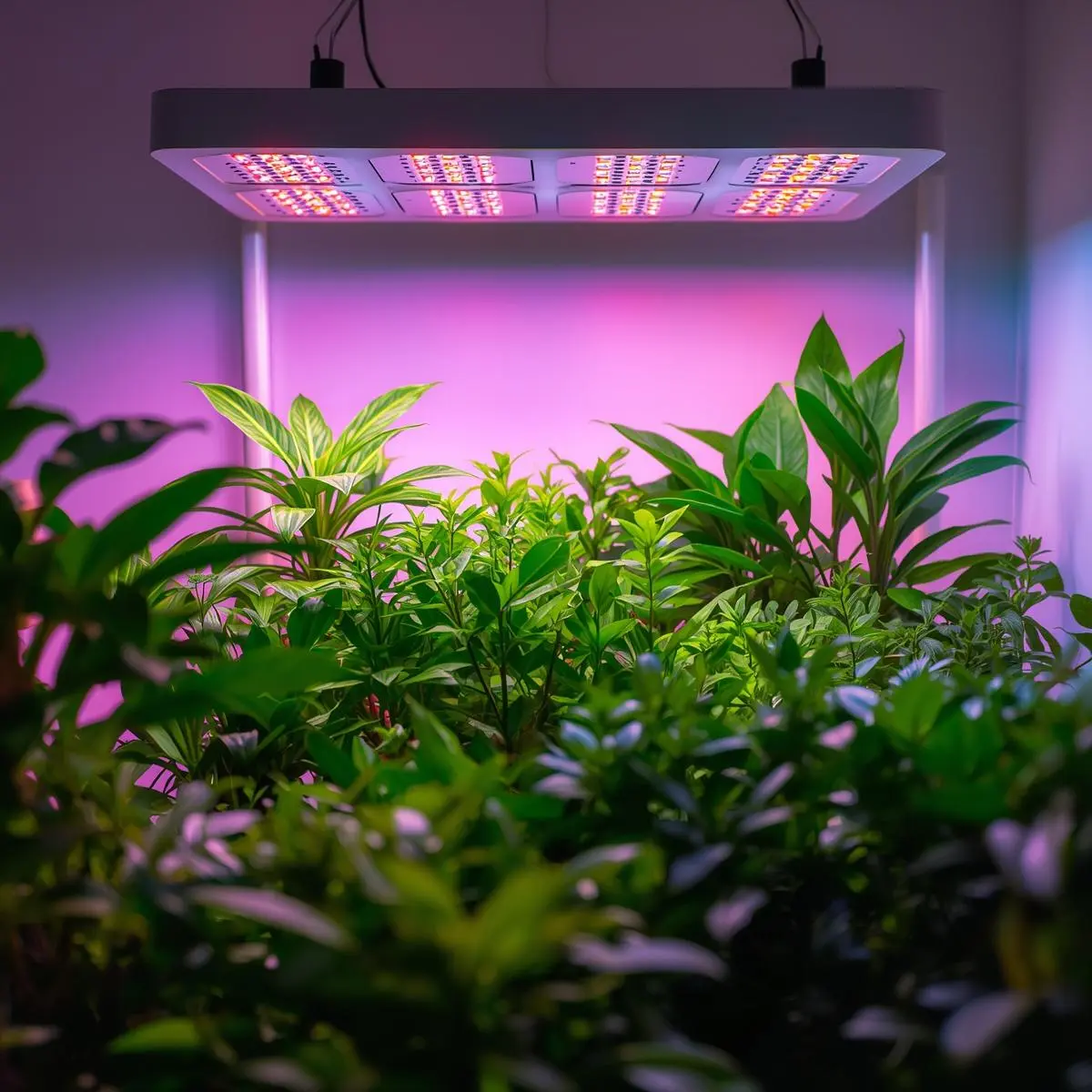
A lot of new growers see “1000 watt LED grow light” on a listing and picture one thing: a serious, commercial-grade fixture that’ll blanket their whole tent in light. Sometimes that’s true. Often, it isn’t even close.
Here’s the catch nobody puts in the title. A “1000 watt LED grow light” might genuinely draw close to 1000 watts from your wall outlet—or it might draw 150 watts and just be labeled “1000W equivalent” because that’s what an old HID bulb it’s replacing used to pull. Same name on the box. Wildly different plant.
That gap matters more than most buying guides admit. It changes how much canopy you can light evenly, how big your harvest realistically gets, how hot your tent runs, and what shows up on your power bill every month. At Grow With Hydroponics, we get questions about this constantly, usually after someone’s already bought the light and is wondering why their corners look sad.
This guide walks through what a 1000 watt LED grow light actually covers, what kind of yield you can reasonably expect, how to estimate running costs before you commit, and the mistakes that trip up almost everyone the first time around.
Quick Answer: A true 1000-watt LED grow light (one that actually draws close to 1000W from the wall) can cover roughly 5×5 to 6×6 feet for vegetative growth and 4×4 to 5×5 feet for flowering. Many “1000W equivalent” lights only draw 150–300 real watts and cover closer to 2×2 to 3×3 feet. Running a true 1000W LED for 12 hours a day costs roughly $54/month at $0.15 per kWh, while a 200W equivalent costs closer to $11/month. Always check the actual wattage and PPFD map, not just the name on the box.
What Does “1000 Watt” Actually Mean on an LED Grow Light?
It can mean two completely different things, and that’s the whole problem. Either the fixture genuinely pulls close to 1000 watts of electricity, or it’s been marketed as a “1000W equivalent” to an old-school HID bulb while drawing a fraction of that.
True 1000W fixtures are big. They’re heavy, expensive, and built for grow rooms that need serious output—think 4×4 tents and larger, or multi-light commercial setups. A “1000W equivalent” LED, on the other hand, is usually a budget panel that might draw anywhere from 100 to 300 actual watts. It’s not necessarily a bad light. It’s just not the light the name suggests.
So how do you tell them apart? You stop reading the headline number and start reading the spec sheet.
- Actual power draw — what the fixture pulls from the wall, in watts, not the “equivalent” claim
- PPFD (Photosynthetic Photon Flux Density) — a measurement of how much usable light actually lands on your canopy, in micromoles per square meter per second
- DLI (Daily Light Integral) — the total amount of usable light your plants get across a full day, which factors in both intensity and photoperiod
- Coverage area — the manufacturer’s recommended footprint for veg versus flower, ideally backed by a PPFD map rather than a marketing graphic
Honestly, the PPFD map tells you more than the wattage ever will. Two lights can both say “1000W” and produce very different amounts of usable light at canopy height.
How Much Space Does a 1000 Watt LED Grow Light Actually Cover?
A true 1000W LED can cover roughly 5×5 to 6×6 feet for vegetative growth and around 4×4 to 5×5 feet once plants move into flowering. A “1000W equivalent” budget light, by contrast, often covers only 2×2 to 3×3 feet—fine for herbs and seedlings, not so much for a full canopy.
Coverage also depends on hanging height, lens angle, and what you’re growing, so treat the numbers below as a starting point rather than gospel.
| Listing type | Typical real wattage | Veg coverage | Flowering coverage | Best suited for |
|---|---|---|---|---|
| Budget “1000W equivalent” panel | 100–200W | 2×2 to 3×3 ft | 2×2 ft | Herbs, seedlings, small trays |
| Mid-range “1000W”-labeled LED | 200–400W | 3×3 to 4×4 ft | 3×3 ft | Small grow tents, leafy greens |
| High-output LED bar fixture | 600–800W | 5×5 to 6×6 ft | 4×4 to 5×5 ft | Productive 4×4–5×5 tents |
| True 1000W LED fixture | 900–1000W | 6×6 ft or more | 5×5 to 6×6 ft | Large grow rooms, multi-plant setups |
Notice that flowering coverage is always smaller than veg coverage. That’s not a typo — flowering plants need higher light intensity, so the same fixture covers a smaller area well once buds start forming. I’ve seen a 5×5 tent packed wall-to-wall under a 600W LED where the center plants looked fantastic and the corner plants just… sulked. Same light, same room, very different outcomes depending on where the canopy sat.
Will a 1000 Watt LED Grow Light Work in a 4×4 Grow Tent?
In most cases, yes — but only if the fixture’s real output lands in that 600–1000W range. A genuine high-output LED in that bracket can light a 4×4 tent evenly from corner to corner. A “1000W equivalent” pulling 150 watts simply won’t have the horsepower.
The goal for a 4×4 space isn’t just brightness in the middle. It’s even PPFD across the whole canopy, so your corner plants aren’t stretching toward the light while your center plants get blasted. Uneven light creates uneven plants, and uneven plants mean uneven harvests.
Before settling on a fixture for a 4×4 tent, look for:
- A published PPFD map showing intensity at the edges, not just dead-center
- Adjustable hanging height to dial things in across growth stages
- Dimmable controls for seedlings and early veg
- Decent ventilation in the tent itself, since more output usually means more heat
- A driver and build quality that won’t quit on you in year two
A Grow Light Calculator can take a lot of the guesswork out of this—plug in your tent dimensions and it’ll help you figure out what PPFD and DLI you’re actually working with at different hanging heights.
Matching Your Light to the Right Tent
A 1000 watt LED is wasted in the wrong-sized tent—too small and you’re cooking your plants, too big and you’re lighting empty space. If you’re still picking out your grow tent, it’s worth getting the dimensions right first.


How Much Yield Can You Get from a 1000 Watt LED Grow Light?
A 1000 watt LED doesn’t hand you a guaranteed yield number — that depends just as much on the crop, the environment, your nutrient program, and your own experience as it does on the light. But there are a few practical ways to estimate what’s realistic.
Estimating Yield by Grams Per Watt
“Grams per watt” is a rough shorthand a lot of growers use to ballpark output relative to actual power draw, not the label on the box.
- Beginner results: roughly 0.3–0.5 grams per watt
- Intermediate results: roughly 0.5–0.8 grams per watt
- Advanced, dialed-in setups: 0.8–1.2+ grams per watt
A true 1000W fixture has the horsepower to support a big harvest — but only if temperature, humidity, airflow, and nutrients are all working together. Drop the light into a poorly ventilated tent with inconsistent feeding, and the wattage stops being the limiting factor. The environment is.
Why DLI Matters More Than Wattage
DLI, or Daily Light Integral, is the total amount of photosynthetically usable light your plants receive over a 24-hour period. Think of PPFD as the brightness at any one moment, and DLI as the total “dose” of light your canopy banks across the whole day.
Since photosynthesis runs on that daily total, DLI has a huge influence on growth rate and final yield — arguably more than the wattage printed on the box. A DLI Calculator lets you match your light’s intensity and your photoperiod to what your specific crop actually needs, instead of just running 12 hours because that’s what the last grower did.
One more thing worth saying: more plants under one light doesn’t automatically mean more total yield. I’ve seen growers cram a tent full of small plants under a single fixture, only to end up with a lower total harvest than a few well-trained plants spread out under the same light would’ve produced.
How Much Does It Cost to Run a 1000 Watt LED Grow Light?
A true 1000W LED running 12 hours a day costs roughly $54 per month at $0.15 per kWh, while a 200W “1000W equivalent” running the same schedule costs closer to $11 per month. That’s not a small gap — it’s nearly 5x.
The formula is simple enough to do on a napkin:
- Take the fixture’s actual wattage, not the label
- Divide by 1000 to get kilowatts
- Multiply by hours run per day
- Multiply by 30 for a monthly estimate
- Multiply by your electricity rate per kWh
So for a true 1000W LED at 12 hours/day: 1000 ÷ 1000 × 12 × 30 = 360 kWh per month. At $0.15/kWh, that’s $54. Run the same math on a 200W equivalent and you get 72 kWh, or about $10.80 a month.
And remember — the light is rarely your only load. Inline fans, water pumps, humidifiers, and especially air conditioning all stack on top of that number. If you’re running a true 1000W fixture in a warm climate, the AC running to offset that heat can end up costing more than the light itself.
How High Should You Hang a 1000 Watt LED Grow Light?
Hanging height depends on the fixture’s real output and your plants’ growth stage, and the manufacturer’s PPFD chart (if they provide one) should always win over generic advice. That said, here’s a starting range that works for most setups.
| Growth stage | Suggested hanging height | Notes |
|---|---|---|
| Seedlings | 30–40 inches | Lower intensity if your fixture is dimmable |
| Vegetative | 24–32 inches | Watch for stretching as a sign it’s too far away |
| Flowering | 18–28 inches | Adjust based on how the canopy responds |
| True 1000W (high output) | 24–36 inches | Stronger lights generally need more distance |
If leaves start bleaching, curling, or drying out faster than usual near the top of the canopy, that’s your light telling you it’s too close — raise it a few inches before you start troubleshooting nutrients or pests. On the flip side, if seedlings are stretching into long, thin stems reaching for the light, lower it gradually. I’ve watched basil seedlings nearly double in height overnight chasing weak or distant light, which is a pretty dramatic way to learn that lesson.
Small adjustments beat big ones. Moving a light six inches and waiting a day or two to see how plants respond is almost always better than cranking the dimmer to full and hoping.
Get the Right Light for Your Space
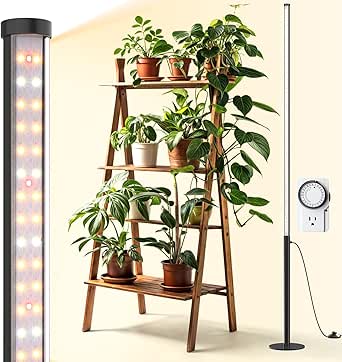
A 1000 watt LED is only the right call if your space, crop, and budget actually line up with what it puts out. If you’re not sure yet, browse a few options below before you commit.



Common Mistakes Growers Make With 1000 Watt LED Grow Lights
- Trusting the title over the spec sheet. “1000W” on the listing tells you almost nothing on its own — the actual wattage in the specs is what matters.
- Ignoring the PPFD map. A light can be strong in the center and noticeably weaker at the edges, which creates uneven growth across the canopy.
- Hanging the light too close, too soon. Powerful LEDs can bleach or stress plants fast. Start higher than you think you need to, then lower it gradually.
- Running full intensity on young plants. Seedlings and early veg don’t need (and can’t handle) full power. Use the dimmer if your fixture has one.
- Forgetting everything else that draws power. Fans, pumps, humidifiers, and AC all add up — sometimes more than the light itself.
True 1000W or “1000W Equivalent”—Which Should You Buy?
Honestly, this comes down to your space more than your budget. A true 1000W LED makes sense if you’ve got a larger canopy, solid ventilation, enough vertical clearance, and crops that can actually use that much intensity. For most beginners, that’s more light—and more heat, and more cost—than they need.
A “1000W equivalent” LED, on the other hand, can be plenty for a small tent, herbs, lettuce, seedlings, or a casual hobby setup. It runs cooler, costs less to operate, and won’t overwhelm a tight space. What it won’t do is light up a large flowering canopy the way a genuine 1000W fixture will.
Shop Smart: Before you buy, pull up the actual spec sheet and check the real watt draw, the PPFD map (ideally showing edges, not just center), flowering coverage area, dimming controls, and warranty. A smaller, well-designed fixture can easily outgrow a poorly engineered “1000W” light—the number on the box is the least useful piece of information here. For a deeper breakdown of PPFD maps and how to read them like a pro, see LED Grow Lights Guide: How to Choose, Use, and Optimize for Indoor Growing (2026).
Setting up a smaller space or a house plant shelf instead? Check out “LED Grow Lights for House Plants.
FAQ: 1000 Watt LED Grow Light
How much space does a 1000 watt LED grow light cover?
A true 1000W LED typically covers 5×5 to 6×6 feet for vegetative growth and 4×4 to 5×5 feet for flowering. Many “1000W equivalent” budget lights only cover 2×2 to 3×3 feet, so always check the actual wattage and PPFD map before assuming coverage.
How much electricity does a 1000 watt LED grow light use?
A true 1000W LED running 12 hours a day uses roughly 360 kWh per month, costing around $54 at $0.15/kWh. A 200W “1000W equivalent” on the same schedule uses about 72 kWh, or roughly $11 a month.
Is a 1000 watt LED grow light good for flowering?
Yes, as long as it delivers enough PPFD evenly across the canopy. Flowering generally calls for higher and more consistent light intensity than seedlings or leafy greens need, so an underpowered “1000W equivalent” may fall short during this stage.
Can a 1000 watt LED grow light burn or stress plants?
Yes—a high-output LED hung too close can bleach leaves, dry out the canopy, or stress plants during flowering. Proper hanging height, dimming on young plants, and good airflow all help prevent this.
Is one 1000W LED better than two smaller lights?
Not necessarily. Two smaller fixtures spread across a tent can sometimes provide more even edge-to-edge coverage than a single powerful light mounted in the center, especially in rectangular spaces. The right choice depends on your tent’s shape and how your canopy is arranged.
Buy the Light That Matches Your Room, Not the Label
A 1000 watt LED grow light can be a genuinely great investment—but the number on the box tells you almost nothing about coverage, yield, or running cost on its own. What matters is the real wattage, the PPFD map, the DLI your crop needs, and how all of that lines up with your tent size and budget.
If you’re working with a small space, a true 1000W fixture is probably overkill—more heat, more cost, more light than your plants can use. If you’ve got a larger canopy, a weak “1000W equivalent” will leave your corners under-lit no matter how the listing reads.
At Grow With Hydroponics, our general advice is to plan around real measurements — actual wattage, PPFD, DLI, and monthly cost — rather than the headline number on a listing. Once your light, space, and environment are actually working together, you’ll notice it pretty quickly: plants stop stretching and start filling out the way they’re supposed to.
