

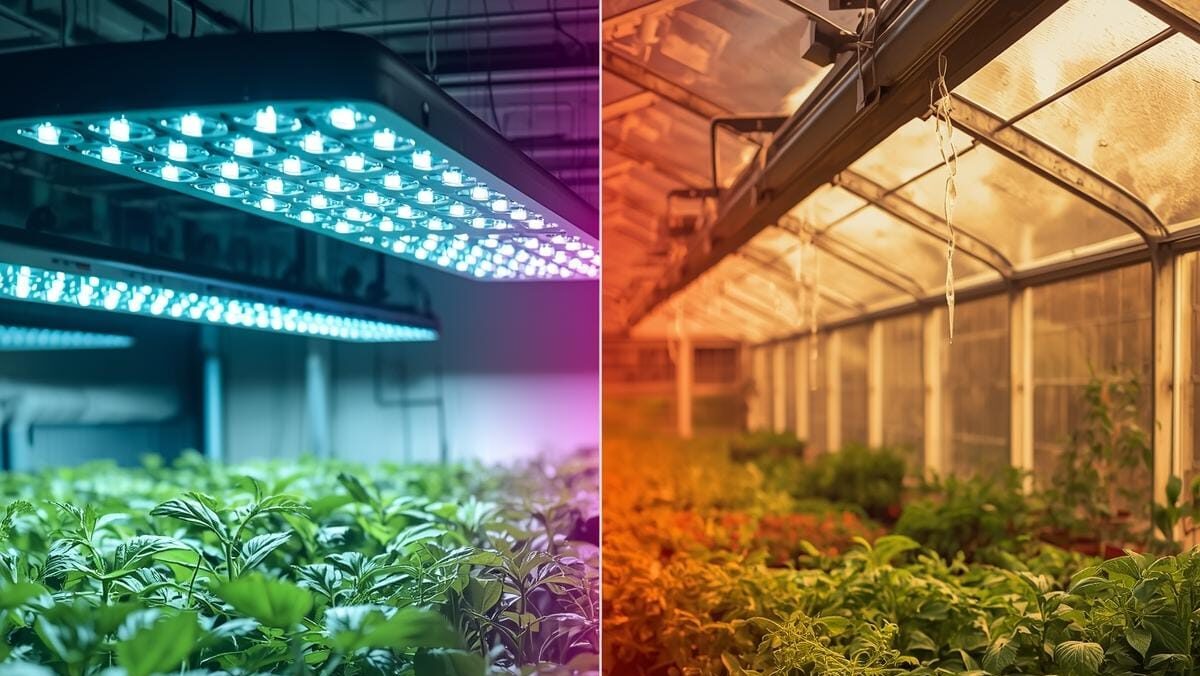
Light is the single most leveraged variable in indoor growing. Get it right and everything else — nutrients, humidity, airflow — starts to fall into place. Get it wrong and no amount of fussing will save your yield. At Grow With Hydroponics, we field more questions about grow lights than any other topic. And the most common mistake we see? Growers assuming there’s one universal answer. There isn’t. The best grow lights for a 4×4 tent running tomatoes are completely different from what you’d choose for a low-profile seedling rack, a mushroom fruiting chamber, or a supplemented greenhouse bay.
This is not an LED-only guide. This is the full picture—LED, T5 fluorescent, CMH (ceramic metal halide), and HPS (high-pressure sodium)—compared honestly so you can match the right technology to your actual situation, budget, and crop. Because that’s what good lighting decisions are built on. Not hype. Not defaults.
Quick Answer
Full-spectrum LED grow lights are the best choice for most indoor growers in 2026. They use less electricity, produce less heat, last longer than HPS or CMH lights, and provide the balanced spectrum needed for seedlings, vegetables, herbs, and flowering crops.
What Are the Best Grow Lights Available for Indoor Growers Today?
Before comparing, it helps to understand what you’re actually choosing between. Each light technology has a distinct profile of strengths, trade-offs, and ideal use cases.
| Light Type | Best For | Efficiency | Heat Output | Entry Cost |
|---|---|---|---|---|
| LED Grow Lights | All stages, tight spaces, energy savings | High | Low | Medium–High |
| T5 Fluorescent | Seedlings, clones, leafy greens, mushrooms | Medium | Very Low | Low |
| CMH / LEC | Veg + bloom, quality and spectrum | Medium-High | Medium | Medium |
| HPS | High-output flowering, commercial scale | Medium | High | Low–Medium |
Think of these as four different tools in a toolbox. A hammer isn’t better than a screwdriver—context decides everything.
How Do Different Plants Respond to Artificial Grow Lights?
Every crop responds differently to artificial light, and understanding that saves you from expensive mistakes.
- Mushrooms — Don’t photosynthesize, but use light as a directional and developmental cue. They need soft, diffused light to trigger fruiting — not intense direct beams that dry out delicate mycelium.
- Leafy greens—Lettuce, kale, and spinach respond best to blue light (400–500 nm), which encourages compact, lush, marketable growth.
- Flowering crops — Tomatoes, peppers, and herbs thrive under red and far-red light (600–800 nm), which drives bloom initiation, fruit set, and yield.
Matching light spectrum to plant type isn’t optional—it’s the foundation of an efficient indoor growing setup. Get this wrong and even premium fixtures underperform.
What Is the Best Grow Light Spectrum for Each Growth Stage?
Light spectrum is where most beginner guides oversimplify. The question isn’t just “red vs. blue”—it’s about matching wavelengths to growth stage and crop type.
| Wavelength | Range | Primary Effect on Plants |
|---|---|---|
| Blue Light | 400–500 nm | Compact vegetative growth, strong roots |
| Red Light | 600–700 nm | Flowering stimulus, fruit set, photosynthesis |
| White / Full-Spectrum | Broad | Balanced development across all stages |
| Far-Red | 700–800 nm | Bloom acceleration, Emerson effect |
Example: A grower running lettuce and herbs side by side in the same rack would do well with a full-spectrum LED or T5 cool white—both deliver enough blue output to keep leafy crops tight while supporting herb aromatics. Swap in an HPS and the yellow-heavy spectrum produces stretched, pale lettuce. That’s a real outcome, not a hypothetical.
For detail, see Full Spectrum vs Red & Blue Grow Lights: Which Is Best for Hydroponic Growth?

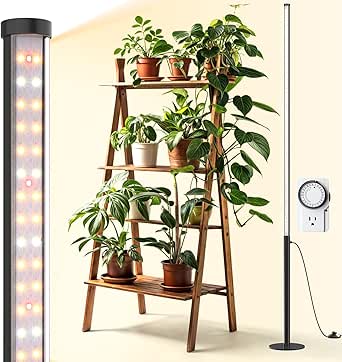


Why Are LED Grow Lights the Most Popular Choice for Best Grow Lights?
LED grow lights have earned their market dominance — and for good reason. Modern full-spectrum LEDs cover the entire photosynthetically active range (400–700 nm), with quality units extending into far-red (700–800 nm) for enhanced flowering response.
Core LED advantages
- 50–70% less power consumption vs. HPS equivalents
- Lifespan up to 50,000 hours — no scheduled bulb replacements
- Low heat output — significantly reduces HVAC burden
- Adjustable light spectrum on premium units
- Compact form factor—ideal for tents, racks, and vertical grows
For mushroom cultivation, LEDs work particularly well. Cool white LEDs (5000–6500K), placed 12–18 inches above the fruiting area on a 12-hour timer, provide reliable fruiting cues without heat that would dry out substrate. Maintaining 80–95% relative humidity is far easier when your lights aren’t radiating warmth into the chamber.
Recommended LED brands:
- Spider Farmer — professional-grade PAR output, widely trusted by serious growers
- Mars Hydro — versatile, commonly used in both hydroponic and mushroom setups
- Viparspectra—budget-friendly full-spectrum options for new growers
Shop Smart: When comparing LED panels, wattage on the box is almost meaningless. Pair your purchase with our DLI Calculator so you’re buying the right fixture for your crop’s actual light needs — not just the brightest one on the shelf.
Are T5 Fluorescent Lights Still Among the Best Grow Lights for Beginners?
Frankly, T5s get undersold. They’re not glamorous. They don’t have RGB controls or companion apps. But for specific applications, nothing beats them on cost-per-performance.
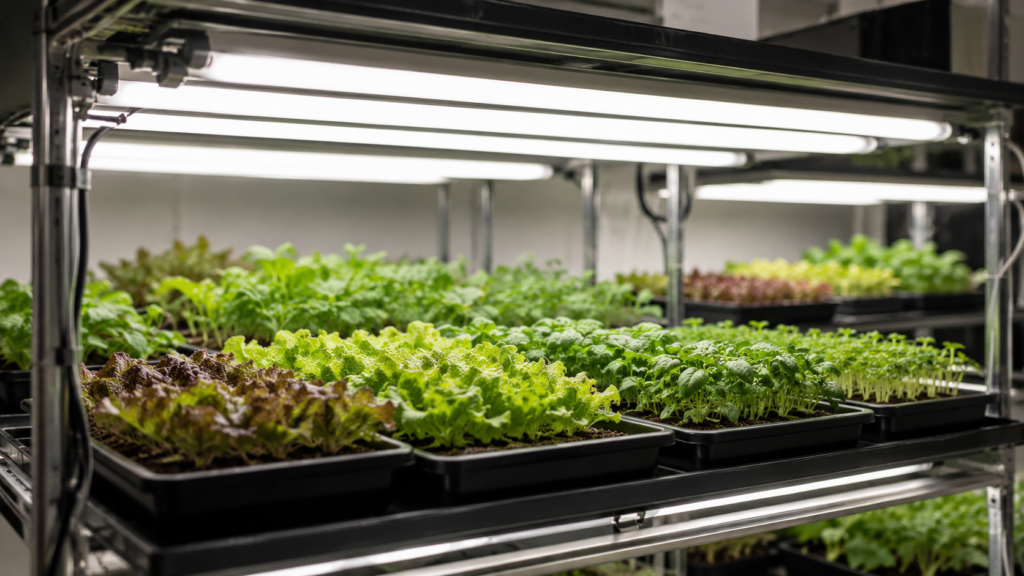
Where T5 fluorescents genuinely excel:
- Seedling and clone propagation — gentle, even coverage with zero heat stress risk
- Leafy greens — lettuce, kale, and spinach thrive under T5’s blue-dominant spectrum
- Mushroom cultivation — cool, diffused light that won’t desiccate mycelium
- Low-clearance racks — T5 bars sit close to canopy without burning
Their ceiling is around 200–300 μmol/m²/s even when stacked, which rules them out for fruiting crops at scale. But a 4-lamp T5 fixture runs around 216W and costs a fraction of an equivalent LED panel. For beginners dialing in propagation or leafy green production, that’s a sensible, low-risk starting point.
And T5s are forgiving. Even if placement isn’t perfect, you’re not going to stress a tray of seedlings. That matters when you’re still learning.
How Do CMH Grow Lights Compare to LED and HPS for Serious Growers?
CMH (ceramic metal halide)—also called LEC (Light Emitting Ceramic)—sits in a genuinely interesting position: more efficient than HPS, more natural-looking spectrum than most LEDs, and widely respected among quality-focused growers.
The defining feature is the broad, continuous spectrum CMH produces. Unlike HPS, which spikes heavily in yellow-orange, or standard LED, which peaks in red and blue channels, CMH covers the visible spectrum more evenly—including UV wavelengths that stimulate terpene, flavonoid, and essential oil production. For aromatics and flowering herbs, that distinction is real.
CMH performance at a glance:
- 315W CMH covers a 3×3 ft footprint effectively
- 630W double-ended CMH suits a 4×4 to 5×5 ft. canopy
- Bulb replacement needed every 10,000–12,000 hours
- Runs warmer than LED, cooler than HPS
- No separate ballast required on most modern units
The trade-off: higher upfront cost than HPS, and a slightly lower efficiency ceiling than top-tier LEDs. But growers who’ve used CMH for quality-driven crops—herbs, specialty flowers, tomatoes—rarely go back. The veg-to-bloom transition especially benefits from CMH’s full-spectrum output, which handles both stages without a light swap.
See How to Grow Roses Hydroponically: Science-Backed Complete Guide (2026).
When Does HPS Still Make Sense as One of the Best Grow Lights?
HPS (high-pressure sodium) isn’t dead. It’s just no longer the default—and it shouldn’t be used by default anymore.
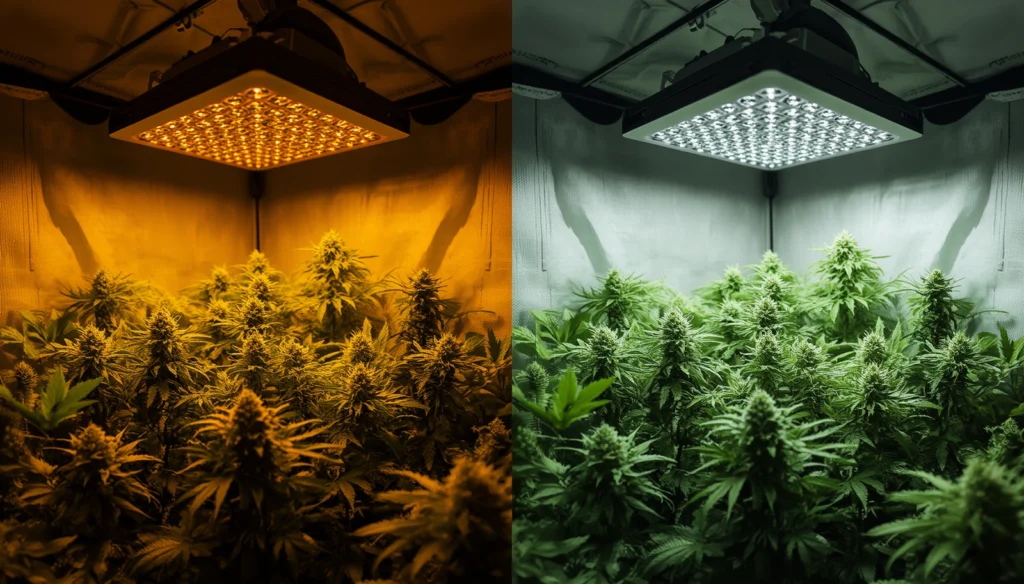
That said, dismissing HPS entirely misses where it still wins. A 1000W HPS fixture pushes 130,000+ lumens and remains hard to beat on raw output per dollar at commercial scale. In large flowering rooms where heat can be actively exhausted, HPS is a proven, cost-effective workhorse.
Where HPS still makes practical sense in 2026
- Large-scale flowering rooms with active HVAC and heat exhaust
- Cold climates where radiant heat from lights is an asset, not a liability
- Commercial operations where upfront fixture cost is the primary constraint
- Supplemental greenhouse lighting where natural daylight covers spectrum gaps
The honest trade-off: HPS runs hot (adding real HVAC load), its spectrum skews yellow-orange (limiting vegetative performance), and bulbs degrade significantly after 10,000–12,000 hours. For home growers or space-constrained setups, operational costs typically outweigh the lower purchase price over any meaningful grow cycle.
How Do You Calculate the Right Amount of Light for Your Grow Space?
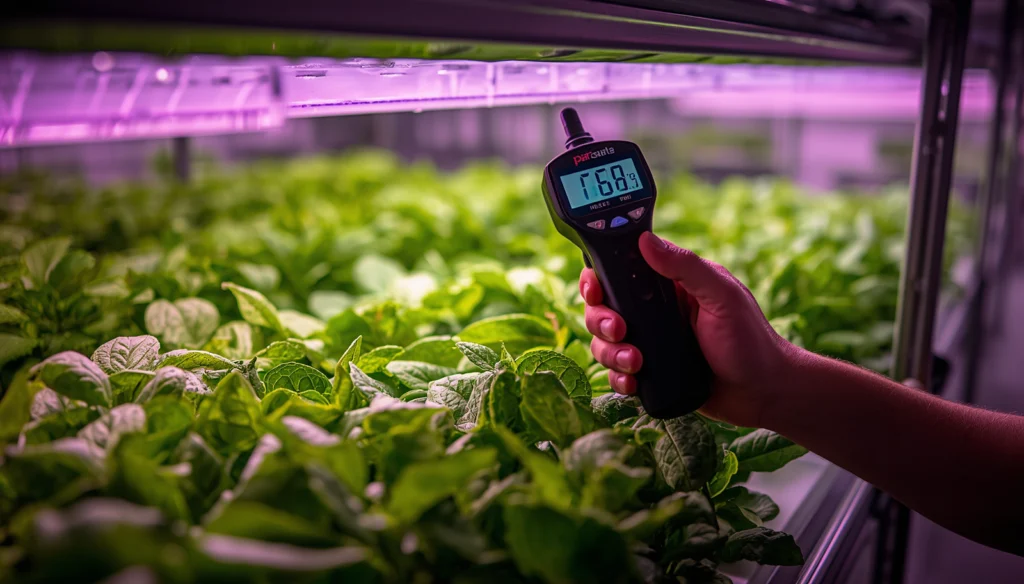
PPFD (photosynthetic photon flux density, measured in μmol/m²/s) is the metric that actually matters — not lumens, not watts. Lumens measure light as human eyes see it. Plants don’t care about that.
| Crop Type | Recommended PPFD (μmol/m²/s) | Best Light Match |
|---|---|---|
| Leafy Greens | 200–400 | T5, LED, CMH |
| Fruiting Crops | 400–700 | LED, CMH, HPS |
| High-Light Fruiting (CO₂ enriched) | 700–1,200 | HPS, high-power LED |
| Mushrooms | 100–200 | T5, cool white LED |
| Seedlings / Clones | 100–250 | T5, low-intensity LED |
Most plants need 2,000–5,000 lumens per sq. ft., while high-demand fruiting crops can push up to 7,000 lumens/sq. ft. But again — measure in PPFD if you want accuracy.
A PAR meter gives you ground truth at canopy level. Manufacturer PPFD charts are measured at ideal distances under ideal conditions. Real-world numbers differ. Measure before you assume you’re hitting target intensity.
Pro tip: Use our Grow Light Calculator to convert PPFD targets into photoperiod recommendations—especially useful when you’re dialing in seasonal light schedules or supplementing natural daylight in a greenhouse.
How to Set Up the Best Grow Lights for Mushrooms Specifically
Mushroom cultivation breaks most of the rules people assume about grow lights—because mushrooms don’t photosynthesize. Light is a trigger, not a fuel source.
What mushrooms actually need:
- Duration: 12 hours of indirect light per day to cue fruiting
- Intensity: Low—100–200 μmol/m²/s is more than sufficient
- Spectrum: Cool white (5000–6500K LED or T5 fluorescent)
- Placement: 12–18 inches above fruiting zone; avoid direct beam exposure
- Heat: Minimal—use T5 or LED specifically to avoid drying the substrate
Placement tips that actually matter:
- Use reflective Mylar or white poly to distribute light evenly without intensifying it
- Run timers to simulate natural day/night cycles—consistency beats intensity
- Keep all electrical components away from misting fans and moisture sources
A waterproof LED strip with adjustable brightness is the cleanest solution for basement or tent mushroom grows. Easy to maintain, easy to time, low risk.
What Are the Best Greenhouse Lighting Strategies for Year-Round Production?
Greenhouse growing introduces a variable that pure indoor growing doesn’t face: existing sunlight. The goal shifts from replacing natural light to supplementing it during low-light periods—winter months, overcast regions, or early morning/evening gaps.
Effective greenhouse supplemental lighting approaches:
- Overhead LED panels — uniform coverage for large, uniform crops (lettuce, herbs, tomatoes)
- Interlighting systems — LED bars positioned between plant rows; improves light penetration in tall canopies
- Hanging light bars — ideal for seedling benches and low-clearance propagation zones
- HPS supplemental lighting — cost-effective for large bays with active temperature management
Modern greenhouse controllers integrate light sensors to dynamically dim or shut off supplemental lighting when natural DLI is sufficient—reducing energy waste without compromising yield consistency.
Explore a Complete Guide on How to Grow Roses Hydroponically.
How Do You Pair the Best Grow Lights with a Hydroponic System?
Hydroponic systems and grow lights are more tightly coupled than most beginners realize. Photosynthesis drives the rate at which plants consume nutrients—increase light intensity and DLI (daily light integral), and your plants will drink faster and eat more.
Core pairing principles
- High-light setups (600+ μmol/m²/s) require more frequent EC monitoring and higher nutrient concentrations
- Switching from LED to HPS mid-grow—or vice versa—means recalibrating your feeding schedule; plants behave differently under different spectra
- Pale, leggy growth is often a light deficiency, not a nutrient issue—rule out light before adjusting your reservoir
- Mushroom hydroponic setups in climate-controlled environments need low-heat LED panels specifically to maintain moisture without extra humidity inputs
Balanced lighting ensures proper nutrient uptake and prevents the stretched, pale growth that signals your light-to-nutrient ratio is off.
Use our Hydroponic Nutrient Calculator to build a feeding schedule that accounts for your specific light intensity and growth stage—rather than using generic manufacturer charts.
What Are the Most Common Grow Light Mistakes Beginners Make?
Some of these are obvious in hindsight. Most aren’t until you’ve ruined a grow.
Mistake 1: Using household bulbs. Standard LEDs and incandescents lack the PAR wavelengths plants need. They produce light humans see—not light plants use.
Mistake 2: Hanging lights too close. Heat stress, tip burn, and bleaching follow. LEDs run cooler but are not immune. Always verify with the manufacturer’s recommended distance and a PAR meter.
Mistake 3: Ignoring the dark cycle. Plants need uninterrupted darkness for respiration and hormonal cycling. Interrupted dark periods stall growth and can prevent mushroom fruiting entirely.
Mistake 4: Overexposing mushrooms. More light means stressed, deformed fruiting bodies and dried-out substrate — not faster harvests.
Mistake 5: Buying on wattage alone. Wattage tells you power draw. PPFD tells you what your plants actually receive. The gap between those two numbers is where bad purchasing decisions live.
How Do You Maintain Grow Lights to Maximize Lifespan?
A clean light is a more efficient light. This is less exciting than spectrum theory but more impactful than most growers expect.
| Light Type | Cleaning Frequency | Bulb Replacement | Watch For |
|---|---|---|---|
| LED | Weekly dust wipe | N/A (~50,000h diode life) | Flickering drivers, dimming output |
| T5 | Monthly | Every 12–18 months | Color shift, reduced output at tube ends |
| CMH | Monthly | Every 10,000–12,000h | Spectrum shift before visible dimming |
| HPS | Monthly | Every 10,000–12,000h | Slow lumen depreciation, color change |
Avoid running any fixture at maximum output continuously. Running LED lights at 80–90% capacity meaningfully extends driver and diode life. For HPS and CMH setups, it reduces heat stress on ballasts and extends bulb consistency.
Are Eco-Friendly Grow Light Options Worth Considering?
Increasingly, yes — with caveats.
Solar-assisted greenhouse lighting is becoming practical for growers in high-sunlight regions who want to offset supplemental lighting costs. Paired with smart controllers and battery storage, some operations run supplemental lighting partially off-grid. The upfront cost is significant; long-term savings are real.
For most indoor growers, the most impactful “green” decision remains switching to high-efficiency LEDs. The energy reduction — often 50–70% vs. HPS — compounds quickly at scale, and the reduced HVAC load multiplies those savings further.
Low-voltage LED strips running on 24V DC systems are gaining traction for small-scale mushroom and propagation setups—minimal energy draw, safe in humid environments.
FAQs About the Best Grow Lights for Indoor and Greenhouse Growing
Q1: How many hours of light do mushrooms need daily?
Around 12 hours of indirect light per day is generally sufficient to trigger and maintain fruiting. Furthermore, consistency matters more than intensity—so stick to a reliable timer schedule.
Q2: Can regular LED bulbs substitute for grow lights?
Not effectively. Standard LEDs are optimized for human vision, not plant photosynthesis. Consequently, they lack the specific PAR wavelengths that drive plant growth. Dedicated grow lights are necessary.
Q3: What’s the difference between CMH and HPS grow lights?
CMH produces a broader, more natural spectrum — including UV — making it better for quality-focused and aromatic crops. HPS delivers more raw lumens per watt in the flowering spectrum but lacks UV coverage and runs significantly hotter. Therefore, the right choice depends on your crop and space.
Q4: What color light works best for seedlings?
Blue and balanced white light spectrum (5000–6500K) encourages compact, stocky seedlings with strong root systems. As a result, T5 cool-white or white LED is typically the recommended choice for propagation.
Q5: Are greenhouse supplemental lights expensive to run?
Not with modern technology. LED grow lights have reduced operating costs dramatically — often 60–70% lower than equivalent HPS setups. Additionally, smart light controllers that dim in response to natural light levels cut costs even further.
Q6: Can I mix different grow light types in one setup?
Yes, and many experienced growers do. For example, a CMH or white LED for broad-spectrum coverage combined with targeted red LED supplementation during bloom is a common and effective hybrid approach.
Q7: How do I know if my plants are getting enough light?
Pale color, elongated internodes (stretching), and slow growth are the classic signs of insufficient PPFD. Accordingly, use a PAR meter or the DLI calculator to verify you’re hitting target intensity—don’t guess.
Light Smarter, Grow Better
The best grow lights aren’t the most powerful ones or the most expensive ones. They’re the ones matched to your crop, your space, and your growth stage. A T5 rack outperforms a 600W HPS for mushroom cultivation. A 315W CMH outperforms a budget LED panel for herb quality and aromatics. Context is everything.
Whether you’re setting up a compact mushroom fruiting chamber, a hydroponic leafy green system, or a year-round supplemented greenhouse, the framework stays the same: identify your crop’s PPFD target, choose the light type best suited to your heat tolerance and space, and verify with measurement—not guesswork.
Grow With Hydroponics has the calculators, tools, and guides to help you dial in every variable — starting with your lights. Everything else gets easier from there.
