

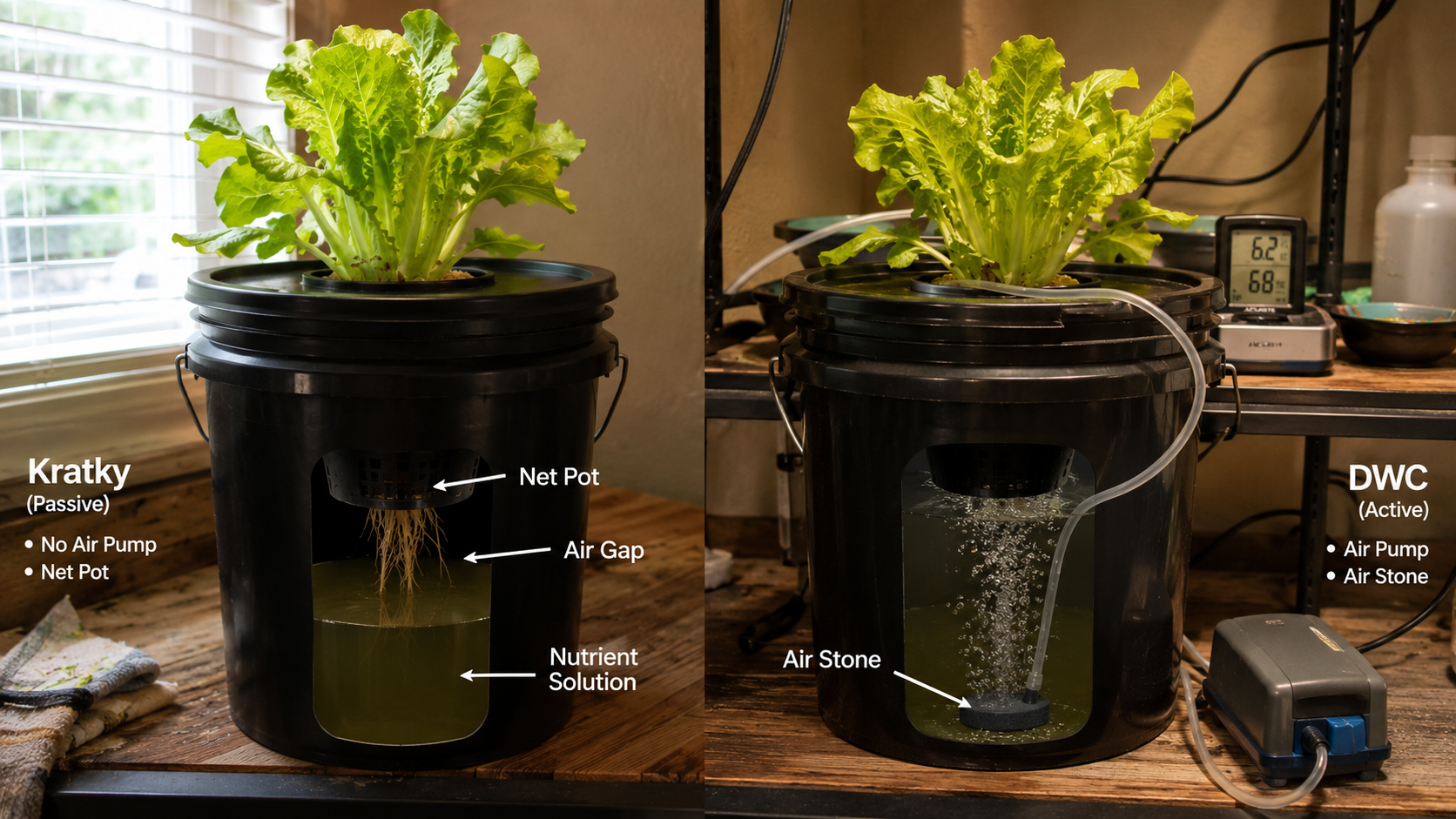
If you’ve killed a Kratky lettuce jar in July because the water turned murky and warm, you already understand the whole debate between these two systems in one gut-punch of a lesson. Kratky and Deep Water Culture, or DWC, both grow plants with their roots hanging in nutrient solution — no soil, no drip lines, no timers running all day. The difference comes down to one thing: how oxygen gets to those roots. At Grow With Hydroponics we get this question constantly from people setting up their first system, and the honest answer is that neither method is “better” in a vacuum. It depends on what you’re growing, how much you want to babysit it, and whether you’re okay running an air pump 24/7.
This guide walks through how each system actually works, where each one breaks down, and which crops and setups favor Kratky vs DWC so you’re not guessing.
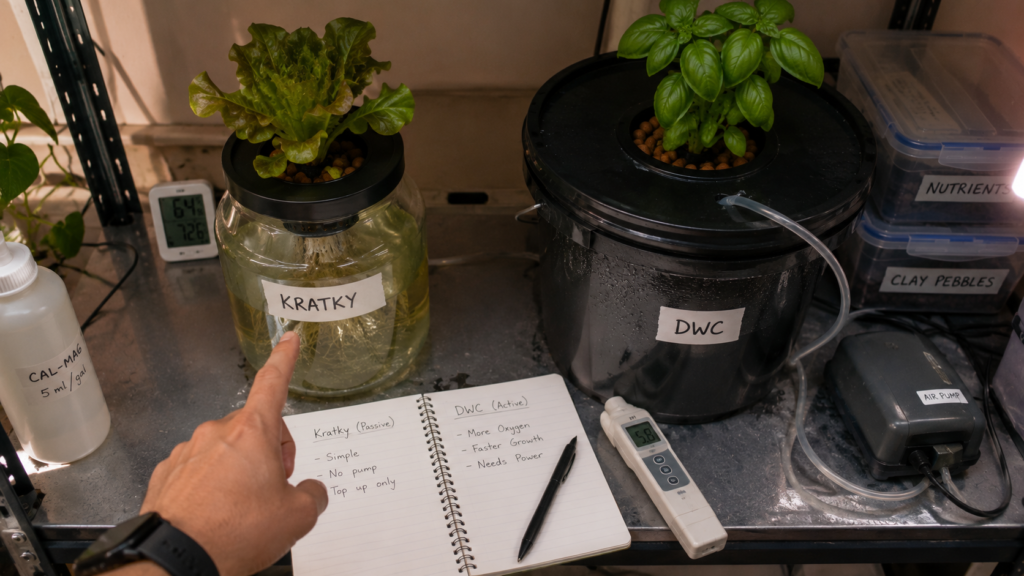
Quick answer: Kratky is a pump-free passive system where a shrinking air gap oxygenates the roots as plants drink the solution — best for lettuce, herbs, and other fast, short-cycle crops. DWC uses a continuously running air pump and stone to keep roots fully submerged in oxygenated water, supporting longer cycles and heavier feeders like tomatoes and peppers, at the cost of ongoing maintenance and electricity.
What Is the Kratky Method?
The Kratky method is a non-circulating hydroponic technique where plant roots hang above a reservoir of nutrient solution with no pump, air stone, or electricity involved at all. It was developed by B.A. Kratky, a horticulturist at the University of Hawai’i, who first described the suspended-pot, non-circulating approach in a paper presented at the South Pacific Soilless Culture Conference. [1] His later commercial-scale version used a shallow tank lined with polyethylene sheeting, filled with nutrient solution and topped with a rigid sheet that the plants sit on [2].
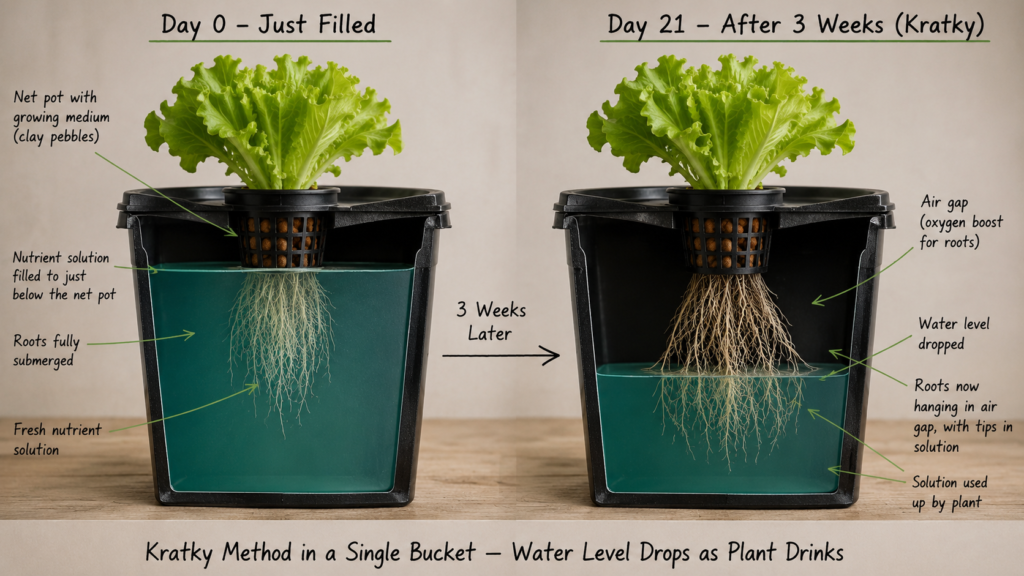
Here’s the mechanism that makes it work. A seedling sits in a net pot with its roots partly submerged. As the plant drinks, the water level drops on its own, and that drop opens up an air gap between the water surface and the bottom of the lid. Roots that end up in that gap get direct access to atmospheric oxygen, while the roots still underwater keep pulling nutrients. No refill, no top-off, no pump — you fill the reservoir once at planting and don’t touch it again until harvest.
That simplicity is also the limit. Because nothing replenishes the solution, the whole crop cycle has to fit inside whatever nutrients and water you started with. Fast, small, shallow-rooted crops finish before that runs out. Big, thirsty, long-season plants don’t.
Best Crops for Kratky
Kratky shines with leafy greens and quick herbs — think lettuce, spinach, arugula, basil, and similar crops that finish in a handful of weeks. Tomatoes and peppers are technically possible, but they need a much larger reservoir (commonly cited in the 8 to 15 liter range per plant for fruiting crops) and closer nutrient monitoring than the “set it and forget it” reputation suggests. Root vegetables like carrots and potatoes generally don’t work at all, since they need to develop below the waterline rather than reach into open air.
What Is Deep Water Culture (DWC)?
DWC is an active hydroponic system where plant roots stay fully or mostly submerged in nutrient solution that’s continuously oxygenated by an air pump and air stone. Unlike Kratky, DWC doesn’t rely on a shrinking air gap — it keeps the water itself saturated with dissolved oxygen so submerged roots don’t suffocate.
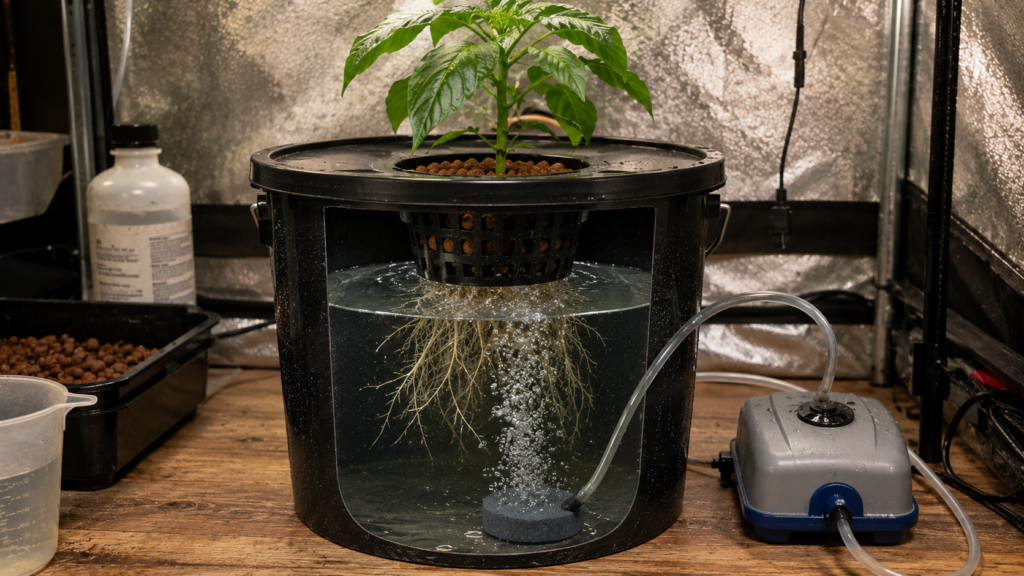
The setup is similar on the surface: net pots holding the plants, sitting in lids over a reservoir. The real difference is what’s happening underwater. An air stone connected to a pump pushes a steady stream of bubbles through the solution, which does two things — it physically agitates the water so it doesn’t stagnate, and it raises the dissolved oxygen (DO) content that roots pull from directly. As a rule of thumb, dissolved oxygen levels at or above 5 mg/L are considered the healthy range for submerged roots, with anything lower flagged as detrimental and potentially fatal to the plant.[^3] That threshold is really the whole reason DWC needs a pump running around the clock — without it, warm standing water simply can’t hold enough oxygen to keep fully submerged roots alive for long.
Because DWC doesn’t force you to size the reservoir around a fixed nutrient budget the way Kratky does, growers top off water and rebalance nutrients as the crop goes, which opens the door to longer-cycle, heavier-feeding plants.
Shop Smart: Air Pumps & Stones for DWC
If you’re going the DWC route, don’t cheap out on aeration — it’s the one part of the system doing all the oxygen work. A quiet, reliably-sized pump and a fine-bubble air stone are worth the extra few dollars.


Kratky vs DWC: How Oxygen Actually Reaches the Roots
This is the one mechanism that explains almost every practical difference between these two systems, so it’s worth slowing down on.
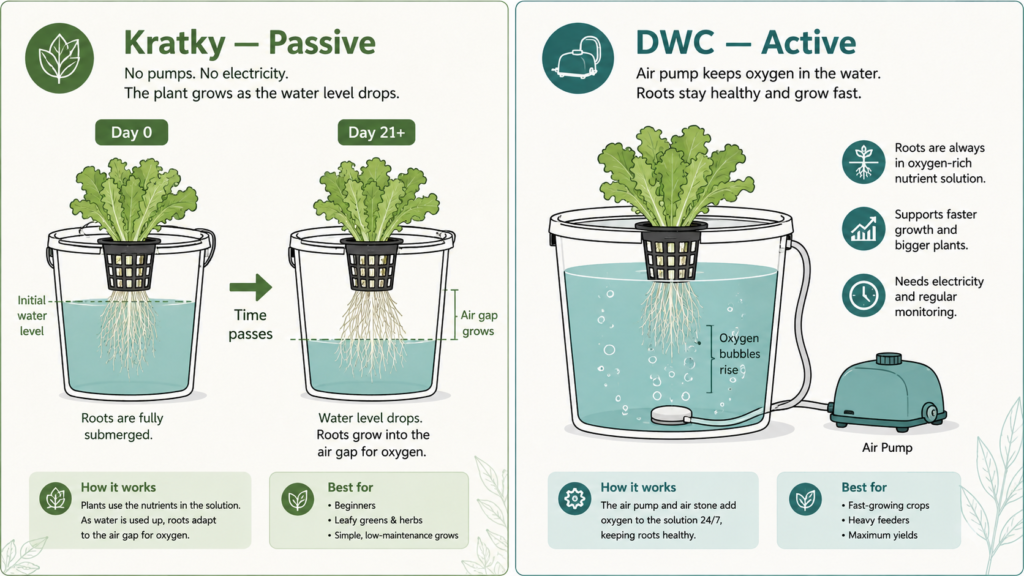
In Kratky, oxygen delivery is passive and self-adjusting. As the plant drinks, the air gap grows automatically, so oxygen supply roughly tracks the plant’s growing root mass without you doing anything. The catch is that this only works while the water level is still dropping in the right direction — it can’t recover from a mistake. If someone accidentally tops off a Kratky reservoir mid-cycle, the air gap disappears and previously oxygenated roots go back underwater, which commonly triggers rot.
In DWC, oxygen delivery is active and constant, driven entirely by the pump. That gives you more control — you can push DO higher during a heat wave, run larger reservoirs, and support crops that would drain a Kratky bucket dry. But it also means the system has a single point of failure. Cut the power for a few hours during a warm spell and dissolved oxygen can crash fast, since warm water simply can’t hold as much oxygen as cool water — saturated DO falls from roughly 9.1 mg/L at 68°F down toward 7.6 mg/L at 86°F as the water warms [4].
Water temperature matters in both systems, but it bites differently. Cornell University’s Neil Mattson has pointed out that larger DWC reservoirs generally hold a bigger buffer of dissolved oxygen and are less prone to sudden temperature and pH swings than smaller setups — but that same buffer gets squeezed in summer, since warmer water holds less oxygen right as faster-growing roots are respiring, and consuming that oxygen, more quickly. [5] A Kratky jar sitting in direct afternoon sun has no pump to compensate for that dip; a DWC reservoir at least has continuous aeration fighting back.
Common Mistakes With Each System
In Kratky: the single biggest mistake is topping off the reservoir instead of letting the level drop. A close second is starting the water level too high, which drowns the roots and prevents air roots from ever forming properly. Undersized containers for fruiting crops is the third — a tomato in a 3-liter jar will drain it and concentrate salts to root-burning levels within days.
In DWC: the most common failure is a pump that stops or an air stone that clogs without anyone noticing for a day or two, since warm, still water in a DWC bucket goes stagnant faster than most growers expect. Skipping reservoir cleaning is close behind — because DWC solution is topped off rather than fully replaced each cycle, organic buildup and pathogen load (notably Pythium, the root-rot organism) accumulate if the tank isn’t flushed periodically.
If you’re not sure which symptoms point to oxygen starvation versus a nutrient problem, our plant health diagnosis tool walks through the visual differences between root rot, deficiency, and lockout so you’re not guessing at 11pm over a wilting seedling.
Kratky vs DWC: Side-by-Side Comparison
| Factor | Kratky Method | DWC |
|---|---|---|
| Power required | None | Air pump, continuous |
| Best crops | Lettuce, herbs, spinach, short-cycle greens | Lettuce, herbs, and with larger setups: tomatoes, peppers, cucumbers |
| Maintenance | Very low — fill once, harvest | Moderate — top off water, monitor pump, periodic reservoir cleaning |
| Typical cycle length | 25–55 days for most leafy crops | Can run much longer with topping off |
| Startup cost | Low (container, net pots, nutrients) | Low–moderate (adds air pump and stone) |
| Oxygen delivery | Passive air gap, self-adjusting | Active aeration, constant |
| Failure risk | Topping off water by mistake; high water temps with no recovery mechanism | Pump failure or clogged air stone going unnoticed |
| Scalability | Limited by fixed nutrient budget per cycle | More scalable with reservoir top-offs |
Kratky vs DWC Decision Checklist
Run through these questions before you build either one:
- Do you have reliable power where the system will sit? No → Kratky. Yes → either works.
- Are you growing lettuce, herbs, or other fast greens only? Yes → Kratky is simpler and cheaper for this. No, you want tomatoes or peppers → lean DWC or a larger-format Kratky build.
- Can you check on the system daily? No, you travel often → Kratky’s hands-off nature is safer. Yes, you’re around → DWC’s higher yield potential becomes more accessible.
- Does your grow space get hot in summer? Yes → DWC’s active aeration gives you more room to recover from a dissolved-oxygen dip; a neglected Kratky jar has no such backup.
- Is this your first hydroponic build? Kratky is the lower-risk, lower-cost way to learn the fundamentals before adding pumps and monitoring to the mix.
Shop Smart: Starter Kits for Either System
Whether you landed on Kratky or DWC, a pre-sized starter kit takes the guesswork out of container and net pot sizing for your first cycle.


Frequently Asked Questions
Can you convert a Kratky system into DWC? Yes — adding an air pump and air stone to a Kratky reservoir effectively turns it into a DWC setup, since continuous aeration is the defining feature that separates the two methods. Some growers do this mid-cycle in hot weather specifically to prevent the dissolved oxygen crash that stagnant, warm Kratky water is prone to.
Which grows faster, Kratky or DWC? Growth rates in side-by-side trials have gone both ways depending on setup and crop. One student research comparison found that Kratky-grown plants eventually caught up to and surpassed early DWC growth, even though the DWC plants had a faster start.[6] In practice, differences often come down to reservoir size, water temperature control, and how consistently the grower manages each system rather than the method itself having a fixed speed advantage.
Is Kratky or DWC better for beginners? Kratky is generally the easier starting point because there’s no equipment to fail — no pump to clog, no power outage to worry about — which makes it a lower-stakes way to learn pH and nutrient basics. DWC adds a small amount of complexity but opens the door to a wider range of crops once you’re comfortable.
Why is my Kratky water turning cloudy or smelly? Cloudy or foul-smelling Kratky water usually means the solution has warmed up enough for algae or bacteria to take hold, or that the air gap closed up because water was mistakenly added back. Keeping the reservoir opaque, out of direct heat, and never topped off addresses most cases.
Do I need an air pump for DWC even in a small bucket? Yes — a pump and air stone are what define DWC and keep dissolved oxygen high enough for fully submerged roots to survive; without one, you effectively have a stagnant bucket rather than a functioning DWC system.
Final Thoughts
Neither Kratky nor DWC is the universally “right” system — they’re solving the same oxygen problem with opposite strategies, one passive and self-limiting, the other active and more capable but dependent on equipment. Start with Kratky if you want the lowest-risk way to learn hydroponic basics on lettuce and herbs, and move toward DWC once you’re ready to run longer cycles or take on fruiting crops. Grow With Hydroponics has guides for both paths, and if you’re still narrowing down which setup fits your space, our complete hydroponic system guide covers how these two stack up against NFT, wick, and ebb-and-flow builds as well.
Sources
[1] Kratky, B.A. — non-circulating hydroponic method, Acta Horticulturae 648 (2004), South Pacific Soilless Culture Conference proceedings. Source: ctahr.hawaii.edu (University — primary source).
[2] Kratky, B.A. — commercial-scale suspended-pot system, Acta Horticulturae 843 (2009). Source: ctahr.hawaii.edu (University — primary source).
[3] Dissolved oxygen thresholds for submerged plant roots. Source: blog.hannainst.com (manufacturer technical resource, water-quality instrumentation).
[4] Saturated dissolved oxygen vs. water temperature (68°F–86°F range). Source: frontrowag.com (commercial grower technical resource, citing physical constants).
[5] Reservoir size, temperature/pH stability, and summer oxygen demand in DWC. Neil Mattson, Cornell University, quoted via urbanagnews.com (university researcher, quoted in trade publication).
[6] Comparative Kratky/DWC growth-rate trial. Source: projectboard.world, Ohio Academy of Science student project (educational program — single student trial, not a peer-reviewed controlled study; treat as illustrative rather than definitive, which is why the article hedges this claim).
