

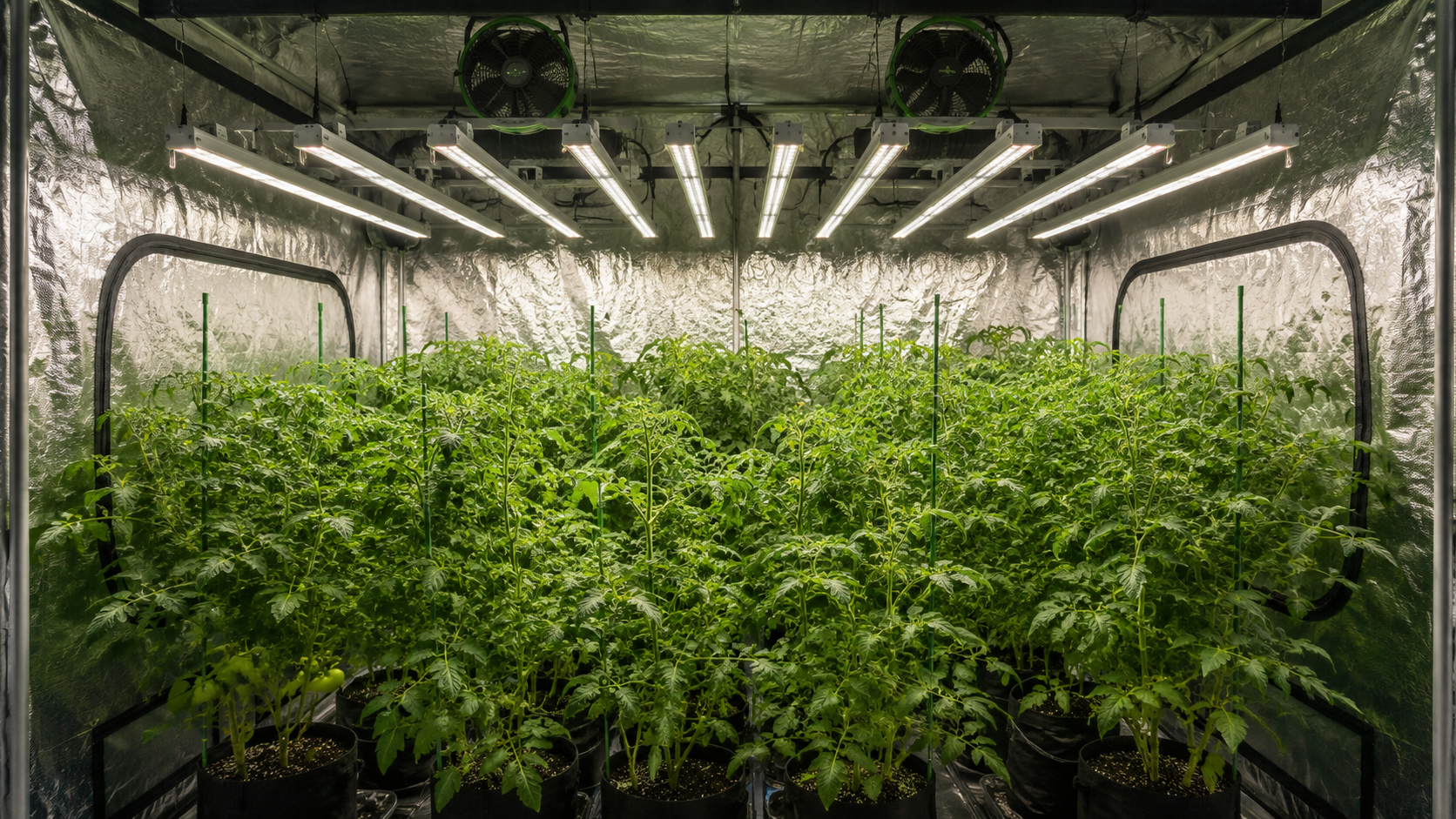
Here’s the problem with most best LED grow lights guides: they’re written around affiliate commissions, not around your actual growing space. You’ll find a list of fixtures with vague descriptions, a few star ratings, and zero usable guidance on whether any of them will actually work in your 2×2 closet or your 5×5 tent.
The specs that matter — PPFD output, PPE efficiency, uniformity ratio, actual watt draw — are buried or missing entirely. And then growers end up buying lights that look impressive on paper but leave half the canopy dim. At Grow With Hydroponics, we’ve worked through enough of these scenarios to know: the fixture is rarely the problem. The sizing process is. This guide fixes that.
Whether you’re starting with a countertop herb kit, a 2×2 closet, or a 4×4 flowering tent, here’s exactly how to choose the best LED grow lights for your space — with real numbers, not marketing language.
Quick Answer The best LED grow lights match your grow space footprint, crop type, and PPFD requirement — not just wattage. For small spaces (2×2 ft), 100–200W true-draw fixtures work well. For a 4×4 tent in flower, you need 300–480W actual draw delivering 600–900 µmol/m²/s at canopy level. Look for PPE above 2.5 µmol/J, demand a real PPFD map, and ignore “equivalent watt” claims. They’re meaningless.
What Actually Matters When Choosing the Best LED Grow Lights
The best LED grow lights are chosen by three numbers: PPFD, PPE, and actual watt draw. Everything else is packaging.
Why PPFD Beats Wattage Every Time
PPFD (Photosynthetic Photon Flux Density), measured in µmol/m²/s, tells you how much usable light actually reaches your plants at canopy level. Wattage only tells you how much electricity the fixture consumes. Two lights drawing the same 400W from the wall can deliver wildly different PPFD — depending on diode quality, driver efficiency, and optical design.
This is the biggest trap in the hobby market. A light marketed as “1000W equivalent” might draw 100–200W actual from the wall. It’s not equivalent to a real 1000W HPS. Not even close. Honest manufacturers publish a PPFD map — a grid showing light intensity across the full footprint at a specific mounting height. If there’s no PPFD map, move on.
What PPE Tells You About Running Costs
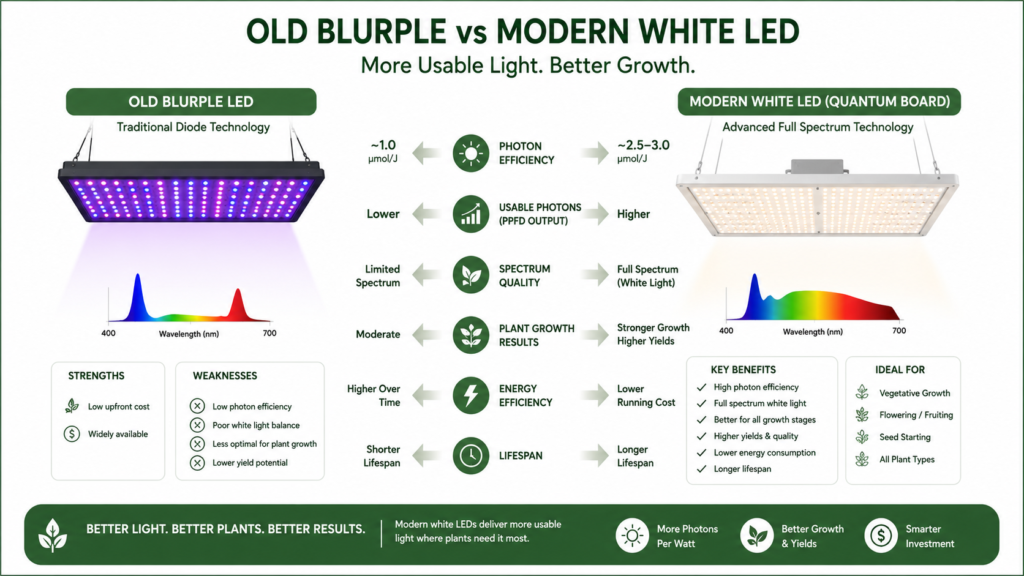
PPE (Photosynthetic Photon Efficacy) measures how many usable photons you get per joule of electricity, expressed as µmol/J. It’s the number that determines what your light costs to run long-term.
Here’s the 2026 benchmark landscape:
- Below 2.0 µmol/J: Budget/blurple tier. Outdated technology.
- 2.0–2.4 µmol/J: Entry-level. Fine for herbs and seedlings.
- 2.5–2.8 µmol/J: Mid-range performance. The minimum for serious growing.
- 2.8–3.0 µmol/J: Premium efficiency. The sweet spot for home grows.
- Above 3.0 µmol/J: Top-tier. Worth the premium for permanent installations.
Most reputable fixtures in 2026 use Samsung LM301B or LM301H EVO diodes, which sit solidly in the 2.7–3.0 µmol/J range. Anything below 2.5 µmol/J at current market prices means you’re overpaying per photon, full stop.
How to Size Your LED Grow Light by Space
Size your light to your footprint first. Then check PPFD. Then check PPE. This order matters.
Best LED Grow Lights for Small Spaces (Countertops, Shelves, and 2×2 Tents)
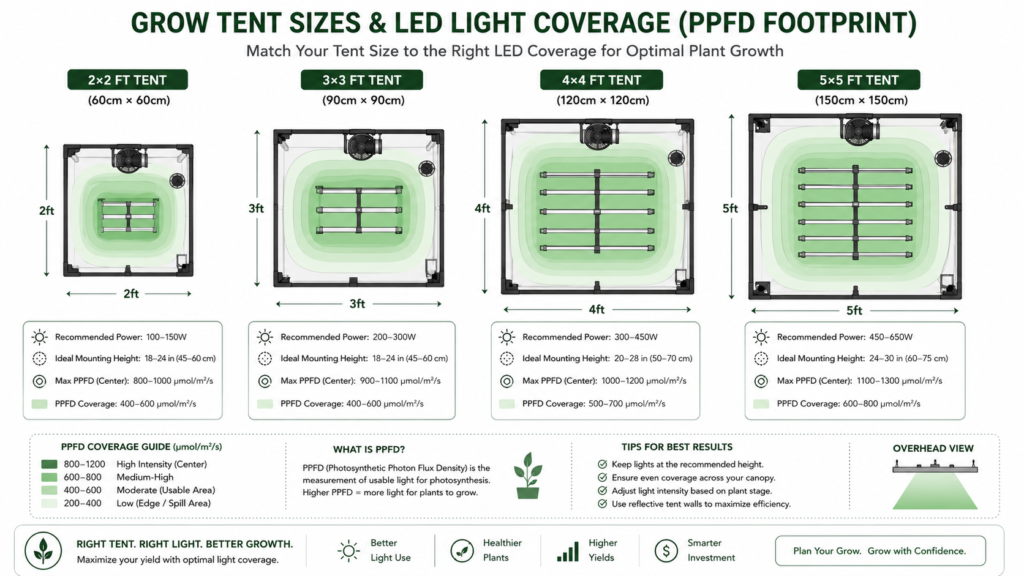
Small spaces are where most beginners start — and where most beginners make the same sizing mistake. A 100–200W true-draw quantum board or compact bar array is the right tool for a 2×2 ft (60×60 cm) footprint.
Leafy greens and herbs need a PPFD of 200–400 µmol/m²/s at canopy level. Seedlings need less — around 150–250 µmol/m²/s. For those crops in a small space, a 100W fixture running at moderate mounting height handles the job without burning leaves or running up electricity costs. You don’t need more. A 700W bar array over a tray of basil is genuinely wasteful.
For open shelving or countertop hydroponic kits — the kind you’d run in a kitchen or spare room — T5 or T8 bar-style LED strips are practical. They mount flat under shelves, run cool, and deliver consistent PPFD across trays of lettuce or herb seedlings. For a 1ft × 4ft shelf section, a 40–60W T8 bar running 16 hours delivers workable DLI for leafy greens without taking up visual space or generating heat in a living area.
The one caveat for small spaces: if you’re flowering in a 2×2 tent, PPFD needs to climb to 600–800 µmol/m²/s at canopy level. A 150W quality fixture (2.5+ µmol/J) handles this at appropriate mounting height. Anything drawing less than 100W won’t consistently hit flowering PPFD targets in a 2×2.
Best LED Grow Lights for Mid-Size Spaces (3×3 and 4×4 Tents)
The 4×4 tent is the most common home grower footprint, and it’s where sizing gets more consequential. Underpowering it is the single most common reason home growers see disappointing harvests from fruiting crops.
For a 3×3 ft flowering tent: 200–300W actual draw, targeting 600–800 µmol/m²/s at canopy. A quality 240W quantum board from brands like Spider Farmer, Mars Hydro, HLG, or AC Infinity covers this footprint well.
For a 4×4 ft flowering tent: 300–480W actual draw, targeting 600–900 µmol/m²/s average across the canopy. This is the tier where bar-style fixtures start outperforming single-board panels — the distributed diode array reduces the centre-heavy PPFD distribution and delivers more even light to the corners. A light that reads 1,000 µmol/m²/s dead centre but 400 at the edges is leaving a quarter of your plants behind.
At this footprint, check PPFD uniformity. You want a minimum-to-average ratio above 0.7. That means if the average canopy PPFD is 700 µmol/m²/s, the weakest point shouldn’t drop below 490. Manufacturers who publish honest PPFD maps include this ratio. Those who don’t are usually hiding something.
Mounting height directly affects PPFD uniformity — raising or lowering your fixture by a few centimetres changes the distribution across the canopy significantly. Once you’ve settled on a fixture, spend 20 minutes with a PAR meter verifying actual canopy readings before you commit to a final hanging position.
Best LED Grow Lights for Large Spaces (5×5 Tents and Grow Rooms)
At 5×5 ft and above, a single fixture almost always produces worse uniformity than two or more smaller fixtures. The physics work against you — a single point source, no matter how powerful, struggles to deliver even PPFD across 25+ square feet of canopy.
For a 5×5 ft tent: 500–650W actual draw. Two 300W bar arrays positioned to overlap coverage zones consistently outperform a single 600W unit in edge-to-edge uniformity.
For grow rooms over 50 sq ft: plan around target PPFD and total PPF output, not fixture count. A room targeting 800 µmol/m²/s across 60 sq ft of canopy (5.6 m²) needs roughly 2,240 µmol/s total PPF. At 3.0 µmol/J efficiency, that’s about 745W of actual draw. Divide by fixture size based on your ceiling height and hanging options.
High-CO₂ grow rooms are a different animal. With supplemental CO₂ at 1,000–1,500 ppm, most fruiting crops can productively use 1,000–1,500 µmol/m²/s. That’s substantially more than ambient-CO₂ targets — so if you’re running CO₂, you need significantly more light than the standard fixtures. Try our free CO₂ Calculator for Grow Rooms (Plants ppm, Flow Rate & Runtime Tool).


LED Grow Light Types: Which Format Fits Your Space?
Quantum Boards
Quantum boards spread a large number of diodes across a flat panel, creating even light distribution and lower operating temperatures per diode. They’re the dominant format for 2×2 to 4×4 spaces. Cooler-running diodes extend fixture lifespan. The wide distribution makes them naturally better-suited to square footprints. Most top-performing hobbyist fixtures in 2026 are quantum boards or bar-style variants of the same concept.
Bar-Style Arrays
Bar lights arrange LEDs across multiple long strips extending from a central spine — the “spider” or “multi-bar” design. The wider spread of diodes across the footprint produces superior uniformity for 4×4 and larger footprints, especially in corner PPFD. For 5×5 and larger, bar-style is consistently the better choice. Brands like Gavita, Photontek, AC Infinity Ionframe EVO, and Mammoth Nova produce commercial-grade bar arrays for home use.
T5/T8 Strip Lights for Shelving and Small Spaces
For seed starting, countertop herb gardens, and supplemental shelf lighting, T5/T8 LED bars are practical and cost-effective. They mount flush under shelving, daisy-chain simply, and deliver consistent PPFD across flat, shallow growing trays. They’re not fixtures for serious flowering — maximum PPFD is limited and coverage is shallow. But for growing microgreens, starting seedlings, or keeping a kitchen herb tray alive year-round, they do exactly what’s needed without overhead.
How to Match PPFD to Your Crop
| Crop Type | Target PPFD (µmol/m²/s) | Daily Light Hours | Typical Fixture Size |
|---|---|---|---|
| Seedlings / clones | 150–250 | 18 hrs | 50–100W (any format) |
| Microgreens | 200–300 | 12–16 hrs | T5/T8 bars, 40–80W |
| Lettuce / spinach | 200–400 | 14–16 hrs | 100–200W / 2×2 to 4×4 |
| Herbs (basil, cilantro) | 250–450 | 14–18 hrs | 100–200W / 2×2 to 4×4 |
| Strawberries | 400–600 | 14–16 hrs | 200–300W / 3×3 to 4×4 |
| Tomatoes / peppers (veg) | 400–600 | 18 hrs | 300–480W / 4×4 |
| Tomatoes / peppers (flower) | 600–900 | 12–14 hrs | 300–480W / 4×4 |
| High-intensity crops + CO₂ | 1,000–1,500 | 12–16 hrs | 600W+ / 5×5 and up |
Use our free Grow Light Calculator — Advanced PPFD Grid, DLI & Crop Optimizer to model your specific space, hanging height, and crop combination before committing to a fixture. It removes the guesswork from the sizing process entirely.
5 Mistakes That Make Even Good LED Grow Lights Underperform
Frankly, most light-related problems aren’t caused by bad fixtures. They’re caused by one of these five things:
- Buying advertised wattage, not actual draw. A “1000W” light often draws 150–200W from the wall. Always find the true power consumption, usually buried in the spec sheet.
- Using vegetative coverage claims for a flowering setup. Advertised coverage areas almost always describe vegetative targets. For flowering, that footprint shrinks — usually by 25–40%.
- Ignoring uniformity. A PPFD of 900 in the centre and 300 at the corners is a problem. Check the map, not just the headline number.
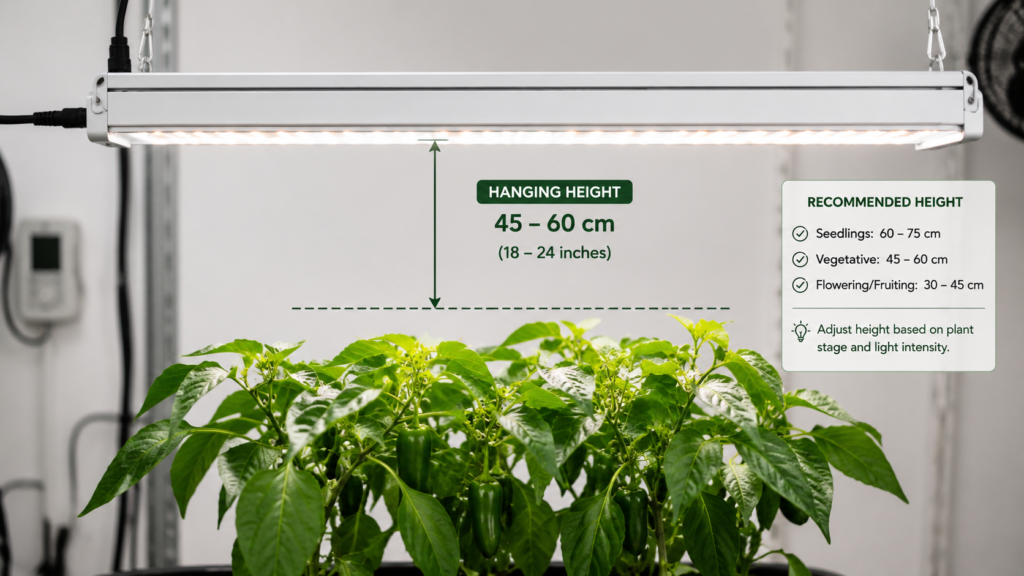
- Wrong mounting height for the fixture design. Moving a 480W bar from 24 inches to 18 inches above the canopy can double PPFD at the centre and burn the tops. Adjust gradually and measure.
- Skipping the PAR meter check after install. Set it and forget it isn’t a strategy for lighting. Take 12–15 PPFD readings across the canopy after installation. If the corners read below 60% of the centre, you have a uniformity problem that dimming won’t fix.
🛍️ Shop Smart: Verified LED Grow Lights by Footprint
Our Shop Smart page organises LED grow lights by grow space size, so you’re comparing real specs — not marketing copy — across the right options for your footprint.

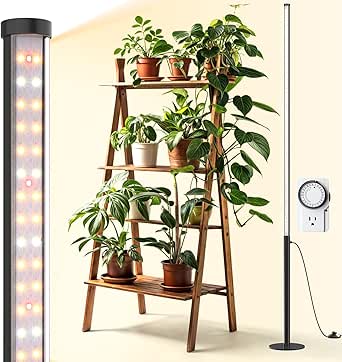


LED Grow Light Buying Checklist — Before You Spend a Dollar
| Spec | What to Look For | Skip If |
|---|---|---|
| PPE (µmol/J) | 2.5 minimum; 2.8+ preferred | Below 2.0 |
| Actual watt draw | Listed clearly in specs | Only “equivalent watts” given |
| PPFD map | Full grid, at stated height | Only centre-point reading |
| Uniformity (min/avg) | Above 0.7 | No uniformity data provided |
| Diodes | Samsung LM301B, LM301H EVO | No diode spec listed |
| Dimming | 0–100% continuous | Binary on/off only |
| IP rating | IP65 for hydroponic environments | No IP rating listed |
| Warranty | 5 years minimum | Under 3 years |
| Spectrum | Full spectrum white + red | Blurple (red/blue only) |
| Third-party data | Published IES/PPFD file available | Marketing-only specs |
Frequently Asked Questions About LED Grow Lights
What wattage LED grow light do I need for a 4×4 tent?
Plan for 300–480W of actual power draw for a 4×4 ft flowering footprint. This delivers the 600–900 µmol/m²/s PPFD that most fruiting crops need at canopy level. Don’t size by “equivalent watts” — a light labelled “1000W equivalent” often draws 150–200W actual from the wall, which is simply insufficient for flowering coverage across 16 square feet.
Are bar lights better than quantum boards for indoor growing?
For 4×4 ft and larger footprints, bar-style fixtures generally deliver better canopy uniformity because the distributed strips reduce the centre-heavy PPFD pattern of single-board panels. For 2×2 to 3×3 spaces, a quality quantum board performs comparably and typically costs less. Format matters less than whether the fixture’s published PPFD map actually covers your footprint evenly.
What is the difference between PPF and PPFD for grow lights?
PPF (Photosynthetic Photon Flux) is the total photon output of the fixture per second, measured in µmol/s. It tells you how much light leaves the fixture. PPFD is how much of that light lands on your canopy per square metre per second — the number that determines what your plants actually receive. Always evaluate a light by its PPFD at your intended mounting height and canopy footprint, not by PPF alone.
How many hours should LED grow lights run per day?
Most hydroponic crops in the vegetative stage run 16–18 hours of light per day. Flowering and fruiting crops typically run 12–14 hours. Photoperiod-sensitive plants (like some cannabis varieties and strawberries) require specific day length to trigger flowering — usually 12 hours dark. Leafy greens and herbs are day-neutral and thrive on 14–16 hour photoperiods. Use a digital timer and match your photoperiod to the crop’s biology, not a fixed schedule.
Do I need a waterproof LED grow light for hydroponics?
Yes, for any setup near open reservoirs, nutrient solution trays, or high-humidity environments. Look for a minimum IP65 rating, which protects against dust ingress and water jets. IP66 or IP67 is better for high-wash growing areas. Fixtures without an IP rating in hydroponic environments risk corrosion, early failure, and electrical hazards. This is non-negotiable, not optional.
Choose Right, Grow Smarter
Choosing the best LED grow lights isn’t complicated once you stop shopping by wattage labels. Know your footprint. Set your PPFD target based on crop type. Look for a minimum 2.5 µmol/J PPE. Demand a real PPFD map. And measure actual canopy readings after installation.
The growers who consistently get great results from their lighting aren’t spending more money — they’re spending it better. A 300W fixture with 2.9 µmol/J and a solid PPFD map will outperform a “1000W equivalent” blurple panel every single grow cycle.
Grow With Hydroponics exists to make those decisions simpler. Use our free Grow Light Calculator to model your space, get accurate PPFD predictions at your target mounting height, and arrive at a fixture spec before you ever open a browser to shop. Start with the numbers. Buy to those numbers.
