

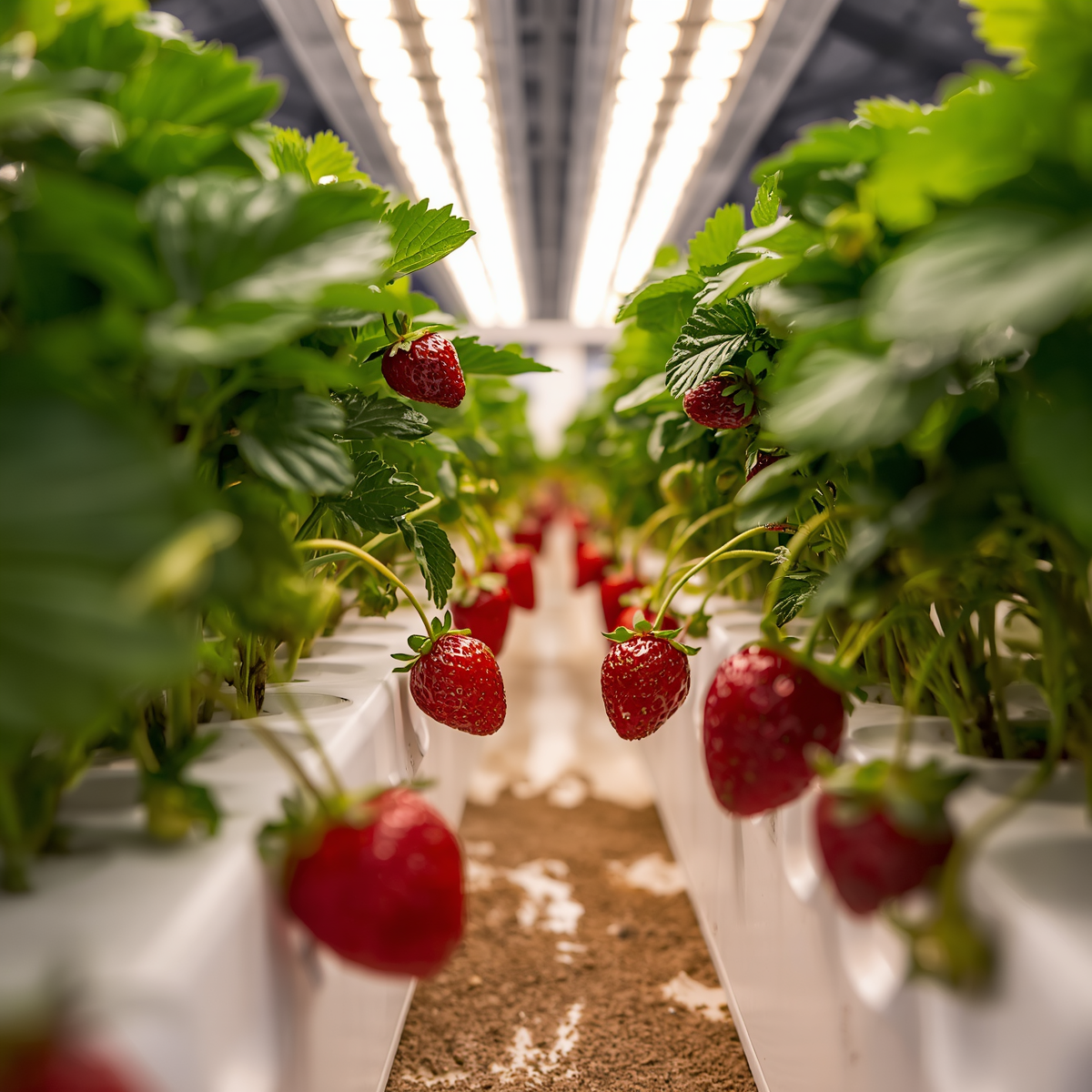
Pick up a strawberry from a supermarket in January and take a bite.You know exactly what you’re getting: pale flesh, hollow sweetness, and a vague memory of what a real strawberry is supposed to taste like. That berry was likely picked underripe, travelled hundreds of miles, and sat in cold storage long enough to lose anything interesting about its flavor.Growing hydroponic strawberries indoors solves that problem completely—and then some. When you control the environment, you pick at peak ripeness every time. But the benefits go well beyond taste, and they’re more practical and measurable than most beginners expect. At Grow With Hydroponics, we’ve helped growers work through everything from system selection to nutrient management on strawberries, and this guide covers what actually matters: the real advantages, the right setup choices, variety selection backed by research, and the most common mistakes to avoid before you invest in a system.
Why Hydroponic Strawberries Outperform Soil-Grown Fruit
The case for growing hydroponic strawberries indoors isn’t built on hype. The data is fairly clear.Production of strawberries in hydroponic systems has grown from 6.7 tons to 93 tons in just a decade, and indoor farming systems allow complete control of the growing environment, enabling consistent year-round production of high-quality strawberries. That kind of commercial momentum doesn’t happen without real results at the production level.For home growers, the practical advantages stack up quickly:Year-round harvesting. Weather becomes irrelevant. Controlled environments enable 4–6 growing cycles annually compared to just 1–2 in traditional soil farming. In a well-managed indoor setup, fresh strawberries in December are entirely achievable.Significant water savings. Recirculating hydroponic systems reuse nutrient solution continuously, with water use running as much as 90% lower than conventional soil-based strawberry farming. That’s not a marketing claim—it’s how closed-loop systems work.No soil-borne disease pressure. Gray mold (Botrytis), Verticillium wilt, and crown rot are serious threats to soil-grown strawberries. Removing soil from the equation eliminates the primary vector for most of these diseases. Pests can still appear in an indoor setup, but without soil as a breeding ground, the pressure drops considerably.Space efficiency. Strawberries have naturally compact root systems, which makes them well-suited to vertical towers, NFT channels, and stacked systems. You can produce meaningful harvests in a spare corner of a garage or a section of a spare room.Flavour and quality control. Nutrient formulation directly influences sugar content and berry development. Hydroponic strawberries offer superior flavour, consistent quality, and complete control over growing conditions. That control is something no outdoor grower can replicate.What Hydroponic System Works Best for Strawberries?
This is where growers spend too much time debating and not enough time deciding. The honest answer is that strawberries are relatively flexible—their shallow, compact root systems adapt to several systems. But some are clearly better than others.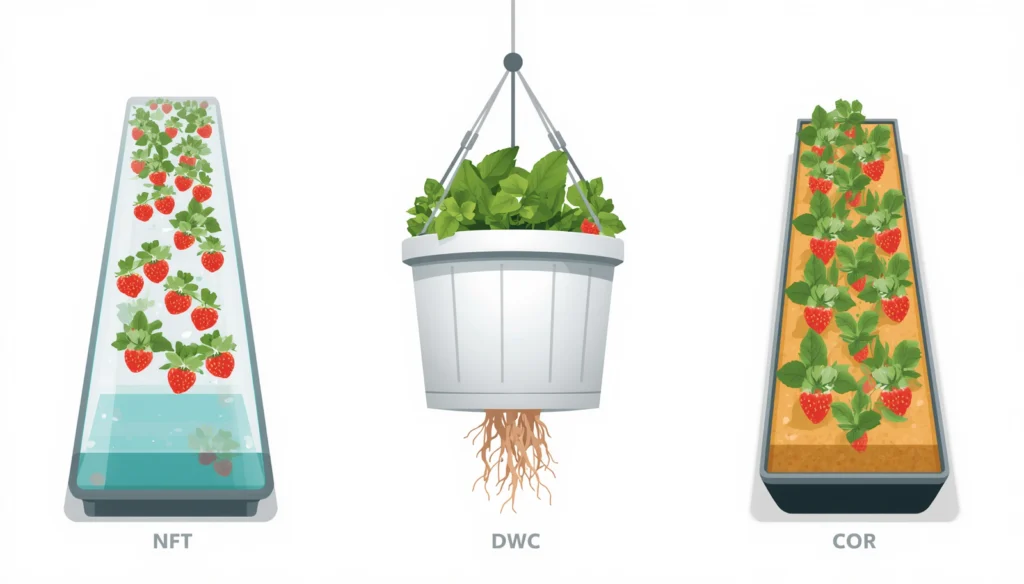
NFT (Nutrient Film Technique) — The Commercial Standard
NFT systems have become the gold standard for commercial hydroponic strawberry production. A thin film of nutrient solution, typically only 1–3mm deep, continuously flows through slightly angled channels, bathing plant roots in a constant supply of water, nutrients, and dissolved oxygen while air spaces provide adequate oxygenation.NFT scales cleanly, uses water efficiently, and produces consistent results. For serious home growers or anyone considering a larger setup, it’s the right direction.DWC (Deep Water Culture) — The Beginner’s Entry Point
For first-time strawberry growers, DWC is the most accessible starting point. Roots hang directly into an oxygenated, nutrient-rich reservoir. DWC systems provide constant access to water, nutrients, and oxygen—conditions strawberries respond well to—and are one of the easiest methods for home growers to start with. A dark storage tote, net pots, an airstone, and a pump is genuinely all the hardware required.Substrate Systems (Coir or Rockwool) — What the Research Supports
Worth knowing: a 129-day greenhouse comparison found that a coir-based substrate system substantially outperformed three water-culture systems—NFT, vertical stacked flow, and aeroponics—for total yield and resource-use efficiency. If maximum yield is the priority, substrate culture in coir or rockwool remains the safest evidence-based choice based on recent trials.A complete beginner’s guide to hydroponic systems: covers all major hydroponic system types, setup steps, and beginner decision guidance.Which Strawberry Varieties Perform Best Hydroponically?
Variety selection is the decision most beginners underestimate. Get it wrong and you’ll spend an entire growing season fighting a plant that was never suited to a controlled indoor environment.Day-neutral strawberries are ideal for hydroponic systems because they produce fruit continuously regardless of daylight hours. June-bearing strawberries produce one large crop annually and require specific cold dormancy periods, making them unsuitable for controlled hydroponic environments.
Getting Growing Conditions Right for Hydroponic Strawberries
Strawberries are not difficult to grow hydroponically, but they are precise. They respond visibly—and quickly—to conditions outside their preferred range.pH and EC
The nutrient solution should be maintained at a maximum EC of 1.2 dS/m, and the pH of the drainage water should be within a range of 5.5 to 6.5. For most growers, targeting 5.8–6.0 is the practical sweet spot—it keeps all major nutrients accessible and gives you a buffer before lockout begins.On EC: more is not better. Research has demonstrated that excessive nutrients actually decrease both yield and quality, so running a higher EC hoping for bigger berries tends to backfire. Follow a calibrated nutrient solution and resist the temptation to push EC as a yield lever.Temperature and Humidity
Strawberries thrive in cooler temperatures, ideally between 65–75°F during the day and 50–55°F at night. Humidity should be kept above 60% to help the plants absorb calcium properly.Low humidity is a frequently overlooked problem. When relative humidity drops below 60%, calcium uptake stalls—and calcium deficiency in strawberries shows up as tipburn on new growth and poor fruit development. This is one of the more common indoor growing problems that gets misdiagnosed as a nutrient issue when it’s actually an environmental one.Light Requirements
A minimum daily light integral (DLI) of 17 mol/m²/d is recommended for strawberry plant runner growth and fruit production, with 20 mol/m²/d considered the optimum DLI level.In practical terms, that means 12–16 hours of quality LED lighting per day, targeted at a PPFD of around 400–600 µmol/m²/s at canopy level. Don’t rely on a low-output countertop light for strawberries—they need more than leafy greens, and undersized lighting shows up quickly as poor fruit set and small berries. Use our DLI Calculator to confirm your current or planned setup hits the right daily total before investing in plants.Nutrients for Hydroponic Strawberries: Getting the Formula Right
Strawberry nutrition is more nuanced than many beginners expect, particularly around potassium and calcium.For maximum yield and quality, a starting nutrient solution containing approximately 160–170 ppm nitrogen, 55–60 ppm phosphorus, and 400–500 ppm potassium is recommended. Maintain a K:Ca ratio near 1–1.4:1 and a K:Mg ratio near 4:1, at appropriate pH (5.5–6.0) and EC levels for your growing conditions.This balance matters because calcium and potassium compete for uptake. Push potassium too high and calcium absorption drops, which leads directly to the tipburn and poor fruit quality mentioned earlier.For pollination indoors—something easy to forget without natural pollinators present—manually pollinating strawberries by gently brushing or shaking the flowers to transfer pollen is essential in controlled environments where natural pollinators are absent, as it ensures fruit development and optimal yields. A soft paintbrush or even a gentle daily shake of the plant does the job.Use our Hydroponic Nutrient Calculator when mixing your solution to verify that your ratios are hitting the right targets for strawberries specifically—not a generic leafy green formula.Understanding EC and PPM for hydroponic nutrient management—a supporting guide on measuring and adjusting nutrient solution strength.Common Hydroponic Strawberry Mistakes to Avoid
Choosing the wrong variety. June-bearing types require cold dormancy and concentrated seasonal conditions that a controlled indoor environment can’t replicate. Always start with day-neutral varieties.Ignoring humidity. A dry indoor environment—particularly in winter with heating running—regularly drops below the 60% threshold strawberries need. A simple hygrometer and a small humidifier solve this. Missing it results in tipburn and calcium-related fruit problems that are easy to misread as nutrient deficiencies.Skipping hand pollination. Strawberry flowers are self-fertile but benefit significantly from physical pollen transfer. In a sealed indoor environment with no air movement or insects, poor pollination leads directly to misshapen, small fruit. Brush every open flower every few days.Running EC too high. The instinct to push nutrients for bigger berries is understandable but counterproductive with strawberries. Excess EC reduces both yield and fruit quality. Stay within the recommended range and adjust pH before touching EC when problems appear.Neglecting runner management. Strawberry plants put energy into producing runners—horizontal stems that want to become new plants. In a hydroponic system, runners compete for resources with fruiting. Remove them on a schedule to keep the plant focused on berry production.Hydroponic Strawberry Growing Conditions at a Glance
| Parameter | Recommended Range | Notes |
| pH | 5.5–6.5 (target 5.8–6.0) | Check every 2–3 days; drifts fast |
| EC | 1.2–1.8 mS/cm | Don’t exceed—more lowers quality |
| Temperature (day) | 65–75°F (18–24°C) | Cooler encourages fruit development |
| Temperature (night) | 50–55°F (10–13°C) | Night drop improves flavour |
| Relative Humidity | 60–75% | Below 60% causes calcium lockout |
| DLI | 17–20 mol/m²/day | Minimum for fruit production |
| Light Hours | 12–16 hours per day | Use full-spectrum LED |
| Best Varieties | Albion, Seascape, Monterey | Day-neutral only for year-round crops |
| First Harvest | 60–90 days from transplant | Varies by variety and conditions |
Frequently Asked Questions About Hydroponic Strawberries
How long does it take to harvest hydroponic strawberries? Expect your first berries 60–90 days from transplant, with continuous harvesting possible for five to six months under stable conditions. Day-neutral varieties don’t need a rest period, so the system can remain productive through multiple cycles with proper management.Can I grow hydroponic strawberries year-round indoors? Yes, with the right setup. Day-neutral varieties produce continuously as long as temperature stays between 35°F and 85°F and lighting is consistent. The main variable indoors is the quality and duration of your grow lights. Provide adequate DLI and your plants won’t notice what season it is outside.What is the best hydroponic system for strawberries at home? For beginners, DWC is the most accessible and forgiving starting point. For growers ready to step up, NFT is the proven commercial choice. Recent research also supports coir substrate systems as high performers for total yield. All three work—pick the one that matches your skill level and budget.Do hydroponic strawberries need to be pollinated? Yes. Strawberry flowers can self-pollinate, but indoor setups have no natural pollinators and limited airflow. Hand pollinating with a small soft brush or gently shaking open flowers every few days significantly improves fruit set, size, and quality.Why are my hydroponic strawberry leaves showing brown edges? Check humidity first. Tipburn on new growth—brown leaf margins—is a classic sign of calcium uptake failure driven by low relative humidity, not nutrient deficiency. If humidity is below 60%, increase it before adjusting the nutrient solution. If humidity is fine, check pH and then EC.Fresh Strawberries, on Your Terms
Growing hydroponic strawberries indoors isn’t complicated once the fundamentals are right: the correct variety, a system suited to your experience level, pH and EC in range, enough light, and humidity above 60%. Those five things, managed consistently, produce results that soil growing in a seasonal climate simply cannot match.The appeal isn’t just yield. It’s the control. Ripe fruit harvested when it’s actually ready, not when the distribution window demands it. Flavour that supermarket logistics don’t allow.At Grow With Hydroponics, the tools to build that control are here—from nutrient calculators to grow space planners. Use the Hydroponic Nutrient Calculator to dial in your strawberry solution from the first mix, and when you’re ready to build or upgrade your system, Shop Smart to find the right equipment for your space. Hydroponic herb growing guide for beginners—related article on beginner-friendly hydroponic crops to grow alongside strawberries in a home setup.