

If you’re shopping for high-valued plant LED grow lights, you’re probably trying to solve three challenges at once: delivering the correct spectrum, achieving the right intensity, and doing it all safely and compliantly. This guide breaks down the essentials in plain language so you can compare lighting options with confidence. If you want the technical breakdown, read The Ultimate LED Grow Light Guide: Science-Backed Indoor Setup (2026). It cuts through the marketing and tells you what to look for.
Why Lighting Decisions Matter for High-Valued Plants
High-valued plants respond dramatically to light quality and consistency. Indoors, lighting is your “sun,” and the smallest imbalance can ripple through an entire cycle. The good news? Modern LEDs give growers far more control over spectrum, intensity, and efficiency than older HID systems—as long as you understand what the lighting specs actually mean. So, the common mistake is choosing a fixture based on wattage or “equivalent to HPS” claims. What truly matters is:
- How many usable photons reach your canopy?
- How evenly that light is delivered.
- Whether the fixture is certified for real horticultural environments.
Consistency Means Higher Yields & Less Stress
In indoor environments, consistency is profit. Uneven lighting leads to:
- Irregular plant development.
- Longer trimming sessions.
- More grading variability.
- Higher HVAC loads.
- Increased operational cost.
High-efficacy LEDs (more photons per watt) usually produce less heat, which can lighten your cooling load and improve environmental stability.
The Only Grow-Light Metrics You Really Need
Lighting spec sheets can look technical, but you truly only need to understand a few key terms. Once these click, evaluating LED grow lights becomes much easier.
PPFD: How much light actually hits the canopy
PPFD (photosynthetic photon flux density) measures the number of useful photons that reach one square meter per second (µmol·m⁻²·s⁻¹).
Think of PPFD like rainfall intensity. A PPFD map reveals hot spots and dim zones—both of which impact growth just as much as the average number itself.
DLI: Total daily light delivered
DLI (Daily Light Integral) measures the total number of useful photons plants receive in a day (mol·m⁻²·day⁻¹). It connects your PPFD and lighting duration. Plants respond to accumulated photons, not just momentary brightness—so DLI is essential for planning and optimizing growth.
PPF & Efficacy: How much usable light the fixture produces
- PPF: Total photons emitted per second (µmol/s)
- Efficacy: Photons produced per watt (µmol/J)
High efficacy = lower electrical and cooling cost per harvest.
Spectrum Basics for High-Valued Plant LED Grow Lights
“Spectrum” refers to the mix of wavelengths a fixture emits. Spectrum influences plant structure, flowering behavior, stress responses, and more—but it’s not magic. Intensity and uniformity still do most of the heavy lifting.
Full Spectrum vs. Blurple
Older LED grow lights relied heavily on red/blue “blurple” mixes. They can grow plants, but modern white/full-spectrum horticultural LEDs offer benefits such as:
- Better visibility for plant inspection
- Wider wavelength distribution
- More consistent results across rooms
- Easier staff training
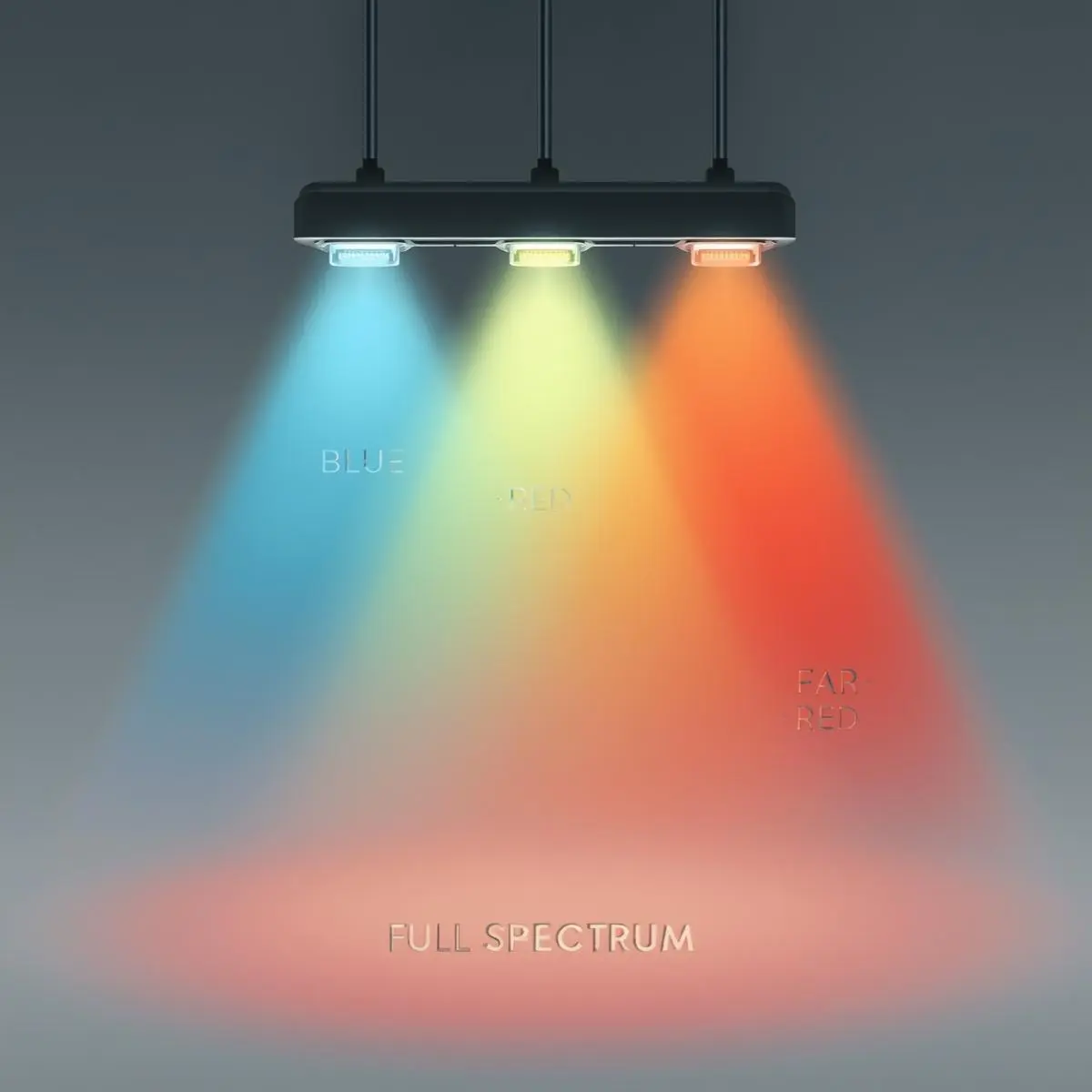
Red, Blue & Far-Red: What They Actually Do
- Blue light → Compact growth, stronger structure
- Red light → Core driver of photosynthesis
- Far-red → Influences canopy shape and plant signaling
Spectrum should support your goals—but no spectrum tweak can fix poor PPFD or uneven coverage.
UV: Use With Caution
Some growers explore UV for secondary metabolite strategies, but UV introduces safety and risk management challenges. Use proper PPE and consult professionals before experimenting.
In large-scale operations, stable PPFD + uniformity + environmental control outperform trendy spectrum add-ons every time.
Intensity: How Bright Should Your LED Grow Lights Be?
Intensity is where yield is won or lost. Too little light limits growth; too much stresses plants and inflates HVAC loads.
Use PPFD Maps—Not Just “Max PPFD” Claims
A maximum PPFD number alone is misleading because it represents only one point directly under the fixture.
What you need is a PPFD grid map for your exact footprint and hanging height. Uniformity leads to:
- Consistent plant development
- More efficient workflow
- Better final product uniformity
DLI Helps You Avoid Guesswork
DLI connects intensity + time into one meaningful number. When you use DLI to plan lighting:
- You reduce wasted electricity
- You improve stability
- You tune your environment more accurately
Ready to dial in your lighting? Use our DLI Calculator to find your perfect daily light levels and boost plant performance instantly.
Hanging Height & Canopy Shape Matter
PPFD changes dramatically depending on:
- Mounting height
- Fixture optics
- Plant structure
This is why professional setups emphasize repeatable layouts—consistent points, spacing, and validation using a PAR meter.
Coverage & Uniformity: The Most Overlooked Specification
Spectrum matters. Intensity matters. But coverage determines daily consistency.
Bar-Style vs. Panel-Style Fixtures
Bar-style fixtures tend to deliver better uniformity by spreading light sources across a larger area. Panel-style fixtures can work well too—what matters is whether the PPFD map is even at your target height.
Poor coverage can also create microclimates, changing transpiration rates and causing growth inconsistency.
Demand Honest Photometric Reporting
Trustworthy suppliers provide:
- Defined mounting heights
- Clear grid measurements
- Consistent test environments
For commercial growers, aligning with recognized testing frameworks (e.g., horticultural safety standards) simplifies permitting, insurance, and compliance.
Safety Basics: Electrical, Fire & Compliance
Lighting safety isn’t optional—it’s core to a professional grow environment.
Horticultural spaces include humidity, heat, and heavy power loads. Your fixtures must be certified and installed correctly.
UL 8800: What It Means
UL 8800 evaluates horticultural lighting equipment for real-world safety. Certification helps ensure the fixture meets requirements for installation, electrical safety, moisture resistance, and more.
What “Certified” Should Mean
Ask suppliers:
- What standard was used?
- Which lab performed the testing?
- What does the certification cover?
If answers are vague, that’s a red flag—especially when high-powered fixtures hang above valuable crops and staff.
Moisture, Wiring & Proper Installation
Even great fixtures can be unsafe if installed incorrectly. Always:
- Use qualified electricians
- Protect drivers and connections
- Route cables to avoid water exposure
Design your space so fixtures can be serviced safely and predictably.
Eye Safety & Photobiological Protection in Grow Rooms
Modern LEDs are bright enough to cause glare and discomfort. This isn’t just convenience—it’s a safety consideration.
IEC 62471: Key Safety Standard
IEC 62471 assesses photobiological safety for lighting products, including horticultural LEDs. Understanding this helps you create safer work environments and select the right PPE.
Blue Light Hazard: Keep the Facts Straight
The “blue light hazard” refers to potential retinal stress from staring directly at intense light sources—not from indirect exposure while working in a grow room.
Practical steps:
- Don’t stare at fixtures
- Reduce glare with shading strategies
- Use proper eye protection
What to Look for When Buying LED Grow Lights for High-Valued Plants
Choosing the best fixture is about matching performance to your space, goals, and workflow.
A Real Buyer’s Checklist
- Ask for PPFD maps at your exact footprint
- Confirm efficacy (µmol/J)
- Review thermal management
- Check certification status
- Evaluate supplier support quality
For commercial operations, warranty service, documentation, and spare parts support are just as important as raw performance. Explore Hydroponic GrowSpace Planner Calculator.
Trust Verified Data
Use PAR meters or third-party test reports when possible. Standard definitions (like PPFD) help ensure everyone speaks the same technical language.
Get Spectrum + Intensity + Safety Right
The best LED grow lights for high-valued plants balance spectrum, intensity, uniformity, and safety. Reliable lighting equals reliable yields.
If you want a setup you can confidently scale, focus on measurable metrics and consistent lighting practices, not marketing hype. Shop Smart with Grow With Hydroponics and get the right tools for every stage of your indoor garden.

Dr. Awais Yousaf
Algorithm Specialist and Associate Professor leading R&D at Grow With Hydroponics. With 5+ years of hands-on experience in smart hydroponic systems, deep learning, and sustainable AgriTech, he is passionate about turning small spaces into high-yield indoor farms. Connect at awais.yousaf@iub.edu.pk