
Related Hydroponic Tools
- Use our DLI Calculator to optimize plant lighting.
- EC to PPM Converter for Nutrient Accuracy.
Use our Hydroponic Nutrient Calculator to create precise nutrient mixes.
- Read our complete VPD guide.
- Explore all hydroponic calculators and tools developed by Grow With Hydroponics to optimize your grow setup.


VPD Calculator: The Complete Guide for Hydroponic Growers
Your pH is perfect. Your EC is dialled. Your lights are on schedule. And yet the plants look stressed—slow growth, tip burn creeping in, or that stubborn wilting that appears a few hours after lights-on.
Nine times out of ten, the environment is the culprit. Specifically, VPD.
At Grow With Hydroponics, we’ve watched growers chase nutrient deficiency symptoms for weeks—only to find the real issue was a humidity and temperature combination that was quietly strangling transpiration the whole time. Once they started tracking VPD, the fixes were obvious. The problem was never the nutrients.
This guide covers everything you need to actually use a VPD calculator — not just understand the theory. You’ll learn the difference between air VPD and leaf VPD, the exact targets for each growth stage, how to read a VPD chart, and the practical steps for fixing a grow room that’s running out of range.
What Is VPD and Why Does It Matter More Than Humidity Alone?
VPD stands for Vapor Pressure Deficit. The name sounds more complicated than it is.
Think of it this way: warm air can hold more moisture than cold air. VPD measures the gap between how much moisture the air is holding right now and how much it could hold at that temperature. The bigger that gap, the “thirstier” the air is—and the harder it pulls water out of your plant’s leaves.
Here’s the key insight: humidity alone tells you nothing useful without temperature. A reading of 60% RH means something completely different at 18°C than it does at 30°C. At 18°C, 60% RH gives you a VPD of roughly 0.84 kPa—comfortable for vegetative growth. At 30°C, the same 60% RH produces a VPD of around 1.69 kPa — right at the edge of flowering stress territory.
That’s why growers who set a humidity target and walk away are guessing. VPD gives you the single number that actually describes what your plants are experiencing.
Air VPD vs Leaf VPD—Which One Should You Use?
This is the distinction most guides skip, and it matters more than most growers realise.
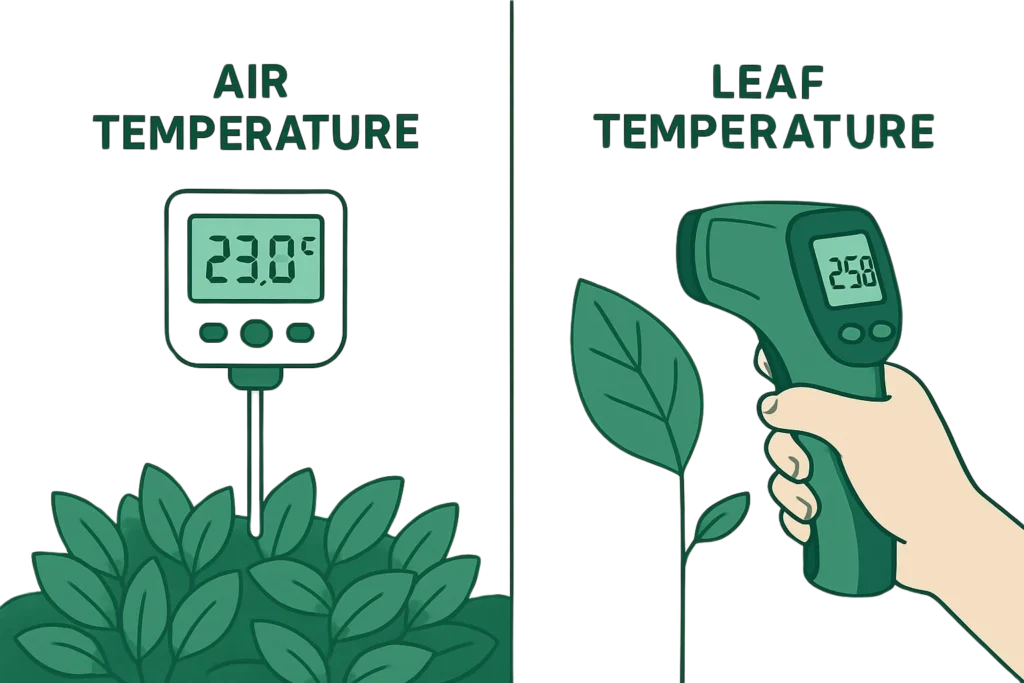
Air VPD is calculated using your air temperature and relative humidity. It’s the figure your thermo-hygrometer gives you when you plug the numbers into any basic calculator. It’s fast, easy, and available to anyone with a sensor.
Leaf VPD uses the actual surface temperature of the leaf—which is typically 2–3°C cooler than the surrounding air because transpiration itself has a cooling effect. Leaf VPD is the more accurate measurement because it captures the vapour pressure difference directly at the stomata, which is where gas exchange actually happens.
The practical difference looks like this:
| Measurement Type | Input Needed | Accuracy | Best Used When |
|---|---|---|---|
| Air VPD | Air temp + RH | Good estimate | No IR thermometer available |
| Leaf VPD | Leaf temp + RH | More precise | IR thermometer is available |
For most home growers, air VPD is a perfectly solid working number. If you have an IR thermometer (they cost around $15–25), measure your canopy leaf temperature directly and enter it into the leaf temperature field in the calculator above. You’ll get a more accurate read—especially under intense LEDs that raise air temperature at the canopy.
A common mistake is using the air temp from a sensor mounted on the tent wall, two feet above the canopy. That reading may be 2–3°C off from actual canopy temperature, and those degrees shift your VPD calculation enough to move you out of the optimal zone without realising it.
VPD Targets by Growth Stage — The Numbers That Actually Matter
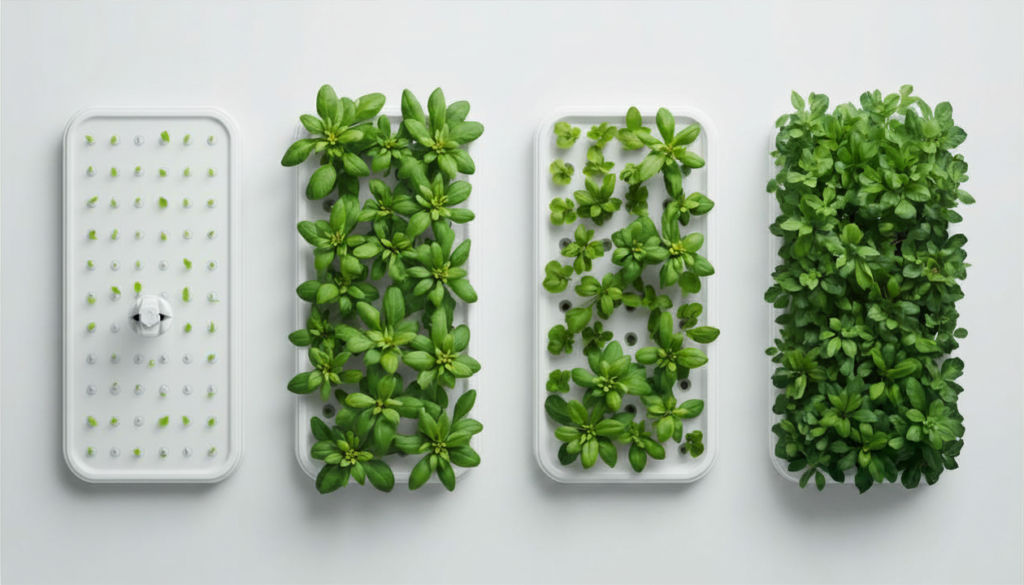
Different growth stages need different VPD ranges. The progression from seedling to flower is intentional: young plants need gentle conditions while mature plants benefit from stronger transpiration pull to move water and nutrients efficiently through denser tissue.
| Growth Stage | Ideal VPD (kPa) | Air Temp (°C) | Relative Humidity |
|---|---|---|---|
| Propagation / Clone | 0.4 – 0.8 | 20–24 | 70–85% |
| Seedling | 0.4 – 0.8 | 20–24 | 65–80% |
| Vegetative | 0.8 – 1.2 | 22–26 | 55–70% |
| Early Flower | 1.0 – 1.3 | 22–26 | 50–60% |
| Late Flower | 1.2 – 1.6 | 20–24 | 40–50% |
A few observations from growing experience worth adding here:
Seedlings at 0.8 kPa or above will show stress fast — they don’t have the root mass to supply water as quickly as high VPD demands it. Dial the humidity up and temperature down in your propagation zone.
Late flower growers often resist dropping humidity because they worry about plant stress. But running 60–65% RH in week 7 of flower with dense canopies is exactly the environment that produces mould and bud rot. The target of 40–50% RH in late flower isn’t arbitrary—it’s protective.
How to Read the VPD Chart
The VPD chart above the calculator shows the full grid of temperature and humidity combinations plotted as a colour heatmap. Here’s how to read it quickly:
- Green zones = optimal VPD for your selected growth stage
- Blue zones = VPD too low — too humid, transpiration is suppressed
- Red/orange zones = VPD too high — too dry, plants are under moisture stress
Find your current temperature on one axis and your current humidity on the other. Where they intersect is your current VPD. If you’re in the green, you’re set. If you’re in the blue or red, use the adjustment section below.
The chart is especially useful for planning environmental changes before you make them. Want to drop humidity from 65% to 55%? Trace the new column on your current temperature row—the chart shows you exactly where you’ll land before you touch the dehumidifier dial.
Why VPD Is More Critical in Hydroponics Than in Soil
This is the part most general VPD guides don’t explain—and it’s the reason VPD matters more to you as a hydroponic grower than to someone growing in a pot of soil.
In soil, the growing medium acts as a buffer. Water availability to the plant is limited by how fast water moves through the substrate. Even in high-VPD conditions, a plant in soil can only transpire as fast as soil water moves toward the root zone. There’s a natural governor on the system.
In hydroponics—DWC, NFT, coco, drip—roots have constant, direct access to water. There is no buffering medium slowing uptake. This means VPD directly drives how fast the plant transpires without any natural speed limit. When VPD is high in a hydroponic system, plants transpire extremely aggressively. That’s often fine for healthy, established plants. But the consequence is that calcium — which travels almost exclusively via the transpiration stream — gets pulled toward the leaves so fast it can’t be replenished in new growth.
This is why tip burn on lettuce and calcium deficiency in hydroponic tomatoes are so frequently linked to high VPD, even when calcium levels in the reservoir are correct. The nutrient is present. The delivery mechanism is overwhelmed.
Conversely, low VPD in hydroponics slows transpiration to the point where nutrient uptake stalls. The solution is full of everything the plant needs, but without adequate transpiration pull, movement through the plant is sluggish. You’ll see slow growth, pale new leaves, and soft tissue—all symptoms of poor nutrient mobility, all caused by environmental conditions, not your nutrient formula.
Seeing yellow leaves, brown tips, or stunted growth? Use our Plant Health Diagnosis Tool to quickly identify whether the problem is a nutrient deficiency, pH imbalance, pests, or environmental stress.
How to Fix VPD That’s Out of Range
When VPD Is Too High (Air Too Dry)
Symptoms: upward leaf curl, wilting before lights-off, tip burn on new growth, dry crispy leaf margins.
| Fix | Method | Speed |
|---|---|---|
| Raise humidity | Add a humidifier rated for your space | Fast (hours) |
| Lower air temperature | Adjust AC setpoint down 1–2°C | Fast |
| Reduce light intensity slightly | Dim LEDs 10–15% during affected hours | Immediate |
| Improve air circulation | Oscillating fan distributes humidity evenly | Fast |
Note on dimming lights: LEDs raise canopy temperature and therefore VPD. During hot periods or with powerful LEDs at close range, reducing intensity slightly lowers canopy temp and brings VPD back into range without touching the HVAC system.
When VPD Is Too Low (Air Too Humid)
Symptoms: slow growth, soft stems, weak turgor, mould or powdery mildew, and leaves that feel “wet” or heavy.
| Fix | Method | Speed |
|---|---|---|
| Reduce humidity | Run a dehumidifier—size it properly for the space | Fast |
| Raise temperature slightly | Increase setpoint by 1–2°C | Fast |
| Increase airflow | More air movement prevents humid pockets near canopy | Immediate |
| Improve exhaust | Higher CFM exhaust removes humid air faster | Same day |
One practical note: humid pockets near dense canopies cause more problems than the average RH reading suggests. The sensor on your tent wall shows 55% RH, but inside a dense flowering canopy the local humidity can be 70%+. Oscillating fans that move air through the canopy — not just around it — solve this without touching your HVAC settings.
VPD Best Practices for Common Hydroponic Crops
Not all crops want the same VPD. Here’s a quick reference for the most common hydroponic plants:
| Crop | Preferred VPD (kPa) | Notes |
|---|---|---|
| Lettuce / leafy greens | 0.5 – 0.9 | Sensitive to high VPD; tip burn risk above 1.0 kPa |
| Basil / soft herbs | 0.6 – 1.0 | Moderate tolerance; drops basil aroma production above 1.2 |
| Tomatoes | 0.8 – 1.4 | Tolerant of wider range; benefits from higher VPD at fruiting |
| Cucumbers | 0.7 – 1.2 | Prefers consistent conditions; dislikes swings |
| Strawberries | 0.6 – 1.1 | Moderate range; flowering stage sensitive to >1.3 kPa |
| Roses (hydroponic) | 0.7 – 1.2 | Strong transpiration needs; low VPD delays flowering |
Want to grow stunning roses without soil? Discover the complete step-by-step method in our guide to growing hydroponic roses, including the best systems, nutrients, and proven techniques for bigger blooms.
Leafy greens are the most VPD-sensitive crops in the list. Lettuce tip burn is almost always a VPD and calcium story—not a calcium deficiency in isolation. If you’re growing lettuce and seeing brown edges on inner leaves, check your VPD before adjusting your nutrient formula.
The Equipment You Actually Need to Monitor and Control VPD
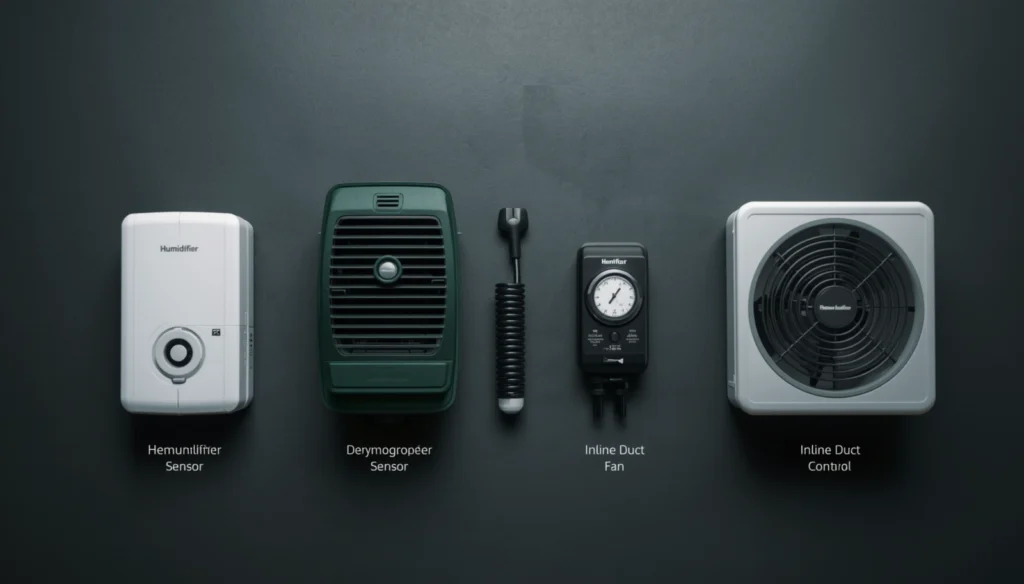
Measuring VPD Accurately
A thermo-hygrometer is the baseline—it measures temperature and humidity simultaneously. Cheap ones work, but cheap ones also drift. A sensor that reads 3°C warm throws your VPD calculation off by 0.2–0.3 kPa, which is enough to put you outside the optimal zone without knowing it.
For canopy-level accuracy, add an infrared thermometer for periodic leaf temperature checks. It takes five seconds to point at a leaf and get a reading — that number entered into the leaf temperature field of the calculator above gives you a significantly more accurate VPD than air temperature alone.
For serious growing, integrated environment controllers (AC Infinity CONTROLLER 69 Pro, Inkbird IBS-TH2 with logging) track both parameters continuously and can be set to trigger fans, humidifiers, and dehumidifiers automatically when VPD drifts out of target range.
Controlling VPD
The three tools that move VPD in most home grows:
- Humidifier — raises RH, lowers VPD. Size it for your actual grow space volume, not the packaging claim.
- Dehumidifier — lowers RH, raises VPD. The most important piece of kit in late flower.
- Exhaust fan with speed controller — moving air out pulls in drier or more humid air from outside, depending on your ambient conditions.
Browse the Shop Smart section for ventilation equipment that pairs with VPD management — including fans, controllers, and environmental monitors that have been vetted for real grow room use.
Ventilation Equipment for VPD Control
Humidity that won’t drop and heat that won’t shift are the two most common reasons VPD stays out of range. The right exhaust fan, carbon filter, and speed controller give you direct, repeatable control over your grow room environment.
These are the ventilation tools most commonly used alongside the VPD calculator to make the numbers actually match reality.

How to Use the VPD Calculator — Step by Step
The calculator at the top of this page is straightforward. Here’s how to get the most accurate reading from it:
Step 1 — Select your unit preference. Choose °C or °F based on your sensors. If you’re using metric sensors with Fahrenheit display, convert before entering.
Step 2 — Enter air temperature. Use the reading from a sensor at canopy height — not a sensor mounted on the wall or near the intake vent. Canopy temperature is what matters.
Step 3 — Enter relative humidity. Again, canopy-level reading. The sensor should be at the same height as the top of your plants.
Step 4 — Enter leaf temperature (optional but recommended). Point an IR thermometer at a mid-canopy leaf and enter that reading. This activates leaf VPD mode, which is more accurate than air VPD.
Step 5 — Select your growth stage. Seedling, Vegetative, or Flowering. The calculator applies the correct optimal range for your stage and tells you whether you’re in range, too low, or too high.
Step 6 — Read the analysis. The result shows your VPD in kPa and tells you exactly what it means for your current stage. The colour indicator and interpretation text give you immediate, actionable feedback.
Step 7 — Export or copy results. Use the Export CSV button to log readings over time. Tracking VPD daily alongside yield outcomes is one of the most useful data habits any grower can build.
Common VPD Mistakes Growers Make
Measuring from the wrong location. A sensor on the tent wall, near the intake, or above the canopy gives a reading that doesn’t reflect what your plants are experiencing. Mount the sensor at canopy level, facing the plants.
Ignoring day/night VPD differences. Lights-on raises temperature and usually drops RH (warm air holds more moisture, so proportional RH appears to fall). Lights-off reverses this. Your VPD in the dark period may be completely different from your daytime reading — and plants are still transpiring, just more slowly, in darkness.
Chasing humidity targets instead of VPD targets. Setting a dehumidifier to 55% RH regardless of temperature is how you end up wildly out of VPD range on cold nights and hot summer afternoons. Set your target as a VPD number and let the equipment work toward that outcome.
Making too many changes at once. Adjusting temperature and humidity simultaneously means you can’t tell which change produced the result. Move one variable, wait 2–4 hours, and check again.
Not accounting for canopy density. A young plant in a 1.2 m tent and the same tent in week 8 of flower have radically different humidity dynamics. As canopy fills and transpiration increases, the plant itself becomes a major humidity source. VPD management in late veg and early flower requires more active attention than at any other stage.
Frequently Asked Questions About VPD
What is a good VPD for hydroponics?
For most hydroponic crops, 0.8–1.2 kPa during vegetative growth and 1.0–1.5 kPa during flowering covers the majority of common species. Leafy greens like lettuce prefer the lower end of the range (0.5–0.9 kPa) and show tip burn symptoms faster when VPD climbs above 1.0 kPa. Use the crop-specific table above and the calculator to confirm your exact conditions.
Why does my VPD calculator show a different reading than my sensor?
Most thermo-hygrometers display temperature and humidity separately — they don’t calculate VPD. You need to enter both values into a VPD calculator to get the combined reading. If your sensor has a built-in VPD display, check which formula it uses (air VPD vs leaf VPD) and whether it accounts for leaf temperature offset. Most basic sensors only calculate air VPD.
Can VPD be too low in hydroponics?
Yes, and it’s more common than most growers expect. VPD below 0.4 kPa means the air is nearly saturated — transpiration effectively stops. Plants in this environment struggle to move nutrients through their tissue even when the reservoir is perfectly balanced. Mould and mildew risk also climbs sharply below 0.4 kPa, especially in late flower.
How does VPD affect calcium deficiency in hydroponic lettuce?
Calcium travels to leaves via the transpiration stream. When VPD is too high, water moves to leaves faster than it can be replenished — calcium concentrates at older tissue and doesn’t reach rapidly growing new leaves. This produces the classic lettuce tip burn pattern: brown edges on inner, newest leaves. Before adjusting calcium in your nutrient solution, check your VPD.
What tools do I need to monitor VPD in a grow tent?
At minimum, a calibrated thermo-hygrometer at canopy level and a VPD calculator. For leaf VPD accuracy, add an IR thermometer. For automated monitoring and control, an environment controller (such as the AC Infinity CONTROLLER series) that tracks VPD continuously and triggers humidity/temperature equipment automatically is the most practical upgrade for any grower running multiple cycles per year.
VPD Is the Variable Most Growers Overlook Until It Costs Them a Harvest
Nutrients get attention. Lights get attention. pH and EC get checked twice a day by growers who haven’t yet measured VPD once.
The three key things to take away:
- VPD is more informative than humidity alone—because temperature and humidity interact, and you need both.
- Leaf VPD is more accurate than air VPD — if you have an IR thermometer, use it.
- The fix for most VPD problems is simple — a dehumidifier, a humidifier, or a fan position change solves 90% of out-of-range situations.
Use the calculator at the top of this page every time conditions change—season shifts, new equipment, different growth stage, different crop. It takes thirty seconds and removes one of the biggest sources of unexplained plant stress from your grow room.
Grow With Hydroponics has built this tool and the full suite of hydroponic calculators for exactly this reason — so you spend less time guessing and more time growing. If your VPD is dialled but something still looks off, the Plant Health Diagnosis Tool can help you work through symptoms systematically.
Gardening rarely rewards guesswork. VPD monitoring is how you stop guessing.
Explore the Full Hydroponic Tools Suite
The VPD calculator is one tool in a complete set built for growers who want data, not guesswork. From DLI and nutrient mixing to grow space planning, everything is free; no signup required.


Related Tools
- DLI Calculator—Calculate your Daily Light Integral and confirm your lights are delivering enough photons for each growth stage.
- EC ↔ PPM Converter — Convert between EC and PPM across all three scales instantly.
- Plant Health Diagnosis Tool — If your environment is right but plants still look stressed, run a symptom check here.
- Hydroponic Nutrient Calculator — Build your exact nutrient solution once VPD and environment are sorted.
- CO₂ Calculator — VPD and CO₂ work together—highlight environments with elevated CO₂ benefit most from tighter VPD control.