

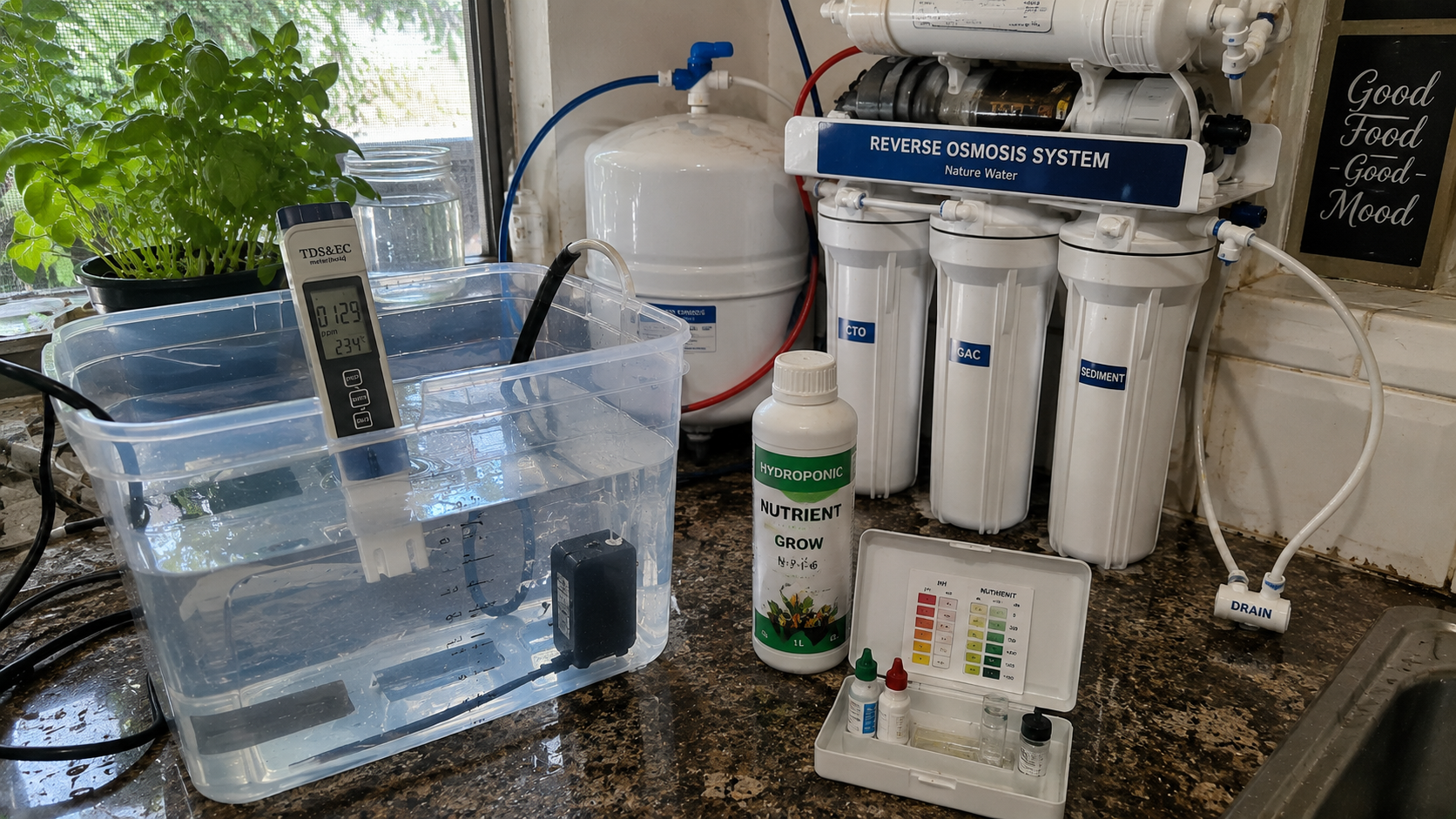
Somebody asks this question in nearly every hydroponics forum thread, usually right after their first nutrient deficiency scare. They dumped in a bottle of Cal-Mag because someone told them to, watered from the tap, and now the leaves still look off. Frankly, this is where most beginners go wrong: they treat water as a blank slate when it’s actually the first ingredient in the recipe.
Tap water vs RO water for hydroponics is a real decision with real consequences, but it’s not a universal answer. It depends on what’s coming out of your tap. Hydroponic Systems: Types, Comparison & How to Choose gets this question constantly from readers running everything from a two-gallon Kratky bucket to a full NFT table, and the honest answer is: test your water first, then decide. This guide walks through what tap and reverse osmosis (RO) water actually do differently in a nutrient solution, how to tell which one your setup needs, and where growers waste money going one direction when the other would’ve worked fine.
Quick answer: Tap water works for most hydroponic growers if it starts under about 200-300 ppm total dissolved solids and isn’t heavily chloraminated. RO water strips minerals and disinfectants entirely, giving precise control but requiring added Cal-Mag. Neither is universally better — it depends on your source water and system sensitivity.
What’s the difference between tap water and RO water?
Tap water is municipal or well water that’s been treated to meet safe drinking standards, but it still carries dissolved minerals, and often a disinfectant residual. RO water has been pushed through a semipermeable membrane that strips out nearly everything dissolved in it, leaving a near-blank baseline.
That’s the core distinction. Tap water arrives with a mineral and chemical signature that varies by city, well, and season. RO water arrives close to zero on the total dissolved solids (TDS) scale, meaning almost nothing is in it except what you deliberately add.
Why this matters for nutrient solutions
Soilless growing removes the buffering that soil normally provides. In soil culture, the soil itself moderates pH and nutrient availability. In hydroponics, there’s no buffer — whatever’s in your water becomes part of the nutrient math whether you accounted for it or not, according to Oklahoma State University Extension.
That means your starting water isn’t neutral. It’s either adding baseline minerals your nutrient formula didn’t budget for, or it’s a clean canvas that needs everything supplied.
What’s actually in tap water that affects plants?
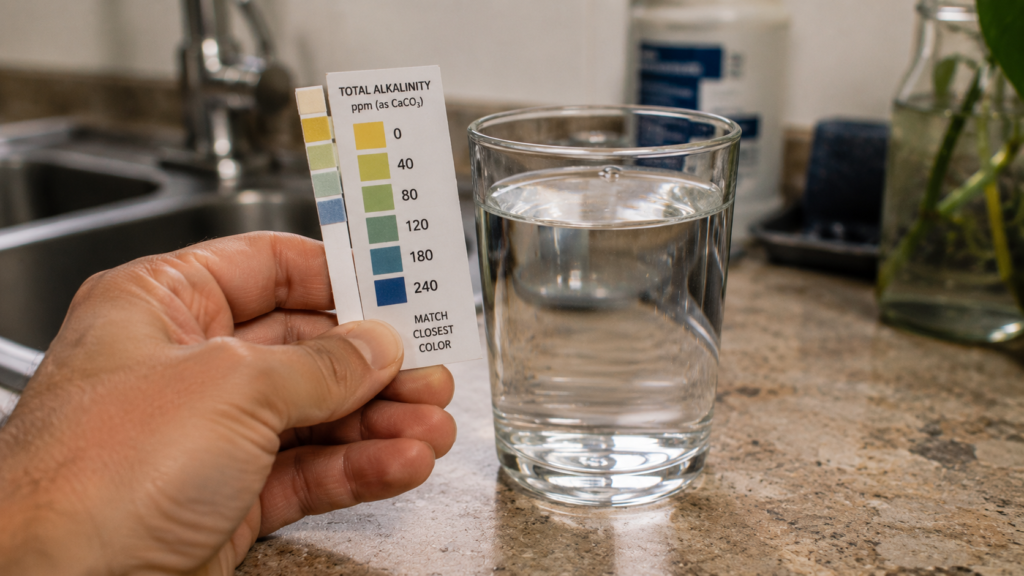
Tap water commonly carries three things that matter to hydroponic growers: dissolved minerals (calcium, magnesium, sodium, bicarbonate), a disinfectant residual (chlorine or chloramine), and background alkalinity. Each interacts with your nutrient solution differently, and none of them show up on a basic pH strip.
Alkalinity and pH drift
Alkalinity isn’t the same thing as pH, and mixing the two up is one of the most common beginner mistakes. Alkalinity measures water’s capacity to resist pH change — mainly driven by bicarbonate. Oklahoma State Extension notes that water with alkalinity above roughly 75 ppm will push nutrient solution pH upward over time, which means you’ll be chasing pH corrections far more often than a grower on softer water.
Cornell University’s hydroponic greenhouse crop formulas are built around this exact variable — one widely used lettuce and herb recipe is formulated to work well specifically for source water with alkalinity between 40 and 200 ppm. If your water sits outside that range, the same recipe behaves differently in your reservoir than it did in the lab that developed it.
Chlorine and chloramine
Municipal water is disinfected to keep it safe to drink, and the EPA caps both chlorine and chloramine at a maximum residual disinfectant level of 4.0 milligrams per liter. That’s a public health standard, not a hydroponics one, and the two disinfectants behave very differently once they’re in your reservoir.
Chlorine dissipates from standing water within about 24 hours, especially with some surface agitation. Chloramine doesn’t. It’s more chemically stable — which is exactly why some utilities prefer it, since it holds up longer through long distribution pipes — and won’t off-gas the same way. More than one in five Americans are on chloraminated water, per the EPA, so this isn’t a rare edge case.
Beginners commonly misunderstand this and let their reservoir “sit out overnight” assuming that handles it, not realizing chloramine needs an activated carbon filter or a dechlorinating agent to actually break down. Experienced growers check their local water quality report first instead of guessing.
Tap water vs RO water hydroponics: a practical comparison
| Factor | Tap water | RO water |
|---|---|---|
| Starting TDS/EC | Variable, often 100-400+ ppm | Near 0 ppm |
| Mineral content | Calcium, magnesium, sodium naturally present | Stripped almost entirely — needs Cal-Mag added |
| pH stability | Can drift upward with high alkalinity | Starts near-neutral, easier to dial in |
| Consistency batch to batch | Varies with season, treatment changes | Very consistent |
| Disinfectant residual | Possible chlorine or chloramine | Removed by the membrane |
| Upfront cost | None (already paying for it) | $100-400+ for a home unit |
| Ongoing cost | None beyond utility bill | Electricity, membrane replacement, wasted water |
| Waste water | None | Typically several gallons of reject water per gallon produced |
| Best fit | Low-alkalinity source water, casual growers | Sensitive crops, high-alkalinity source water, precision setups |
Neither column wins outright. A grower on soft municipal water with low alkalinity is often just adding unnecessary cost and waste by running RO. A grower on hard well water with high bicarbonate is fighting pH swings every single feeding until they either switch to RO or start acidifying aggressively.
A decision framework: should you switch to RO?
Rather than guessing, run through this sequence. It’s the kind of troubleshooting flowchart most articles on this topic skip entirely.
- Test your source water’s EC/TDS and, if possible, alkalinity. A basic TDS meter tells you starting ppm; a water utility’s annual quality report (or a home test kit) gives you alkalinity.
- If TDS is under roughly 150 ppm and alkalinity is under 75 ppm, tap water is probably fine as-is. Just confirm whether your utility uses chloramine.
- If TDS is 150-300 ppm with moderate alkalinity, tap water can still work, but expect to check pH more frequently and possibly acidify with phosphoric or citric acid.
- If TDS exceeds 300-400 ppm, or alkalinity is consistently high, RO becomes worth the investment — you’ll spend less time and product fighting pH drift than you would buying an RO unit.
- If you’re growing especially sensitive crops — tissue-culture starts, certain ornamentals, or anything where uniform batch-to-batch water matters — RO’s consistency is worth it even at moderate tap TDS.
That threshold isn’t arbitrary; it echoes the alkalinity ranges Cornell’s formulas are calibrated against and the alkalinity concern flagged by Oklahoma State Extension. Below it, added acid and standard nutrient dosing usually keep pace. Above it, the compounding drift becomes a weekly chore.
A worked example
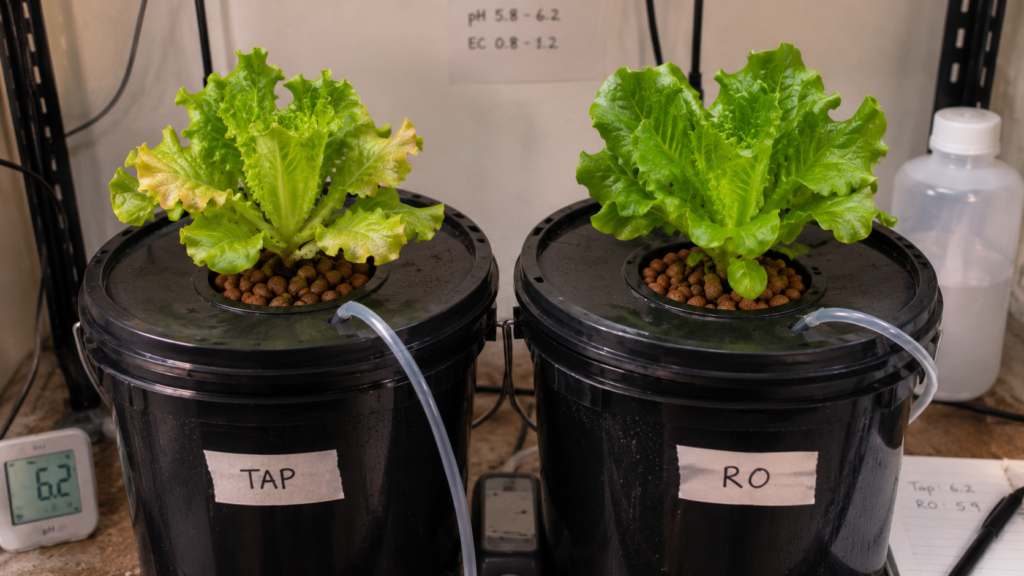
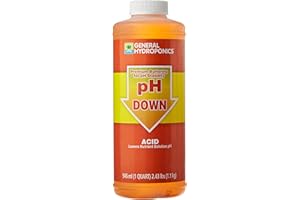
Say a grower starts a DWC lettuce reservoir with tap water sitting at 280 ppm TDS and moderate-high alkalinity. They dose nutrients to a target EC of 1.4, check pH on day one — it’s fine, 5.8. By day four, without any additions, the pH has crept to 6.4 as the bicarbonate buffers against their acid dosing. They’re now adding pH-down every other day just to hold the line, and the plants show early signs of iron lockout from the elevated pH. That drift is the alkalinity doing exactly what Extension research predicts — and it’s the single biggest reason growers on hard water eventually give up and buy an RO unit, not because tap water is inherently bad, but because their specific tap water wasn’t a good match.
Common mistakes with both approaches
Mistake 1: Switching to RO and skipping Cal-Mag. RO water strips out the calcium and magnesium that tap water often provided for free. Growers who switch and don’t add a cal-mag supplement usually see deficiency symptoms within two to three weeks — ironic, since they switched to solve a water problem and created a nutrient one.
Mistake 2: Assuming all “filtered” water is RO water. A pitcher filter or under-sink carbon filter removes chlorine taste and some sediment, but it doesn’t touch dissolved minerals or alkalinity the way reverse osmosis does. Those are different problems with different fixes.
Mistake 3: Not retesting after a municipal treatment change. Utilities sometimes switch between chlorine and chloramine seasonally, per water industry sources — a grower who tested their water once two years ago may be working from stale information.
Advanced tips and buying guidance
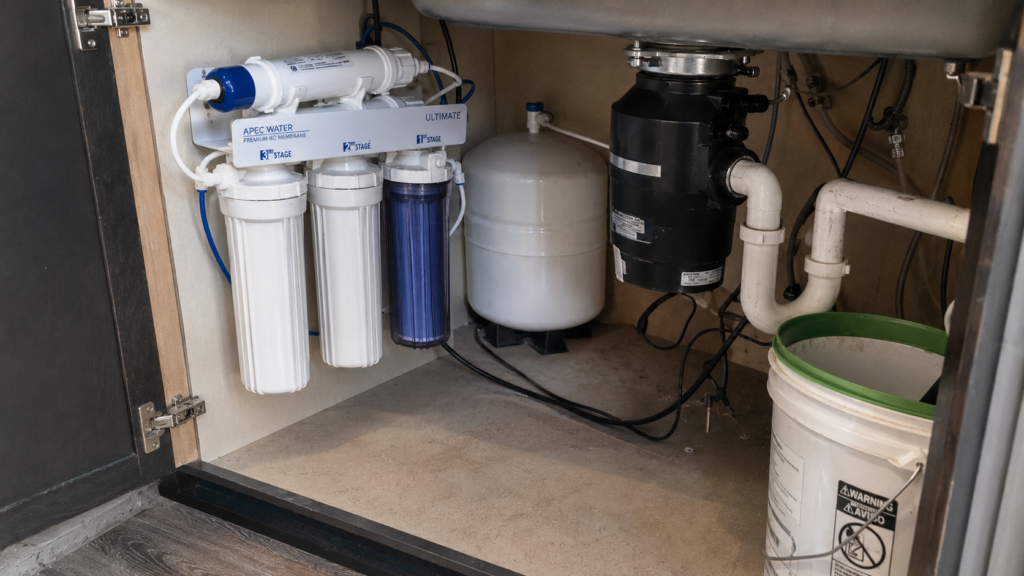
If you’re leaning toward RO, know what you’re signing up for. Home units typically run continuously producing a few gallons per hour, and they waste several gallons of “reject” water for every gallon of purified output — not a dealbreaker for most home growers, but worth knowing before buying, especially in drought-restricted regions. Membrane replacement is a recurring cost, usually every couple of years depending on source water hardness.
Whichever water source you land on, get in the habit of checking your resulting EC after mixing nutrients rather than trusting the bottle’s dosing chart blindly, since your baseline mineral content changes the math. Grow With Hydroponics built the EC to PPM Converter for exactly this — plug in your reading and confirm you’re actually landing in your target range instead of assuming the label got it right for your water.
If you do go the RO route and want a Shop Smart tip: buy a unit rated in gallons-per-day above what you think you need. Undersized units run constantly and wear out faster, and the price difference between a 50 GPD and 100 GPD home unit is often smaller than growers expect.
Get your water numbers right before you guess
If you haven’t tested your source water yet, that’s step one — a decent TDS meter and pH kit pay for themselves the first time they save you a week of chasing a mystery deficiency.
Common myths about hydroponic water sources
- “RO water is always better for hydroponics.” Not if your tap water already starts clean — you’re just adding cost, waste, and an extra mineral-dosing step for no real gain.
- “Letting tap water sit overnight removes everything harmful.” That only handles chlorine. Chloramine needs active filtration or a chemical dechlorinator.
- “Hard water is automatically bad for plants.” Moderate hardness supplies useful calcium and magnesium. Extension research from Oklahoma State University notes hard water becomes a problem mainly through its alkalinity-driven pH effects, not the minerals themselves.
- “Distilled and RO water are the same thing.” Both produce very low-TDS water, but distillation boils and re-condenses water, while RO forces it through a membrane — different processes, similar end result, different equipment.
Reader Value Test
Would a grower bookmark this after reading a typical top-ranking result? Yes — most existing articles present tap-vs-RO as a binary opinion (“RO is better” or “tap is fine”) without giving a testable threshold to act on tonight. This piece gives one: check your TDS and alkalinity, then follow the five-step framework above.
The unique value here is the decision framework tied to actual alkalinity research, plus the worked EC-drift example showing why hard tap water specifically causes problems over days, not instantly — something no competing article walks through numerically.
One open question a careful reader might still have: exactly how much Cal-Mag to add per gallon of RO water for their specific crop. That’s crop- and growth-stage-dependent enough that it deserves its own dedicated breakdown rather than a compressed answer here.
FAQ
Does RO water need Cal-Mag added? Yes. RO water strips out nearly all dissolved calcium and magnesium along with everything else, so plants grown in pure RO water without supplementation will develop deficiency symptoms within a few weeks. Most growers add a dedicated Cal-Mag product at the rate their nutrient line recommends.
Can I use tap water for hydroponics without any treatment? Often yes, if your tap water tests under roughly 150-200 ppm TDS with low alkalinity and isn’t chloraminated. Test your specific water first rather than assuming — municipal water quality varies significantly by city, season, and source.
How do I know if my water has chlorine or chloramine? Check your local water utility’s annual Consumer Confidence Report, which lists the disinfectant type and typical residual levels. Chlorine dissipates from standing water within about a day; chloramine requires active carbon filtration to remove.
Is rainwater better than both tap and RO water? Rainwater is naturally soft and low in dissolved solids, similar to RO water in that respect, but it’s inconsistent and can pick up contaminants from roofing or storage containers. It’s a reasonable supplement in areas with reliable rainfall, not a dependable primary source for a serious setup.
Does water source matter more for some hydroponic systems than others? Yes. Systems with small reservoirs and no continuous top-off, like Kratky or small DWC buckets, are more sensitive to starting water quality since there’s no dilution over time. Larger recirculating systems with frequent reservoir changes are somewhat more forgiving.
Getting your water source right isn’t glamorous, but it’s one of the few variables you only have to figure out once. Test what’s coming out of your tap, weigh it against the framework above, and you’ll spend a lot less time chasing pH swings that had nothing to do with your nutrients in the first place. Grow With Hydroponics has more tools like the EC to PPM Converter to help you dial in the rest of your reservoir once your water source is sorted.
