

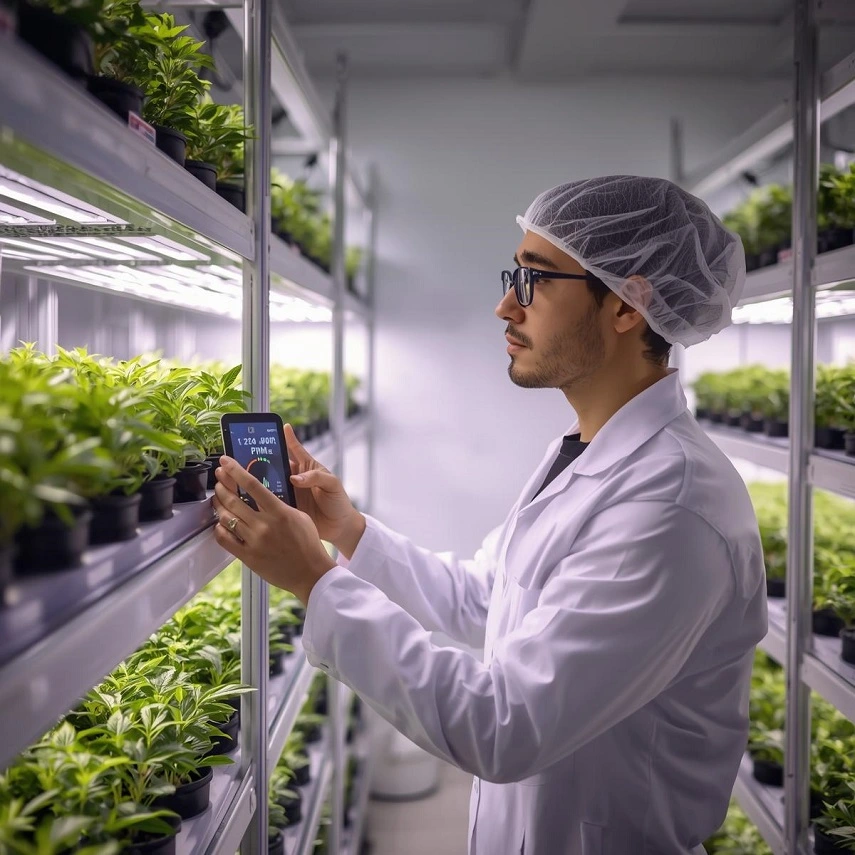
If you’ve ever checked your nutrient solution and thought, “Why is my PPM different from what the chart says?”—you’re not alone. Not even close.
The confusion around the 500 vs 640 vs 700 PPM scale has tripped up beginners and experienced growers alike. One meter shows 1000 PPM. Another shows 1400 PPM. Same bucket of water. Suddenly you’re second-guessing your entire feeding schedule—and maybe dumping perfectly good nutrients down the drain.
Here at Grow With Hydroponics, we’ve seen this exact problem cost growers yields, flavor, and sometimes entire crops. Frankly, it’s avoidable.
Here’s the truth:
The issue isn’t your nutrients. It’s how your meter interprets them.
In this guide, you’ll learn:
What the 500 vs 640 vs 700 PPM scale actually means
Which one is most accurate for hydroponics
Why EC matters more than any PPM number
How to avoid costly feeding mistakes (the kind that turn lush greens into sad, yellowing regrets)
Quick Answer: 500 vs 640 vs 700 PPM Scale Explained
Let’s cut to it. Here’s how the same nutrient solution reads across the three scales:
| EC (mS/cm) | 500 Scale | 640 Scale | 700 Scale |
|---|---|---|---|
| 1.0 | 500 | 640 | 700 |
| 1.5 | 750 | 960 | 1050 |
| 2.0 | 1000 | 1280 | 1400 |
Key takeaway:
500 scale (NaCl) → Most common, less accurate for hydroponics
640 scale (KCl) → Most accurate for hydroponic nutrient solutions
700 scale (442) → Not ideal; originally designed for water quality testing
Best practice: Use EC instead of PPM whenever possible. I’ll explain why in a minute.
What Is the 500 vs 640 vs 700 PPM Scale?
Here’s where most articles get it wrong—and I mean confidently wrong.
Your meter does not actually measure PPM. It can’t. Not directly.
Instead, it measures Electrical Conductivity (EC)—a real, physical property of your solution—and then converts that measurement into PPM using a preset scale.
So when we talk about the 500 vs 640 vs 700 PPM scale, we’re really talking about the following:
Different mathematical formulas used to convert EC → PPM
Think of it like this:
EC = actual temperature (real, measurable)
PPM = Celsius vs Fahrenheit vs Kelvin (different ways to express the same reality)
Same solution. Different numbers. No wonder beginners pull their hair out.
How the 500 vs 640 vs 700 PPM Scale Works in Hydroponics
Each scale is based on a different reference solution. Here’s what that means in practice.
1. 500 Scale (NaCl Standard)
Conversion: 1.0 EC = 500 PPM
Based on: Sodium Chloride (table salt)
Why it’s popular:
Widely used in the US
Simple, round numbers (people like neat math)
Downside:
Because it’s based on sodium chloride, the 500 scale doesn’t accurately reflect the diverse ions present in hydroponic nutrient solutions.
2. 640 Scale (KCl Standard) — The Best Choice
Conversion: 1.0 EC = 640 PPM
Based on: Potassium Chloride
Why it matters:
Potassium chloride is chemically closer to real hydroponic nutrient composition
Used in commercial agriculture and research settings
If you want accuracy, this is your scale. Full stop.
3. 700 Scale (442 Standard)
Conversion: 1.0 EC = 700 PPM
Based on: Mixed salts (Calcium, Magnesium, Sodium—a 4-4-2 blend, hence “442”)
Reality check:
Designed for water quality testing (think tap water, wastewater, aquarium monitoring)
Not ideal for hydroponic feeding
Often leads to underfeeding because the inflated PPM reading makes you think you’re running hot when you’re not.
500 vs 640 vs 700 PPM Scale: Which One Should You Use?
When comparing the 500 vs 640 vs 700 PPM scale, the real question isn’t which one is “correct”—it’s which one matches your system and meter. Let’s answer the big question directly—the one every new grower wants shouted from the rooftops.
There is no single “correct” PPM scale.
But that’s not a helpful answer, so here’s the practical one:
For hydroponics:
Best choice: 640 scale
Acceptable: 500 scale (if you’re consistent and know what you’re using)
Avoid: 700 scale
I’ve seen growers run entire cycles on the 500 scale with great results—because they were consistent. The problem isn’t which scale you use. The problem is mixing scales or assuming every meter speaks the same language.
500 vs 640 vs 700 PPM Scale vs EC: What Matters More?
Here’s where experienced growers level up. And where beginners save themselves years of frustration.
Instead of asking:
“Which PPM scale is correct?”
Ask:
“Why am I using PPM at all?”
Advantages of EC:
| Feature | EC | PPM |
|---|---|---|
| Universal standard | ✅ Same reading everywhere | ❌ Varies by scale |
| No conversion confusion | ✅ Direct measurement | ❌ Hidden math |
| Used in research & commercial farms | ✅ Yes | ❌ Rarely |
| Eliminates scale mismatch errors | ✅ Completely | ❌ Not possible |
Real-world example:
Two growers. Same nutrient solution. Same reservoir.
Grower A uses 500 scale → sees 1000 PPM
Grower B uses 700 scale → sees 1400 PPM
Same solution. Completely different numbers. They argue for twenty minutes on a forum before someone finally asks, “What scale is your meter?”
That’s wasted time. EC avoids it entirely.
Real Example: How Scale Confusion Damages Plants
Let’s walk through a common disaster.
A feeding chart (maybe from a popular nutrient brand) recommends:
1000 PPM (500 scale)
But your meter uses the 700 scale.
What happens next?
Your meter reads the same solution at ~1400 PPM
You think, “That’s way too hot—I’ll burn my plants.”
You dilute the solution
Your plants are now underfed
Result: Slow growth, pale leaves, weak stems, and that nagging feeling that you’re failing at something simple.
I’ve seen this exact scenario kill lettuce crops in under two weeks. Lettuce—the plant that grows like a weed when you ignore it.
How to Use the Right PPM Scale (Step-by-Step)
Step 1: Identify Your Meter’s Scale
Check:
User manual (yes, the one you tossed in a drawer)
Packaging
Settings menu (cycle through modes)
Most common meters: BlueLab, HM Digital, Apera, Vivosun. Each has a different default.
Step 2: Match Your Feeding Chart
Use the same scale as your chart
OR convert values properly (see Step 3)
Step 3: Use a Converter Tool (Stop Guessing)
Instead of doing mental math while your nutrient solution sits there oxidizing:
Use the EC ↔ PPM Converter
This tool lets you:
Switch instantly between 500, 640, and 700 scales
Avoid feeding errors before they happen
Step 4: Transition to EC (Highly Recommended)
Over time—and I’d say start this week—do this:
Start tracking EC instead of PPM
Write down your own feeding benchmarks for each crop
Ignore PPM entirely once you’re comfortable
I made this switch six years ago. Haven’t thought about PPM scales since. That’s the goal.
Advanced Tip: Why Experienced Growers Ignore PPM
In professional hydroponic setups—greenhouses, vertical farms, and research facilities—you will rarely hear the following:
❌ “Run at 1200 PPM”
Instead, you’ll hear:
✅ “Run at 1.8 EC”
Why?
Because EC:
Reflects real nutrient strength (actual ions in solution)
Works across all systems (dwc, drip, NFT, aeroponics)
Removes interpretation errors between growers, meters, and brands
When two commercial growers talk, they don’t ask, “What PPM scale do you use?” They compare EC directly. Be like them.
Shop Smart Tip (Avoid This Costly Mistake)
When buying a TDS or EC meter—and you will eventually buy one—do this:
Always check:
Does it show EC clearly? (Not buried in a menu)
Does it specify which PPM scale it uses in the manual?
What if the product page is vague? Skip it.
Shop Smart: A good meter should let you track EC directly. Pair it with our EC ↔ PPM Converter to stay consistent across charts and systems. And while you’re at it, check out the complete guide to hydroponic nutrients for deeper feeding strategies or browse our Shop Smart page for expert-tested tools we actually use and trust.
FAQ: 500 vs 640 vs 700 PPM Scale
Which PPM scale is most accurate for hydroponics?
The 640 scale (KCl) is the most accurate because potassium chloride better reflects real hydroponic nutrient solutions than sodium chloride or mixed water-quality salts.
Can I mix different PPM scales between meters?
No. Mixing scales leads to incorrect feeding, plant stress, and the kind of slow decline that’s hard to diagnose. Pick one scale and stick with it across all your meters.
Why does my meter show different PPM than online charts?
Because your meter uses a different conversion scale (500, 640, or 700) than the chart assumes. Check your meter’s manual. If you can’t find it, assume a 500 scale—it’s the most common default in consumer meters.
Should beginners use EC or PPM?
Beginners can start with PPM—it’s more intuitive at first. But transitioning to EC is strongly recommended within your first few grow cycles. Think of PPM as training wheels. EC is the real bike.
Does a higher PPM always mean more nutrients?
Not exactly. A higher PPM reading could mean the following:
More nutrients (good)
A different scale (misleading)
Or dissolved solids from your tap water (calcium, magnesium, carbonates) that aren’t usable by plants
Always measure your baseline tap water PPM before adding nutrients. You’d be surprised how many beginners skip this step.
Stop Chasing PPM Numbers
The 500 vs 640 vs 700 PPM scale debate isn’t really about numbers. It’s about understanding what those numbers represent—and what they hide.
Once you shift to EC-first thinking:
Your feeding becomes consistent across reservoirs, meters, and grow cycles
Your plants respond better (no more mystery deficiencies)
Your confidence as a grower increases—because you actually understand what you’re measuring
At Grow With Hydroponics, we always emphasize one principle:
Measure accurately. Interpret wisely. Grow confidently.
If you’re serious about improving your results—and I think you are, or you wouldn’t have read this far—start tracking EC today. Use the right tools. Eliminate the guesswork.
For more hands-on help, visit the Grow With Hydroponics blog for feeding schedules, troubleshooting guides, and real-world grower stories. We don’t do hype. We do what works.

Dr. Awais Yousaf
Algorithm Specialist and Associate Professor leading R&D at Grow With Hydroponics. With 5+ years of hands-on experience in smart hydroponic systems, deep learning, and sustainable AgriTech, he is passionate about turning small spaces into high-yield indoor farms. Connect at awais.yousaf@iub.edu.pk