

Most indoor spaces look bright to us.
To a plant? They’re closer to a cave.
That’s exactly why understanding what full spectrum LED grow lights are has become essential for modern indoor growers. Whether you’re growing basil on a kitchen shelf or running a full hydroponic setup in a tent, light isn’t just helpful—it’s everything.
At Grow With Hydroponics, we’ve seen the same pattern again and again: fix the lighting, and everything else improves—growth rate, color, yield, even basic plant health.
So here’s what we’re going to do in this guide:
- Break down what full spectrum LED grow lights actually are
- Explain why plants depend on them
- Show you how to choose the right one
- And help you use them like a grower—not a marketer
Let’s start with the part most people get wrong.
What Are Full Spectrum LED Grow Lights? (And Why Your Plants Depend on Them)
Let’s simplify it—because the industry loves making this confusing.
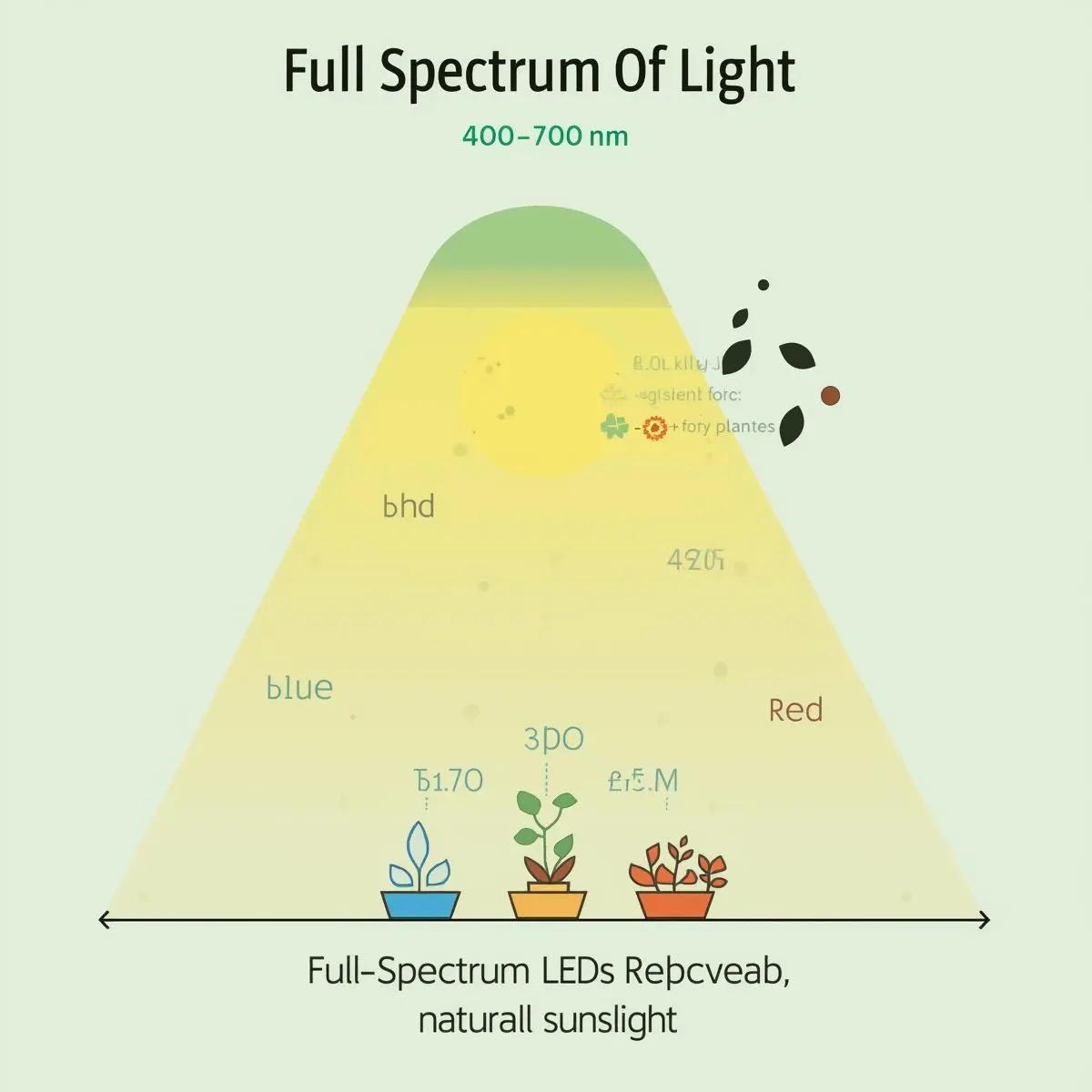
Full spectrum LED grow lights are artificial lights designed to mimic natural sunlight by covering the Photosynthetically Active Radiation (PAR) range (400–700 nm).
But here’s the key insight:
Plants don’t “see” light like we do. They use it as fuel.
What Makes Full Spectrum Different?
Older grow lights (the “blurple” era):
Focused only on red + blue wavelengths
Caused unnatural, stretched growth patterns
Made it nearly impossible to spot pests or deficiencies
Modern full spectrum LEDs:
Deliver balanced wavelengths across the entire PAR range
Provide natural white light (you can actually see your plants)
Support the full plant lifecycle—from seed to harvest
I’ve watched growers switch from blurple to full spectrum and immediately stop overwatering because they could finally see the soil surface.
Why Do Plants Need Full Spectrum LED Grow Lights Indoors?
How Do Plants Actually Use Light?
Plants aren’t picky eaters, but they are specific about wavelengths:
Blue light (400–500 nm) – Controls compact growth and leaf development. Too little blue, and your seedlings look like they’re reaching for the ceiling.
Red light (600–700 nm) – Drives flowering and fruiting. Without enough red, tomatoes get shy.
Green light (500–600 nm) – Penetrates deeper into the canopy, reaching lower leaves that red and blue miss.
Without this balance, plants stretch, weaken, or simply refuse to produce.
Can Natural Window Light Replace Grow Lights?
Short answer: almost never.
Even a bright south-facing window:
Lacks consistency (clouds, seasons, window film)
Changes dramatically from January to July
Provides weak PPFD levels—often under 100 µmol/m²/s
I know what you’re thinking: “But my succulents are fine.” Sure, low-light plants survive. But thrive? Rarely. That’s why understanding what are full spectrum LED grow lights becomes critical—they give you control over intensity and duration, something you can’t control with natural sunlight.
What Are Full Spectrum LED Grow Lights Specs You Should Understand?
Let’s cut through the marketing noise.
Key Lighting Terms (Simplified Table)
| Term | What It Means | Why It Matters |
|---|---|---|
| PAR | Usable light range (400–700 nm) | Defines what light plants actually use |
| PPF | Total light output from the fixture | Measures raw power (µmol/s) |
| PPFD | Light reaching the plant surface | Most important metric for growth |
| CCT | Color temperature (Kelvin) | Indicates warm vs. cool tone (less critical for plants) |
| CRI | Color accuracy | Helps you spot yellowing leaves or early deficiencies |
What PPFD Should You Aim For?
Seedlings → 100–200 µmol/m²/s
Leafy greens (lettuce, spinach) → 200–400
Fruiting plants (tomatoes, peppers) → 400–800
This is where many growers fail. They buy lights based on “watts” or pretty pictures, never check the PPFD map, and wonder why their peppers are all leaves and no fruit.
Research-Backed Benefits of Full Spectrum LED Grow Lights
Modern controlled-environment agriculture runs on these lights. For good reason.
Proven Benefits:
Faster growth cycles due to optimized wavelength balance
Higher yields in tents, shelves, and vertical farms
Better energy efficiency (more µmol per joule)
Low heat output reduces plant stress and watering frequency
Example
In a side‑by‑side 2×4 grow tent test—same nutrients, same fan, same cannabis clone:
Standard “blurple” LED → uneven growth, internodal stretching, lower bud density
Full spectrum LED → compact nodes, 30% better leaf density, easier harvest
Only the light changed. Everything else stayed identical.
How to Choose Full Spectrum LED Grow Lights (Step-by-Step)
Step 1: Match Light to Your Space
Start with your actual growing area:
Small shelf (1–2 sq ft) → low‑watt LED bars (20–50 W actual)
Medium setup (2×2 or 2×4 tent) → panel lights (100–200 W)
Larger grow tent (4×4+) → high‑output fixtures (300–600 W)
Step 2: Check These Specs Carefully
Ignore “1000W equivalent” marketing. Focus on:
Actual wattage (from the wall, not the product name)
PPFD distribution maps – look for uniformity across your canopy
Efficiency (µmol/J) – aim for 2.0 µmol/J or higher
Full spectrum curve – should include blue, green, red, and some far‑red
Step 3: Look for Safety & Build Quality
A good light includes:
Aluminum heat sinks (passive cooling is a plus)
MeanWell or similar stable drivers
Overheat protection
Certifications (CE, UL, ETL)
Shop Smart Tip:
When you choose a grow light, don’t guess coverage. Use our DLI Calculator to match your light’s PPFD to your plant’s daily light needs. It’s a game-changer—especially for beginners who don’t yet trust their gut.
For a deeper dive on fixture selection, see our LED Grow Light Guide: Science-Backed Indoor Setup (2026).
How to Use Full Spectrum LED Grow Lights Indoors
What Is the Ideal Distance?
Seedlings → 12–18 inches (start farther to avoid bleaching)
Houseplants → 12–24 inches
Fruiting crops → 10–16 inches
And adjust by touch—literally. Put your hand at canopy height. If it feels hot, back the light off.
How Long Should Lights Stay On?
Leafy plants (lettuce, herbs) → 12–14 hours
Fruiting plants (peppers, tomatoes) → 14–16 hours
Seedlings → 16–18 hours
Consistency matters more than brute intensity. A timer is non-negotiable. I’ve seen otherwise good growers lose entire harvests because they forgot to turn lights on for two days straight.
How Do You Know If Plants Are Getting Enough Light?
Your plants will tell you. Learn to read them:
Compact, dark green growth → ✔ Good. Keep going.
Stretching, pale leaves → ❌ Insufficient light. Move the fixture closer or increase the duration.
Bleached or curled upper leaves → ❌ Too much light. Raise the light or dim it.
For a detailed walkthrough on PPFD targets for different crops, check out our PPFD for Indoor Plants Explained.
Example Indoor Grow Setups Using Full Spectrum LED Grow Lights
| Setup | Typical PPFD | Best for |
|---|---|---|
| Windowsill supplement—small LED bar | 100–250 | Houseplants, winter maintenance |
| Grow shelf—LED bars under each level | 200–400 | Herbs, lettuce, seedling starts |
| 2×4 grow tent—200–300 W full spectrum panel | 400–800 | Peppers, tomatoes, compact cannabis |
In a shelf setup, I’ve grown enough basil to make pesto every week. Without the lights, those same plants would have been spindly, sad, and barely worth harvesting.
FAQ: What Are Full Spectrum LED Grow Lights?
Are full spectrum LED grow lights safe for home use?
Yes—with common sense. Don’t stare directly into the diodes (it’s uncomfortable, not instantly dangerous). Use certified products (CE, UL) and keep fixtures away from water splash zones.
Can I just use regular LED bulbs from the hardware store?
Technically, yes. Practically? They’re a compromise. Regular bulbs:
Have weak intensity (low PPFD beyond a few inches)
Lack a full plant-tuned spectrum.
Won’t support serious growth or flowering
Great for a single low-light pothos. Not for tomatoes.
Do I need separate veg and bloom lights?
No. That’s an older paradigm from HPS and fluorescent days.
A single full-spectrum LED handles both:
Vegetative growth (with plenty of blue)
Flowering stage (with strong red and some red)
You just adjust duration (longer for veg, shorter to induce bloom) and intensity as plants mature.
Master Light, Master Growth
Now you truly understand what are full spectrum LED grow lights—and more importantly, how to use them without falling for hype.
They’re not magic. They’re not another gadget. They’re the foundation of indoor growing success. Period.
At Grow With Hydroponics, we believe once you control light, everything else becomes easier. Nutrients make sense. Growth cycles become predictable. Even troubleshooting gets simpler when you can actually see what’s happening.
Start simple. One light. One tray of lettuce. Observe every day. Adjust distance, check PPFD, trust what the leaves tell you.
Because once you get lighting right…
you stop guessing—and start growing with confidence.

Dr. Awais Yousaf
Algorithm Specialist and Associate Professor leading R&D at Grow With Hydroponics. With 5+ years of hands-on experience in smart hydroponic systems, deep learning, and sustainable AgriTech, he is passionate about turning small spaces into high-yield indoor farms. Connect at awais.yousaf@iub.edu.pk