Most beginners don’t fail because they ignore their plants. They fail because they underestimate one variable—light. You can nail your nutrients, keep pH dialled in, run a clean reservoir, and still end up with stretched, pale, barely-productive plants because the grow light system doing the heavy lifting just isn’t up to the job.
Light isn’t another item on the checklist. It’s the engine.
Without enough of the right kind, photosynthesis sputters, growth stalls, and even a healthy seedling turns into a lanky disappointment reaching toward a fixture that was never built for serious growing.This guide cuts through the spec sheets and marketing language. AtGrow With Hydroponics, we’ve seen what a properly matched grow light system does for an indoor garden—and what the wrong one quietly ruins. The goal is to find the right-fit system for your space and your plants. Once you do, you’ll wonder why you waited so long. Explore The Ultimate LED Grow Light Guide: Science-Backed Indoor Setup (2026).
What Is a Grow Light System—and Why Does It Matter More Than Everything Else?
A grow light system is any artificial lighting setup that replaces or supplements sunlight for plant growth indoors. That sounds simple. In practice, it’s where most indoor gardens succeed or silently fail.Here’s the core issue: plants don’t respond to lumens—the brightness measurement we use for human eyes. They respond to PAR, Photosynthetically Active Radiation, which covers the 400–700 nm wavelength range that actually drives photosynthesis. A light that looks bright to you may be delivering almost nothing useful to your plants, and a light that looks modest might be packed with the exact wavelengths they need.PPFD (Photosynthetic Photon Flux Density) measures real-time light intensity in terms of usable photons hitting the canopy per second, while DLI (Daily Light Integral) accounts for how long plants are in that light over a full day. This balance between light duration and intensity is crucial for matching each crop’s specific light requirements.Get these right and your plants grow faster, flower harder, and produce more. Get them wrong and no amount of perfect nutrients will fix it.
What Types of Grow Light Systems Should You Actually Consider?
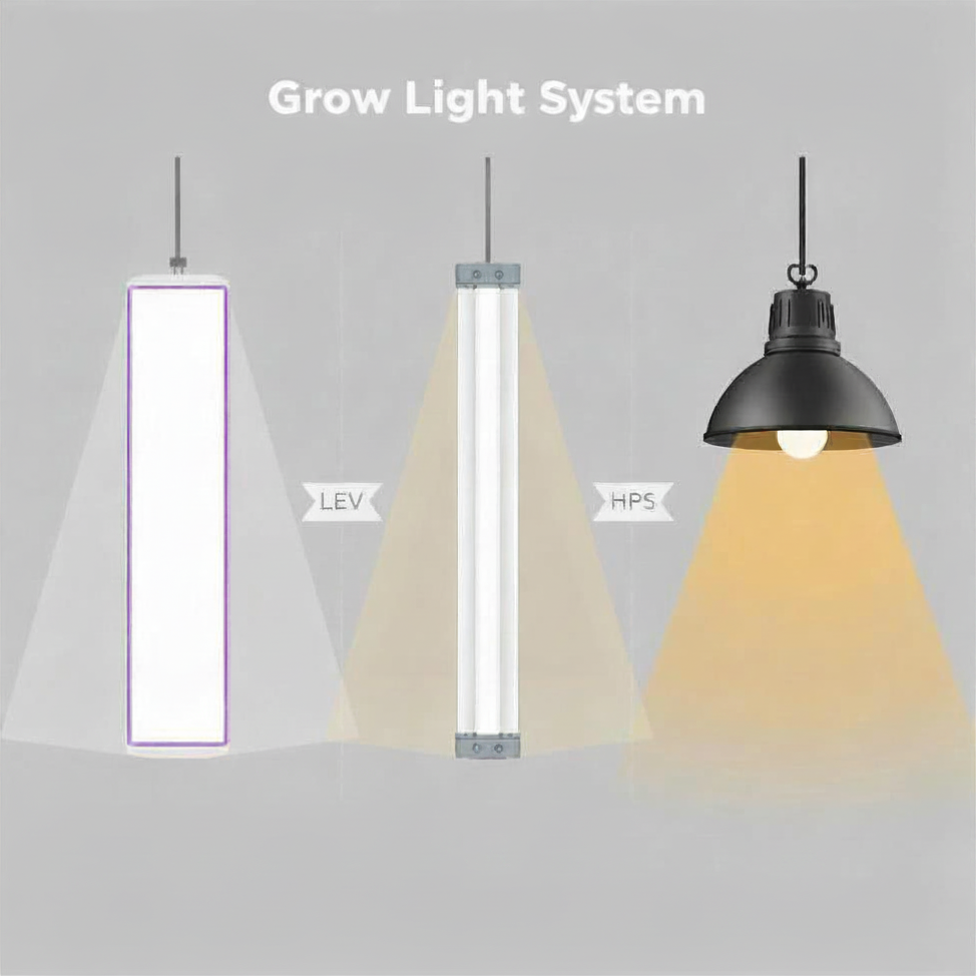
There are three main technologies worth knowing. Everything else is a variation on these.LED, fluorescent, HPS — three technologies, three very different trade-offs. The one that looks most familiar isn’t always the one your plants prefer.
LED Grow Light Systems — The Current Standard
LED grow lights offer 50–80% energy savings over older technologies, a lifespan of 50,000+ hours, lower heat output, and full-spectrum customisable lighting. LED technology has advanced significantly, providing equal or better yields while dramatically reducing operating costs.Modern full-spectrum LEDs are the default choice for home growers in 2025 for good reason. They run cool enough to hang closer to the canopy, cover the full photosynthetic range without bulb swapping, and cost less to operate month over month. The upfront price is higher than alternatives, but the running economics close that gap quickly.One note of caution: not all LEDs are equal. A properly designed lighting layout aims for uniformity ratios of 0.85 or higher, meaning the lowest PPFD reading should be at least 85% of the highest reading across the canopy. Uniformity is a major differentiator between professional lighting systems and low-cost fixtures. A cheap LED panel with hot spots in the centre and dim edges produces uneven growth, regardless of the wattage printed on the box.
Fluorescent Grow Lights (T5/T8) — The Seed-Starting Workhorse
Fluorescent lights, including T5 and CFL varieties, are commonly used for seed starting and early plant development. They emit less heat than HPS lights and are more affordable in small-scale settings.T5 fluorescents do one thing well: start seeds and grow herbs in the early stages without burning them. They don’t have the intensity for fruiting crops or serious production. But if you’re germinating, propagating cuttings, or growing leafy greens on a tight budget, they’re still a viable option—particularly for growers who want simplicity over precision.
HID Lights (HPS/MH) — High Output, High Commitment
High-Intensity Discharge lights—High Pressure Sodium and Metal Halide—were the industry standard for decades. HPS grow lights convert only about 30% of the energy they use into usable light, while LED grow lights convert approximately 50% of electricity into light. That difference compounds across an entire growing season in electricity costs and, critically, in heat management.HPS lights still find a place in large commercial operations where the economics of scale favour their lower upfront cost. For home growers? The heat output, cooling requirements, and bulb replacement schedule make them a harder case to justify against modern LEDs.
Understanding Grow Light Spectrum: What Plants Actually Use
Blue builds structure. Red triggers flowering. Green reaches where the others don’t. A full-spectrum grow light system handles all three without you managing a thing.
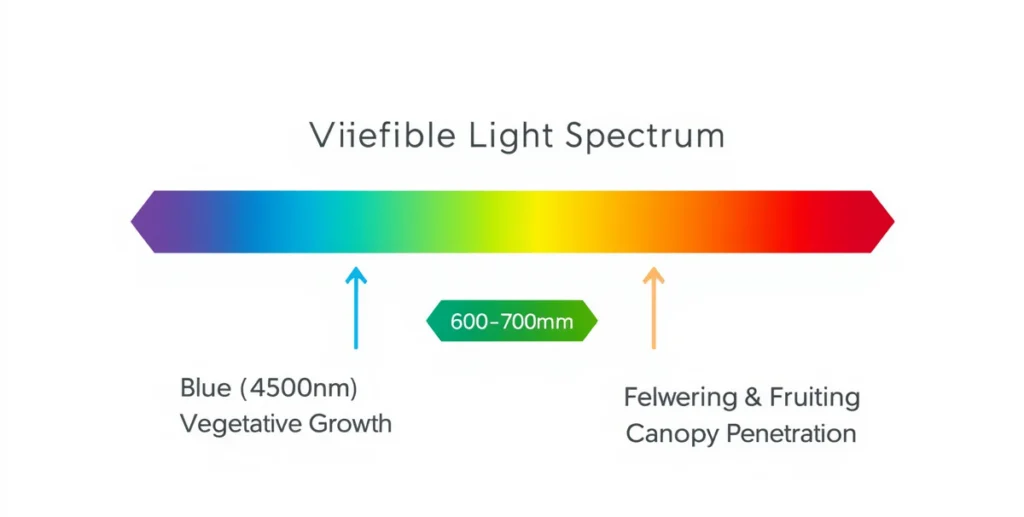
Spectrum is not a marketing concept. It’s the wavelength distribution of light your fixture emits, and different wavelengths trigger genuinely different biological responses.Blue light supports structural growth and compact morphology, while red light drives biomass and flowering. Optimal growth requires a balance of both. Here’s how that breaks down practically:Blue light (400–500 nm) promotes compact, leafy vegetative growth and is critical for seedlings. Too little blue and plants stretch—they grow tall and thin, allocating resources to height rather than leaf mass. This is the leggy seedling problem most beginners encounter.Red light (600–700 nm) is the bloom trigger. Plants absorb red light through a pigment called phytochrome, which triggers the production of gibberellins—hormones that stimulate seed germination and flowering responses. Without adequate red, flowering plants stall before producing.Green light (500–600 nm) was long dismissed as unnecessary. More recent studies have shown that adding green light to an LED fixture actually increases crop yields compared to fixtures without it, partly because green wavelengths penetrate deeper into the plant canopy than red or blue, reaching lower leaves that would otherwise be shaded.The takeaway: a genuine full-spectrum LED covers all of this without you having to manage bulb swaps or supplemental fixtures. For home growers, it’s the practical choice from seed to harvest.
How to Read PPFD and DLI When Buying a Grow Light System
These two metrics are the ones that actually tell you whether a fixture will perform.PPFD is the instantaneous density of photosynthetic photons hitting the canopy, in µmol/m²/s. DLI is the total photosynthetic photons delivered over a day, in mol/m²/d. DLI gives you flexibility—you can often reach the same DLI with a higher PPFD and shorter day, or a lower PPFD and a longer photoperiod.The formula: DLI = PPFD × hours × 3600 ÷ 1,000,000In practice, here’s what crops need:
Crop Type
Target PPFD (µmol/m²/s)
Daily Light Hours
Target DLI (mol/m²/day)
Seedlings
100–250
14–16
5–14
Herbs & Leafy Greens
200–400
14–16
12–18
Fruiting Vegetables (tomatoes, peppers)
600–900
16–18
25–35
High-demand crops with CO₂ supplementation
900–1,200
18
35–45
Low-light plants like lettuce thrive under 200–400 µmol/m²/s. Fruiting and flowering plants need 600+ µmol/m²/s for best yields. Too much light causes light burn, while too little leads to stretching.Before buying any fixture, use our DLI Calculator to verify whether the light’s stated PPFD, at your intended hanging height and photoperiod, actually delivers the daily light dose your crops need. This one check has prevented more wasted purchases than anything else. Understanding EC and PPM in hydroponic nutrient management—a supporting article on measuring and managing nutrient solution strength alongside lighting adjustments.
Matching Your Grow Light System to Each Growth Stage
Plants don’t need the same light throughout their life cycle. That’s not a complicated concept, but it’s one a lot of beginners ignore—then wonder why seedlings burn or mature plants fail to flower.Seedling Stage: Start with PPFD in the 100–250 range. For seedlings, keep lights 24–36 inches away to prevent light burn. If you’re using a dimmable LED, set it to 30–40% power rather than adjusting height alone—it gives you more precise control. Seedlings are far more sensitive to light stress than mature plants.Vegetative Stage: Move lights to 18–24 inches, increase PPFD to 300–500 depending on the crop, and extend the photoperiod to 16–18 hours. More blue light at this stage promotes compact, bushy structure rather than vertical stretch.Flowering and Fruiting Stage: Position lights too close and you risk light burn, bleaching, and stunted growth. Hang them too far away, and plants stretch weakly toward the light. For fruiting crops, aim for 12–18 inches at full power, 12–14 hours of light, and a shift toward a red-dominant spectrum if your fixture allows it.One practical rule: change one variable at a time. If you adjust height and spectrum and photoperiod simultaneously, you have no idea which change drove the plant response. Adjust, observe for several days, then adjust again if needed.
How to Set Up a Grow Light System That Actually Works
Setup mistakes are common and preventable. Here’s the practical sequence.
Measure your grow space first. Know the exact footprint before choosing a fixture. A light marketed for a 4×4 ft area often delivers adequate PPFD only in the central 2×3 ft at full intensity. Check the manufacturer’s PPFD map, not just the coverage claim.
Hang at the correct height for the growth stage using the guidance above. Start conservative—higher than you think—then lower gradually while watching for stress.
Set a timer and leave it alone. Most hydroponic crops benefit from consistent 18/6 (18 hours on, 6 hours off) schedules during vegetative growth, transitioning to 12/12 for flowering in photoperiod-sensitive species. Leafy greens and herbs often produce best results under 16/8 or even continuous lighting.
Digital or WiFi timers are worth the modest extra cost. Mechanical timers work but lose precision over time—and a one-hour drift in photoperiod during flowering is enough to stress photoperiod-sensitive plants.
Rotate your plants weekly. Light intensity drops toward the edges of any fixture’s footprint. Rotating pots keeps growth even across the canopy and prevents one side of each plant from leaning toward the source.
Monitor for stress signals:
Upward-curling leaves, bleaching at the top: light too close or too intense
Stretching stems, pale leaves, leaning growth: light too far or insufficient intensity
Uneven growth across the canopy: uniformity issue—rotate plants or reposition the fixture
When you’re ready to Shop Smart on a new LED fixture, focus on three things: verified PPFD maps from an independent test, a useful dimming range (30–100% covers most scenarios), and an adjustable hanging system. The fixture that fits your space and growth stage beats the one with the most impressive-looking spec sheet every time.
Common Grow Light System Mistakes That Cost You Yield
Trusting wattage over PPFD. Wattage tells you how much electricity a fixture consumes, not how much useful light it delivers. A quality modern LED can produce higher light output than a 1000W HPS while using 30% less power. Always compare PPFD at canopy height, not wattage on the box.Skipping timers. Manual light management fails. Your schedule changes, you forget, the plants get 10 hours one day and 18 the next. Photoperiod-sensitive crops can revert from flowering to vegetative growth with as little as a few nights of inconsistent darkness. A $15 digital timer solves this permanently.Not accounting for the inverse square law. LED grow light intensity follows the inverse square law: doubling the distance from the light reduces the PPFD at canopy level by a factor of four. Raising a light from 12 inches to 24 inches doesn’t halve the light—it delivers roughly a quarter of what it was. Small distance changes matter more than most growers realise.Keeping the old “blurple” mindset. Early red-blue LED panels were better than nothing, but the science has moved on. Excluding certain wavelengths that contribute to plant growth—particularly green—can negatively affect yields. A genuine full-spectrum white LED is the current best practice for home growers who want one fixture that handles every stage.Changing multiple variables at once when troubleshooting. Yellow leaves appear. You change the spectrum, raise the light, and add a nutrient boost all on the same day. Three days later, growth improves—but you have no idea what actually fixed it. Change one thing. Wait. Observe. Then adjust again.Troubleshooting nutrient deficiencies in hydroponicplants—a supporting tool for identifying and fixing plant health problems that often get misattributed to lighting.
Shop Smart: Grow Light Systems Our Experts Actually Recommend
Not every fixture on the market earns wall space in a serious grow room. Our team has filtered out the underpowered panels, the misleading wattage claims, and the fixed-position lights that can’t adapt as your plants grow.
Every pick is chosen for verified PPFD output, build quality, and real-world growing performance—across every budget and growing space size.
Light Is the One Variable You Can’t Borrow From Somewhere Else
A well-chosen grow light system doesn’t just keep plants alive—it determines what they’re capable of. Paired with good nutrient management and proper environmental control, the right light is what turns a hopeful experiment into a reliable, productive indoor garden.At Grow With Hydroponics, the tools exist to take the guesswork out of this. Use the DLI Calculator before you buy a fixture—enter your intended photoperiod and the manufacturer’s PPFD at your hanging height, and it tells you whether the daily light dose actually matches what your crop needs.Get the light right, and everything else in your grow room starts making more sense
Frequently Asked Questions About Grow Light Systems
What is the best grow light system for beginners? A full-spectrum LED with a dimmable output and adjustable hanging height. It handles every growth stage without bulb changes, runs cool enough to place closer to the canopy than older tech, and costs less to run month over month. Start with a fixture sized to your actual grow space, not the largest one available.How many hours a day should indoor plants be under grow lights? Maintain LED lights for 14–16 hours daily for herbs and leafy greens, and keep temperatures between 65 and 75°F for continuous harvests. Fruiting crops typically want 16–18 hours during vegetative growth, dropping to 12 hours to trigger flowering. Always use a timer—manual scheduling drifts, and plants pay the price.Can a regular LED bulb replace a grow light? Not effectively for most crops. Standard LED bulbs are designed to look bright to human eyes, which means they’re optimized for green wavelengths. Plants need meaningful blue and red output. A proper LED grow bulb fitted into a desk lamp can sustain seedlings or very low-light plants, but it won’t support serious vegetative growth or flowering.What does PPFD mean and why does it matter more than wattage? PPFD measures the actual photons reaching your plant canopy per second—the light your plant can use. Wattage measures electricity consumption only. A high-watt fixture with poor design delivers less usable light than a well-engineered lower-watt LED. Always compare PPFD at canopy height, ideally from an independent test report.How do I know if my grow light is causing stress? Upward-curling leaves, bleaching near the top, or stunted new growth usually indicate light that’s too intense or too close. Stretching, pale stems, and plants leaning toward the fixture indicate insufficient light or poor spectrum. Adjust one variable, give plants 3–4 days to respond, and reassess before changing anything else..
Dr. Awais Yousaf
Algorithm Specialist & Associate Professor
Algorithm Specialist and Associate Professor leading R&D at Grow With Hydroponics. With 5+ years of hands-on experience in smart hydroponic systems, deep learning, and sustainable AgriTech, he is passionate about turning small spaces into high-yield indoor farms. Connect at awais.yousaf@iub.edu.pk