

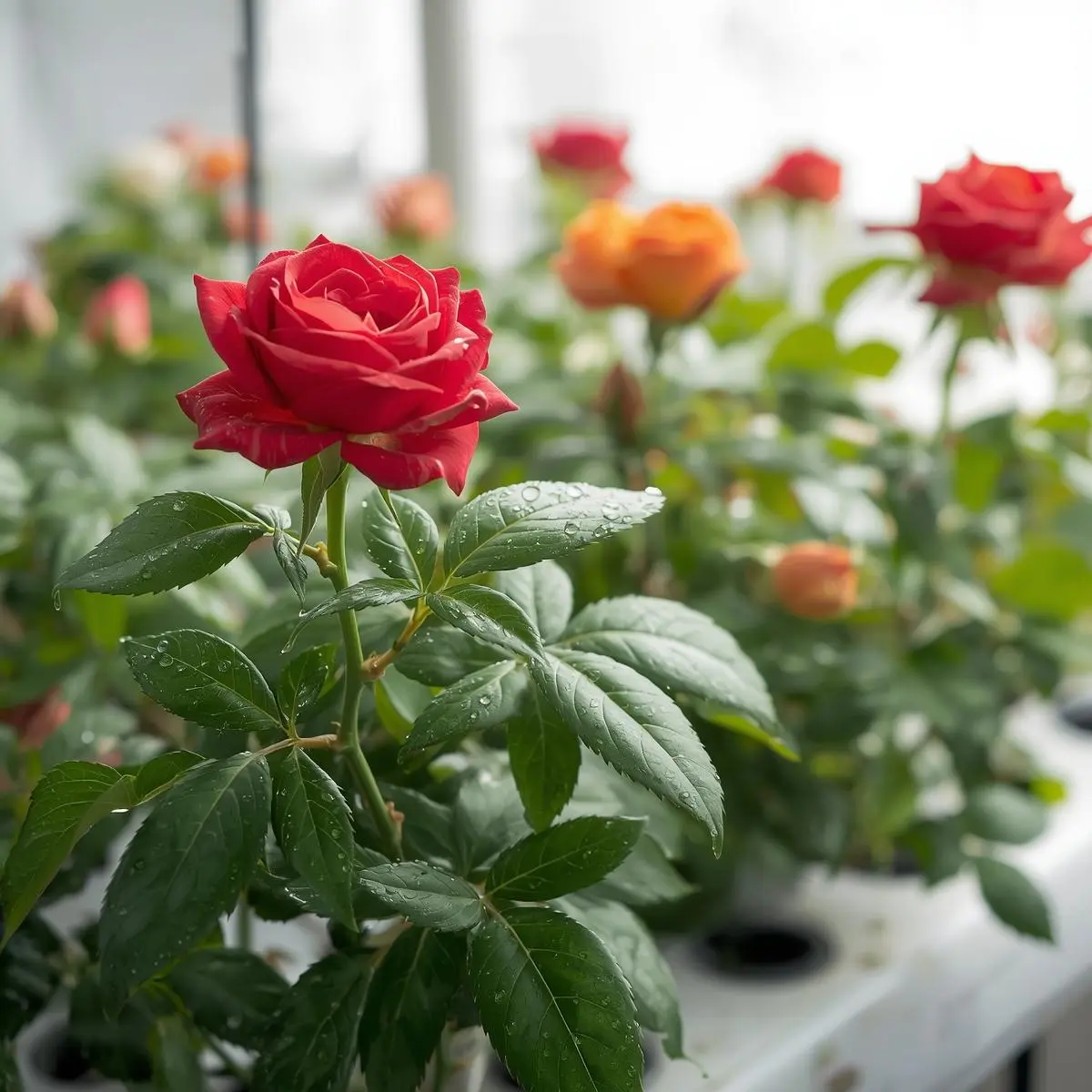
Roses have earned their title as the queens of the garden—lush foliage, stunning blooms, and that unmistakable fragrance. But here’s the thing about growing them hydroponically: they’ll let you know immediately when something’s off with their nutrition. No soil buffer, no forgiveness. Just clear signals you need to read. Have you noticed yellowing leaves on otherwise healthy plants? Stems that seem weaker than they should be? Spots or discoloration that weren’t there last week? You’re not imagining it, and frankly, this is where most indoor growers start to panic unnecessarily. At Grow With Hydroponics, we’ve spent over a decade helping gardeners decode these plant distress signals. In this guide, we’ll walk through exactly how to identify nutrient deficiency symptoms in roses, why they happen in hydroponic systems (spoiler: it’s almost always something simple), and the precise fixes that bring your plants back to vigorous health.
Why Roses Show Nutrient Deficiencies in Hydroponics
Hydroponics gives you precision control, but it also demands attention.
Unlike soil, which can buffer your mistakes for weeks, a hydroponic rose feels every imbalance in real time.
I’ve walked into grow rooms where the plants looked perfectly fine on Monday and by Thursday were showing clear deficiency patterns. That’s not a knock on the grower—it’s just the nature of the system. When the nutrient solution isn’t right, roses tell you fast.
Common causes include:
Incorrect nutrient concentrations – too strong burns roots, too weak starves them
pH fluctuations – even a 0.3 shift can lock out specific nutrients
Temperature and humidity swings – affecting transpiration and uptake
Water quality issues – high salts or low mineral content throwing off ratios
How to Identify Nutrient Deficiency Symptoms in Roses
Recognizing deficiencies early isn’t just helpful—it’s the difference between a quick fix and weeks of recovery. Let’s break down what to look for.
Nitrogen Deficiency in Roses
Symptoms
Older leaves turn uniformly yellow—not spotted, not patchy, just pale and tired. New growth looks light green, almost washed out. Overall growth slows to a crawl.
Why It Happens
Nitrogen drives leaf development and photosynthesis. In hydroponics, it’s either missing from the solution entirely or locked out by incorrect pH. I’ve seen growers chase this with half measures, adding a little here and there, and the plants just sit there, stalled.
The Fix
Increase nitrogen gradually—don’t shock them. Then check your pH. For nitrogen uptake, you want 5.5–6.5. Wait a week and observe. These aren’t houseplants you can fix overnight.
Learn more about balancing hydroponic nutrients.
Phosphorus Deficiency in Roses
Symptoms
Older leaves turn dark green, almost blue-green, then develop purple or reddish hues. Roots look underdeveloped. Flowers? Good luck—they’ll show up late or not at all.
Why It Happens
Phosphorus fuels energy transfer and flowering. If your pH drifts above 6.5, phosphorus becomes unavailable even if it’s sitting right there in the tank. I’ve watched growers add more phosphorus, watch the pH, and still miss that the two are connected.
The Fix
Adjust phosphorus levels based on growth stage—more during flowering. Keep pH locked in at 5.5–6.5. And here’s the trick: don’t overload other nutrients trying to compensate. That just makes things worse.
Potassium Deficiency in Roses
Symptoms
Leaf edges look scorched—brown, crispy, dying from the margins inward. Older leaves curl. Stems feel weak; flowers underwhelm.
Why It Happens
Potassium regulates water use and stress tolerance. In hydroponics, EC fluctuations are the usual culprit. Your meter says 2.0, but the plants aren’t getting what they need because calcium and magnesium are competing for uptake.
The Fix
Boost potassium slowly. Check EC—roses want 1.6–2.2 mS/cm depending on growth stage. And keep calcium and magnesium balanced. They’re all fighting for the same receptors.
Calcium Deficiency in Roses
Symptoms
New leaves come out distorted—hooked, twisted, weird. Flower ends rot. Leaf tips burn.
Why It Happens
Calcium moves slowly through plants. In hydroponics, high ammonium or potassium blocks it entirely. I’ve seen pH bounce between 5.5 and 6.8 over a week and calcium lockout happen by day three.
The Fix
Add calcium nitrate incrementally—don’t dump it in. Maintain a stable pH between 5.8 and 6.2. Avoid sudden EC spikes. Calcium hates turbulence.
Magnesium Deficiency in Roses
Symptoms
Older leaves show yellowing between the veins while the veins themselves stay green. Leaves curl upward. Growth slows.
Why It Happens
Magnesium sits at the center of every chlorophyll molecule. If calcium levels are too high, magnesium gets pushed out. Simple competition.
The Fix
Add magnesium sulfate (Epsom salt) carefully. Balance it with calcium—don’t fix one by breaking the other. Check older leaves first; they’re your earliest warning.
Iron Deficiency in Roses
Symptoms
Yellowing starts on young leaves; veins stay green. New growth looks stunted and pale. Flowers lose color intensity.
Why It Happens
Iron gets locked out fast when pH climbs. Roses are sensitive to this—they’ll show iron issues before almost any other plant in your grow room.
The Fix
Use chelated iron—it stays available longer. Keep the pH between 5.5 and 6.0. And watch phosphate levels; too much binds iron into useless forms.
Minor Micronutrient Deficiency Symptoms in Roses
Manganese, zinc, boron, copper—they’re trace elements, but roses notice when they’re missing. Symptoms are subtle:
Speckled leaves
Distorted growth patterns
Smaller flowers than expected
The Fix
Use a complete micronutrient mix formulated for hydroponic roses. Don’t try to fix individual micronutrient problems—you’ll create imbalances elsewhere. Monitor EC and pH, and let the plants tell you if you’ve got it right.
Tools to Help Monitor and Fix Nutrient Deficiency Symptoms in Roses
Here’s where precision beats guesswork every time. A few tools make the difference between chasing symptoms and preventing them:
- Plant Health Diagnosis Tool– Quickly determine which nutrient deficiency symptoms in roses they may be experiencing.
DLI Calculator – Match light levels to what your roses can actually use.
VPD Calculator – Get temperature and humidity right so nutrients actually move through the plant.
Hydroponic Nutrient Calculator – Mix solutions accurately, not by feel.
Grow Space Simulator – Test changes before you make them.
When you Shop Smart for nutrients or supplements, pair the purchase with these tools. Buy the right solution the first time—not the brightest bottle on the shelf.
Nutrient Deficiency Symptoms in Roses Comparison
| Nutrient | Primary Symptom | Best Use Case Fix |
|---|---|---|
| Nitrogen | Uniform yellowing of older leaves | Vegetative growth phase adjustment |
| Phosphorus | Purple/red hues on older leaves | Flowering stage boost |
| Potassium | Scorched leaf edges | EC stabilization |
| Calcium | Distorted new growth | pH stability focus |
| Magnesium | Interveinal chlorosis | Ca:Mg balance correction |
| Iron | Yellow new leaves with green veins | pH reduction to 5.5–6.0 |
| Micronutrients | Speckling, distortion | Complete micronutrient mix |
Common Q&A About Rose Nutrition
Can I use tap water for hydroponic roses?
Yes, if it’s tested first. High salts or unknown mineral content will fight your nutrient solution. Test EC and pH, then adjust.
How quickly can I fix deficiencies?
Mild issues often respond within 1–2 weeks. Severe deficiencies take longer and need sequential adjustments—don’t fix everything at once.
Can overfeeding cause similar symptoms?
Absolutely. Too much fertilizer locks out other nutrients. The symptoms look identical. Always adjust gradually.
Prevention: Maintaining Nutrient Balance
Monitor weekly – pH, EC, nutrient levels. Write them down. Memory fails; notes don’t.
Feed by stage – Vegetative roses need different ratios than flowering ones. Don’t treat them the same all year.
Control environment – Wrong VPD means nutrients sit in the solution while plants look deficient.
Track everything – Leaf appearance, solution changes, and adjustments made. Patterns emerge over time.
Explore our full hydroponic rose guide.
Start Diagnosing, Start Fixing
Nutrient deficiencies in hydroponic roses aren’t failures—they’re feedback.
Every yellow leaf, every twisted stem, every faded bloom tells you exactly what needs adjusting. The trick is learning to read the signals before panic sets in.
Start with observation. Use the tools that remove guesswork. Make changes slowly and track what happens. At Grow With Hydroponics, we’ve watched beginners become confident rose growers by following exactly this approach.
Your roses will talk. You just have to listen.
Ready to optimize your rose garden? Track your nutrients, trust your tools, and let the plants show you what they need.

Dr. Awais Yousaf
Algorithm Specialist and Associate Professor leading R&D at Grow With Hydroponics. With 5+ years of hands-on experience in smart hydroponic systems, deep learning, and sustainable AgriTech, he is passionate about turning small spaces into high-yield indoor farms. Connect at awais.yousaf@iub.edu.pk