

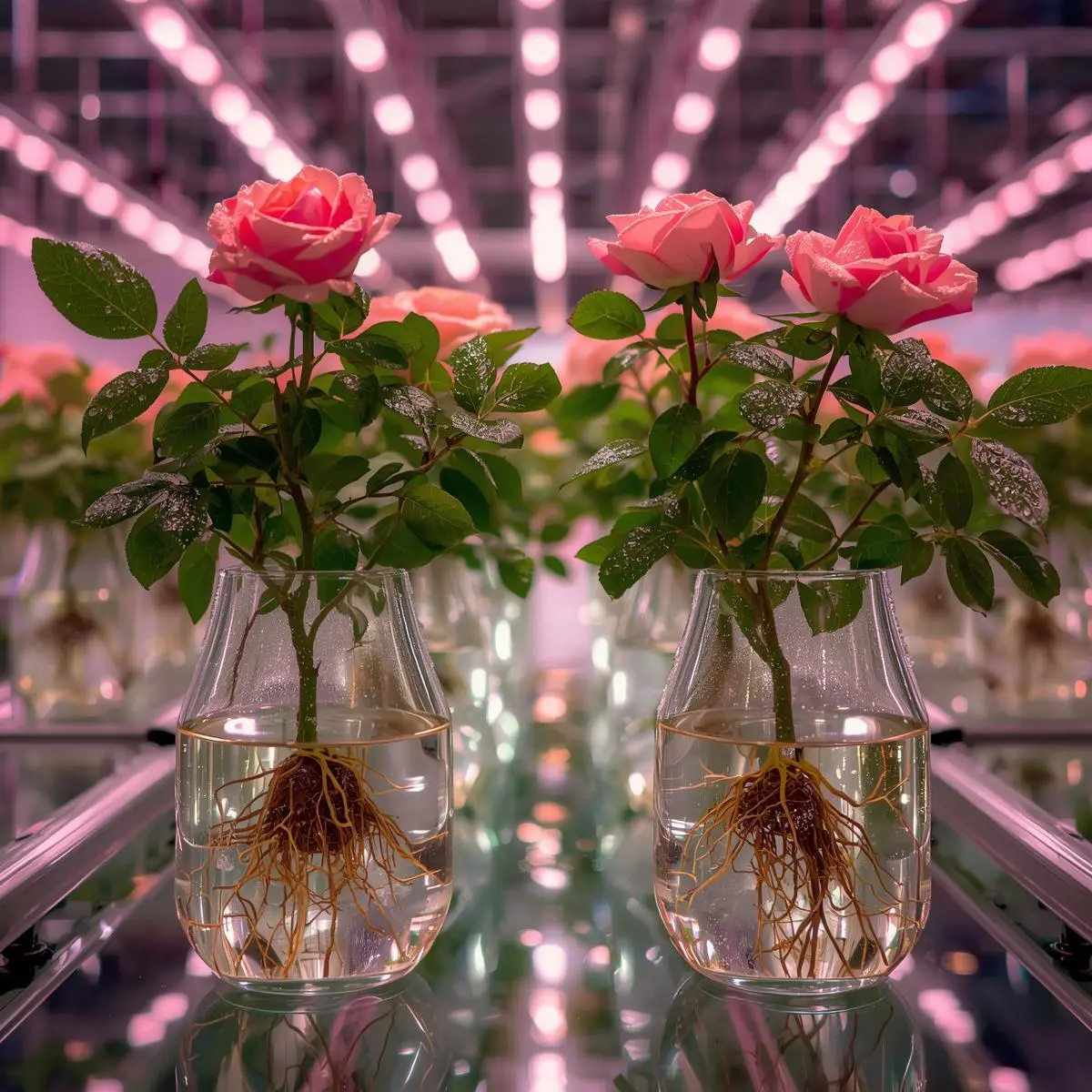
You did everything you were supposed to do. You filled the reservoir carefully, mixed the nutrients by the label, and hung the light at the recommended height. Then, two weeks in, the leaves started yellowing. A week after that, the buds stalled before they opened. By the time you finally pulled a root and found brown slime where white fuzz should be, you’d already lost the growth.
This isn’t a rare story. It’s the most common one.
Beginner mistakes in hydroponic rose growing rarely look dramatic while they’re happening. They look like slightly off-color leaves, or slower growth than expected, or buds that never quite open. By the time the damage is visible and obvious, you’re already a week into a problem that started three weeks ago. Hydroponics doesn’t give you the warning window that soil does—and roses, specifically, are less forgiving than almost anything else you could choose to grow in a system.
At Grow With Hydroponics, we’ve tracked the same pattern year after year. The failures aren’t random. They trace back to a handful of specific, preventable mistakes. This guide covers them all — what they are, why they happen, how to catch them early, and what to do instead.
Why Do Beginner Mistakes Hit Hydroponic Roses So Hard?
Understanding why roses are unforgiving in hydroponic systems matters before diving into individual mistakes. It reframes how you think about prevention.
Soil acts as a buffer. The biological complexity of a healthy growing medium—microbes, organic matter, and natural cation exchange—absorbs and corrects moderate imbalances before the plant ever feels them. A grower who lets their pH slip for a day in soil rarely loses the plant. In hydroponics, that same pH slip translates directly to nutrient lockout, because there’s nothing between the root and the solution. The plant experiences every imbalance in real time.
Roses compound this problem. They’re heavy feeders with specific, stage-dependent demands for potassium, calcium, and iron that most standard hydroponic formulas don’t adequately address. They’re also sensitive to environmental drift—temperature, humidity, and light intensity that sits outside their tolerance window doesn’t just slow growth; it stops flowering entirely.
Soil gives you a week to notice and fix a mistake. Hydroponics gives you days. With roses, sometimes hours.
For the complete foundation every rose grower needs, check out our comprehensive guide: How to Grow Roses Hydroponically: Science-Backed Complete Guide (2026).
Beginner Mistake #1: Treating pH Like a “Set It and Forget It” Variable
Ask any experienced hydroponic grower what kills most beginner grows, and the answer is almost always the same: pH drift. It’s not glamorous, it doesn’t generate much excitement, and it’s extremely easy to neglect once the system appears to be running smoothly. That’s exactly why it’s so destructive.
Why Does pH Matter So Much for Hydroponic Roses?
pH controls nutrient availability. Even a perfectly mixed, correctly concentrated nutrient solution becomes essentially useless to your plant if the pH drifts outside the absorption window. Specific nutrients lock out at specific pH levels—iron becomes unavailable above pH 6.5, calcium and magnesium become problematic below 5.5, and phosphorus availability peaks in a surprisingly narrow window around 6.0–6.2.
For hydroponic roses, the target pH range is 5.5–6.2, with most experienced growers keeping it tightest around 5.8–6.0 during active flowering. Outside that range, the nutrient formula in your reservoir may as well be tap water.
The added complication specific to roses: a study on hydroponic rose culture found that pH in the root zone fluctuates naturally across growth stages — rising from pinching through sprouting, then declining toward the flowering phase. This means your solution pH doesn’t just drift from external causes; it’s being actively shifted by your plant’s own biology. If you’re not checking and adjusting daily, you’re always behind.
What Does pH Drift Look Like?
The symptoms are easy to misread. A calcium deficiency shows as distorted, hooked new growth and blossom-end problems. Iron deficiency shows as yellowing between the veins of young leaves. Both are common in roses, and both are frequently caused not by absent nutrients but by a pH that’s preventing uptake of nutrients that are actually present in the solution.
Frankly, if you’re diagnosing nutrient deficiencies in hydroponic roses and you haven’t confirmed your pH first, you’re troubleshooting the wrong thing.
What to do instead:
- Check pH daily — not every few days, not weekly
- Target 5.5–6.2; keep it tightest at 5.8–6.0 during bloom
- Use a quality digital pH pen with regular calibration; cheap strip tests are not accurate enough for roses
- If using high-alkalinity tap water (above 75 ppm bicarbonate), increase check frequency—alkaline water actively pushes pH upward between measurements
Beginner Mistake #2: Getting EC Wrong in Both Directions
EC—electrical conductivity—is how you measure nutrient concentration in your reservoir. Get it wrong in either direction, and roses respond badly. The frustrating part is that overfeeding and underfeeding can produce symptoms that look nearly identical to each other and to pH-related lockout.
What EC Range Do Hydroponic Roses Need?
Roses are heavy feeders, but their appetite changes significantly across the growth cycle. A practical stage-based EC guide:
| Growth Stage | EC Target (mS/cm) | pH Target | Primary Nutrient Priority |
|---|---|---|---|
| Early vegetative | 1.4–1.6 | 5.8–6.2 | Nitrogen, calcium |
| Active vegetative | 1.6–1.8 | 5.8–6.2 | Balanced N-P-K |
| Transition to bloom | 1.8–2.0 | 5.8–6.0 | Phosphorus, potassium |
| Active flowering | 2.0–2.2 | 5.8–6.0 | Potassium, calcium, iron |
| Late bloom/pre-harvest | 1.8–2.0 | 6.0–6.2 | Reduce nitrogen |
Overfeeding — pushing EC above 2.2–2.4 — causes osmotic stress at the roots. The plant can no longer absorb water efficiently because the solution is more concentrated than the root cells themselves. Leaf edges brown and crisp. Roots darken. Growth stalls. It looks like drought stress even though the reservoir is full.
Underfeeding — EC consistently below 1.4 — produces slower, weaker growth and stems that can’t support proper bloom weight. The plant survives but never produces what the genetics would otherwise allow.
Does the Type of Nutrient Formula Matter?
Yes — significantly. Roses are heavy feeders with specific demands for potassium, calcium, and iron during flowering that a generic “leafy green” or all-purpose hydroponic formula won’t meet. A nutrient formula designed for lettuce and herbs will leave hydroponic roses chronically deficient in the exact elements they need most for bloom development.
Use a complete, bloom-focused hydroponic formula that includes a full micronutrient profile—chelated iron in particular, which stays available across a broader pH range than standard iron forms.
Tool Tip: Use the Nutrient Calculator to mix stage-appropriate solutions with precision. It removes the guesswork from N-P-K ratios at each growth stage and ensures your calcium and magnesium levels don’t compete with potassium for uptake — a common and easily overlooked cause of apparent deficiencies in roses that are otherwise well-fed.
Beginner Mistake #3: Ignoring Water Temperature Until It’s Too Late
This is the mistake that earns the most shock from growers who discover it after a root rot event. Water temperature isn’t a secondary consideration. In hydroponics, it’s arguably as important as pH.
Why Does Reservoir Temperature Matter for Roses?
Two things happen as water temperature rises above 70–72°F (21–22°C):
First: dissolved oxygen content drops. Roots need oxygen to respire — it’s the same biological requirement as any other living tissue. Oxygen-depleted water forces roots into anaerobic conditions, which both stresses the plant directly and creates the environment where root pathogens thrive.
Second: Pythium — the primary pathogen responsible for root rot in hydroponic systems — becomes dramatically more active above 72°F. Pythium doesn’t just grow faster in warm water; it spreads faster through a shared reservoir system, meaning a single affected plant can contaminate an entire crop within days if water temperature is high and circulation is shared.
By the time roots turn brown and slimy and the leaves show wilting despite a full reservoir, the damage is typically too advanced for a simple flush to fix. Prevention is the only practical strategy.
Practical targets:
- Keep nutrient solution temperature between 65 and 68°F (18 and 20°C)
- Never allow reservoir temperature to exceed 72°F (22°C)
- In warm climates or under high-intensity lighting that generates heat, a reservoir chiller is not a luxury—it’s necessary infrastructure
What Do Healthy Roots Look Like vs. Diseased Roots?
Healthy hydroponic rose roots are bright white to cream-colored, slightly fuzzy in texture, and carry no odor beyond a faint earthy smell. Pythium-infected roots turn tan, then brown, then grey-black. They become slimy to the touch and smell unmistakably foul. If you find that, act fast: drain the reservoir, prune all visibly infected root material, clean and sterilize the system, and refill with fresh nutrient solution at the correct temperature with strong aeration running
Beginner Mistake #4: Underestimating What Light Actually Requires
Roses are highlight plants. They don’t adapt gracefully to inadequate light — they tell you immediately through slow growth, weak stems, and buds that stall before they open. But the more common light mistake isn’t running lights that are too dim; it’s running the wrong light at the wrong distance for the wrong duration and never measuring whether the plant is actually receiving what it needs.
How Much Light Do Hydroponic Roses Need?
For healthy vegetative growth and reliable bloom, hydroponic roses need a DLI (Daily Light Integral) of 20–30 mol/m²/day. This typically means running a quality full-spectrum LED at 500–700 PPFD for 14–16 hours during vegetative growth, shifting to a 12-hour photoperiod to trigger and sustain flowering.
Two common light mistakes that derail rose timelines are
Running lights too far from the canopy. Light intensity follows the inverse square law—double the distance, quarter the intensity. A fixture positioned 24 inches above the canopy delivers a fraction of the light that the same fixture delivers at 14 inches. Stems stretch, internodes lengthen, and buds develop poorly.
Never adjusting during the grow. A distance that was appropriate for newly transplanted starts becomes inadequate as the plant fills out its canopy. Light management is an ongoing task, not a one-time setup.
Shop Smart: Before puasing any grow light for roses, use the DLI Calculator to verify what daily light dose the fixture will actually deliver at your intended mounting height and run time. Our Shop Smart equipment page lists fixtures with confirmed PPFD data so you can match the purchase to your plant’s real requirements — not marketing claims.
Beginner Mistake #5: Letting Environment Drift Without Monitoring VPD
Temperature and humidity in the grow space are not independent variables. They interact — and that interaction determines whether your roses can actually use the nutrients and light you’re providing.
VPD (Vapour Pressure Deficit) is the measure of that relationship. It describes the “pulling power” of the air—how efficiently it draws moisture (and nutrients) through the plant. VPD too low (high humidity, warm temperature) and transpiration slows, nutrient movement through the plant stalls, and powdery mildew becomes an immediate risk. If VPD is too high (low humidity, high temperature) and the plant closes its stomata to conserve moisture, shutting down the gas exchange that makes photosynthesis possible.
For hydroponic roses, target a VPD of 0.8–1.2 kPa during active growth, adjusted slightly higher (1.0–1.4 kPa) during flowering to maximise transpiration-driven nutrient uptake.
Common environmental symptoms that beginners misread as nutrient problems:
- Drooping leaves despite adequate root moisture → often high VPD or high temperature stress
- Powdery white coating on leaves → low VPD, inadequate airflow, humidity accumulation
- Bud abortion before opening → temperature spikes above 85°F (29°C) during bud development
Tool Tip: The VPD Calculator helps you find the specific temperature-humidity balance your growing space needs. It’s particularly useful when seasonal changes shift ambient conditions — what worked in winter often needs adjustment in summer when ambient temperatures rise.
Beginner Mistake #6: Skipping System Maintenance Because Nothing Looks Wrong Yet
This is the mistake that arrives with the most expensive consequences. Growers who maintain clean systems don’t have dramatic reservoir crashes. Growers who don’t maintain their systems eventually lose a crop during what seems, until that moment, to have been going well.
What Does a Proper Maintenance Schedule Look Like?
Daily:
- Check and log pH and EC
- Top off with fresh, pH-adjusted water as needed (evaporation concentrates nutrients—topping off with nutrient solution raises EC faster than intended)
- Visual inspection of leaves and any visible root sections
Weekly:
- Inspect pump flow and tubing for partial clogs
- Check reservoir for early signs of algae (green tinting on reservoir walls or tubing)
- Visual root inspection if accessible — look for any shift from white toward tan or brown
Every 1–2 weeks:
- Full reservoir change with fresh nutrient solution
- Wipe down reservoir walls and net pots
- Replace solution fully if EC can no longer be corrected reliably, or if any off-odour develops
Between grow cycles:
- Full system teardown, cleaning with dilute hydrogen peroxide or food-grade steriliser
- Inspect and replace tubing, air stones, and pump inlet filters
Algae is an early warning sign worth taking seriously. It competes with roots for oxygen, clogs emitters, and creates organic matter that feeds the same bacterial populations that cause root rot. The trigger is almost always light leaking into the reservoir. Light-proof everything — reservoir lids, inlet holes, net pot collars.
Beginner Mistakes in Hydroponic Roses: Quick Diagnosis Guide
| Symptom | Most Likely Cause | First Check |
|---|---|---|
| Uniform yellowing of older leaves | Nitrogen deficiency or pH lockout | Check pH first; then EC |
| Scorched, brown leaf edges | Potassium deficiency or EC too high | Check EC and compare to stage target |
| Twisted, hooked new growth | Calcium deficiency | Check pH (Ca locks out below 5.5); check Ca in the formula. |
| Yellow between veins on young leaves | Iron deficiency | Check pH (Fe locks out above 6.5) |
| White powder on leaves | Powdery mildew from low VPD | Check humidity and improve airflow |
| Brown, slimy roots | Root rot (Pythium) | Check reservoir temperature; increase aeration |
| Buds forming but not opening | Light too low; temperature spike; EC too low during bloom | Check DLI; check EC for flowering stage |
| Wilting despite full reservoir | Root rot or high VPD stress | Pull a root and check the temperature. |
Advanced Habits That Separate Consistent Growers from Beginners
Once the fundamentals are managed, a few additional habits make a measurable difference in how consistently hydroponic roses perform:
Keep a grow log. Record pH, EC, reservoir temperature, and any observations daily. Patterns that are invisible day-to-day become obvious across two or three weeks. A log also makes troubleshooting dramatically faster — instead of guessing when a problem started, you can trace back to the exact conditions present when symptoms first appeared.
Change one variable at a time. Adjusting light intensity, nutrient formula, and VPD simultaneously makes it impossible to know what worked. Change one thing, observe for 3–5 days, then adjust again if needed. This sounds slow. It’s actually faster than the alternative — a spiral of compounding adjustments where you’ve lost track of the baseline.
Start with a smaller system than you think you need. Managing one or two plants with rigorous attention teaches you what hydroponic roses actually require at each stage. Scaling to more plants before you’ve learned those signals means more plants experiencing the same undiagnosed problem.
The Growers Who Succeed Are the Ones Who Monitor Everything
The gap between a beginner who loses their first hydroponic rose crop and a grower who produces consistent, full blooms on schedule isn’t talent. It’s the willingness to check the numbers every day, log what you find, and change only one variable at a time when something needs adjusting.
Hydroponic roses reward precision and attention in ways that few other crops do. The same system properties that make beginner mistakes so damaging—no soil buffer, no error margin, and immediate plant response—also mean that correct management produces results soil growing simply can’t match. Faster growth, bigger blooms, and harvests that don’t depend on the outdoor calendar.
The beginner mistakes in hydroponic roses covered in this guide are all preventable. Not after years of trial and error—but from the very first grow, if you know what to look for and why it matters.
Grow With Hydroponics has the calculators, diagnostic tools, and practical guides to support every stage of that process—from first fill of the reservoir through peak flowering and beyond. Start with the fundamentals, measure daily, and let the plant tell you what it needs.
FAQ: Beginner Mistakes in Hydroponic Roses
How often should I change the nutrient solution for hydroponic roses?
Every 1–2 weeks is the standard recommendation, with full changes when the solution smells off, when EC can no longer be corrected reliably, or when roots show any early signs of discoloration. Between full changes, top off with plain pH-adjusted water — not nutrient solution — to replace evaporation losses without driving EC upward.
What’s the most common reason hydroponic rose buds abort before opening?
Temperature spikes are the most frequent cause — particularly temperatures above 85°F (29°C) during bud development. Low DLI during the flowering stage and EC that hasn’t been adjusted upward for bloom demands are the next most common culprits.
Can I use a generic hydroponic nutrient formula for roses?
Not effectively. Roses have significantly higher demands for potassium, calcium, and chelated iron during flowering than standard formulas provide. A bloom-specific formula, ideally one designed for flowering crops rather than leafy greens, is necessary for consistent bud development and bloom size.
How do I know if my pH meter is accurate?
Calibrate it with fresh calibration solution before each use or, at minimum, weekly. An uncalibrated pH meter is worse than no meter because it gives you false confidence in numbers that may be significantly off. Budget pH pens often drift and should be replaced annually at a minimum.
My roses look healthy, but growth has slowed dramatically. What should I check first?
In order: pH, then EC, then reservoir temperature, then light DLI. The majority of slow-growth scenarios in hydroponic roses trace back to one of these four variables sitting outside the optimal range—often despite appearing to be fine on the surface.

Dr. Awais Yousaf
Algorithm Specialist and Associate Professor leading R&D at Grow With Hydroponics. With 5+ years of hands-on experience in smart hydroponic systems, deep learning, and sustainable AgriTech, he is passionate about turning small spaces into high-yield indoor farms. Connect at awais.yousaf@iub.edu.pk