

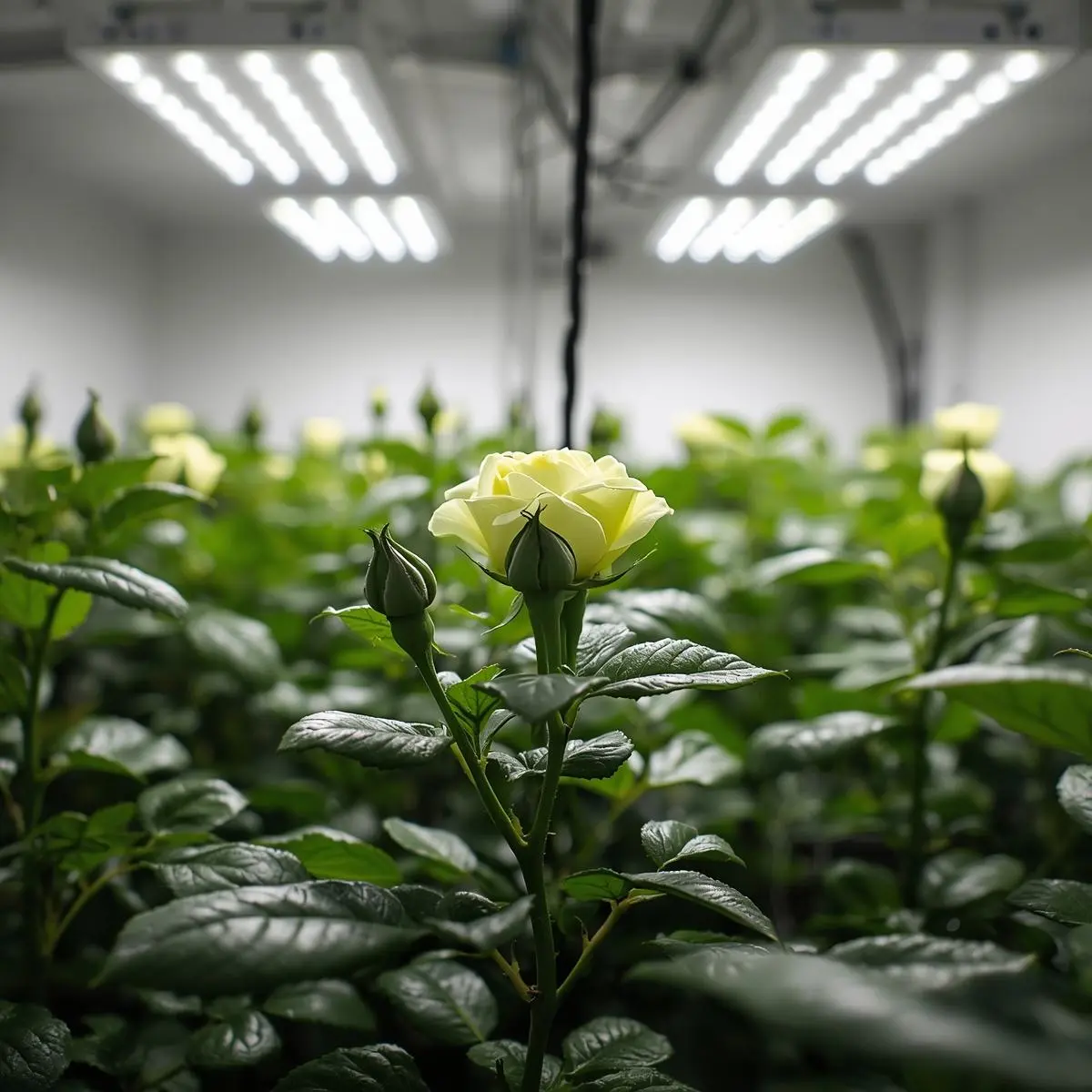
If your indoor roses are lush and green but refuse to bloom, don’t reach for another bottle of fertilizer just yet. More often than not, the real culprit is hiding in plain sight: the growing environment.
You see, roses aren’t fussy. They’re reactive. Get the balance of heat, moisture, and light wrong, and they’ll happily grow leaves while holding back flowers. At Grow With Hydroponics, we’ve watched countless growers chase nutrient deficiencies that didn’t exist—meanwhile, temperature swings, bone-dry air, and weak lighting were the real problems all along.
This guide walks you through controlling the full indoor climate so your roses produce stronger stems, healthier leaves, and far better blooms.
Don’t just ask what to feed your roses; ask whether your room is helping them use what you feed.
Temperature controls metabolism. Humidity drives transpiration. Light fuels photosynthesis and flowering. When those three work together, roses become predictable. When they don’t?You get a plant that looks healthy but still refuses to bloom.
What Is the Ideal Temperature, Humidity & Light for Roses Indoors?
Let’s clear something up right away: there’s no single magic number. The right environment shifts slightly depending on growth stage, season, airflow, and even your specific light fixture.
That said, here’s a reliable starting point based on decades of greenhouse research and real-world indoor growing:
| Environmental Factor | Recommended Range | Why It Matters |
|---|---|---|
| Day temperature | 20–26°C / 68–79°F | Supports active photosynthesis |
| Night temperature | 16–18°C / 60–65°F | Encourages strong flowering rhythm |
| Relative humidity | 55–70% RH | Controls transpiration and leaf health |
| VPD range | 0.8–1.2 kPa | Balances water movement through the plant |
| DLI for flowering | 18–25 mol/m²/day | Provides enough light energy for blooms |
| Photoperiod | 12–16 hours | Maintains consistent growth rhythm |
These aren’t random numbers. Studies on cut roses show that temperature and humidity directly affect flower size, stem length, and even vase life. But here’s the reality check a lot of online guides skip: a compact indoor tent, a sunny windowsill, and a full hydroponic grow room will all behave differently. Treat these ranges as your compass—not handcuffs.
Why Does Temperature Matter So Much for Indoor Roses?
Think of temperature as the speed control on your plant’s engine. Too cool, and everything slows to a crawl—growth, nutrient uptake, even root activity. Too hot, and roses stretch, soften, and lose water faster than they can replace it.
For most indoor setups, aim for 20–26°C during the day. That’s the sweet spot for steady photosynthesis without heat stress. At night, let it drop to 16–18°C.
That night drop isn’t optional fluff—it’s biology. Roses evolved with cooler nights, and they expect that rhythm. Keep the room at a flat 24°C around the clock, and you’ll often see soft growth, weak stems, and delayed flowering. I’ve seen otherwise healthy roses refuse to bloom for weeks simply because the grower was afraid to let temperatures vary.
What Happens If Roses Get Too Hot?
Heat stress announces itself long before the plant collapses. Watch for:
Leaves curling upward during the warmest part of the day
Crispy edges on leaves or petals (often mistaken for nutrient burn)
Medium drying out suspiciously fast
Flowers that open weak and fade within a day or two
Buds that turn brown and drop off
A single hot afternoon usually won’t kill a rose. The real damage comes from repeated heat stress without matching adjustments to humidity, airflow, and watering.
What Happens If Roses Get Too Cold?
Cold stress is slower but just as frustrating. Signs include:
Sluggish growth even under decent light
Pale or yellowing leaves (nutrients aren’t moving well)
Buds that stay tiny for weeks
In hydroponic systems, root issues if water temperature also drops
Stable daytime warmth plus a gentle nighttime cool-down is almost always better than dramatic temperature swings.
What Humidity Level Is Best for Ideal Temperature, Humidity & Light for Roses?
Humidity isn’t just “moisture in the air.” It controls how easily water moves from the roots, through the stems, and out the leaves. That movement is what delivers nutrients and cools the plant.
Here’s a practical humidity roadmap for indoor roses:
65–70% RH during early leafy growth
55–60% RH during flowering
Avoid long periods above 80% RH unless airflow is excellent
Research has shown that very high humidity can reduce postharvest flower quality in some rose varieties. So don’t just crank the humidity and call it a day. Manage it carefully.
Why Is High Humidity Risky for Roses?
High humidity helps vegetative growth—up to a point. But pair it with stagnant air, and you’re basically inviting fungal problems to dinner.
Common signs of excess humidity:
Powdery mildew (white patches on leaves)
Gray mold (Botrytis) on flowers and dead tissue
Soft, floppy stems from weak transpiration
Leaves that stay wet for hours after watering
Poor nutrient flow—the plant isn’t drinking
In many cases, a simple circulation fan or small dehumidifier will do more for your roses than an expensive additive.
Why Is Low Humidity Also a Problem?
Low humidity pulls water out of the plant too quickly. When roses transpire faster than their roots can supply water, stress follows fast.
Symptoms include:
Dry, brown leaf tips
Wilting under lights even when the medium is moist
Bud drop before flowers open
Smaller, less impressive blooms
Spider mites (they love dry air)
This is exactly why temperature and humidity should never be managed in isolation.
How Does VPD Improve Ideal Temperature, Humidity & Light for Roses?
VPD stands for Vapor Pressure Deficit. In plain English: it measures how strongly the air pulls moisture from your plant’s leaves. It’s the single best tool for connecting temperature and humidity into one useful number.
Instead of asking, “Is 60% humidity good?” you ask, “Is 60% humidity good at this temperature?”
| Growth Stage | VPD Target | What It Supports |
|---|---|---|
| Early vegetative | 0.8–1.0 kPa | Steady leaf growth, good nutrient movement |
| Bud formation | 0.9–1.1 kPa | Balanced transpiration, stronger stems |
| Flowering | 1.0–1.2 kPa | Lower disease pressure, better bloom quality |
If VPD is too low, the air is too moist. The plant stops transpiring properly. If VPD is too high, the air pulls water too aggressively—leading to wilt, edge burn, and stress.
Real-world example: a room at 26°C and 40% RH feels fine to you. But under strong LEDs, that’s stressful for roses. Raising humidity or slightly lowering temperature can bring everything back into balance.
A VPD Calculator is genuinely useful here. Enter your readings, see the result, then adjust the room based on what the numbers tell you.
How Much Light Do Roses Need Indoors?
Roses are high-light plants. They’ll survive in moderate light, but survival isn’t flowering. If your rose is green but won’t produce buds, weak light is one of the first things to check.
Indoor growers should think in DLI (Daily Light Integral) —the total amount of usable plant light received in one day.
| Light Level | DLI Range (mol/m²/day) | Likely Result |
|---|---|---|
| Low | Below 12 | Weak growth, poor flowering |
| Moderate | 12–18 | Healthy leaves, limited blooms |
| Strong | 18–25 | Good flowering, stronger stems |
| Excessive | Above 30 | Bleaching, stress (without CO₂ and climate control) |
DLI isn’t just theory. Greenhouse growers rely on it daily because it tells you total light delivery—not just brightness at one moment.
Can Roses Get Too Much Light?
Yes. And this is where a lot of new LED owners get humbled.
More light is only better if the plant has enough water, humidity, nutrients, root health, and even CO₂ to use it. Throw intense light at a stressed rose, and you’ll see:
Bleached or pale leaves near the fixture
Crispy upper leaf margins
Short, bunched-up, stressed growth
Buds that abort before opening
Petals that fade within a day
A DLI Calculator helps you match your grow light’s intensity and hours to your rose’s actual needs—not some marketing claim on a box.
Shop Smart: When you Shop Smart for grow lights, don’t buy based on wattage or “bloom switches.” Use a DLI Calculator first. Match the fixture to your rose’s requirements, canopy size, and daily schedule. Your wallet—and your plants—will thank you.
What Is the Best Light Schedule for Indoor Roses?
Most indoor roses do well with 12–16 hours of light per day. If your light is moderate, lean toward the longer schedule. If it’s intense, shorter can be fine.
A beginner-friendly approach:
Start with 14 hours of light per day
Observe for 7–10 days—check leaf color and bud development
Increase intensity only if the plant looks ready
Raise or dim the fixture if upper leaves show stress
Keep a dark period. Roses need a daily rhythm.
Don’t run lights continuously unless you’re running a very specific experiment. Some studies have looked at continuous lighting, but they also show that humidity, temperature, and airflow become more critical under extended light. Translation: not for beginners.
How Do Temperature, Humidity & Light for Roses Work Together?
This is where most indoor growers get lost. Temperature, humidity, and light form a triangle. Change one side, and the other two move.
Here’s how that plays out in real life:
| Situation | What Happens | Better Adjustment |
|---|---|---|
| High light + low humidity | Plant loses water too fast | Raise RH or reduce light intensity |
| High temp + high humidity | Disease pressure spikes | Improve airflow, reduce humidity |
| Low light + high humidity | Weak, soft growth | Increase light, improve ventilation |
| Cool nights + wet leaves | Fungal risk rises | Water earlier, increase air movement |
| Strong LEDs + warm room | Leaf stress appears fast | Monitor VPD and canopy temperature |
Think of environmental control as a conversation. Your rose is always talking through its leaves, stems, and buds. The question is whether you’re listening.
What Are the Most Common Mistakes with Indoor Rose Environments?
Even careful growers repeat these. The good news? They’re easy to fix once you know what to look for.
Mistake 1: Chasing perfect numbers separately
A grower keeps humidity at 60% and temperature at 26°C, assuming all is well. But with intense light and poor airflow, the plant still suffers.
Fix: Track temp, humidity, and light together. Use VPD as your guide.
Mistake 2: Buying strong lights without a plan
Weak lights give you leafy plants with no flowers. Strong lights give you stress.
Fix: Plan your DLI before you buy or upgrade.
Mistake 3: Ignoring airflow
Still air encourages fungus and uneven temps. The room may show 60% RH, but inside the canopy, trapped moisture can still create disease-friendly conditions.
Fix: Use gentle circulation fans. Air should move leaves slightly—not blast them.
Mistake 4: Keeping the room too constant
Roses benefit from rhythm. A mild night drop supports natural growth.
*Fix: Allow a safe day-night difference. Don’t hold identical conditions for 24 hours.*
Mistake 5: Diagnosing everything as nutrient deficiency
Yellow leaves and weak blooms aren’t always hunger. Environmental stress blocks nutrient use even when your solution is perfect.
Fix: Check climate first. Then adjust feeding.
Example: Why a “Healthy” Indoor Rose May Not Bloom
Imagine this setup:
Temperature: 24°C day and night
Humidity: 45% RH
Light schedule: 10 hours under a weak LED
Airflow: minimal
Nutrients: technically correct
The plant stays green, but flowering is weak. Why? Light dose is too low. Humidity is stressful. Missing night drop gives no rhythm.
Now compare a better version:
Day temp: 22–25°C
Night temp: 16–18°C
Humidity: 60–65% during growth, 55–60% during bloom
Light schedule: 14–16 hours, DLI checked
Airflow: gentle and continuous
This doesn’t require perfection. It requires alignment.
How Can Beginners Control Ideal Temperature, Humidity & Light for Roses?
Start simple. You don’t need a commercial greenhouse.
Beginner checklist:
Place sensors at canopy height (not floor, not wall)
Record morning and evening readings for one week
Adjust one factor at a time so you know what helped
Don’t mist flowers—especially during bloom
Give plants space so air moves through the canopy
Remove dead leaves quickly
Check light distance whenever plants grow taller
Small corrections almost always work better than dramatic changes.
FAQ: Ideal Temperature, Humidity & Light for Roses
What temperature is too hot for indoor roses?
Above 30°C can stress indoor roses, especially under strong grow lights or low humidity. Short warm periods are usually fine, but repeated heat stress reduces flower quality and increases water demand.
What humidity is best for flowering roses?
During flowering, 55–60% RH is safer than very high humidity. It supports transpiration while lowering fungal risk on petals and buds.
Do roses need a night temperature drop?
Yes. A gentle night drop (16–18°C) imitates natural conditions and supports stronger growth rhythm and better flower development.
Why are my indoor roses growing leaves but no flowers?
Most common reasons: low DLI, weak lights, no night temperature drop, or environmental imbalance. If leaves look healthy but buds are poor, check light quantity first.
Can I grow roses under LED lights only?
Yes. Focus on PPFD, DLI, coverage area, and heat management—not wattage alone. Many excellent LED fixtures work perfectly for indoor roses.
Control the Room, Then the Rose Will Respond
The secret to better indoor roses isn’t a mystery nutrient or a complicated trick. It’s environmental alignment. When Ideal Temperature, Humidity & Light for Roses are managed together, your plant uses water and nutrients efficiently, builds stronger stems, and produces better blooms.
Start with the basics:
Daytime temperature around 20–26°C
Cooler night period
Humidity matched to growth stage
VPD to balance moisture movement
Enough DLI for flowering
Then observe. Roses are honest plants. They show you quickly whether the room is helping—or holding them back. Once your environment is stable, the next step is to connect it with nutrients, pruning, and system design through our complete guide to grow roses hydroponically.
At Grow With Hydroponics, our goal is to help you grow with confidence, not guesswork. Use your readings. Adjust patiently. Let each cycle teach you something.
For more on balancing nutrients with environment, check out our pillar guide hydroponic nutrient basics.
New to VPD? Start here “like this vpd explained beginners.
Once the room is right, your roses will stop merely surviving—and start performing.

Dr. Awais Yousaf
Algorithm Specialist and Associate Professor leading R&D at Grow With Hydroponics. With 5+ years of hands-on experience in smart hydroponic systems, deep learning, and sustainable AgriTech, he is passionate about turning small spaces into high-yield indoor farms. Connect at awais.yousaf@iub.edu.pk