

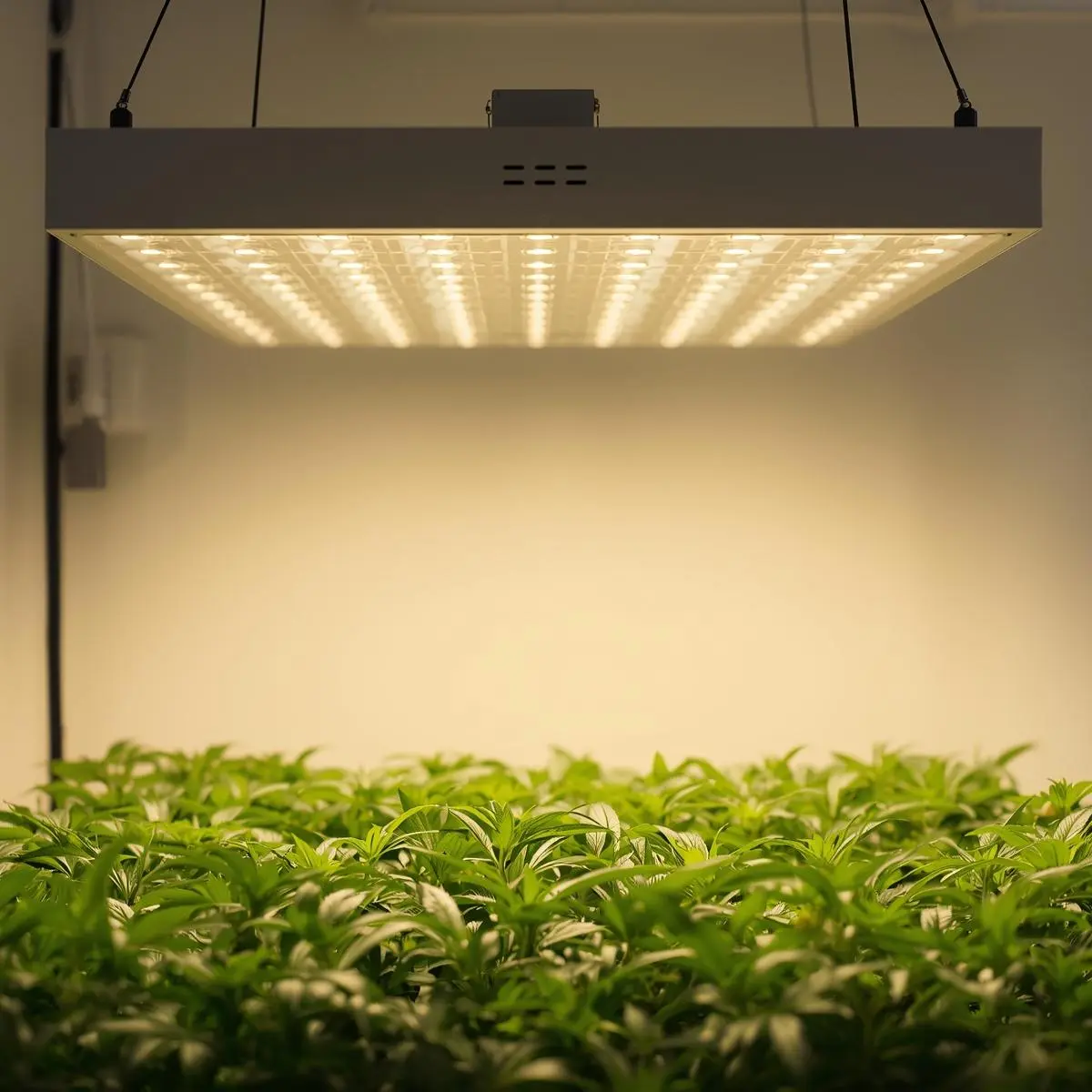
Search for good LED grow lights and you’ll drown in a sea of flashy spec sheets. Big numbers. Bold claims. It’s enough to make anyone’s head spin.
But here’s the quiet truth you only learn after you’ve burned through a few cheap units: a good grow light isn’t just about being bright. It’s about being trustworthy. It’s a fixture that delivers photons across your entire canopy, doesn’t guzzle power like it’s going out of style, and is still humming along three years from now when the warranty paperwork is long gone. Whether you’re running a tent in your basement or a full-blown greenhouse, the fundamentals of judging quality don’t change—you just can’t afford to ignore them.
What Good LED Grow Lights Really Means
First, define “good” by your own goal, not the marketing copy. A light that’s perfect for starting lettuce is a terrible choice for flowering cannabis. It’s that simple.
Good depends entirely on your crop, its stage, the PPFD and DLI you’re targeting, and the physical layout of your grow space. Write this down before you even look at a product page. It’ll save you from about 80% of bad purchases right off the bat.
This is where tools like the PPFD and DLI calculators on Grow With Hydroponics earn their keep—they translate plant science into a real lighting plan. Use them. Guessing is a luxury you can’t afford.
And here’s the big one everyone misses: coverage and uniformity matter as much as any peak number. A listing might scream about a monster PPFD reading right under the center diode. Your plants, however, live across an entire canopy.
A good LED grow light provides even intensity from edge to edge, with minimal hot spots. Uneven light means uneven growth—and suddenly you’re playing musical chairs with your plants or cranking the fixture higher than you should, wasting energy just to compensate for a bad design.
The Good LED Grow Lights Metrics That Actually Matter
Forget lumens. Plants don’t read by human streetlights.
PPFD (Photosynthetic Photon Flux Density), measured in µmol/m²/s, is the metric that counts. It tells you how many usable photons are actually hitting the leaves each second. If a seller can’t provide a PPFD map—showing you the intensity across a realistic area at a stated height—view that as a very bright red flag. Good products are transparent. They show you the grid, the spacing, the drop-off at the edges.
Then there’s DLI—the Daily Light Integral. Think of PPFD as the intensity right now; DLI is the total daily budget. It’s what your plants actually live on, and it’s the single best predictor of growth speed and yield. A good light helps you hit your DLI target reliably, day after cloudy day, without cooking your plants or your utility bill.
Now, spectrum. Look, “full spectrum” has become a meaningless sticker. The practical truth? Most crops do just fine under a balanced white light with some added deep red for efficiency. Be wary of extreme, science-project spectra. What you often gain in a slight theoretical bump, you lose in the ability to actually see your plants—to spot pests or a nutrient deficiency before it becomes a crisis.
Finally, let’s talk efficiency. This isn’t about “watt equivalents,” a phrase that should be banned. It’s about PPE (Photosynthetic Photon Efficacy), measured in µmol/J. That’s how many photons you get per joule of electricity you pay for. This number, right here, is what separates a savvy investment from an energy hog. Demand to see it.
How to Verify Performance Claims
Real data beats marketing poetry every single time. A serious manufacturer can provide a test report from a reputable lab. You don’t need to be an engineer to spot transparency. Look for clear methodology. If the product page is all glowing purple photos and words like “bloom booster” with zero hard numbers, walk away.
And that PPFD map? It’s useless if it doesn’t tell you the mounting height and the coverage area. A beautifully even map for a 2×4 tent is meaningless if you’re lighting a 4×8 table. Bar-style fixtures often win on uniformity; some board-style lights can create harsh hotspots. The geometry matters.
Build Quality: What Separates “Good” From Disposable
This is where the rubber meets the road. Or rather, where the heat meets the sink.
Thermal design is everything. LEDs die with heat, slowly and quietly. A good LED grow light uses a proper, hefty heat sink and isn’t over driving its diodes to hit an impressive-sounding wattage. Be deeply suspicious of tiny, whirring fans in a humid grow environment—they are destined to fail, and they’ll take your light with them.
The driver—that box on the cord—matters as much as the diodes. A cheap driver causes flicker, output drift, and premature failure. Look for brands that use quality, name-brand drivers with smooth, flicker-free dimming. And make sure the warranty actually covers it.
Speaking of environment, your light lives in a harsh world of humidity, foliar sprays, and salt mist. It needs moisture-resistant materials and corrosion-resistant screws. This isn’t optional. A good light is built for the grow-room, not the showroom.
Controls and Usability: Quality You Feel Daily
Smooth, stable dimming isn’t a luxury. It’s what lets you acclimate seedlings, manage canopy heat, and fine-tune your energy use. Jerky, stepped dimming is a sign of a cheap driver.
And the little things? Multiple hanging points, clean cable routing, intuitive controls. These are the details that save your sanity during installation and every time you need to adjust things.
Value and Total Cost of Ownership
The cheapest light is often the most expensive. Value is the sum of efficiency, reliability, and consistency over thousands of hours. If two lights deliver the same PPFD, the one with the higher PPE (µmol/J) pays for the difference on your power bill, usually within a year or two.
And that warranty? A ten-year promise is only as good as the company standing behind it. Clear terms, a straightforward claims process, and accessible support are part of the product you’re buying. You’re buying predictability.
Buy Light Like a Production Tool
At the end of the day, good LED grow lights are about removing variables. They’re about predictable output, manageable costs, and not wondering if your lights will turn on today. When the data is clear, the build is solid, and the company acts like it’ll still be around in five years, you can finally focus on what matters—growing.
If you’re weighing your options, lean on the comparison Hydroponic Tools Suite and real-cost calculators e.g Hydroponic GrowSpace Planner Calculator. Places like Grow With Hydroponics built them for a reason—to help you Shop Smart, so you only have to buy once.

Dr. Awais Yousaf
Algorithm Specialist and Associate Professor leading R&D at Grow With Hydroponics. With 5+ years of hands-on experience in smart hydroponic systems, deep learning, and sustainable AgriTech, he is passionate about turning small spaces into high-yield indoor farms. Connect at awais.yousaf@iub.edu.pk