

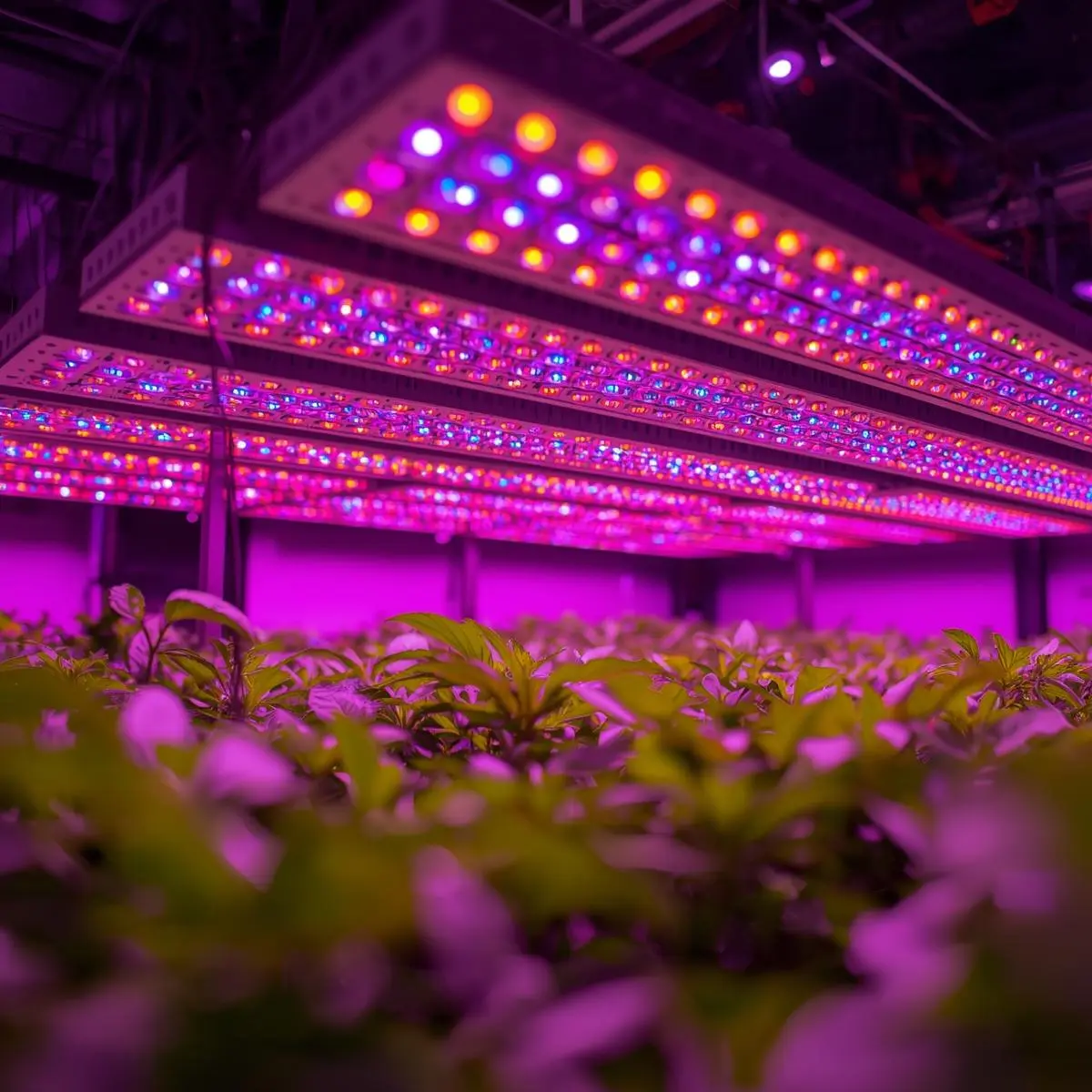
Let’s be honest: shopping for Best LED Grow Lights for Indoor Plants can feel like decoding a foreign language. You’re hit with wattage wars, the ubiquitous “full spectrum” label, and spec sheets that seem designed to impress rather than inform. It’s enough to make anyone want to just stick their indoor plants by the sunniest window and hope for the best.
But here’s the thing—once you move past the marketing noise, the principles of The Ultimate LED Grow Light Guide: Science-Backed Indoor Setup (2026) are surprisingly straightforward. I’ve spent years testing fixtures in everything from boutique urban farms to my own slightly overambitious kitchen herb corner. The goal isn’t to buy the “best” light in some abstract sense. It’s to find the one that fits your actual life, your actual plants, and your actual shelf.
This guide cuts through the jargon. We’ll translate the specs that matter, ignore the ones that don’t, and get you to a setup where your plants don’t just survive—they thrive.
What “Best” Really Means (Spoiler: It’s Not About Price)
The “best” LED grow light for you is the one that delivers the right quality and quantity of light to your specific plants, without wasting energy or requiring a PhD to operate. Most mistakes happen right here—we get sold on raw power, when what plants truly need is precision.
Think of it this way: you wouldn’t water a cactus and a fern the same way. Light is no different. The clever part isn’t the fixture itself; it’s how well you match its output to a living thing’s needs.
The Two Metrics That Actually Matter: PPFD & DLI
If you forget everything else, remember these two acronyms. They’re your compass.
- PPFD (Photosynthetic Photon Flux Density): This is your real-time measurement. It tells you how many usable photons are hitting a specific spot on your plant’s leaves each second. It’s the measure of light intensity at the canopy.
- DLI (Daily Light Integral): This is the grand total. It’s the cumulative amount of light your plant receives over the entire photoperiod. A plant doesn’t care if it gets its daily dose from 12 hours of moderate light or 6 hours of blazing sun—as long as the DLI hits its target.
Here’s where it gets interesting. Indoors, you can often use DLI to your advantage. Can’t afford a super-intense light? No problem. Run a gentler fixture for a few more hours. It’s a forgiving, flexible approach that works beautifully for most houseplants. Try our free tool Daily Light Integral (DLI) Calculator for best results.
Full Spectrum: Necessary, But Not a Magic Bullet
Yes, you want full spectrum light. It looks natural to our eyes and provides the range plants use for everything from photosynthesis to flowering. But—and this is a crucial but—spectrum is the quality of the light. Without sufficient light intensity (PPFD), it’s like serving a gourmet meal on a microscopic plate. Your plant stays hungry.
For most people growing herbs and houseplants, a balanced white full spectrum LED is the perfect workhorse. It makes plant inspection easy and integrates into living spaces without that lurid purple glow.
Matching Light to Plant Personality
Grouping your plants by light hunger is the first step to success.
- The Low-Key Crew (Pothos, Philodendron, ZZ Plants): These plants are masters of making do. They want consistent, even coverage more than brute strength. A simple bar light or low-output panel is often perfect. The goal is to supplement, not simulate, the sun.
- The Middle Ground (Most “Bright Indirect” Houseplants, Leafy Herbs): This is the sweet spot for many indoor gardeners. Here, a light with dimming capability is worth its weight in gold. You can start seedlings low, then ramp up intensity as plants mature, avoiding shock. It’s about control.
- The Sun Worshipers (Basil, Mint, Peppers, Succulents): These plants are truthful. Give them weak light, and they get leggy and pathetic. Give them what they crave, and they prosper. For this group, you need to trust the data—clear PPFD maps from the manufacturer are non-negotiable. Panel lights or high-output bar lights are typical choices.
Form Follows Function: Choosing a Fixture Style
The shape of your light is dictated by the shape of your space.
- Bar Lights: The undisputed champions for shelves, seed starting racks, and any multi-tier setup. Their linear design provides that even coverage low-light plants love and prevents hotspots on tender seedlings.
- Panel Lights: Ideal for lighting a clustered group of medium-sized pots on a table or in a corner. They’re tidy, often more powerful, and easier to manage than a jungle of individual bulbs.
- Bulbs & Clip Lights: Fine for a single specimen plant in a dark corner, but be prepared to rotate the pot religiously. The coverage is almost always narrow and uneven.
How to Read a Spec Sheet Without Being Fooled
Ignore “equivalent wattage.” Please. It’s a fictional number comparing LEDs to obsolete technology. Focus instead on:
- PPF (Photosynthetic Photon Flux): The total light output of the fixture.
- PPFD Maps: The only honest way to judge coverage. A reputable company will show you a grid of PPFD values at a stated hanging height. No map? Move on. You’re buying a mystery box.
- Efficacy (PPE): Measured in µmol/J, this tells you how efficiently the fixture converts electricity into plant-usable light. Higher is better, but balance it with overall output.
The Setup: Where Good Lights Become Great
Even the best fixture can fail with a poor installation.
- Distance: Start conservative. Hang the light higher than you think, observe for a few days, and lower incrementally. Leaf burn from a light too close is frustratingly permanent.
- Photoperiod & DLI: Use the DLI concept. For medium-light plants, try 14-16 hours at a moderate PPFD. It’s gentler on the plants and the fixture than blasting them for 8 hours. Online DLI calculators make this simple.
- Safety: This isn’t glamorous, but it’s critical. These lights run for thousands of hours. Look for proper safety certifications (UL/ETL for your region) and robust thermal design. Feel the fixture after 12 hours—if it’s too hot to touch comfortably, that’s a red flag for longevity.
Troubleshooting: Reading Your Plants’ Feedback
Your plants are constantly telling you about the light. You just have to listen.
- Leggy, stretched growth: The light is too weak or too far. Increase intensity or decrease distance.
- Bleached leaves or tight, upward curling: Too much of a good thing. Raise the light or dim it.
- Leaning dramatically: The coverage is uneven. Either rotate the plant daily or, better yet, improve the light distribution.
Daily Light Integral (DLI) Calculator is an essential tool for indoor farming.
A Note on Efficiency & Cost
LED grow lights are efficient, but waste is still possible. The real energy efficiency win comes from right-sizing your fixture. Don’t use a 300-watt panel for a single pothos. Use a timer. And remember, the upfront cost is just part of the equation—a well-chosen, efficient light paying for itself over years of use is the real goal.
Fit Over Hype
At the end of the day, the best LED grow lights for indoor plants are the ones that disappear into the rhythm of your routine. They provide the right amount of usable light (that’s your PPFD and DLI) evenly (coverage) to the plants that actually need it, all while running safely and affordably.
It’s not about buying the most expensive tech. It’s about understanding a few key principles and making a informed choice. Get that right, and everything else—the sturdier stems, the deeper greens, the constant harvest of basil—just becomes the new normal.
How Grow With Hydroponics Looks at Indoor Lighting
At Grow With Hydroponics, we care about what actually works—not just what sounds good. We keep it simple: give your plants the right light for their needs, your space, and your schedule. Once you understand what’s behind your setup, you start getting better results and a lot less hassle. Whether you’re thinking about a shelf garden, a small plant nook, or a whole indoor room, our guides, Hydroponic Tools Suite, and Hydroponic GrowSpace Planner Calculator make things clearer and easier.
Check out:

Dr. Awais Yousaf
Algorithm Specialist and Associate Professor leading R&D at Grow With Hydroponics. With 5+ years of hands-on experience in smart hydroponic systems, deep learning, and sustainable AgriTech, he is passionate about turning small spaces into high-yield indoor farms. Connect at awais.yousaf@iub.edu.pk