

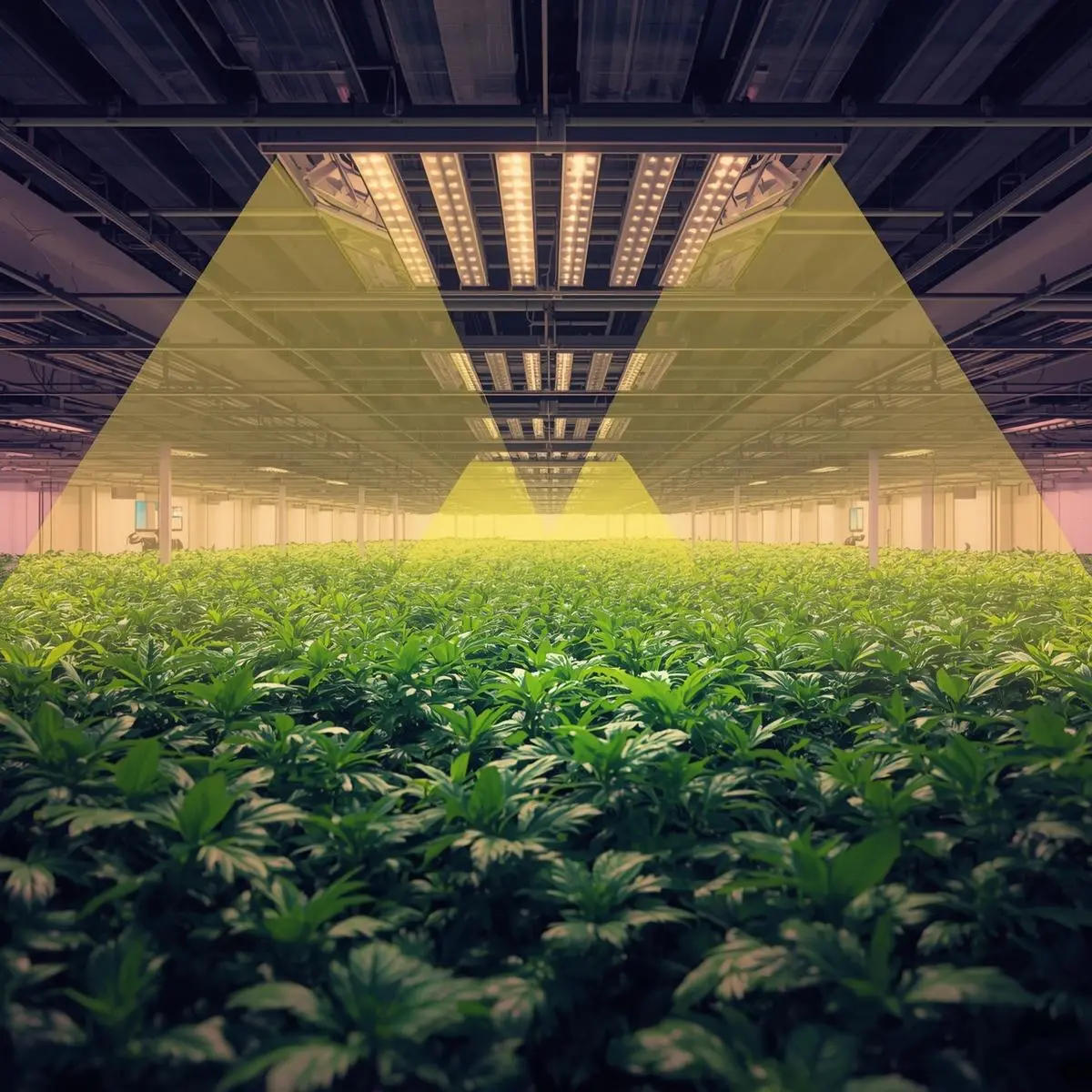
High-Bay Commercial LED Grow Lights: A Practical Guide for Pro Growers
Most facility-scale mistakes don’t announce themselves. They compound quietly—in slightly uneven canopy growth across row 12, in HVAC systems running harder than the engineer spec’d, and in harvest windows that keep slipping by two or three days. By the time you trace it back to the lighting decision made eighteen months earlier, the cost is already baked into your operation.Commercial LED grow lights are the central variable in any serious indoor facility. Not peripheral equipment—the production input that determines your yield consistency, your crop timing, your HVAC load, and your labor schedule simultaneously. Get the specification right, and everything downstream becomes more predictable. Get it wrong and you spend years compensating.This guide is built for facility managers, head growers, and investors who need more than a spec sheet. At Grow With Hydroponics, the focus has always been on decisions that survive real-world conditions—and commercial lighting decisions are where real money lives. Here’s what actually matters when choosing, planning, and operating high-bay commercial LED grow lights at scale.Why Commercial LED Grow Lights Have Displaced Every Alternative
The shift from HPS to LED at a commercial scale isn’t a trend—the economics closed the argument years ago.LEDs consume 40–60% less electricity than HID systems. For a 10,000-square-foot facility, this translates to savings of $5,000–$10,000 annually depending on local utility rates. With lifespans of 50,000-plus hours compared to 10,000–20,000 for HIDs, LEDs also eliminate bulb replacement costs and the maintenance downtime that comes with them.But the electricity bill is only part of the story. LED grow lights reduce energy use by 60–70% compared to traditional systems. They also produce less heat, which lowers cooling costs — a critical factor in large, climate-controlled grow spaces. In a commercial room running 18-hour cycles, that heat reduction is the difference between an HVAC system operating within its design parameters and one that’s perpetually fighting the lighting load.The financial case for converting from legacy HPS is now straightforward. The more important question is which commercial LED grow lights to choose and how to deploy them correctly.Complete guide to grow light systems for indoor growers: covers LED vs HPS vs fluorescent, PPFD, DLI, spectrum explained by growth stage, and setup principles across all growing scales.The Five Metrics That Define Commercial LED Grow Light Performance
Forget lumens. Forget marketing language about “military-grade” components. At commercial scale, five metrics govern every lighting decision worth making.PPFD — The Only Canopy Metric That Matters
DLI — Your Production Schedule in Numbers
DLI (Daily Light Integral) is the total photon dose delivered over 24 hours. It connects your lighting directly to outcomes: growth rate, yield potential, and crop cycle timing. In a professional facility, DLI targets are written into standard operating procedures. They’re not adjusted by feel — they’re calculated, set, and monitored. Use our DLI Calculator to establish and verify your targets before specifying any fixture.Efficacy — Useful but Incomplete
Efficacy (µmol/J) tells you how efficiently a fixture converts watts into plant-usable photons. Across hundreds of fixtures, a 0.2 µmol/J difference adds up to significant energy cost over a facility’s lifespan. But a highly efficient fixture with poor uniformity still costs you yield and adds labour. Multibar fixtures deliver better uniformity and higher PPF than single-bar designs, and can often be mounted closer to plants for stronger, more consistent yields. Efficacy without uniformity is an incomplete specification.Uniformity — The Hidden Labour Cost
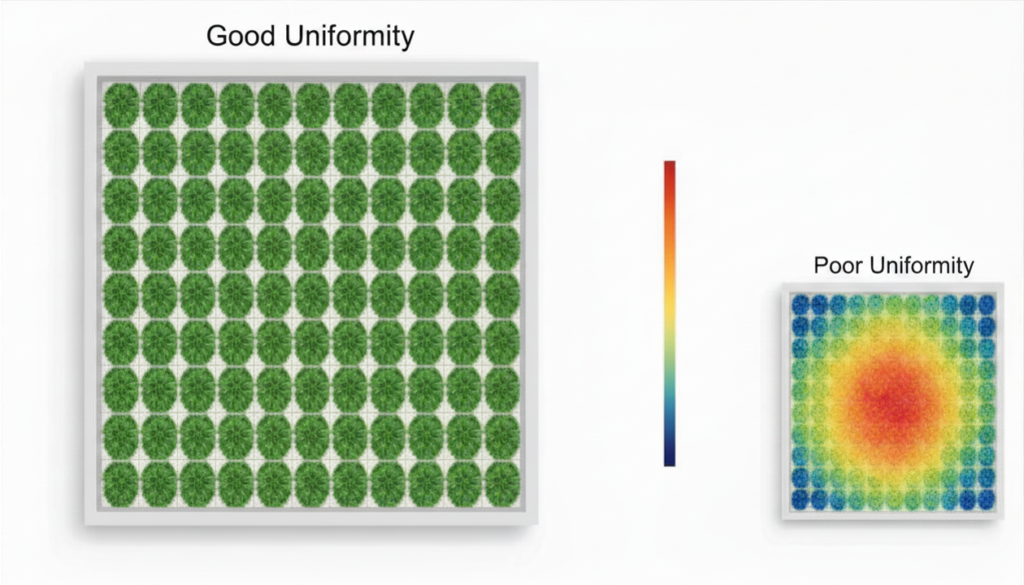
In a high-bay setup, light beams have distance to mix and overlap, creating a relatively even spread of PPFD. In high-density indoor farming, a poorly designed fixture creates intense hot spots directly beneath the diodes and severe shadowing at the edges of the tray—leading to uneven crop growth where plants in the centre suffer from light burn while plants on the perimeter experience stunted growth from photon starvation.Uniform PPFD eliminates compensatory labour: tray rotation, tweaked feed lines, staggered harvests. In a commercial op, the labour cost of managing uneven growth across hundreds of trays compounds faster than most operators model for.Thermal Management — The Long-Game Variable
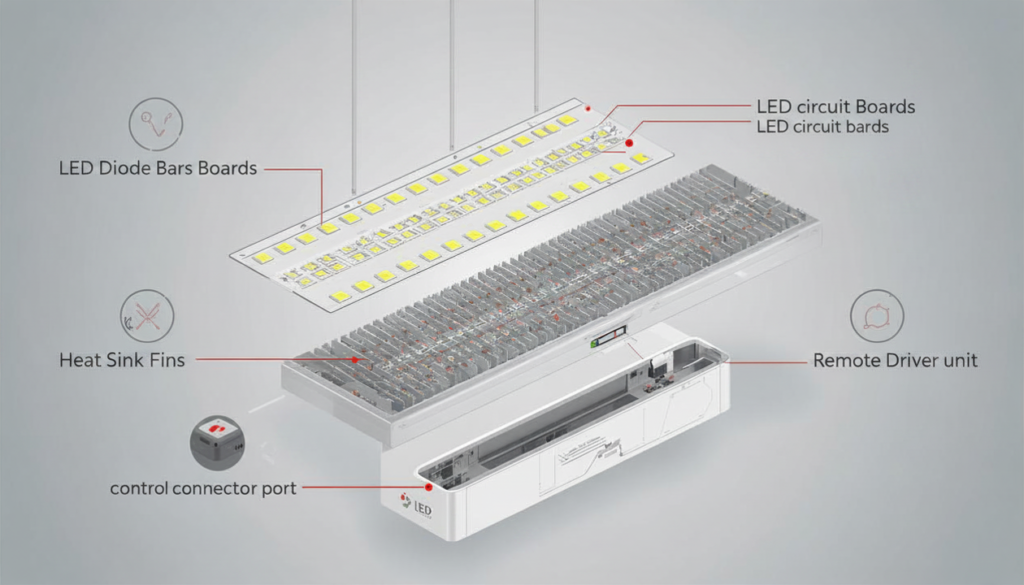
LED drivers can generate up to 20% of a fixture’s heat. In dense multi-tier setups, choosing a remote driver architecture allows you to decouple the power supply and mount it outside the cultivation rack. This removes significant thermal loads from the plants, prevents Vapour Pressure Deficit (VPD) spikes, and reduces HVAC cooling costs.Poor thermal design accelerates lumen depreciation and causes spectral shift over time. The fixture that performs to spec in year one and drifts significantly by year three is not the fixture its data sheet implied.What Spectrum Strategy Works for Commercial LED Grow Lights?
Spectrum decisions at commercial scale carry operational consequences that home growers rarely encounter.Full-spectrum white light is the practical default for most facilities. It supports every growth stage without bulb changes, gives workers accurate colour rendering for pest scouting and quality assessment, and simplifies scaling across multiple rooms or crops. Green light is the missing link in many LED grow lights. Plants evolved under full-spectrum sunlight, not heavy red and blue LEDs. Green light penetrates deeper into the canopy, improves photosynthesis under high PPFD, and helps maximise plant expression across the whole canopy — not just the top layer.Targeted spectrum tuning has a case—but a narrower one than manufacturers suggest. Research published in Frontiers in Plant Science (2024) found that white light with a dual red peak at 640 and 660 nm—compared to white light with a single red peak at 660 nm—increased inflorescence yield and light use efficiency regardless of PPFD, and at higher intensities also increased terpenoid concentrations. That’s a meaningful finding for facilities focused on specific output quality metrics. The caveat is that implementing spectrum changes at scale requires a measurable, facility-wide ROI justification.Far-red and UV additions belong in the same category: only with a clear, quantifiable production goal. Every added variable in a commercial system needs a justified ROI. If you can’t measure the benefit in yield, cycle time, or compound concentration — don’t scale it.What Makes a Commercial LED Grow Light Truly Commercial-Grade?
Optics That Do the Real Work from Height
In high-bay applications, the optics—lenses or reflectors that shape the light beam—determine whether you get a uniform canopy blanket or a spotlight effect with dark edges. Quality optics engineered for ceiling heights above 12 feet deliver a wide, even spread without the intensity peaks that stress plants directly beneath the fixture.This is where the “high-bay” designation earns its meaning. It’s an optical specification as much as a wattage one.Drivers — The Most Common Point of Failure
The driver is the power supply, and in a hot, humid flowering room running 18-hour cycles, it’s the component most likely to cause unplanned downtime. Commercial-grade drivers are rated for wet locations, built with heat-resistant components, offer stable flicker-free dimming curves, and are sourced from manufacturers with verifiable reliability data. LEDs have become the dominant choice for supplemental lighting in commercial indoor operations because energy efficiency improvements translate directly to lower operational costs and improved profitability over time — but that profitability requires fixtures that actually stay online.Keep spare drivers on-hand. It’s not pessimism — it’s facility management.Thermal Design Built for the Long Haul
A fixture’s heat sink design and airflow characteristics directly govern lumen maintenance over its service life. The spec sheet shows output at initial commissioning. What matters commercially is output at 25,000 and 50,000 hours under your specific ambient conditions. Ask manufacturers for L90 and L80 data—the hours at which output drops to 90% and 80% of initial values, respectively. That’s the real lifespan number.How to Plan Your Commercial LED Grow Light Layout Correctly
Start from the agronomic target, not the fixture catalogue.Define your PPFD and DLI requirements for each crop and growth stage first. Cannabis flowering, for example, requires PPFD levels of 800–1,500 µmol/m²/s during the flowering phase. Leafy greens and herbs operate productively at 200–400 µmol/m²/s. Those are fundamentally different fixture and spacing specifications.Then design the layout and mounting height to hit those targets uniformly. Buying fixtures first and trying to retrofit them to an agronomic goal is how facilities end up with permanent PPFD compromises.Post-installation commissioning—taking actual PPFD grid maps after installation—is non-negotiable. It verifies the design performed as specified, identifies any coverage anomalies before they affect a full crop cycle, and creates a baseline performance document for future efficiency audits and facility expansions.Controls, Automation, and Dimming at Commercial Scale
Dimming is a production lever, not just a convenience feature. It lets you ramp intensity precisely for young plants, optimise flowering-stage output, and reduce energy draw during peak utility pricing windows. In a facility with hundreds of fixtures, the energy savings from strategic dimming across a calendar year are material.Automated photoperiod scheduling removes human error from one of the most consequential variables in plant production. Consistent light cycles reduce plant stress. Reduced stress protects yield. This is not a complicated argument—it’s just one that facilities running manual schedules keep relearning the hard way.Specify fixtures that communicate via standard control protocols — 0-10V or DALI — from day one, even if you’re starting with simple timers. Future integration with environmental control systems is orders of magnitude cheaper when the fixtures already speak the right language.Commercial LED Grow Lights Buying Criteria at a Glance
| Specification | What to Look For | Why It Matters |
| PPFD Uniformity | ≥ 0.85 coefficient (min/max ratio) | Consistent crop development, reduced labour |
| Efficacy | ≥ 2.5 µmol/J for premium fixtures | Direct energy cost impact at scale |
| Driver Quality | Wet-rated, dimmable, industrial-grade | Reliability and uptime in humid environments |
| Thermal Design | L90 data available, remote driver option | Long-term output maintenance |
| Spectrum | Full-spectrum white; dual red peak if crop-specific | Worker visibility, broad-stage coverage |
| Control Protocol | 0-10V or DALI compatible | Future integration and automation readiness |
| DLC Certification | DLC Horticultural QPL listed | Rebate eligibility—non-negotiable for incentives |
| Warranty | 5+ years with driver coverage | Commercial-grade confidence |
How Commercial LED Grow Lights Deliver ROI Beyond the Electricity Bill
Energy savings are the headline number—but they’re not the whole calculation.For facilities running 12 to 18 hours of daily photoperiods, transitioning from legacy HPS to commercial LED grow lights can often offset 30–70% of the total fixture cost through utility-backed incentive programmes. In 2026, the DesignLights Consortium (DLC) Horticultural Qualified Products List is the authoritative standard for rebate eligibility—most major utilities will not issue LED rebates for products that lack this certification.And critically: many growers lose significant rebate value by ordering fixtures before their application is approved. Most utility companies view the rebate as an inducement — if the equipment is already purchased, the incentive for the utility to pay disappears. Always secure your pre-approval letter in writing before signing a purchase order.Beyond rebates, Section 179D allows businesses to deduct a significant portion of the cost of energy-efficient lighting improvements on their taxes. Combined with bonus depreciation and available state or municipal credits, many facilities see payback periods well under three years.The soft ROI matters too: the labour hours saved by better uniformity, the yield consistency that makes sales forecasting accurate, the reduced crop loss from fewer equipment failures. These don’t appear on the utility bill — but they show up on the P&L.When you’re ready to Shop Smart on commercial fixtures, verify DLC QPL status before anything else. No certification, no rebate. The savings gap between a DLC-listed fixture and a non-listed alternative is often far larger than the purchase price difference.Understanding PPFD and DLI for indoor growing—a practical guide to light metrics, fixture selection, and setup for growers at every scale.Common Commercial LED Grow Light Mistakes Pro Growers Make
Specifying lights before specifying targets. Choosing a fixture, then working backward to justify it, consistently produces underperforming layouts. Define PPFD and DLI first. Build the fixture spec around those numbers.Trusting centre-point PPFD readings. A single measurement in the middle of a fixture’s footprint tells you the best-case number. It tells you nothing about edge-row performance or the uniformity your crop will actually experience across the full table. Always demand a full grid map.Ignoring DLC status during procurement. Ordering fixtures before verifying DLC Horticultural QPL listing and securing utility rebate pre-approval costs facilities real money. This is an administrative step that pays for itself immediately.Cutting corners on drivers. The driver is the most likely failure point in a commercial fixture. A cheap driver in a hot, humid room is not a cost saving—it’s a deferred maintenance expense with a hard downtime cost attached.Skipping post-installation commissioning. A light plan is a model. Commissioning verifies whether reality matched the model. Facilities that skip this step are operating on assumptions, not data.VPD management for commercial indoor growing environments, supporting a guide on managing temperature and humidity alongside lighting decisions in controlled-environment facilities.Frequently Asked Questions About Commercial LED Grow Lights
What efficacy should I look for in commercial LED grow lights? Target a minimum of 2.5 µmol/J for serious commercial applications. Premium fixtures in 2025–2026 reach 2.8–3.0 µmol/J. That range matters because across hundreds of fixtures running 18-hour cycles, even a 0.2 µmol/J difference translates to meaningful annual energy cost differences at scale. Always verify efficacy from independent test data, not just the manufacturer’s spec sheet.How important is DLC certification for commercial grow lights? The DLC Horticultural Qualified Products List is the absolute authority for rebate eligibility in 2026. Most major utilities will not issue LED rebates for products that lack this certification. For any serious facility, DLC status is a procurement requirement, not a bonus. The rebate value it unlocks frequently exceeds the price premium of choosing a certified fixture. What PPFD levels do commercial crops need? It depends entirely on the crop. Leafy greens and herbs perform well at 200–400 µmol/m²/s. Fruiting crops and tomatoes need 600–900 µmol/m²/s. Cannabis during flowering requires 800–1,500 µmol/m²/s for maximum cannabinoid and terpene production. Design your fixture specification around your specific crop targets, not a generic high-output number.Should I use multibar or single-bar fixtures in a commercial room? Multibar fixtures deliver better PPFD uniformity, higher PPF, and can be mounted closer to plants for stronger, more consistent yields. Single-bar lights are designed for high-bay and greenhouse installs — when used indoors at close range, they create hotspots and uneven coverage. Match the fixture form factor to the mounting height and grow environment. When is the best time to apply for LED rebates? Before purchasing. Most utility companies view the rebate as an inducement to switch—if the equipment is already purchased, the incentive disappears. Secure pre-approval in writing before signing any purchase order. Start the rebate process during the fixture specification phase, not after the purchase order is placed.Light Planned Right Becomes a Production Asset
Commercial LED grow lights are not overhead hardware. They’re a production input — as critical as your nutrient formula, your climate setpoints, or your harvest schedule. The facilities that treat them that way, with clear agronomic targets, verified post-installation performance, and a full accounting of rebate and tax incentive value, consistently outperform the ones that don’t.Plan from the canopy up. Specify from the target down. Verify with a PPFD map before the first crop cycle runs. And keep your DLC certification paperwork in order before you place a single purchase order.At Grow With Hydroponics, the tools exist to support that planning process from day one. Use the DLI Calculator to establish verified daily light targets for your crop before you write a specification—then use those numbers to hold your fixture suppliers accountable to real-world performance. Browse expert-tested commercial lighting through Shop Smart when you’re ready to compare options with the metrics that actually matter.The right lights, planned correctly, are the foundation everything else is built on.
