If you’ve grown hydroponically for more than a week, you’ve had this argument. Probably in a grow shop, probably while holding a meter you’re not quite sure how to use.
Why EC Matters In Hydroponics? Should I be using EC or PPM?
On paper, they’re supposed to tell you the same thing: how strong your soup is. The numbers climb when you add nutrients; they drop when you dilute. Seems straightforward. It isn’t.
After a decade of tuning systems, burning a few crops for science, and picking the brains of commercial growers from Salinas to Amsterdam, I’ll give it to you straight: the pros don’t mess around with PPM. They trust EC. Period.
Not because they’re snobs. Not because it’s fancy. But because EC tells the unvarnished truth—every single time. The EC vs PPM hydroponics debate? In professional circles, it was settled years ago. Let’s talk about why.
What Are EC and PPM Actually Measuring?
First, we need to cut through the fog. These aren’t just numbers; they’re languages. And one of them is fundamentally broken.
What Is EC in Hydroponics?
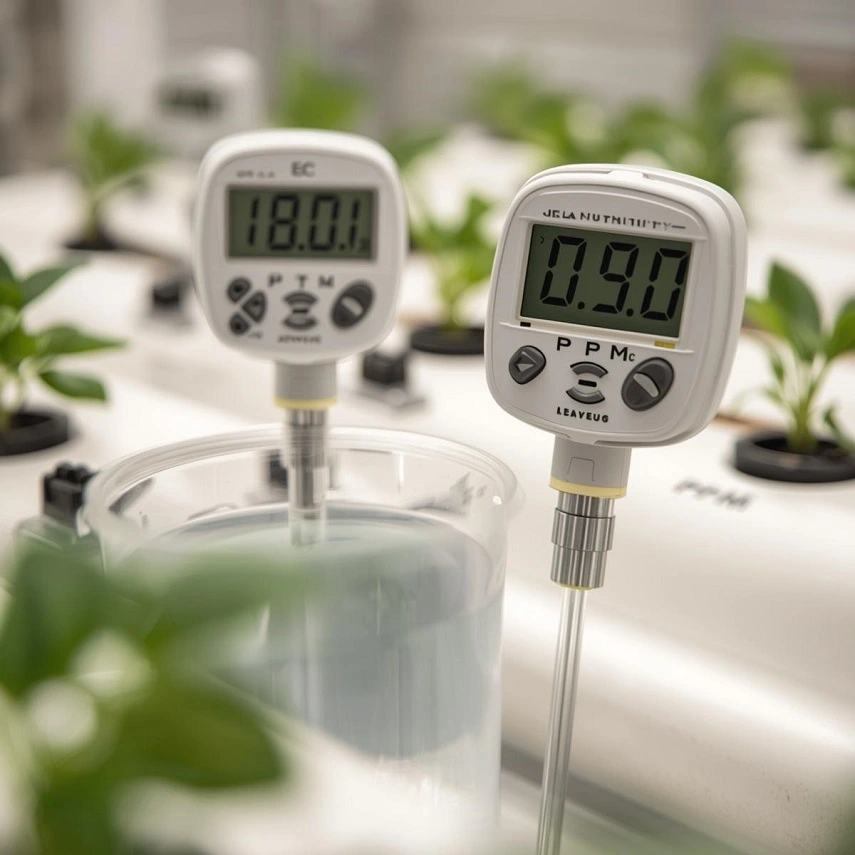
EC—Electrical Conductivity—measures exactly that: how well your solution conducts a tiny current. It’s dead simple. Dissolved mineral salts (your nutrients) are ionic; they carry a charge. More salts, better conduction, higher EC.
It’s direct. It’s repeatable. It’s the same in a lab in Leiden as it is in a basement in Ohio. There’s no interpreter. The signal is the signal.
What Is PPM Supposed to Measure?
PPM sounds intuitive. “Parts Per Million.” It estimates the mass of dissolved solids. Feels solid, right?
Here’s the catch—and most meter manuals bury this in the fine print: PPM isn’t a direct measurement. Your meter measures EC first, then multiplies it by a conversion factor to spit out a PPM number.
And that factor? It’s not a standard. It’s a guess dressed up as data.
The Hidden Problem With PPM (That No One Explains)
This is where the whole facade crumbles. PPM isn’t one scale; it’s several. The two most common are the 500 scale and the 700 scale.
So, picture this: the exact same reservoir, the same nutrients, can read 700 on one meter and 980 on another. Nothing changed but the meter’s internal math. That’s madness.
When a grower tells me their plants are burning at “900 PPM,” my first question is always, “Which scale?” If they don’t know—and most don’t—that number is functionally useless. It’s noise.
But if they say, “My EC is 1.8,” we can start diagnosing. Immediately.
Why EC Matters in Hydroponics (Beyond the Numbers)
This isn’t about pedantry. It’s about control. Professional growers care about what works, not what feels easy.
EC Is Consistent Across the World
Your meter brand doesn’t matter. Your location doesn’t matter. An EC of 2.0 is 2.0 everywhere—in a Dutch greenhouse, a Canadian vertical farm, a university research paper. That’s why every serious nutrient company’s feed chart is written in EC. It’s the lingua franca.
EC Reflects Plant Uptake More Accurately
Plants don’t read labels; they respond to ionic concentration in the root zone. Watch your EC:
If it rises, the plants are drinking more water than nutrients—time to dilute.
If it falls, they’re sucking up salts efficiently—maybe time to feed.
It’s a direct dialogue with your crop. PPM, with its fuzzy translation, muffles that conversation.
Why Professionals Don’t Convert Unless They Have To
Here’s the quiet part: seasoned growers don’t think in PPM. They don’t. They feed, adjust, and troubleshoot in EC. PPM only enters the chat when they’re deciphering an old forum post or helping a beginner. That’s it.
So Why Does PPM Still Exist?
PPM feels easier. Big, round numbers feel precise. It gives you a comforting illusion of accuracy—until you realize you and another grower are talking about two completely different strengths while using the same “800 PPM” number.
EC strips away that illusion. It trades comfort for clarity.
EC vs PPM Hydroponics: A Side-by-Side Reality Check
| Factor | EC | PPM |
|---|---|---|
| Direct Measurement | ✅ Yes | ❌ No (It’s a calculation) |
| Universal Standard | ✅ Yes | ❌ No (Multiple scales) |
| Affected by Meter Brand | ❌ No | ✅ Yes (Wildly) |
| Used by Professionals | ✅ Always | ❌ Rarely |
| Ideal for Troubleshooting | ✅ Yes | ⚠️ Limited |
When Does PPM Still Make Sense?
At Grow With Hydroponics, we’ve seen the confusion firsthand. PPM has its place—when you’re using an old guide, when you’re just starting out and your cheap meter only shows PPM, when transitioning from soil. Fine.
But even then, you should understand it’s a translation. And all translations lose something.
This is exactly why tools matter. Translate EC only when you need to—and if you must, use an EC ↔ PPM Hydroponics Calculator that shows you all the scales so you know what you’re actually dealing with.
How This Improves Your Growing Results
When growers finally make the shift to EC-first thinking, the changes are real: fewer burn issues, faster diagnosis, and more consistent harvests. It’s not magic. It’s just removing a layer of error.
Shop Smart: Tools That Support EC Accuracy
If you’re buying a meter, buy for EC. Get one that displays EC clearly and has automatic temperature compensation. Avoid the ones that hide EC behind a PPM-only display. You’re buying a measuring tool, not a comfort blanket.
Why EC Wins Every Time
Professional growers trust EC because it’s honest. It’s consistent. It’s universal.
PPM isn’t wrong; it’s just a translation of the original text. And you’d never try to fine-tune a complex piece of machinery using a translated manual, would you?
If you want control, start thinking like the pros. Think EC first. Convert only when you absolutely must. Your plants—and your sanity—will thank you.
—
Dr. Awais
Lead Content Creator, Grow With Hydroponics