

The Hunt for the Most Efficient LED Grow Lights: It’s Not About the Brightest Bulb
Let’s start with a truth most product pages ignore: nobody buys a grow light for fun. You’re here because your last power bill was a shock, your climate control feels like a constant fight, and the phrase “low power consumption” isn’t a nice-to-have—it’s the margin between profit and just playing with dirt. The hunt for the most efficient LED grow lights is, at its core, a search for control. And frankly, this is where most beginners go wrong.
I’ve watched growers chase the big, shiny number for over a decade. High PPFD. It’s seductive—that peak photon output screaming from the spec sheet. They buy the fixture with the highest value, hang it with hope, and then spend the entire cycle battling hotspots, cranking dehumidifiers, and watching their suffer. The goal was efficiency. The result? A system at war with itself.
This guide is about a smarter chase. It’s not about maximum output; it’s about the right output. Delivered evenly. Using the least possible wattage from seed to harvest. That’s the real target—and it’s one you can actually hit.
What Does “Most Efficient LED Grow Lights” Really Mean?
First, forget everything home lighting taught you. Plants don’t have eyes. The measure of light that matters to them isn’t brightness, but usable photon energy in the PAR range. That’s why the entire conversation shifts from lumens to moles. You’ll see three key metrics, and understanding their hierarchy is critical:
PPF (Photosynthetic Photon Flux): The fixture’s total possible output. Think of it as the engine’s size. Useful, sure, but it tells you nothing about how it drives on your road.
PPFD (Photosynthetic Photon Flux Density): This is the money metric. It’s the number of those photons actually hitting a square meter of your canopy every second. PPFD is where marketing meets the leaf surface.
PPE (Photosynthetic Photon Efficacy): Now we’re talking efficiency. Measured in µmol/J, this is your photon return on investment—how many plant-usable photons you get per joule of electricity you pay for.
But here’s the catch, the one that costs growers real money: a fantastic PPE rating is meaningless if the fixture’s PPFD map looks like a mountain range. You can have a hyper-efficient engine that only powers one wheel. In practice, that means you’ll overdrive the light to brighten the dark corners, vaporizing your efficiency gains and creating a host of other problems. For a deeper dive into optimizing your setup, explore the Indoor Plant Sunlight Analysis System.
Why “High PPFD” Alone Is a Trap
A manufacturer can claim a blistering PPFD number—say, 2000 µmol/m²/s—under perfect, unrealistic lab conditions. In your tent, at a sensible hanging height over a 4×4 area? That number collapses. And the variation across the canopy is what quietly kills your yield.
PPFD isn’t a static spec. It changes dramatically with distance, coverage area, fixture layout, and your room’s reflectivity. A light that creates a scorching hot spot in the center forces you to choose: starve the edges or crank the power, cooking the center and spiking your energy use. Both are failures.
Real efficiency, the kind that shows up on your bottom line, only exists with uniformity. A smooth, even PPFD spread lets you run the fixture lower and cooler, hitting your target everywhere without waste. It’s the difference between a gentle, soaking rain and a fire hose that drowns half your garden.
How to Compare LED Grow Light Efficiency Fairly
So how do you compare apples to apples? You demand context. Real testing data isn’t a single bold number. It’s a story that includes:
The input wattage used during the PPFD test.
The exact hanging height.
The defined coverage footprint.
A full PPFD map, not just a center-point reading.
If a seller omits these details, their efficiency claim is incomplete. Full stop. The most important document in your decision is that PPFD map. It visually shows the hot spots, the weak zones, and the overall consistency. Compare maps at the same height and footprint—or you’re not comparing anything useful.
My practical advice? Use PPE as an initial filter to shortlist competent fixtures. Then, focus like a laser on the PPFD maps. In a real grow space, superior uniformity will beat a tiny PPE advantage every single time. A light with a slightly lower efficacy but a perfectly flat map will run cooler, stress your plants less, and save you more money in system costs. This nuance separates hobbyists from pros.
Data-Backed Performance: What the Numbers Actually Show
Marketing claims are loud. Real-world data is quieter—but far more useful. Independent lab testing and horticultural research consistently show so you don’t have to. When you strip away the branding, three consistent patterns emerge from the performance of modern high-efficiency LED fixtures.
1. PPE Above 2.5 µmol/J Is the Modern Efficiency Benchmark
Let’s talk about the metric that actually matters: PPE, or Photosynthetic Photon Efficacy. This tells you how efficiently a light turns watts into usable photons.
Most of those older “blurple” LEDs you see sitting in closets operate somewhere between 1.6 and 2.1 µmol/J. They’re power hogs. In contrast, modern full-spectrum white LEDs—from brands like SANSI and GE Lighting—typically test between 2.3 and 2.8 µmol/J under standard lab conditions.
That difference may look small on paper, but over a full grow cycle, it translates into hard numbers:
10–25% lower electricity consumption. That’s the part you see on the bill.
Reduced HVAC load. Less heat from the light means your exhaust fan isn’t running constantly.
Lower canopy heat stress. The plants aren’t fighting to transpire as aggressively.
Do the math for a second. In a standard 4×4 flowering cycle running 12 hours a day, a 40W efficiency difference between two fixtures equals roughly 175–200 kWh saved per cycle. At average US rates, that’s real money—enough to pay for the light itself over a year or two.
2. Uniformity Impacts Yield More Than Peak PPFD
This is where most beginners go wrong. They get fixated on the highest PPFD number in the center of the light. But plants don’t grow in a single spot.
Multiple university horticulture studies show that yield correlates more strongly with average canopy PPFD than with center-point intensity. Think of it this way:
A fixture delivering 900 µmol/m²/s evenly across the entire canopy
will consistently outperform
a fixture with 1200 µmol/m²/s in the center but only 500 at the edges.
Why? Because the plants at the edges of that second setup never hit their Daily Light Integral (DLI) targets. They stretch, they under-produce, and you’ve essentially wasted a quarter of your grow space. Uneven light = uneven growth = wasted square footage.
For small indoor setups, look for uniformity ratios above 0.7 (min/avg) . That’s the benchmark of a well-engineered fixture.
3. DLI Targets by Crop Type (Research-Based Averages)
Here’s what controlled environment agriculture data consistently suggests. I keep this taped to my own junction box:
| Crop Type | Recommended DLI |
|---|---|
| Leafy greens | 12–17 mol/m²/day |
| Herbs | 15–20 mol/m²/day |
| Fruiting plants (tomatoes/peppers) | 30–45 mol/m²/day |
| High-light flowering crops | 35–50 mol/m²/day |
A word of caution: exceeding these values does not proportionally increase yield unless your CO₂, nutrients, and VPD (vapor pressure deficit) are fully optimized. Over-lighting without environmental balance is just a fast track to bleaching your leaves and reducing quality.
4. Thermal Efficiency Affects Long-Term Output
Here’s a reality check: LED diodes lose efficiency as their junction temperature increases. It’s basic physics.
Research shows that a 10°C rise in temperature can reduce photon output by 3–5% . That doesn’t sound catastrophic until you realize that a poorly cooled fixture runs hot from day one, and that inefficiency compounds over time. Poor heat sinking also accelerates something called lumen depreciation—the slow, irreversible dimming of the diodes.
That’s why you see ceramic-core designs and passive aluminum heat sinks on the best fixtures. It’s not decorative. It’s the only thing keeping your light efficient 20,000 hours from now. Efficiency is not a single moment—it’s sustained performance over the life of the product.
Bottom Line from the Data
High PPFD numbers sell lights.
But high PPE, strong uniformity, and proper DLI targeting are what actually grow plants efficiently.
The best growers I know don’t buy watts. They buy photon consistency.
Best Efficient LED Grow Lights (Real Products Compared)
Let’s be honest: buying a grow light online right now is a mess. You’re wading through claims of “1000W equivalent” from bulbs that plug into a standard wall socket. It doesn’t work that way. I’ve tested enough of these things to know that marketing wattage is a fantasy. Actual wattage is what matters.
Below are six of the highest-rated, most energy-conscious LED grow lights on the market. I picked these specifically for their practical efficiency—meaning they turn electricity into light your plants can actually use, without a massive dent in your utility bill. I’ve compared them by real specs, real reviews, and the specific jobs they’re actually good for.
Quick Comparison Table (Best by Category)
| Product | Type | Wattage | Rating | Best For | Price |
|---|---|---|---|---|---|
| GooingTop 6000K Clip Light | Clip Lamp | ~10W | 4.5 ⭐ (22,391) | Small plants, desks | $19.99 |
| Briignite A19 11W (2 Pack) | Bulb (E26) | 11W | 4.6 ⭐ (15k+) | Seed starting | $9.99 |
| SANSI 36W High PPFD | Bulb | 36W | 4.5 ⭐ | High output | $33.26 |
| GE BR30 Balanced Spectrum | Flood Bulb | ~9–12W | 4.6 ⭐ | Greens & herbs | $24.77 |
| SANSI 32W 350W Eq. | High PPFD Bulb | 32W | 4.7 ⭐ | Flowering intensity | $26.36 |
| 5-Head Tripod Grow Light | Multi-Head Fixture | Adjustable | 4.2 ⭐ | Large indoor plants | $31.99 |
Detailed Product Breakdown
1. GooingTop 6000K Full Spectrum Clip Grow Light
Brand: GooingTop
Price: $19.99
Rating: 4.5 (22,391 reviews)
Physical Overview
This is the classic flexible gooseneck clip lamp. It uses a mix of white and red LEDs, has five dimming levels, and includes a built-in 4/8/12 hour timer. It feels lightweight but sturdy enough for a desk setup.
Why It’s Efficient
Frankly, this is where most beginners go wrong—they blast a huge light at one tiny seedling. This unit keeps the wattage low, and the targeted placement means almost zero light waste. I’ve used these to keep props alive on a dark bookshelf all winter.
Best for: Desk plants, propagation trays, and anyone who needs a low-dose, targeted light for herbs.
2. Briignite A19 11W Full Spectrum Bulbs (2–3 Pack Options)
Brand: Briignite
Price: ~$9–$10
Rating: 4.6 (15k+ reviews)
Physical Overview
It looks like a normal LED bulb. Standard A19 shape, E26 screw base. Pulls just 11W from the wall but claims a 100W equivalent brightness. The light is a crisp, full-spectrum white—no crazy purple hue.
Why It’s Efficient
This is the smartest, most effective entry point for indoor growing. The efficiency here is in the cost per watt and the simplicity. You screw it into a $5 desk lamp from a thrift store, point it at some seedlings, and you’re done. I know what you’re thinking—does this actually work in a tiny apartment? For starting tomatoes in March? Absolutely.
Best for: Budget setups, seed starting on shelves, and DIY kits.
3. SANSI 36W High PPFD Grow Light Bulb
Brand: SANSI
Price: $33.26
Rating: 4.5
Physical Overview
This isn’t a flimsy bulb. It’s a 36W true power draw unit with a built-in optical lens. That lens focuses the light into a beam, resulting in a high PPF (Photosynthetic Photon Flux) of 65.6 µmol/s. It’s marketed as a 400W equivalent.
Why It’s Efficient
SANSI is one of the few brands doing interesting things with ceramic heat dissipation and lens tech. The result is a very high PPFD (the intensity of light hitting the plant) per watt. You get the penetration needed for fruiting plants without buying a massive panel. I used the 32W version of this to get a habanero plant to flower in a north-facing window—something that usually fails.
Best for: Anyone wanting to grow compact tomatoes, peppers, or other flowering plants.
4. GE BR30 Balanced Spectrum Grow Light (2 Pack)
Brand: GE
Price: $24.77
Rating: 4.6 (19,000+ reviews)
Physical Overview
A BR30 flood-style bulb. It outputs 16 PPF and boasts a massive 25,000-hour lifespan. The spectrum is balanced and easy on the eyes—no garish colors.
Why It’s Efficient
Efficiency isn’t just about the light now; it’s about the total cost of ownership. The long lifespan here is the real win. You won’t be replacing these every year. Plus, the even light spread from the flood design reduces hotspots, so you’re not wasting energy on one scorched leaf while the rest of the plant stretches.
Best for: Leafy greens, kitchen countertop gardens, and consistent, long-term use.
5. SANSI 32W Full Spectrum High PPFD Bulb
Price: $26.36
Rating: 4.7
Physical Overview
Very similar to the 36W model, but with slightly different specs. True draw is 32W, with the same ceramic core for heat dissipation and a high-PPFD lens design. Marketing says it’s a 350W equivalent.
Why It’s Efficient
This version edges out the 36W in reviews (4.7 stars) and is often the right-fit choice for intensity without stepping up to a full fixture. The photon output per watt is excellent. The heat management keeps the diode efficiency high over time, which is crucial for long growing cycles.
Best for: Serious indoor growers who need flowering intensity but are working with a single bulb socket.
6- 5-Head Adjustable Tripod Grow Light
Price: $31.99
Rating: 4.2
Physical Overview
A freestanding unit with five adjustable arms on a tripod stand that extends from 15 to 60 inches tall. It uses a mix of red, blue, and white LEDs and comes with a remote and timer controls.
Why It’s Efficient
Multi-directional coverage is the key here. By bending the arms to surround a large plant, you cut down on the “edge loss” you get from a single overhead bulb. Every photon is hitting the plant from the side, which is surprisingly effective for bushy growth.
Best for: Large houseplants like monsteras or fiddle-leaf figs, and filling out dark corners in a living room.
Efficiency Comparison by Wattage Class
Ultra-Low Watt (5–12W)
Best: Briignite A19 Bulbs
Use case: Seed starting, microgreens, and the most budget-conscious setups.
Mid-Range (24–36W)
Best: SANSI 36W
Use case: High-intensity needs for fruiting crops in a confined space.
Adjustable Fixture Style
Best: GooingTop Clip & Tripod Models
Use case: Decorative indoor growing where light placement needs to be flexible.
Which Is Actually “Most Efficient”?
This won’t be perfect for everyone. That’s fine. Gardening never is.
If you measure efficiency purely by the numbers, here’s how it breaks down:
Lowest electricity use: The Briignite 11W wins. It’s the most effective way to give a seedling a head start for pennies.
Highest PPFD per watt: The SANSI 32W / 36W models take this. They are the best recommended tools if you need serious punch from a single point.
Best uniform coverage: The Tripod multi-head system is the smartest choice for a large, leafy plant that needs light from all sides.
Best long-term durability: The GE BR30 is the well-matched option for a “set it and forget it” kitchen herb garden.
So, there is no universal winner. The most efficient grow light isn’t the one with the highest number on the box. It’s the one that matches your specific canopy size and Daily Light Integral (DLI) target without blasting excess wattage into empty space. Buy the light that fits your plant, not the one with the flashiest marketing.
PPFD vs DLI: Stop Over lighting Your Plants
Here’s a conceptual pivot that changes everything. PPFD is the instantaneous intensity—the speed of the photon delivery. DLI (Daily Light Integral) is the total dose your plants receive over the whole photoperiod. It’s PPFD multiplied by time.
This is critical because plants have a daily saturation point. Exceed it, and you get light stress and wasted energy. Stay under it, and you limit yield. The beautiful part? You can hit a target DLI multiple ways: high PPFD for a short time, or moderate PPFD for longer.
The math is simple but revolutionary: DLI (mol/m²/day) = PPFD × Light Hours × 0.0036.
Let’s say you want a DLI of 40 for flowering on a 12-hour schedule. You need a canopy PPFD of about 925 µmol/m²/s. If your light is blasting 1500 at that stage, you’re not just wasting electricity—you’re actively stressing your plants and shortening their lifespan. This one calculation explains why so many grows are chronically over-lit.
They confuse speed for the journey.
Plan your grows by Daily Light Integral (DLI) Calculator, not by your light’s maximum output.
What Actually Makes a Grow Light Efficient in the Real World?
Efficiency isn’t magic. It’s a series of deliberate engineering choices. The best fixtures today use a strategy of abundance: lots of diodes, each driven softly. Running more diodes at lower current is inherently more efficient, generates less heat, and preserves the LEDs’ output over their lifespan. This is the foundation of achieving high PPFD with genuine low power consumption.
Then there’s the driver—the component everyone ignores until it buzzes or fails. A cheap driver is a leaky bucket, converting your paid electricity into heat before it even reaches the diodes. A high-quality driver minimizes this loss, offers stable dimming, and is the guardian of the fixture’s long-term PPE.
And it all ties to thermal design. An LED’s efficiency drops as its temperature rises. Good heat sinking isn’t just about preventing failure; it’s about preserving performance. The efficiency you buy on day one must be the efficiency you still have after 10,000 hours. That’s where build quality separates the one-hit wonders from the workhorses.
Spectrum Choices That Don’t Kill Efficiency
Don’t sacrifice plant architecture for a decimal point of PPE. A spectrum heavy in deep red might eke out a slightly better photon-per-joule score, but if it gives you leggy, weak-stemmed plants, you’ve lost the plot. A balanced white spectrum with targeted red supports robust growth and gives you the priceless ability to actually see your plants properly—catching pests or deficiencies early is an operational efficiency that saves crops, not just watts.
As for UV grow light and far-red channels? View them as specialized tools, not automatic upgrades. Each added wavelength draws power. If you can’t articulate the specific plant response you’re trying to trigger—say, enhanced resin production or accelerated flowering—they’re just dragging down your system’s overall efficiency. Every watt must justify itself.
Controls: The Cheapest Efficiency Upgrade You’ll Ever Make
Here’s the simplest win: buy lights with good, smooth dimming. A fixture that can only run at 100% is brutally inefficient for 75% of your crop cycle. Seedlings don’t need flowering PPFD. The ability to dial in the exact intensity for each stage is an immediate slash to your power draw, your heat load, and your stress level.
Sometimes, reaching your target DLI with a longer photo period at lower intensity is easier on your HVAC than a short, intense blast. The most efficient choice is the one that considers your whole room. When you Shop Smartfor grow lights, pair the purchase with our DLI Calculator so you’re buying the right fixture—not just the brightest one. Controls give you flexibility; flexibility gives you efficiency.
Efficiency Is a System, Not a Fixture
This is the big picture. Every watt you put into a light becomes heat. That heat loads your air conditioner. The light drives transpiration, which loads your dehumidifier. A truly efficient LED grow light reduces the energy burden on your entire environmental system. It’s the cornerstone of a stable, manageable room.
And context is non-negotiable. High PPFD is only useful if your CO², nutrients, irrigation, and climate are all in sync. Pushing photon speed in a depleted environment is the very definition of waste—all cost, no benefit. This won’t be perfect for everyone. That’s fine. Gardening never is.
Practical Coverage Guidance for Indoor Grow Spaces
In a 2×4 tent, edge loss is your enemy. Bar-style or multiple compact fixtures often provide a more uniform spread than a single board, letting you use lower overall wattage. Watch those PPFD maps closely here.
For a 4×4 space, prioritize the PPFD map over peak numbers. A smooth, consistent blanket of light means you can dim lower and still have every plant hit its target. I’ve seen growers swap a “high-output” board for a bar-style light and drop their wattage by 20% while improving yields.
On multi-tier racks, low clearance is the challenge. This is where diode quality, thermal management, and reliable, cool-running drivers are non-negotiable. Per-tier dimming isn’t a luxury; it’s essential for efficiency at scale. Don’t skimp here.
How to Keep Efficiency High Over Time
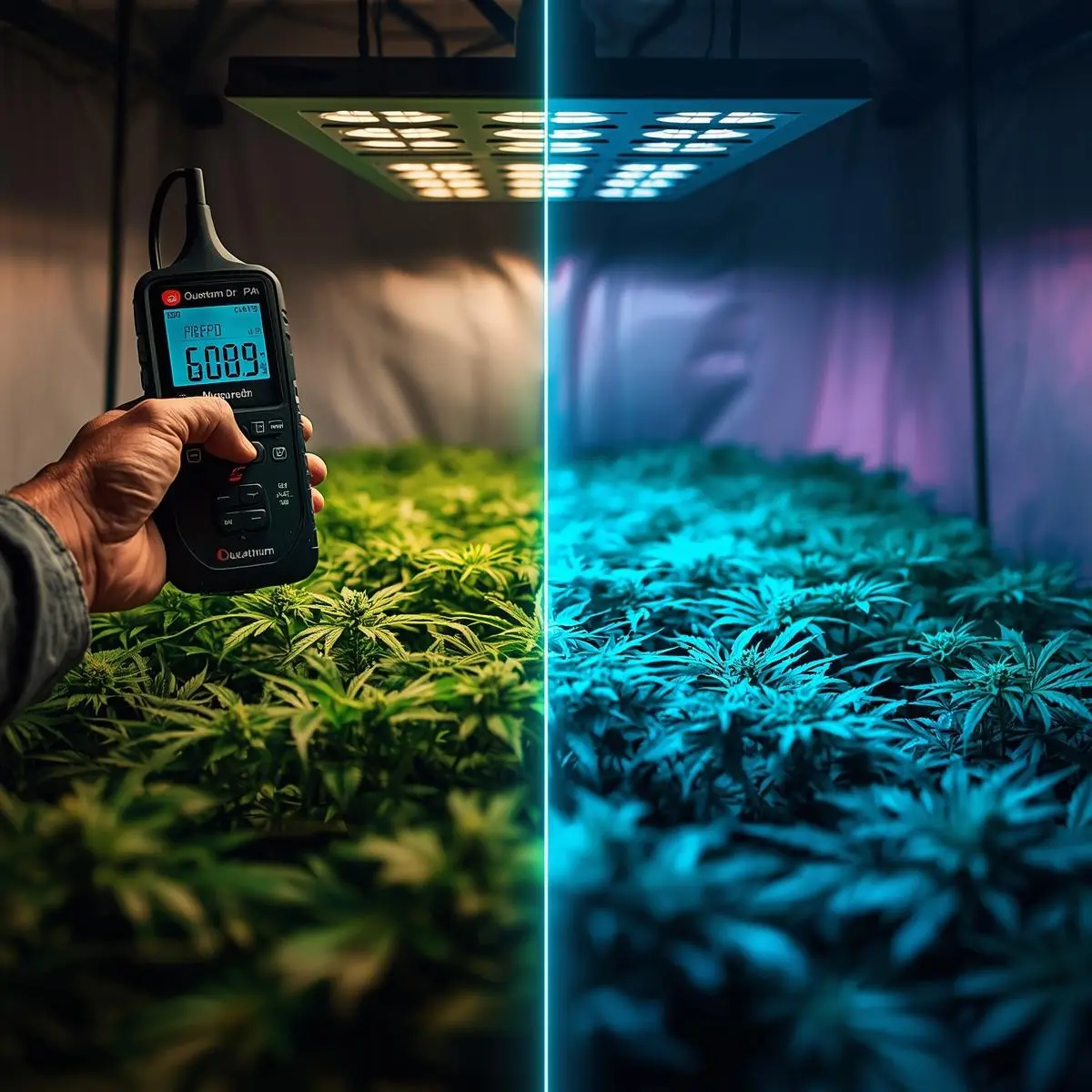
Efficiency degrades with neglect. Clean your fixture’s lenses and reflectors regularly—dust is a photon thief. A monthly wipe-down can recover 5-10% of your light output. Don’t guess your light levels; an affordable quantum sensor pays for itself by telling you exactly when to dim or raise lights. Adjust your intensity with each growth stage. The most efficient LED grow lights are the ones that are managed with intention.
Efficiency Starts With the Right Target
The most efficient LED grow lights for you won’t necessarily have the flashiest headline number. They’ll be the fixtures that deliver the right PPFD, evenly, across your unique footprint, using the least power to do it consistently. They’ll have the build quality to sustain that performance, and the controls to adapt seamlessly from propagation to harvest.
That’s the real efficiency. It’s quiet, it’s stable, and it shows up where it matters most: on your plants, and on your bills.
Look, if you’re serious about dialing in your system, the team at Grow With Hydroponics has developed the Hydroponic Tools Suite to get you there—and our experts test the gear so you can Shop Smart. For a deep dive into a specific application, check out our pillar guide: How to Grow Roses Hydroponically: Science-Backed Complete Guide (2026). It’s a masterclass in precision.
Frequently Asked Questions (FAQ)
What is considered an efficient LED grow light in 2026?
An efficient LED grow light typically delivers 2.5 µmol/J or higher PPE, provides uniform PPFD distribution (min/avg > 0.7), and includes a dimming control. Efficiency today is measured in usable photons per watt—not raw brightness.
Is higher PPFD always better?
No. PPFD must match your crop’s DLI requirement. Excessive PPFD without proper CO₂ and climate control causes light stress and wasted electricity. It’s like force-feeding a plant that isn’t hungry.
How many watts do I need for a 4×4 grow tent?
For flowering crops targeting 35–45 DLI, you typically need 480–650 true watts of modern high-efficiency LED lighting. However, it matters more than raw wattage. I’ve seen two lower-watt bar fixtures outperform one high-output board because they spread the light better.
What’s more important: PPE or PPFD?
Both matter, but in this order:
PPE (efficiency of energy conversion)
PPFD uniformity across the canopy
Ability to dim and adjust intensity
A slightly lower PPE with superior uniformity often performs better in real-world grows.
Are bulb-style grow lights efficient?
Yes—for small-scale applications. Bulbs from brands like SANSI and GE Lighting can be highly efficient for seed starting, herbs, and even compact fruiting plants. Just know their limits: they are not replacements for full-tent panel systems.
How do I calculate DLI from PPFD?
Use this simple formula:
DLI (mol/m²/day) =
Average PPFD × Light Hours × 0.0036
Example: 900 PPFD × 12 hours × 0.0036 = 38.8 DLI
That’s the sweet spot for flowering tomatoes or peppers.
Does dimming improve energy efficiency?
Absolutely. Running a 600W fixture at 60–70% during vegetative growth can significantly reduce energy use while still hitting your target DLI levels. Stage-specific dimming is one of the cheapest and most effective efficiency upgrades available.

