

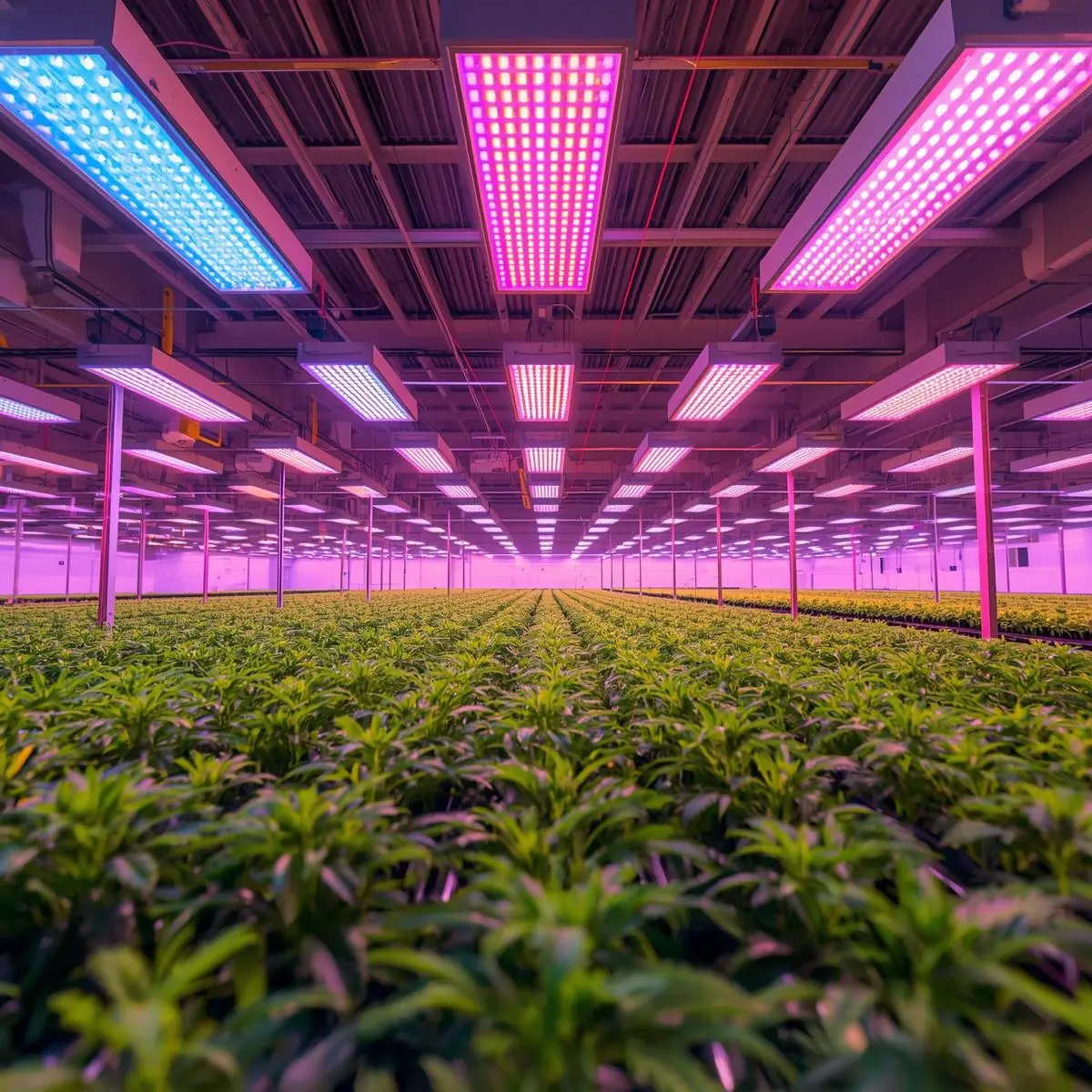
Starting seeds indoors is the gardener’s great power play. It lets you bend the season to your will, whether you’re working with a humble shelf or a full-scale propagation rack. But after a decade of doing this, I can tell you that all that potential hinges on one deceptively simple thing: the quality and consistency of your light.
Here’s the core lesson, learned through plenty of trial and error: seedlings don’t need brute force. They need appropriateness. Used correctly, LED grow lights for seedlings encourage compact, sturdy growth and robust roots, setting the stage for a smooth transition later. No drama, just strong fundamentals.
This guide strips away the marketing hype. We’ll focus on the practical, repeatable practices that actually work.
Why Do Seedlings Need Gentle Light Instead of Maximum Intensity?
Seedlings are built for balance, not extremes
Think about what a seedling is: a tiny bundle of life running on stored energy, with delicate tissues and a root system you could breathe on too hard. At this stage, light isn’t a hammer; it’s a catalyst. It must fuel growth without overwhelming the plant’s ability to manage water, temperature, and structural development.
“Gentle” here isn’t a synonym for “weak.” It means controlled intensity—delivered evenly and consistently. Get the combo of light, temperature, moisture, and airflow right, and you’ll see the proof:
- Thicker stems
- Shorter internodes (the spaces between leaves)
- Stronger root systems
- Faster, more reliable transplant success
To make this easier, we’ve built free tools that help growers dial in the fundamentals—light, temperature, moisture, and airflow. Use our Daily Light Integral (DLI) Calculator, VPD Calculator, and CO₂ Flux Calculator to turn guesswork into measurable, repeatable results.
What happens when seedlings don’t get enough light?
You get the stretch. “Leggy” seedlings are almost always a lighting issue, not a genetic one. They’re literally reaching for more photons, diverting precious energy away from building roots and leaves. The signs are unmistakable: tall, spindly stems, pale leaves, and plants that topple over if you look at them sideways.
Can seedlings get too much light? Absolutely.
It’s a common misconception that more is always better. Overdo it, and you’ll see leaf bleaching, curling, crispy edges, and growth that just… stalls. This is why understanding dose is far more critical than chasing the highest-wattage fixture on the market.
The Three Lighting Numbers Every Seed Starter Should Know
You don’t need a degree in photobiology. But these three concepts will change how you set up your space.
What is PAR and why does it matter?
PAR (Photosynthetically Active Radiation) simply defines the range of light (400–700 nm) that plants use for photosynthesis. Modern LED grow lights for seedlings are engineered to deliver PAR efficiently. The key takeaway? Don’t judge a light by how bright it looks to you. Judge it by how useful it is to the plant.
What is PPFD and how does it affect seedlings?
PPFD is the real-time intensity of that usable light hitting the plant canopy. Think of it as the light’s “strength” in any given moment. It’s a fluid number, changing with distance from the light, fixture design, and coverage area. If seedlings stretch, PPFD is too low. If they bleach, it’s likely too high.
What is DLI and why is it the most important number?
DLI (Daily Light Integral) is the grand total. It’s the amount of usable light (PAR) a plant accumulates over a full day, blending intensity and duration into one supremely practical metric.
For seedlings, DLI is often the best predictor of quality because it answers the only question that truly matters: “How much light did my plants actually get today?”
What Are Practical Light Targets for Seedlings?
A reliable DLI range for most seedlings
While specific plants have specific needs, most common vegetable and herb seedlings hit their sweet spot in a moderate DLI range during propagation. This level supports everything we want: compact growth, strong stems, and healthy root development.
The clever part? Instead of cranking up intensity and risking stress, most seasoned growers accumulate that optimal DLI by extending the photoperiod—the hours of light per day.
How many hours should seedling lights run each day?
Most indoor setups find their rhythm with 14–18 hours of light per day on a strict schedule. A 16 hours on, 8 hours off cycle is a classic, effective approach. And that dark period isn’t downtime—it’s when crucial metabolic recovery happens.
This is where a simple timer becomes your most important tool. It turns good intentions into repeatable results. Consistency matters more than complexity.
Does Spectrum Matter for Seedlings?
Why balanced spectrum works best
For seedlings, a balanced white spectrum is typically ideal. It supports natural morphology and—crucially—lets you see your plants clearly to assess their health. The benefits are straightforward: better leaf structure, more compact growth, and an easier time spotting early signs of nutrient or watering issues.
You don’t need alien-looking, color-heavy lighting for this stage. Simplicity wins.
How Should LED Grow Lights for Seedlings Be Set Up?
Distance matters more than wattage
The most common mistake I see is hanging a perfectly good light too far away. Light intensity falls off with the square of the distance—it’s not a linear drop. Adjustable mounting is non-negotiable.
The playbook is simple: Start higher, then lower gradually. Watch your plants like a hawk and adjust as they grow. Remember, uniformity is more valuable than raw power at the center.
Why even coverage is a game changer
If your center seedlings are lush while the edges stretch, that’s a coverage problem, not a plant problem. Match your fixture’s footprint to your tray size. Uniform seedlings transplant faster, reduce culls, and simplify your entire schedule.
Why Airflow Completes the Lighting System
Light drives growth, but airflow builds toughness. A gentle breeze (from a small fan aimed near, not at, the seedlings) encourages thicker stems, reduces surface moisture, and cuts down on disease risk. It’s the unsung hero of the propagation station.
What Features Matter Most in Seedling LED Fixtures?
Dimming is essential.
Seedlings don’t need the same intensity in week one as they do in week four. Dimming allows you to ramp up light as leaf area expands, maintain consistent coverage, and avoid wasting energy. This flexibility is a hallmark of a thoughtful setup.
Safety should never be optional.
Seed-starting areas are humid. Full stop. Choose fixtures rated for damp conditions and ensure all connections are secure. It’s the boring stuff that prevents the exciting disasters.
How Do You Fix Common Seedling Problems Quickly?
Lighting is usually the lever to pull first.
- Leggy seedlings? Increase PPFD—lower the light or boost intensity.
- Pale or slow growth? Nudge the DLI up gradually.
- Leaf curl or bleaching? Reduce intensity; increase distance.
- Weak stems or damping-off? Improve airflow and let the media dry a bit.
Here’s the hard-won opinion: Lighting fixes most seedling issues faster than any fertilizer ever will.
How Should Light Increase from Seedling to Transplant?
Increase light in steps, not jumps. As true leaves develop, you can—and should—raise the DLI. But do it in small increments over days. This prevents shock and supports steady, stress-free growth.
And remember, “hardening off” is largely about light acclimation. Outdoor sun is a different beast than even the best LED grow lights for seedlings. A gradual introduction prevents a brutal sunburn on your carefully nurtured plants.
Frequently Asked Questions About LED Grow Lights for Seedlings
- What type of light is best for seedlings?
Gentle, consistent LED grow lights for seedlings with a balanced spectrum and even coverage. - How close should LED grow lights be to seedlings?
Close enough to prevent stretching, far enough to avoid bleaching. Let the plants’ response guide you. - How long should seedling lights stay on?
14–18 hours per day, using a timer for consistency. - Do seedlings need darkness?
Yes. It’s essential for their metabolic health. - Why are my seedlings tall and thin?
Almost always insufficient light intensity or uneven coverage. - Is airflow really necessary indoors?
Absolutely. It’s what turns spindly into sturdy.
Strong Starts Are Built with Intention
Great seedlings aren’t an accident. They’re the product of guided, intentional care. When you use LED grow lights for seedlings with an understanding of DLI, PPFD, and coverage, they transform from a simple tool into the backbone of your propagation success.
At Grow With Hydroponics, we’ve noticed something: growers who actually pay attention to the quality and consistency of their lights run into way fewer headaches. Their harvests look better, too. The growers who focus on quality, consistency, and balance always end up with fewer headaches and better harvests. If you’re planning upgrades, Shop Smart. Build a strong start, and the plant will take care of the rest.

