

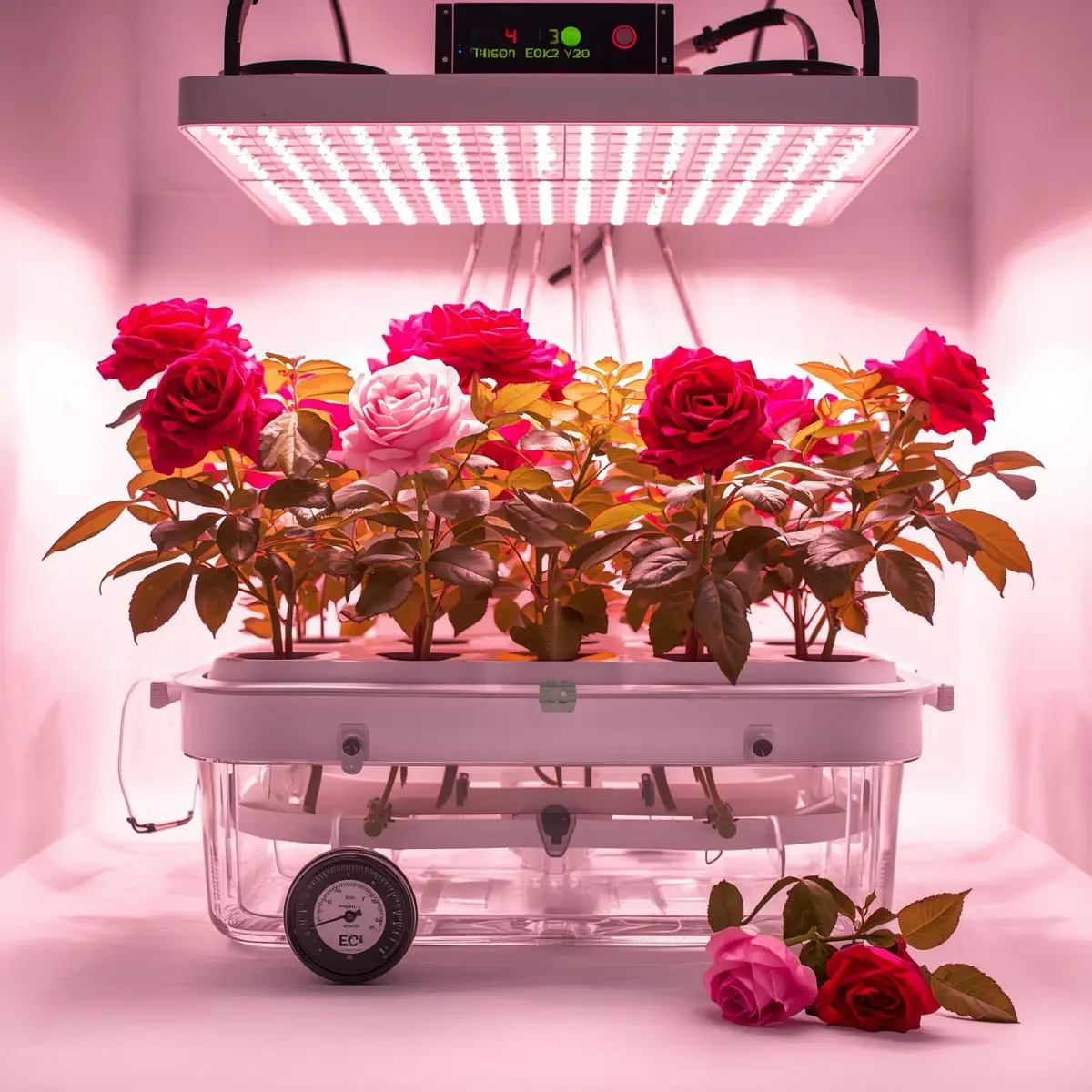
There’s a moment every hydroponic rose grower knows by heart. You’ve dialed in the lights. The roots are pristine—pearl white and reaching. The foliage? Glossy, green, and healthy. And yet… the blooms stay tight, the fragrance feels like a rumor, or the plant just refuses to explode the way a rose should.
Nine times out of ten? It’s not your genetics. It’s not the light spectrum. It’s the hydroponic rose nutrient formula.
This guide walks you through a complete nutrient formula for roses—veg and bloom—that I’ve refined over a decade of hands-on growing. Whether you’re pushing hybrid teas in a DWC system or training climbers in a recirculating setup, you’ll learn:
The exact macro and micronutrient targets for vegetative and bloom stages
EC and PPM ranges that keep roses happy, not stressed
How to tweak your hydroponic rose nutrient formula for bigger blooms and stronger stems
Common mistakes that sabotage flowering before it starts
Here at Grow With Hydroponics, we don’t just hand you ratios—we explain the why behind them. So you can adapt. Intelligently.
Why a Complete Nutrient Formula for Roses (Veg + Bloom) Matters
Let’s be blunt: roses are pigs. Compared to lettuce or herbs, they demand:
Higher potassium during bloom
Consistent calcium—or stems get floppy
Balanced micronutrients for that deep, velvety color
Stable EC, or you’ll see bud drop
In soil, organic matter buffers your mistakes.
In hydroponics? Your complete nutrient formula for roses (veg + bloom) is the ecosystem.
Get it right, and you’ll see:
Thicker stems that actually hold the flower up
Larger buds that open fully
Deeper pigment—almost black on the right varieties
Longer vase life if you’re cutting
Get it wrong, and you’ll spot:
Blind shoots (no flower formation—infuriating)
Bud abortion right when you thought you’d nailed it
Leaf edge burn that creeps in overnight
Pale, weak blooms that look embarrassed to be there
Let’s build this properly.
Complete Nutrient Formula for Roses (Veg Stage)
During vegetative growth, your goal is structure: roots, stems, and leaf mass. You’re building the frame before the painting starts.
Target Nutrient Profile for Vegetative Roses
Here’s the ideal macro range—in parts per million (ppm). This is what a proven hydroponic rose nutrient formula looks like during veg:
Nitrogen (N): 150–180 ppm
Phosphorus (P): 40–60 ppm
Potassium (K): 180–220 ppm
Calcium (Ca): 120–150 ppm
Magnesium (Mg): 40–60 ppm
Sulfur (S): 50–70 ppm
Micronutrients matter just as much—even in smaller doses:
Iron (Fe): 2.0–3.0 ppm
Manganese (Mn): 0.5–1.0 ppm
Zinc (Zn): 0.05–0.1 ppm
Copper (Cu): 0.05 ppm
Boron (B): 0.3–0.5 ppm
Molybdenum (Mo): 0.05 ppm
Ideal EC & pH for Veg Roses
EC: 1.6–2.0 mS/cm
PPM: 800–1000 (using the 500 scale—check your meter)
pH: 5.8–6.2
If you’re constantly switching between EC and PPM scales—and getting confused about which conversion your meter uses—our EC ↔ PPM Converter makes unit swaps instant. Saves headaches.
Why Nitrogen Dominates in Veg
Nitrogen drives:
Leaf expansion
Chlorophyll production
Shoot elongation
But here’s the nuance: roses don’t actually like excessive soft growth.
Too much nitrogen?
Encourages weak, floppy stems
Reduces structural strength
Can delay flowering transition
So in a smart, complete nutrient formula for roses (veg + bloom), we boost nitrogen—but keep potassium competitive. Balance is the game.
Complete Nutrient Formula for Roses (Bloom Stage)
This is where most growers go off the rails.
They’ve read somewhere to slash nitrogen and dump on phosphorus. That’s not how roses work. They’re not tomatoes.
Target Nutrient Profile for Blooming Roses
When flowers start forming, shift to this:
Nitrogen (N): 120–140 ppm
Phosphorus (P): 50–70 ppm
Potassium (K): 250–300 ppm
Calcium (Ca): 140–170 ppm
Magnesium (Mg): 50–70 ppm
Sulfur (S): 60–80 ppm
Micronutrients stay roughly the same. Consistency matters more than shocking them.
Ideal EC & pH for Bloom
EC: 1.8–2.4 mS/cm
PPM: 900–1200
pH: 5.8–6.3
Notice what happened there?
We increased potassium significantly. Not phosphorus.
Why Potassium Is the Star of Bloom
Potassium regulates:
Bud size
Petal thickness (that velvety feel)
Stem strength
Water movement
Disease resistance
Frankly, this is where beginners go wrong. They chase phosphorus numbers and ignore potassium.
In my experience, when growers upgrade their complete nutrient formula for roses (veg + bloom) by increasing K properly, bloom diameter improves within one flowering cycle. Not subtle.
Phosphorus matters—it’s involved in energy transfer. But potassium drives the show.
How to Mix a Complete Nutrient Formula for Roses (Veg + Bloom)
Let’s make this actionable. Theory’s useless if you can’t mix it.
Step-by-Step Mixing Process
Start with RO or low-EC water – Ideally below 0.2 EC. Tap water adds variables you don’t want when fine-tuning a precise hydroponic rose nutrient formula.
Add Calcium Nitrate first – Prevents precipitation with sulfates later. Non-negotiable order.
Incorporate base nutrient (Part A) – Mix thoroughly before adding the next component.
Introduce bloom enhancer (if flowering) – Focus on potassium-rich additives, not “bloom boosters” heavy in P.
Add magnesium sulfate if needed – Only after testing. Don’t guess.
Measure EC and adjust gradually – Never overshoot. Increase in small increments. Roses hate shocks.
Stabilize pH last – Use dilute acid or base. Small adjustments only.
For accurate mixing—especially if you’re building from raw salts or customizing commercial lines—our Hydroponic Nutrient Calculator helps you build precise solutions without the guesswork.
Shop Smart: When you’re buying base nutrients, look for brands that publish full elemental guarantees. If the label’s vague, the formula probably is too. Match your purchase to our calculator’s output—you’ll save money and frustration.
Common Problems With Rose Nutrient Formulas
Let’s troubleshoot what you’re probably seeing right now.
Why Are My Rose Buds Falling Off?
Few things sting more. Possible causes:
EC spiking above 2.5
Sudden nitrogen drop during early flowering
Inconsistent reservoir changes (letting it drift too long)
High VPD stress messing with uptake
Roses hate fluctuation. They’re divas about stability.
Use stable reservoir management. And if you’re dialing in climate, our VPD Calculator helps balance temperature and humidity so nutrient uptake stays consistent. Fix the environment, and half your “nutrient problems” vanish.
Can I Use Tap Water for Hydroponic Roses?
Short answer: sometimes. Longer answer: Check these first:
Base EC (over 0.5? Risky)
Calcium levels (might already be high)
Sodium concentration (anything over 50 ppm causes issues)
Hard water often skews your complete nutrient formula for roses (veg + bloom) by adding excess calcium and bicarbonates you didn’t account for.
If your tap water EC exceeds 0.5, consider RO filtration. Your roses will thank you with bigger blooms.
Should I Flush Roses Before Harvest?
For ornamental roses (not consumption):
Light flushing—lowering EC for 3–5 days—can improve flower clarity and taste if you’re scent-chasing
Avoid extreme flushing; roses still need calcium support right up to cutting.
For commercial cut roses, I’ve found consistent feed often produces better stem quality than aggressive flushing. Your mileage may vary—test both.
Advanced Tips to Optimize Your Complete Nutrient Formula for Roses (Veg + Bloom)
Once the basics are locked, these refinements separate “pretty good” from “show-stopping.”
Adjust Calcium During Heat Stress
In high temperatures:
Increase calcium by 10–15 ppm
Maintain magnesium balance (they compete)
Watch for tip burn as a warning sign
Heat accelerates transpiration, which alters uptake ratios. Calcium gets left behind if you don’t adjust.
Fine-Tune Magnesium for Deeper Color
If blooms appear:
Slightly pale
Less vibrant than expected
Dull under LED lighting
Increase Mg by 5–10 ppm gradually. Magnesium enhances chlorophyll and pigment intensity. I’ve watched pale pinks turn saturated within a week of adjusting.
Maintain Consistent Reservoir Changes
Instead of endlessly topping off with fresh water and nutrients—which lets ratios drift—try:
Full solution replacement every 10–14 days
Mid-cycle testing to catch depletion
Nutrient drift happens invisibly. Especially in flowering roses, where potassium gets sucked down fast. Explore how to grow roses hydroponically from start to finish.
How This Fits Into Growing Roses Hydroponically
This article sits inside our larger guide on mastering roses hydroponically.
Lighting, VPD, pruning, and genetics—all matter. But your complete nutrient formula for roses (veg + bloom) is the backbone. Everything else builds on it.
If you’re planning your grow room:
Choose full-spectrum LEDs with strong red output for flowering
Maintain 12–16 DLI depending on stage (use our DLI Calculator to check)
Control airflow to reduce fungal risk—roses are prone to powdery mildew
And always match your lighting intensity to nutrient strength.
Underpowered light + high EC = stressed plants. Every time.
Mastering the Complete Nutrient Formula for Roses (Veg + Bloom)
Hydroponic roses reward precision.
They’re not fragile—they’re responsive. Big difference.
When you provide a balanced, complete nutrient formula for roses (veg + bloom):
Vegetative growth becomes structured, not leggy
Bloom cycles become predictable
Flower size increases consistently
Stem strength improves dramatically
And here’s the encouraging truth:
You don’t need a commercial lab or expensive equipment. You need understanding. Then the application.
At Grow With Hydroponics, our job is to simplify complex horticulture into steps you can actually use. Take this formula as your baseline. Watch your plants. Adjust intelligently.
Roses communicate through leaf color, stem thickness, and bud formation.
Once you learn their language, success becomes repeatable. Not luck. Not guesswork.
If you’re ready to deepen your system design, explore our pillar guide on How to Grow Roses Hydroponically and start refining your grow room like a pro.
You’ve got this. 🌹

