

Your humidity is “fine.” Your temperature looks good. Your plants are still struggling—slow growth, limp leaves, and that creeping grey fuzz you didn’t invite. Most growers in this situation check their nutrients, adjust their pH, swap grow lights. What they rarely check is the one environmental number that ties temperature and humidity together into a single, actionable reading: VPD, or Vapor Pressure Deficit.
Understanding what VPD is is one of those pivotal moments in a grower’s education. It changes how you read your environment. At Grow With Hydroponics, we’ve watched growers fix weeks-long problems in 24 hours simply by getting their VPD into range—without touching a single nutrient bottle. This guide covers what VPD is, why it matters more than RH alone, how to read a VPD chart, and exactly how to dial it in across every growth stage.
What Is VPD (Vapor Pressure Deficit), Exactly?
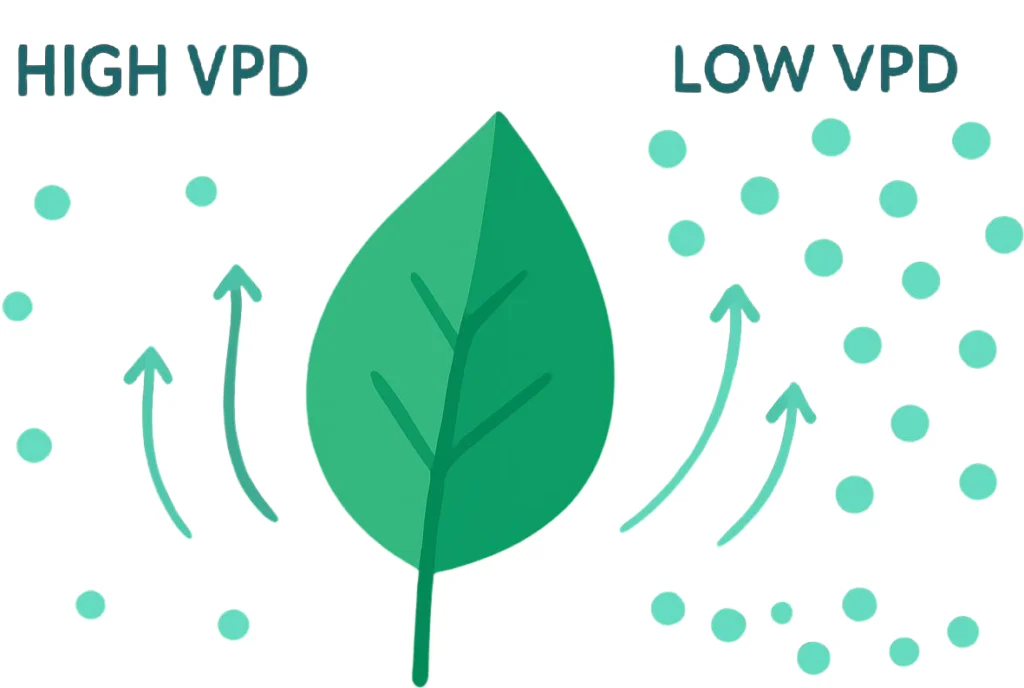
VPD is the difference between how much water vapour the air can hold at a given temperature and how much it’s actually holding right now. That gap — measured in kilopascals (kPa) — is what determines how hard your plant is working to push moisture through its leaves.
Think of it this way: warm air can hold far more water vapour than cool air. When the air is dry and warm, the gap between potential and actual moisture is large. That’s a high VPD. The air is “thirsty,” and it pulls water from your plant aggressively. When the air is cool and already saturated with moisture, that gap narrows. That’s a low VPD—and the plant can barely transpire at all.
Neither extreme is comfortable for a plant.
The Simple VPD Formula
The calculation behind VPD isn’t something you need to memorise, but understanding the logic helps:
VPD = Saturated Vapour Pressure (SVP) − Actual Vapour Pressure (AVP)
The SVP is the maximum moisture air can hold at your current temperature. The AVP is what your room actually contains, derived from your relative humidity reading. The bigger that gap, the higher your VPD — and the harder your plant transpires to keep up.
In practice, most growers skip the manual maths entirely. A VPD Calculator does the work instantly once you plug in temperature and relative humidity. More on that below.
Why VPD Matters More Than Relative Humidity Alone
Relative humidity (RH) is the number most growers know. But RH alone is a partial picture, and that’s where it gets growers into trouble.
Here’s the problem: 60% RH at 24°C (75°F) creates a very different demand on your plants than 60% RH at 30°C (86°F). The number looks identical. The plant experience is completely different. At higher temperatures, air can hold much more water, so even at the same RH percentage, the actual vapour pressure deficit—and therefore transpiration pressure on the plant—is far greater.
VPD combines both temperature and humidity into one number. It tells you what the plant is actually feeling, not just what your meter is displaying.
This matters enormously in hydroponics, where precise environmental control is both possible and necessary. If you’re running RH-only targets, you’re flying partially blind.
How VPD Controls Transpiration, Nutrient Uptake, and Growth
Here’s the core mechanism, and it’s worth understanding properly.
On the underside of every leaf sit tiny pores called stomata. These are how plants breathe—taking in CO₂ for photosynthesis and releasing water vapour through transpiration. VPD is the environmental signal that tells those stomata to open or close.
When VPD is in the right range, stomata stay open. Water moves freely from roots to leaves. Nutrients hitch a ride in that water stream, getting delivered exactly where they’re needed. CO₂ flows in. Photosynthesis runs efficiently. Growth is fast and consistent.
When VPD is too high (dry, warm air), the plant loses water faster than its roots can replace it. To protect itself, it closes its stomata. Photosynthesis slows. Nutrient uptake stalls. You might see wilting even in a well-watered system. In hydroponic setups where EC is already elevated, excessive transpiration can concentrate salts around roots quickly — causing nutrient burn that looks exactly like a feeding problem.
When VPD is too low (cool, humid air), transpiration barely happens. Nutrients don’t move efficiently. Leaf surfaces stay wet. Mould, powdery mildew, and botrytis thrive in exactly these conditions. Plants may look “fine” but grow sluggishly, and disease risk climbs quietly in the background.
This isn’t theory. It plays out in grow rooms daily, and the fix is usually simpler than growers expect once they understand the mechanism.
What Is VPD’s Ideal Range—And How Does It Change by Growth Stage?
There’s no single “perfect” VPD. The right target shifts as your plants develop, because younger plants with smaller root systems and undeveloped cuticles can’t handle the same transpiration demands as mature ones.
Here’s a practical stage-by-stage breakdown:
| Growth Stage | VPD Target (kPa) | Temperature (°C) | Relative Humidity |
|---|---|---|---|
| Seedling / Clone | 0.4 – 0.8 kPa | 20–24°C | 70–85% |
| Early Vegetative | 0.7 – 1.0 kPa | 22–26°C | 60–75% |
| Late Vegetative | 0.8 – 1.2 kPa | 24–28°C | 55–70% |
| Early Flowering | 1.0 – 1.4 kPa | 24–28°C | 45–60% |
| Mid–Late Flowering | 1.2 – 1.6 kPa | 22–26°C | 40–55% |
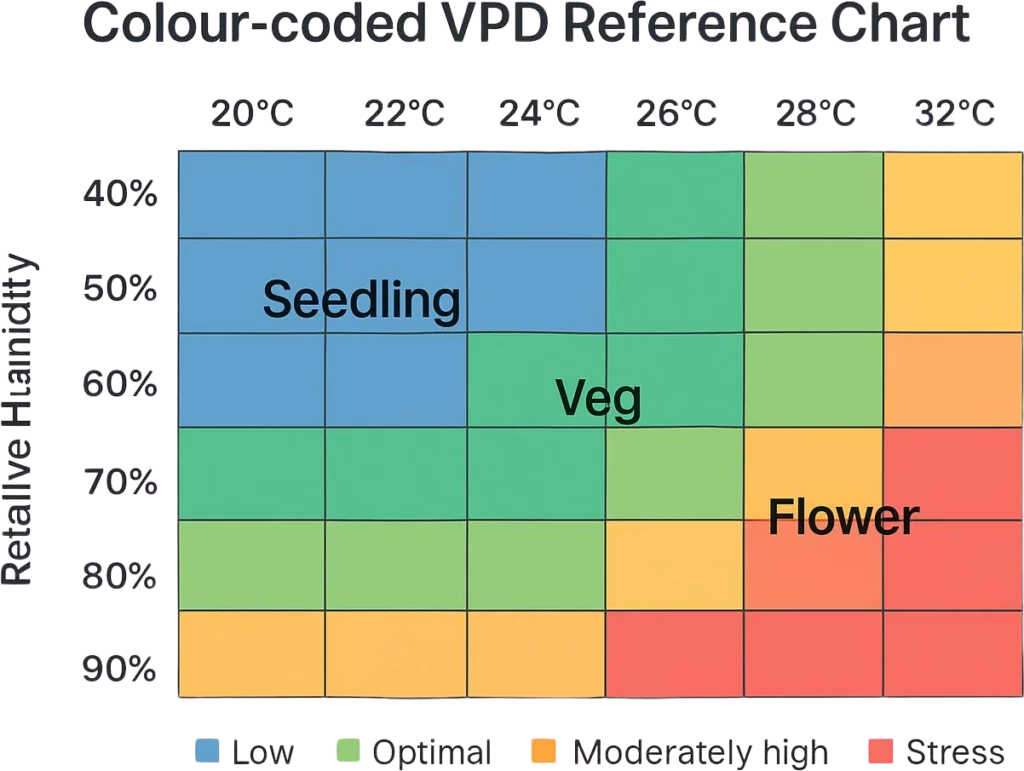
Seedlings need gentle conditions. Their root systems are tiny, and a high VPD will simply pull moisture out of their leaves faster than underdeveloped roots can compensate. Target the lower end — around 0.4 to 0.8 kPa — with higher humidity.
As plants move into the vegetative stage, you can push VPD slightly higher. Stronger roots, larger leaves, and a more developed vascular system mean the plant can handle and benefit from a moderate transpiration rate. A reading around 0.8 to 1.2 kPa is the general sweet spot.
During flowering, the goal shifts. You want enough VPD to keep humidity low and discourage mold—especially in dense canopies where airflow between buds is limited. Pushing toward 1.2 to 1.6 kPa in mid-to-late flower protects against botrytis while keeping plants drinking steadily.
How to Measure and Calculate VPD in Your Grow Room
You need two measurements: air temperature and relative humidity. A quality digital thermometer/hygrometer placed at canopy level — not on the floor, not near the intake — gives you a working reading.
From there, you have three practical options:
- Use a VPD chart. Cross-reference your temperature and RH to find your current VPD value. Simple, visual, works without power.
- Use a VPD Calculator. Input your numbers and get an instant result with stage-based guidance. Our VPD Calculator does this in seconds — including adjusting for leaf temperature offset.
- Use an environmental controller. Higher-end grow controllers measure VPD continuously and can automate humidity and temperature adjustments in real time.
The Leaf Temperature Consideration
Here’s something many growers miss: leaf temperature is not the same as air temperature. Leaves cool themselves through transpiration — the same way sweating cools your skin. Under active LED lighting, leaf surface temperature often runs 1–3°C cooler than the ambient air.
This means if you measure VPD using only air temperature, you’re slightly underestimating the true VPD your plant is experiencing. Experienced growers either point an infrared thermometer at a mid-canopy leaf to get the true leaf temperature, or they apply a small downward offset (1–2°C) when calculating VPD during lights-on periods. At night, when stomata close and transpiration slows, the gap nearly disappears — so air temperature alone works fine for night-time readings.
It sounds like a small detail. But if you’re chasing tight VPD targets in flowering and wondering why results don’t match the chart, leaf temperature is often the answer.
How to Adjust VPD in Your Grow Room
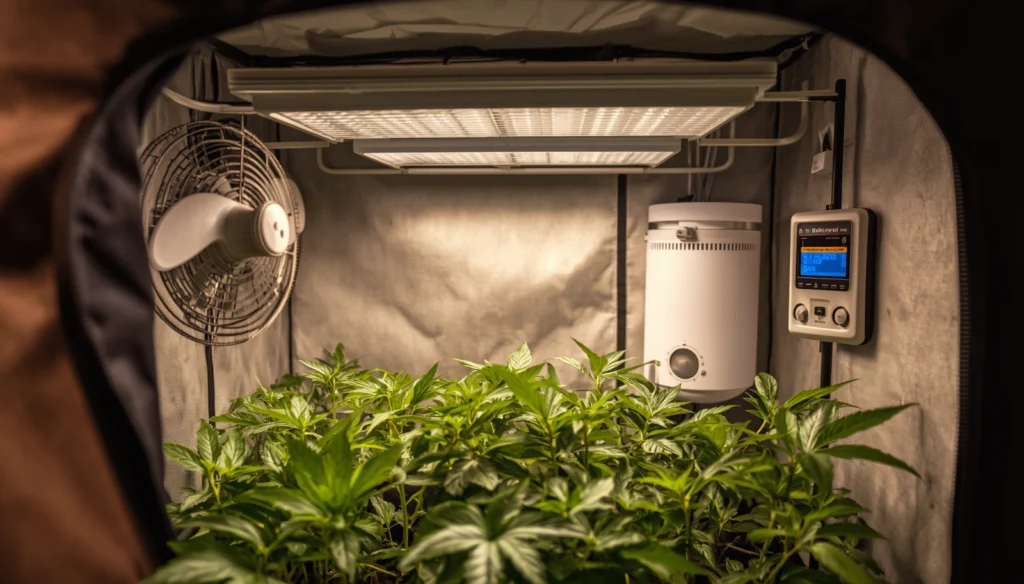
The two levers are temperature and humidity. That’s it. Everything else is just how you move those two numbers.
To lower VPD (if air is too dry):
- Run a humidifier to add moisture to the air
- Reduce temperature slightly—cooler air has less capacity to hold moisture, which narrows the VPD gap
- Reduce lighting intensity temporarily if temperatures are running hot
To raise VPD (if air is too humid):
- Run a dehumidifier—essential in flower, especially in enclosed grow tents
- Increase airflow and ventilation to push humid air out and draw drier air in
- Raise temperature slightly if it’s safe to do so for your crop stage
- Increase the light schedule slightly if you’re running a cool room
A good quality grow tent with adequate ventilation equipment makes all of this considerably easier to manage. Getting temperature and humidity stable first, then fine-tuning, is always the right order of operations.
Shop Smart: Check the Grow With Hydroponics shop for ventilation equipment, hygrometers, and humidity management tools suited to different grow space sizes.
Ventilation Gear for VPD Control
Getting VPD under control starts with moving air the right way. Whether you need a dehumidifier for flowers or a quality fan to eliminate humidity pockets around your canopy, the tools below are what growers actually use—not what looks good on a spec sheet.


Use our VPD Calculator first to find your target—then match your gear to the gap.
Common VPD Mistakes Growers Make
Relying on RH Targets Without Accounting for Temperature
“Keep veg at 60% RH” sounds reasonable until temperatures shift. At 24°C and 60% RH, VPD sits around 0.94 kPa—solid for veg. At 29°C and the same 60% RH, VPD jumps to around 1.32 kPa — borderline high for that stage. Same humidity number. Very different plant experience.
Placing the Sensor in the Wrong Location
A hygrometer sitting on the floor or near an air intake doesn’t reflect what your canopy is actually experiencing. Conditions at floor level can differ significantly from mid-canopy readings, especially in taller grow spaces. Always measure at plant height.
Chasing Perfect VPD at the Expense of Other Parameters
VPD is important, but it doesn’t override everything else. A grower who cranks humidity up to hit a lower VPD target while pushing temperatures dangerously low is fixing one problem while creating another. Plants also have temperature limits, CO₂ needs, and airflow requirements that interact with VPD. Treat it as one variable in a balanced system, not the only number that matters.
Ignoring VPD at Lights-Off
Many growers dial in a great daytime VPD and then forget about the night cycle. When lights go off, temperature drops and relative humidity typically rises. A room running well at lights-on can swing to a low, damp VPD environment in the dark—which is exactly when pathogen pressure is highest. Check your night-time readings too.
Advanced VPD Management: Automation and Stage Progression
Once you’ve got a grip on manual adjustments, the next step is automating VPD management across your grow cycle.
Higher-end environmental controllers — paired with smart humidifiers and dehumidifiers — can hold your grow room within a tight VPD range continuously, even as outdoor conditions, plant transpiration load, and lighting schedules shift. Some controllers allow you to programme stage-by-stage VPD profiles, so the system gradually steps up the target as plants move from seedling through flowering automatically.
For growers not yet at that level, the practical alternative is to check VPD at least twice daily—once mid-lights-on, once mid-lights-off—and make incremental adjustments. Gradual is better. A sudden 0.4 kPa swing in either direction stresses plants as much as running the wrong VPD consistently.
Frequently Asked Questions About VPD
What is VPD in simple terms?
VPD is a single number that tells you how “thirsty” the air is for moisture. A high VPD means dry air that pulls water aggressively from plant leaves. A low VPD means humid air that barely lets plants breathe. Keeping VPD in the right range means plants transpire steadily, absorb nutrients efficiently, and stay healthy.
What is a good VPD for vegetative growth?
For most crops in vegetative stage, a VPD between 0.8 and 1.2 kPa is the general target. Early veg works well toward the lower end; late veg can push closer to 1.2 kPa as plants build more root mass and structural strength.
Can VPD be too low?
Yes, and it’s just as problematic as high VPD. When VPD drops below 0.4 kPa, transpiration nearly stops. Nutrient movement slows, leaves may droop despite adequate watering, and persistently damp leaf surfaces invite mould and mildew. Many growers focus only on the risks of high VPD, but low VPD quietly causes consistent underperformance.
Why does my VPD spike at lights-on?
Grow lights generate heat, raising air temperature quickly when the lights come on. Higher temperature means the air can hold more moisture—widening the VPD gap — even before humidity adjusts. This spike is normal but can be managed by pre-warming the room gradually, using ramped light schedules, or running a humidifier that activates ahead of light-on.
Do I need a VPD calculator or is a chart enough?
Both work. A VPD chart is fast and doesn’t need power—useful for a quick canopy check. A calculator is more precise and useful when you want to factor in leaf temperature offset or experiment with different temperature-humidity combinations before making physical adjustments. For beginners, start with the chart. For tighter control, use a calculator.
Nutrients That Work Harder When Your VPD Is Right
When VPD is dialled in, plants actually use the nutrients you feed them. If you’ve been pushing EC and not seeing results, your environment may be the issue — not your formula. These are the nutrients growers trust when the rest of the system is running clean.


The Metric That Ties Your Whole Environment Together
Getting VPD right doesn’t require expensive equipment or a science degree. It requires understanding that temperature and humidity don’t work in isolation — they interact, and that interaction has a direct, measurable effect on how your plants grow, feed, and defend themselves against disease.
Once you start measuring VPD instead of just relative humidity, you’ll notice patterns you missed before. You’ll understand why that one grow ran faster than expected, or why flowers in one tent always developed rot while the next tent over stayed clean. The variables haven’t changed — you’re just reading them more accurately now.
If you want to work through your specific temperature and humidity numbers, the VPD Calculator at Grow With Hydroponics will map your current readings to a target range instantly. Use it as a regular part of your grow room check-in — not just once, but each time conditions shift.
VPD chart for each growth stage: Ultimate VPD Guide for Veg & Flower: Charts, Calculators, and Optimal kPa for Indoor Growing.
