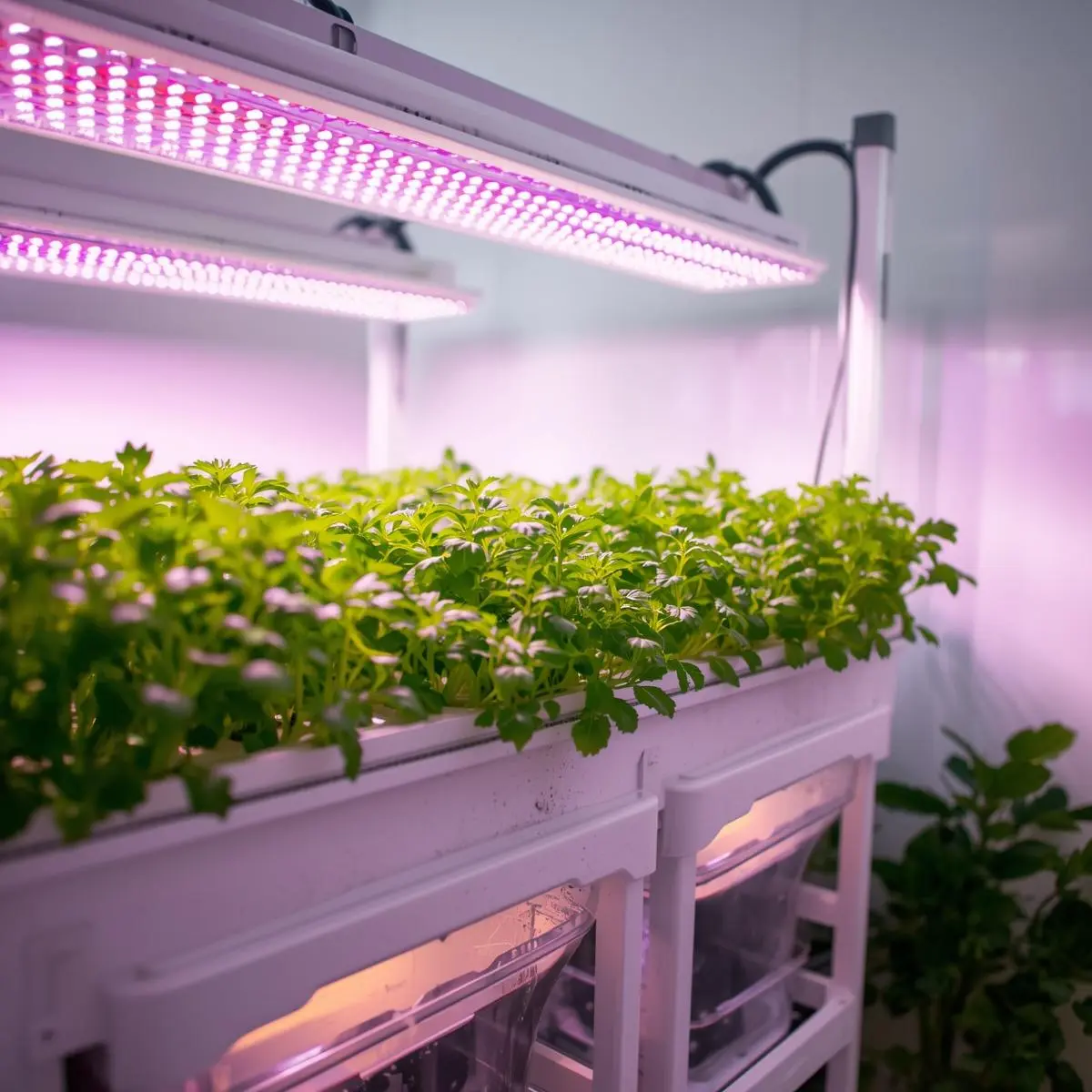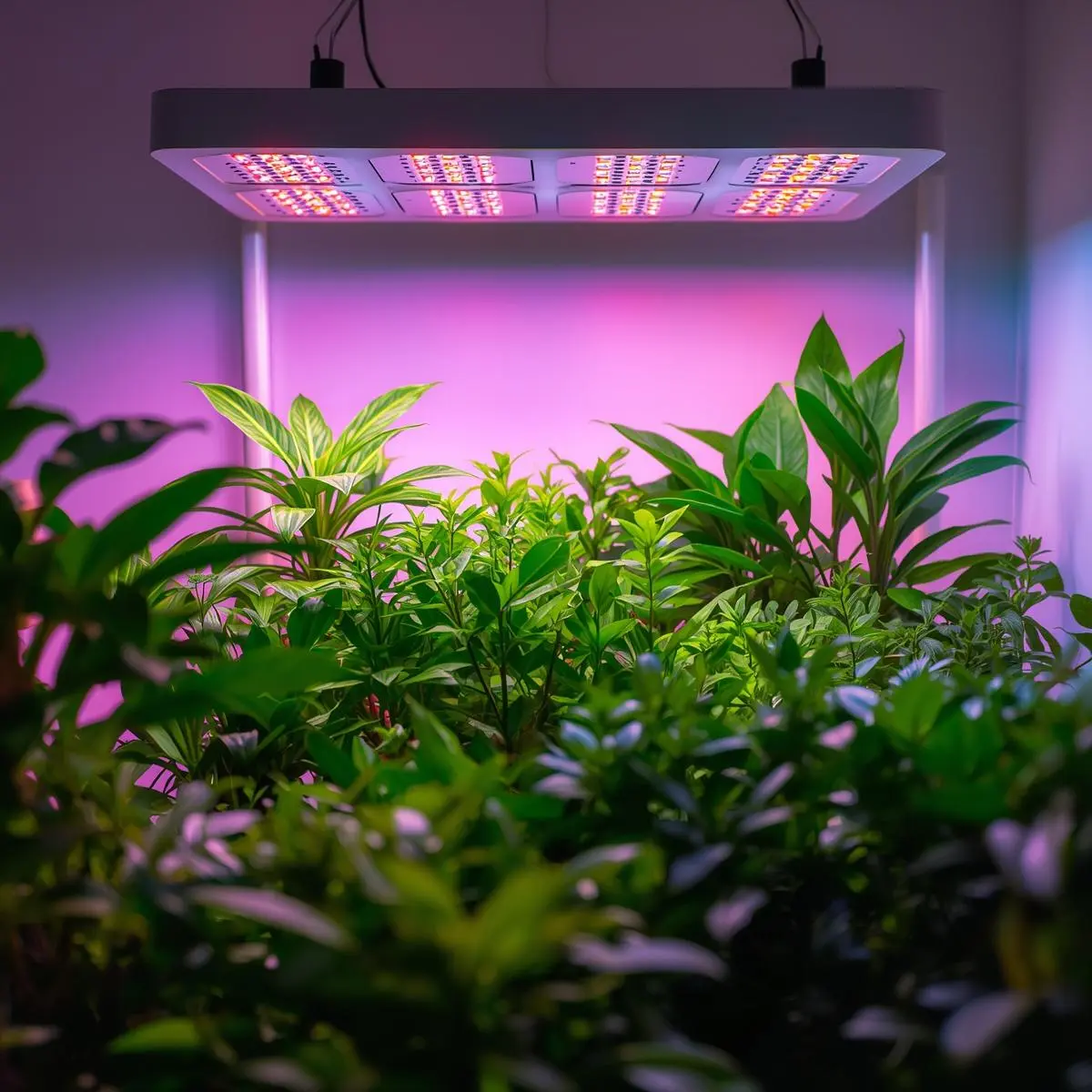
So you’re looking at a 1000 watt LED grow light. Good. You’re asking the right questions, probably the same three everyone has: How much space will it actually cover? What can I realistically harvest? And what’s this going to do to my power bill?
Those are the only questions that matter. Because of that “1000W” label? It’s practically meaningless on its own. I’ve seen fixtures with that sticker draw everything from 600 to 1100 real watts from the wall.
Your yield—and your electricity bill—hinge on that distinction.
Let’s cut through the label and talk about what happens in a real grow room.
What Does a “1000 Watt LED Grow Light” Really Mean?
Is it true wattage or marketing equivalence?
This is where they get you. You need to know if “1000 watt” means actual power draw or an “equivalent” comparison to an old, inefficient HPS light. Here’s the translation:
A true 1000 watt LED grow light will pull about 900–1100 watts from your outlet. That’s its appetite.
A “1000W equivalent” light might only draw 600–750 watts. It’s a different class of hardware.
If you don’t check the actual draw, you’re either about to under-light your garden or pay to heat your ceiling for no reason.
Why wattage alone doesn’t predict results
Watts just tell you what you’re pulling from the wall. They say nothing about what gets to your plants.
Two lights drawing identical power can deliver wildly different results based on one thing: efficiency. The driver quality, the thermal management, how the diodes are laid out—that’s what separates a workhorse from a space heater. This is why seasoned growers glance at wattage, then immediately look for the real metrics.
Which Metrics Actually Predict Coverage and Yield?
PPF: Total photons produced
PPF (Photosynthetic Photon Flux) is your starting point. It counts all the usable photons the fixture spits out every second. Think of it as the total engine output. When comparing lights in this class, it’s the single best number to gauge raw power after you know the true wattage.
If you remember one spec besides the draw, make it PPF.
PPFD: What the canopy actually receives
PPFD (Photosynthetic Photon Flux Density) is where theory meets leaves. It’s the intensity of light hitting each square meter of your canopy. This is the number that directly drives growth.
And here’s the critical part: forget the peak number they love to advertise. What you need is the average and the uniformity. A light with a scorching-hot center and dim edges gives you lopsided growth and a headache. You want an even spread.
DLI: The daily light “dose”
DLI (Daily Light Integral) is the master metric. It folds PPFD and your photoperiod (lights-on time) into one number—the total daily “dose” of photons your plants receive.
The analogy that works:
PPFD is your speed. Hours are your drive time. DLI is the total distance traveled.
Dialing this in is everything. And you don’t have to guess. Shop Smart and use the DLI planners inside the Grow With Hydroponics resource library—it turns lighting from a guessing game into a plan.
How Much Area Can a 1000-Watt LED Grow Light Cover?
Coverage depends on growth stage
A light doesn’t cover a “size.” It covers an area at a useful intensity. That changes with plant stage.
Seedlings & clones: You can cover a larger footprint with gentle light.
Vegetative growth: You start to reign it in, increasing intensity.
Flowering & fruiting: You focus that power into a smaller area for maximum intensity.
Any product claiming one fixed coverage size is selling you a best-case, flowering-stage fantasy.
A practical way to estimate coverage
Here’s some dirty, practical math that growers use: Average PPFD ≈ PPF ÷ Canopy Area. It’s a rough estimate that gets you in the ballpark, accounting for real-world losses. It’s still miles better than the utterly useless “watts per square foot” rule.
Common footprints for this class of light
In practice, a true 1000-watt LED grow light often finds its home over these footprints:
A 4×4 space for high-intensity flowering.
A 5×5 space for a more balanced, efficient spread.
The final determinant isn’t the size on the box; it’s the uniformity across your particular canopy.
What Yield Potential Is Realistic?
Yield isn’t a straight watts-to-grams equation
If anyone promises you “X grams per watt,” smile politely and walk away. Yield is a system-wide outcome. Your genetics, your canopy management, your irrigation, your environment—they’re all in the mix.
A powerful light raises the ceiling, but it doesn’t guarantee you’ll hit it.
Why uniformity raises the yield ceiling
This is non-negotiable. Even light distribution lets every square inch of your canopy perform. If your edges are dim, those plants become a drag on your total yield. It’s why many of us will gladly trade a bit of peak intensity for flawless uniformity. Consistency pays.
When environment becomes the limiting factor
Here’s the ceiling you’ll hit: environment. At high intensities, photosynthesis is limited by CO2, temperature, and humidity. If those aren’t dialed in, cranking the light higher does nothing but stress your plants and bleach your tops. Often, the biggest yield jump comes from fixing your environment, not buying a brighter light.
The Hydroponics Tools Suite—for DLI, VPD, CO2, and sunlight integration—gives you a complete system blueprint, so you fix the cause, not just the symptoms.
How Much Power Does a 1000W LED Grow Light Use?
The basic electricity math
The formula is simple: Daily kWh = (Watts Drawn ÷ 1000) x Hours On.
For a true 1000W light: 12 hours on = 12 kWh, 18 hours = 18 kWh. Multiply by your local power rate. Do this math now. It’s sobering.
Why dimming saves more than money
Dimming isn’t a luxury. It’s a critical management tool. It lets you match light to plant size, reduces early-stage heat stress, and improves uniformity. Frankly, you’ll get better results ramping up intensity than blasting seedlings at 100%. It saves power, yes, but it also builds a better plant.
Heat and HVAC: The Hidden Cost
Here’s the law of thermodynamics they don’t put on the box: nearly all the energy a light uses ends up as heat in your room. A 1000W light is a 1000W heater. LEDs feel cooler because the heat is spread out, but the total heat load is real—especially in late flower when transpiration peaks. And managing that humidity? Your dehumidifier will often draw as much power as your light. Budget for it.
How Spectrum Affects Results at 1000 W
Why balanced white spectrum dominates
Modern high-wattage fixtures lean on a balanced white spectrum with a bump of deep red. It’s the standard for a reason: it supports natural plant structure, makes it easy to spot pests and deficiencies, and performs reliably from veg to flower. The old blurple (red/blue) lights work, but they’re a pain to work under and can hide problems until it’s too late.
Vegetative vs flowering strategy
The strategy is simple: Veg is about building a strong, even structure with moderate intensity. Flower is about delivering high, uniform PPFD without creating hot spots. If you see bleaching, check your light intensity and environment first—it’s rarely a nutrient issue.
Coverage is a function of intensity, not marketing claims.
Installation and Safety Considerations
A real 1000W fixture draws serious current. Add fans, pumps, and a dehu, and you can trip a standard 15-amp circuit fast. Do it right: use a dedicated circuit, secure hanging hardware rated for the weight, and for goodness’ sake, don’t hang it at 6 inches and blast full power on day one. Measure your PPFD. It’s cheap insurance.
Buyer’s Checklist: Choosing the Right 1000W LED Grow Light
Before you spend a dime, verify:
- Actual power draw (from the spec sheet, not the product title).
- PPFD maps at the height you’ll actually use.
- Uniformity data—look for the average, not the peak.
- Reliable dimming (a 0-10V or PWM knob is ideal).
- Solid thermal design (look for hefty aluminum heatsinks).
- A clear, accessible warranty.
A 1000 watt LED grow light is infrastructure. Shop Smart and buy it like you would a furnace or a water pump—for the long haul. If you’re serious about understanding how these metrics translate to real-world performance, The Ultimate LED Grow Light Guide: Science-Backed Indoor Setup (2026) breaks down exactly what those PPFD maps mean—and how to read them like a pro.
Common Mistakes to Avoid
Oversizing your space and then blaming weak genetics. Running full power in a mismatched environment. Thinking “bright to your eyes” means “good for plants.” Forgetting that your HVAC costs might rival your light costs. Most lighting failures are planning failures.
A 1000-watt LED grow light is a phenomenal tool. But it’s just one component. Its potential is only unlocked when you size it with PPFD, manage it with DLI Calculator, and balance it with precise control over air, temperature, and water.
When you stop buying a “light” and start designing a system, that’s when results become predictable and repeatable.
It’s the only approach that scales from a tent to a warehouse. That systems-first philosophy isn’t just good practice—it’s the core of what works, and it’s exactly what the team at Grow With Hydroponics teaches.
In this game, you don’t get points for how hard you try, only for what you actually harvest.