Most homes are caves disguised with drywall. They just don’t provide the consistent, full-spectrum light plants evolved under. That’s where full spectrum LED grow lights for indoor plants stop being a gadget and start being essential.
They’re not just a bulb; they’re a controlled, energy-efficient slice of the solar spectrum, letting you grow anything from basil to bonsai without a south-facing window. Explore The Ultimate LED Grow Light Guide: Science-Backed Indoor Setup (2026).
This isn’t about turning your apartment purple. It’s about understanding what light actually does. So, let’s cut through the marketing. Here’s what “full spectrum” really means, why your plants care, and how to choose a light that works—without the guesswork.
Why Do Indoor Plants Need Full Spectrum Light?
How Plants Actually See Light
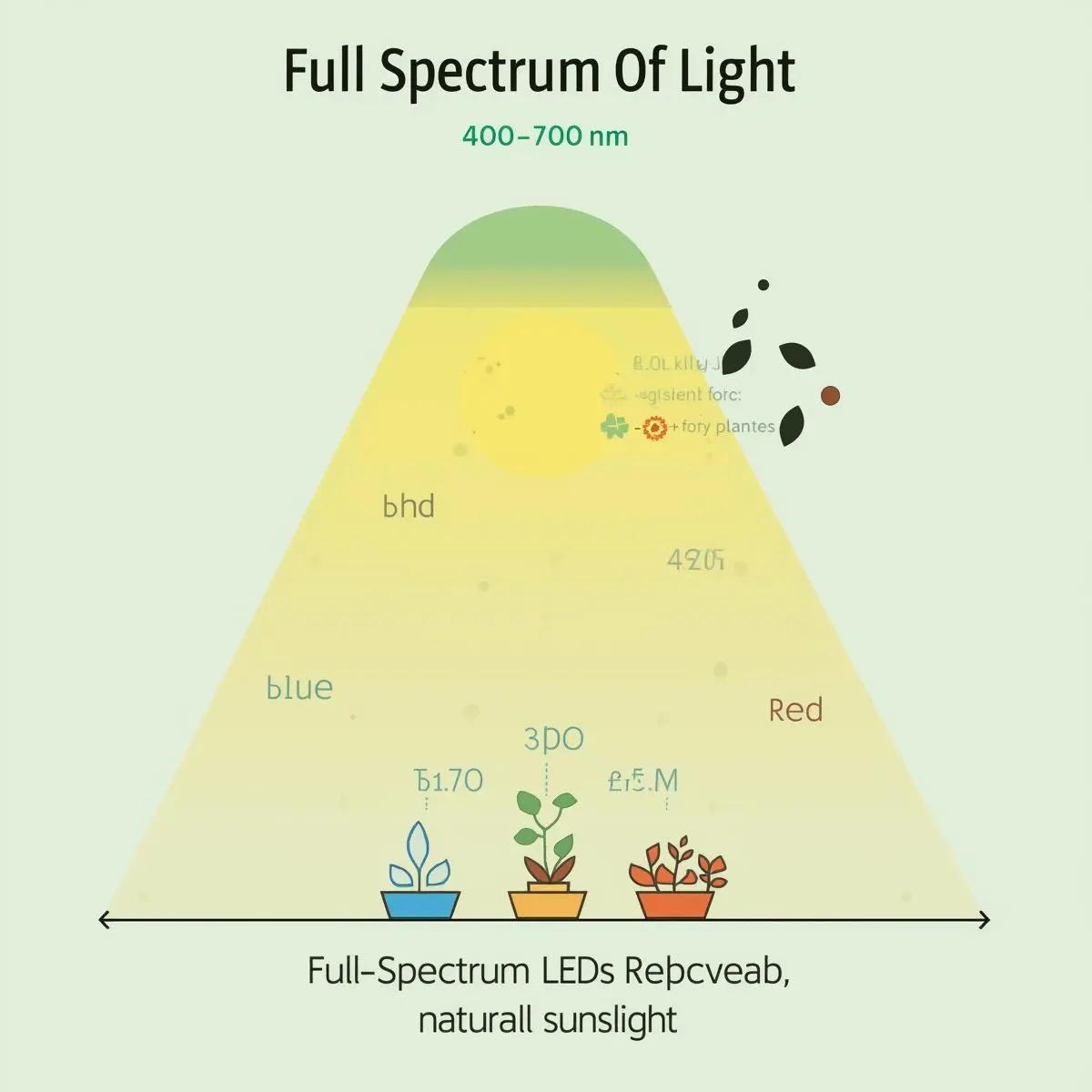
We see brightness and color. Plants see fuel. They operate within the Photosynthetically Active Radiation range—specifically, wavelengths from 400 to 700 nm. It’s a different language entirely.
Blue light? That’s the drill sergeant. It keeps growth compact and stems strong.
Red light is the motivator for flowers and fruit.
And that green/mid-range light everyone ignores? It’s the infiltrator, penetrating deeper into the canopy.
The takeaway?
A light that looks bright to you can be useless to a plant. It’s about quality, not just quantity.
How Full Spectrum LEDs Solve This Problem
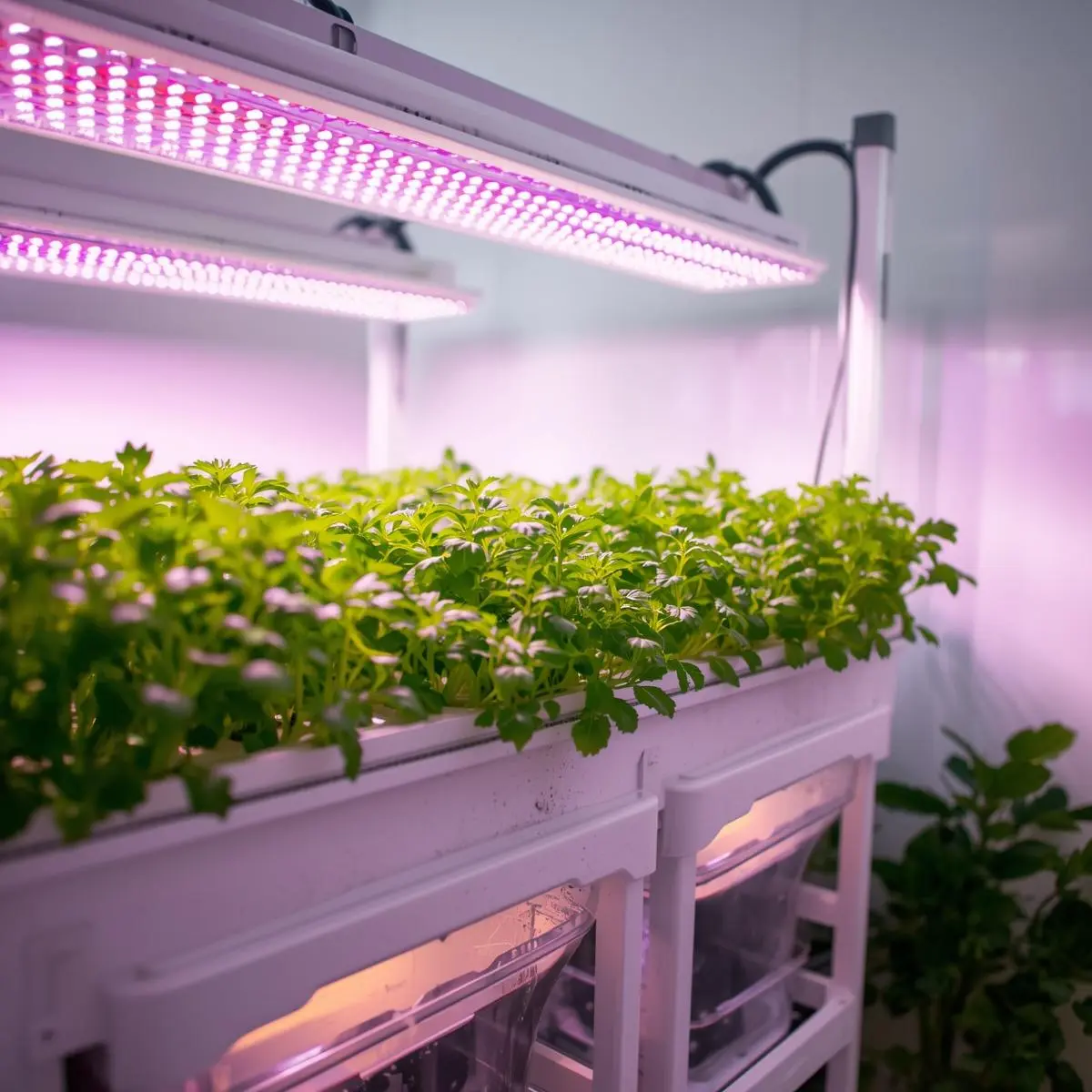
Early grow lights were brutalist art—harsh, purple things that worked but made your living room look like a supervillain’s lab. Modern full spectrum LEDs are different. They mimic natural sunlight, providing a balanced spectral smoothie. The result? You get strong vegetative growth, correct coloration, and healthy flowering and fruiting. Crucially, they emit a soft, natural white light. You can actually see your plants—spot a pest, diagnose a deficiency—instead of squinting through a violet haze.
What Does “Full Spectrum” Really Mean?
Natural White Light vs. Blurple Lights
We covered the aesthetic win. But the real genius is in the details. That pleasant white light isn’t a compromise; it’s a more sophisticated tool. It delivers the reds and blues plants crave but fills in the gaps for a more complete developmental profile.
CCT & CRI: Key Lighting Specs
When you shop, ignore the hype and look at two specs:
CCT (Correlated Color Temperature), measured in Kelvin. You want 5000K–6500K. That’s the crisp, bright white of a cloudy day.
CRI (Color Rendering Index). Aim for 85+. This is what lets you see true leaf color. A low CRI can hide early signs of nutrient stress or disease. It’s your early-warning system.
PAR, PPF, and PPFD (Made Simple)
This is where marketers get slippery. Let’s demystify:
PAR is the type of light plants use.
PPF tells you how much of that light the fixture produces. It’s a total output number.
PPFD is the only one that matters. It measures how many of those usable photons actually hit your plant’s leaves at a given distance. Always, always look for a PPFD map. A high PPF light with poor distribution is like a loudspeaker facing the wrong way.
For more on calculating the right light dose, the DLI Calculator takes the guesswork out of daily light integration.
Research-Backed Benefits of Full Spectrum LEDs
This isn’t bro-science. Full spectrum LED lighting is the backbone of modern controlled-environment agriculture for a reason. The data from universities and commercial facilities is clear: it drives stronger growth, slashes energy use, and gives you unprecedented control over development.
The benefit is in the balance. A good full-spectrum light provides enough blue to prevent stretching, enough red to trigger blooms, and sufficient green for deeper penetration. This one-fixture-fits-all approach supports every stage, from seedling to harvest. And compared to the old, hot HID systems? The energy efficient + low heat profile of LEDs is a game-changer for a spare room or apartment. You’re not fighting a heater.
How to Choose the Best Full Spectrum LED Grow Light
Measure Your Space & Identify Plant Needs
Start simple. Where are the plants? A windowsill, a bookshelf, or a dedicated 2×4 ft grow tent? A peace lily and a pepper plant have wildly different appetites for photons. Match the PPFD to the plant, not the other way around.
Important Specs to Compare
Look past the flashy website. Dig for:
Actual wattage (not the “equivalent” nonsense).
PPFD maps at various heights.
Efficacy (µmol/J). Higher is better—more light per watt.
A real spectrum chart that shows a smooth, sun-like curve.
Dimming capability. You’ll want it.
Safety and Reliability Matter
A cheap light is an expensive risk. Quality shows in stable drivers, proper heat sinks (aluminum, not plastic), over-temperature protection, and legitimate electrical certifications (UL, ETL, CE). Don’t skip this.
How to Use Full Spectrum LED Grow Lights Indoors
Hang height is your first dial. General rule: seedlings 12–18 inches, houseplants 12–24 inches, high-light crops 10–16 inches. Then, watch. Stretching? Lower the light. Bleaching? Raise it. Your plants will talk.
For photoperiod, use a timer. Consistency is key. Try 12–14 hours for foliage, 14–16 for herbs, and 16–18 for seedlings. And for even coverage, rotate your pots weekly. It’s the oldest trick in the book because it works.
When you’re ready to buy, here’s a pro move: Shop Smart by matching any fixture to our Indoor Plant Sunlight Analysis System. It maps your actual space so you’re not guessing whether that sleek panel will actually cover your shelf.
Example Indoor Grow Setups
Windowsill Supplement: A compact bar light. PPFD of 100–250. It’s a boost, not a replacement.
Grow Shelf: Slim LED bars under each shelf, 6–12 inches above trays. Perfect for starting seeds that don’t get leggy and weak.
That 2×4 ft Grow Tent: This is where you go pro. A full-coverage fixture can push 250–500 PPFD for greens or crank to 800 for fruiting crops. You control everything here.
Frequently Asked Questions
Are they safe? Yes. Don’t stare into the diodes, and make sure it’s plugged into a good outlet. Common sense stuff.
Can a regular LED bulb work? For keeping a pothos alive in a dark corner, maybe. For robust growth? No. It lacks the spectrum and the punch.
How do I know if they get enough light? The plant tells you. Compact growth and deep color = good. Stretching, pale leaves = desperate cries for more.
Do I need different lights for veg and bloom? For 99% of home growers, a single full-spectrum light is perfect. You adjust intensity and duration, not the spectrum.
Grow Sunlight Indoors with Full Spectrum LEDs
The promise is simple: full spectrum LED grow lights let you recreate sunlight on your terms. No more praying for a sunny day or battling the dry, oppressive heat of old tech. With balanced wavelengths, brutal efficiency, and minimal heat, they’re the logical endpoint for indoor gardening. From rescuing a houseplant to harvesting dinner, the right light changes everything. It’s not magic. It’s just good physics.
At Grow With Hydroponics, we believe in giving you the tools to stop struggling and start thriving. Whether you’re on your first shelf setup or your fifth grow tent, the right light makes all the difference.