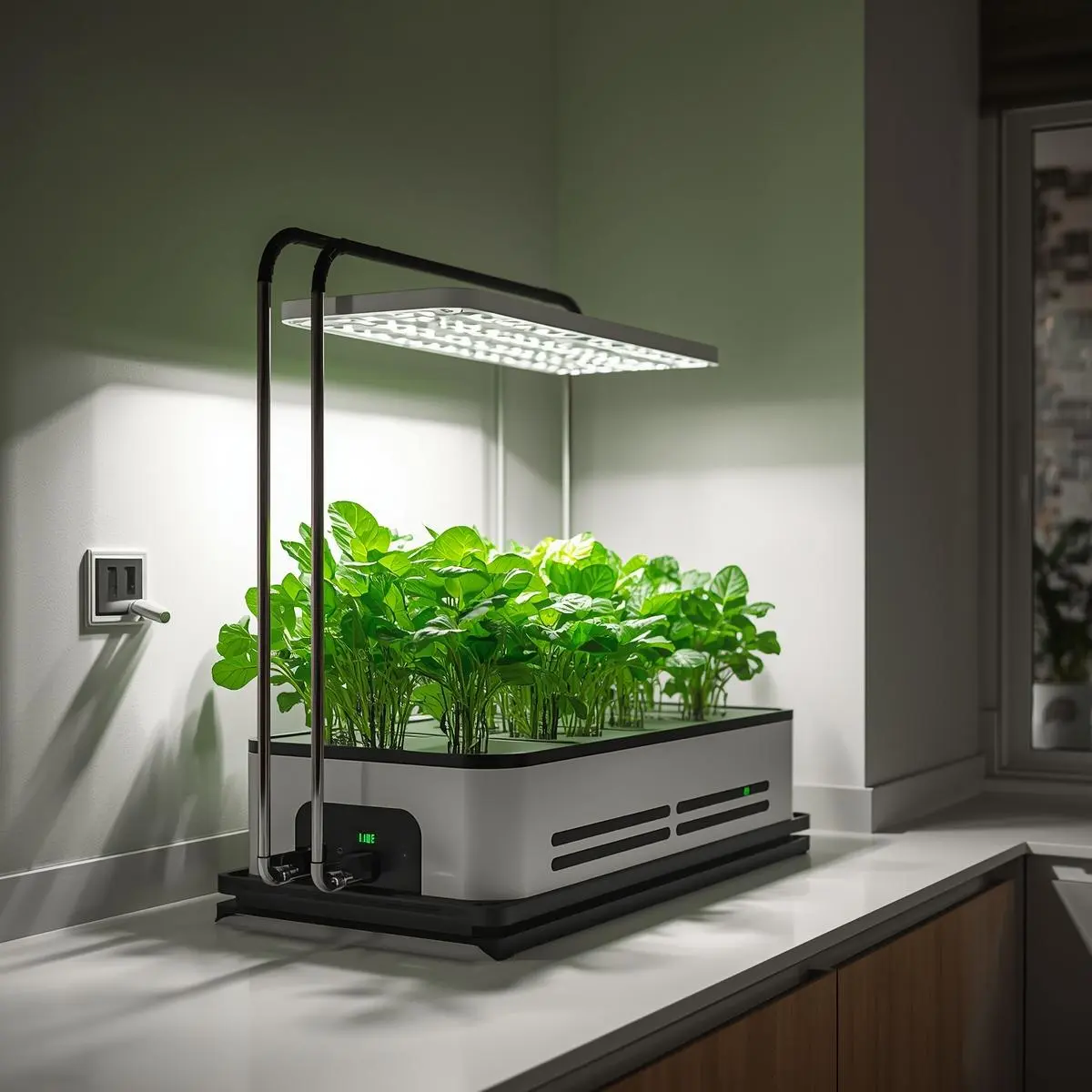
Look, I get it. You’re standing in your grow room, staring at your hydroponic system, and you’re eyeing those elegant, thorny divas we call roses. A voice in your head—probably echoing some traditionalist gardener from your past—whispers:
They need the sun. Real sun. You can’t fake that.
Frankly, that voice is wrong. I’ve seen more roses languish in poorly lit greenhouses than I’ve ever seen fail under a well-tuned LED array. The question isn’t can you, but how you do it right. So, let’s cut through the romanticism. Here’s the straight answer, born from a decade of editing trials, data, and more than a few of my own crispy-leaf failures.
Yes. Roses can not only grow but truly thrive under LED lights alone. No sunlight required. The caveat—and it’s a big one—is that you must understand you’re replacing a complex, dynamic celestial body with a tool. You need to know how to use that tool with precision. This is where most enthusiastic beginners face-plant. They buy a bright light, hang it up, and wonder why their plants are leggy and flower-shy.
Success hinges on delivering the right intensity, spectrum, and—the metric I’ll preach about until I’m blue in the face—the Daily Light Integral (DLI). Get these wrong, and you’re just giving your roses a very expensive tanning bed session. Get them right, and you’ll have cleaner, more consistent, and potentially more abundant blooms than any outdoor garden I’ve ever managed.
Can Roses Grow Under LED Lights Alone? (The Unflinching Short Answer)
Let’s be brutally clear: Yes. LED grow lights are entirely sufficient for the full life cycle of a rose, from cutting to repeat blooming.
But that “yes” comes with three non-negotiable conditions:
Light intensity (PPFD) must be sufficiently high.
Photoperiod must be deliberately controlled.
Daily Light Integral (DLI) must meet the rose’s hefty appetite.
Miss one, and the whole endeavor becomes a lesson in patience and disappointment. Nail all three, and you unlock a level of control that makes outdoor gardening feel like a roll of the dice.
Why Light Matters More Than Soil (Or Any Other Factor)
Here’s a fundamental truth we champion at Grow With Hydroponics: Roses are photosynthetic engines first, pretty flowers second. They don’t inherently care if their roots are in soil, coco coir, or a sterile hydroponic nutrient stream. What they do care about—profoundly—is photon currency.
When you remove the sun, light becomes the undisputed dictator of:
Stem strength (or leggy weakness)
Bud initiation (or perpetual vegetative limbo)
Bloom size and substance
Flowering frequency
This is why professional growers, the ones supplying your local florist, are meteorologists of the microclimate. They don’t guess. They measure. You should, too.
How Much Light Do Roses Actually Need? (Spoiler: It’s a Lot)
Time for numbers. This is where we leave marketing claims behind.
For robust vegetative growth and prolific flowering, most rose varieties demand:
DLI Target: 20–30 mol/m²/day. They’re highlight plants.
PPFD Range: 400–600 µmol/m²/s during the “day.”
Photoperiod: 14–16 hours of light.
And this is the critical pivot point—the moment where hobbyists and effective growers diverge. People obsess over wattage. You should obsess over DLI.
Why DLI Is Your Single Most Important Metric (Forget Wattage)
Wattage tells you your electricity bill. DLI tells you if your roses are eating enough. Two fixtures can both claim to be “600W LEDs” but deliver wildly different photon counts to your canopy due to efficiency, optics, and hood design.
Guessing here is how you waste months. Calculating is how you succeed.
This is precisely why we built tools like the DLI Calculator. You plug in your PPFD (from a meter or a trustworthy fixture spec sheet) and your desired photoperiod. It instantly tells you your DLI. No graduate degree in photobiology required. Use it to:
Match a fixture to your specific rose variety’s needs before you buy.
Dial in the perfect photoperiod to hit that sweet-spot DLI.
Avoid the twin heartbreaks of light starvation or bleaching.
Shop Smart Tip: When you Shop Smart for LED grow lights, pair the purchase with our DLI Calculator. You’re buying photons, not a shiny box. Know exactly how many you need first.
What Happens When You Get It Wrong? (A Diagnostic)
Too Low (The Most Common Crime):
The symptoms are a sad, slow march. Leggy, stretching stems desperately reaching for more. Pale leaves. Buds that abort or never form. You’ll get leaves—sure—but flowering will be pathetic or nonexistent. If you see this, don’t immediately blame your nutrient mix. Nine times out of ten, it’s a light issue.
Too High (Less Common, But Brutal):
Yes, you can have too much of a good thing. Excessive PPFD leads to leaf bleaching (those ugly white or tan patches), heat stress even with cool LEDs, and ironically, reduced bloom quality as the plant goes into survival mode. It’s like force-feeding an athlete.
Do Roses Need Fancy “Full-Spectrum” LEDs?
In a word: Yes. But let’s define terms.
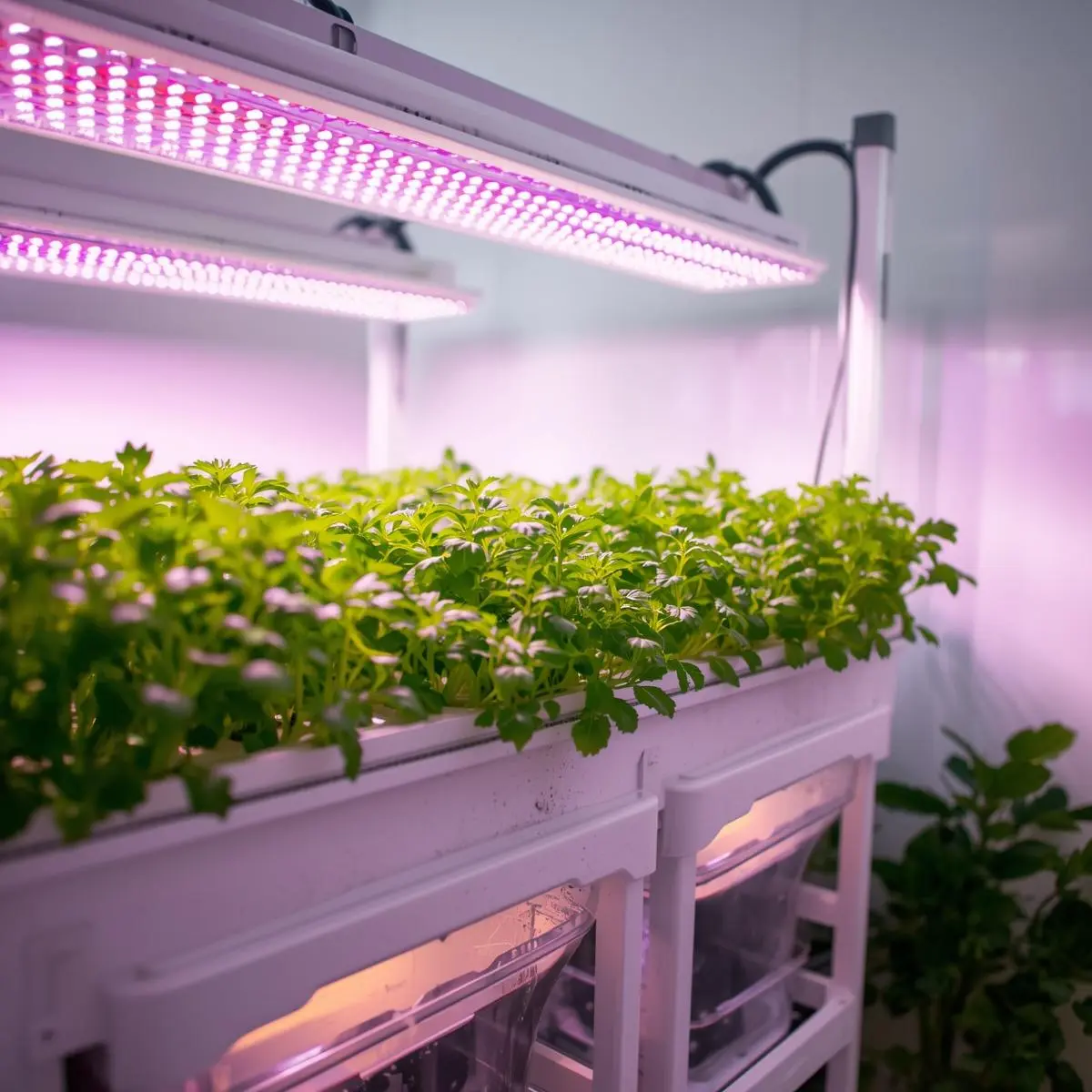
Roses use the full photosynthetic active radiation (PAR) spectrum. They rely on blue wavelengths (400-500 nm) for strong, compact vegetative growth. They crave red wavelengths (600-700nm) to trigger and sustain flowering. The balanced “full-spectrum” or broad-white LED grow lights mimic the sun effectively and are far more pleasant to work under than the old, inefficient “blurple” lights.
Avoid spectrum gimmicks. A quality full-spectrum white LED is the smartest, most effective choice for a multi-phase plant like a rose.
Can You Really Get Flowers With Just LEDs?
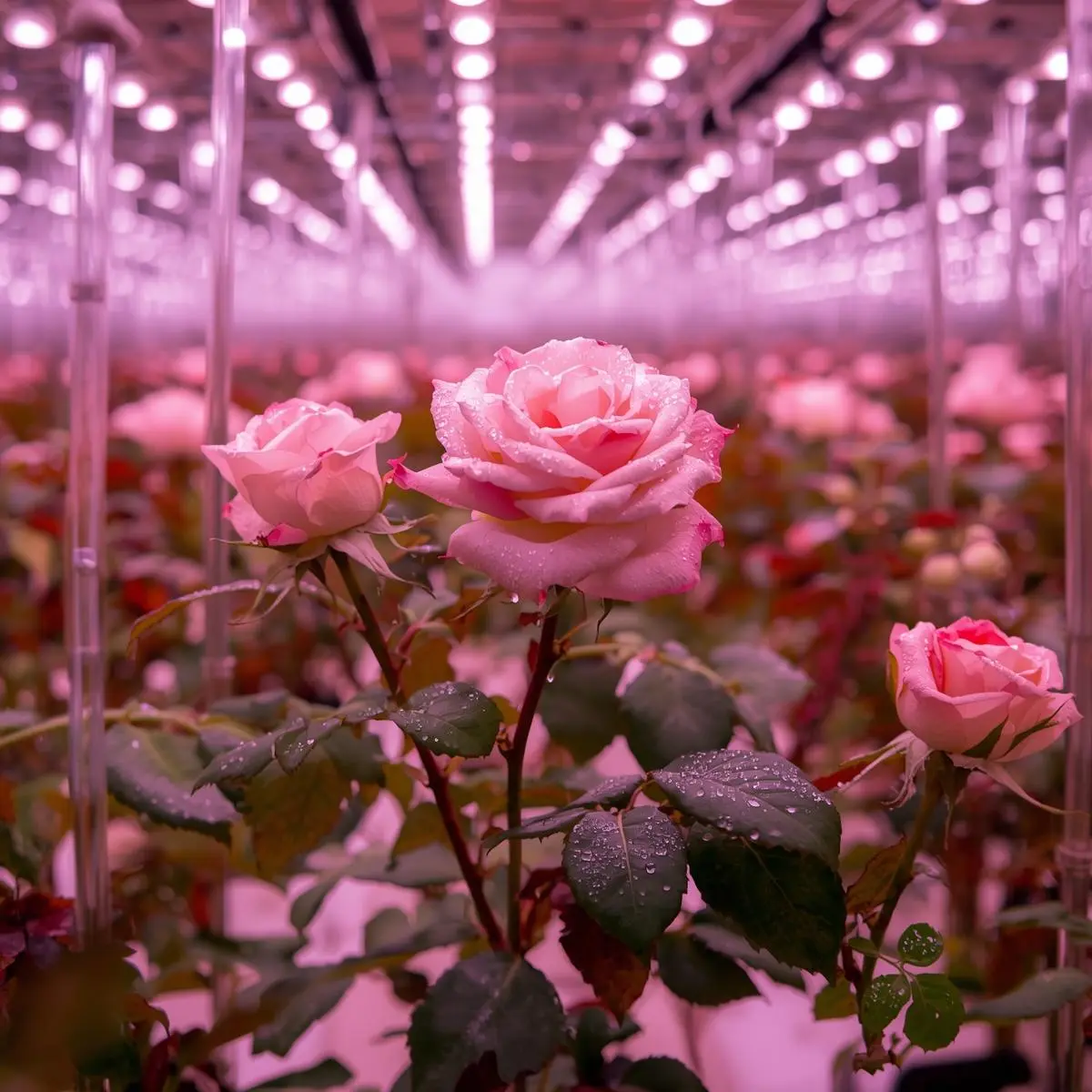
This is the doubt that nags at everyone. Absolutely, you can. Flowering is a biochemical response to accumulated light energy (DLI), given the right supporting environment.
With a consistent DLI of 20-30 mol/m²/day, I’ve seen indoor roses not just match but surpass their outdoor counterparts in predictability. The advantages are stark:
Predictable bloom cycles you can literally schedule.
Near-zero pest pressure (no aphids unless you bring them in).
Immaculate petals with no weather damage.
True year-round flowering.
It’s not magic. It’s a controlled photoperiod.
How to Set Up LED Lights for Roses (The No-Fluff Steps)
Determine Your DLI Target. Start with 25 mol/m²/day. Use the DLI Calculator.
Measure Your PPFD. Borrow or buy a quantum PAR meter. It’s the single best diagnostic tool you can own. Map the light at the canopy.
Adjust Photoperiod. Lower PPFD? Extend hours. Higher PPFD? Shorten them. The calculator does this math for you.
Monitor, Don’t Stare. Watch for stem thickness and rich green leaves. Buds should develop steadily, not stall. For the full journey, see How Long Do Roses Take to Flower Hydroponically?
The Rest of the Equation: Environment is Everything
Light doesn’t work in a vacuum. It’s in a partnership with climate. Pouring on photons while your environment is off is like revving a car engine in neutral.
Temperature: Aim for 22–26°C during lights-on.
Humidity: Hold around 55–65% for vegetative growth.
VPD (Vapor Pressure Deficit): This is the secret lever for health. It dictates how efficiently your roses transpire and use that light-driven energy. A VPD Calculator is indispensable for balancing temp and humidity into that sweet spot of 0.8–1.2 kPa. When VPD and DLI align, growth is explosive.
Common Myths, Busted
“Roses need direct sunlight to smell strong.” Scent is a genetic and nutrient-influenced trait. Plenty of sun-grown roses have no scent. Plenty of LED-grown ones are fragrant.
“The blooms look fake.” The light source doesn’t change petal cell structure. Genetics do.
“It’s not sustainable.” Compared to field-grown roses flown across continents, a localized, hydroponic, LED-lit system using our Nutrient Calculator for precision feeding is a model of efficiency.
When Shouldn’t You Go LED-Only?
Be pragmatic. If your grow space is an unconditioned attic with wild temperature swings, solve that first. If your local electricity cost is astronomical, the math might not work. This isn’t for everyone. That’s fine. Gardening never is.
Yes—If You Trade Guesswork for Measurement
So, can roses grow under LED lights alone?
The answer is a resounding, evidence-backed yes. The transition from sunlight to diodes isn’t about finding an equal—it’s about finding a superior tool for a specific job: reliability.
The key isn’t buying the brightest light. It’s delivering the precise, measurable dose of photons your cultivar needs, day after day. It’s supporting that light with a dialed-in environment. This is the core philosophy of our community at Grow With Hydroponics.
For those ready to dive into the specifics—from cutting selection to reservoir management—our comprehensive guide, How to Grow Roses Hydroponically: Science-Backed Complete Guide (2026), is your logical next step.
Your roses don’t yearn for a distant star. They respond to quantifiable energy. Give them that, and they’ll reward you with blooms, on schedule, no matter what the sky outside is doing.
FAQ: Growing Roses Under LED Lights
Q: Will my LED roses smell as real as the ones from my grandma’s garden?
A: You might be surprised. That classic rose fragrance comes from the plant’s genetics and its overall vitality—not from sunlight specifically. In fact, an indoor rose grown under dialed-in LEDs with perfect food can often smell more potent. Why? Because it’s never battered by a midday heatwave or a pounding rainstorm, both of which can literally wash away and degrade those delicate volatile oils. A stressed outdoor rose might look okay but its scent can be faint. A pampered indoor rose can pour all its energy into being spectacular.
Q: Can I use a regular bright shop light instead of a horticultural LED?
A: You can, but you’ll struggle. Standard shop lights lack the necessary PPFD (intensity) and balanced spectrum. You’ll likely see leggy growth and few, if any, blooms. It’s the most common reason for failure. Investing in a proper full-spectrum LED grow light matched to your space with our DLI Calculator is the right-fit solution.
Q: How close should the LED lights be to my rose canopy?
A: There’s no universal inch measurement. It depends entirely on your fixture’s output (PPFD). Follow this rule: hang the light at the manufacturer’s recommended distance for flowering plants, then use a light meter (or the fixture’s dimmer) to dial in the PPFD to 400-600 µmol/m²/s at the canopy. Watch for stress signs and adjust. This is where the Indoor Plant Sunlight Analysis System can provide photon-level precision.
Q: Is it cheaper to grow roses indoors with LEDs or outdoors in the sun?
A: Initially, outdoors is “free.” But factor in the costs of pesticides, water waste, weather-related crop loss, and seasonal limitations. A well-optimized LED setup provides year-round, predictable blooms with lower long-term inputs. The smartest approach views it as an investment in control and consistency, not just utility costs.
Q: My LED-grown rose has lush leaves but no buds. What’s wrong?
A: You’ve hit the classic “vegetative trap.” This is almost certainly a DLI issue—your light intensity or photoperiod is too low to trigger the flowering signal. Use the DLI Calculator to verify you’re hitting 20-30 mol/m²/day. Also, check your VPD; if humidity is too high, the plant may not transpire efficiently enough to support bud formation.
Q: Do I need to change the LED light spectrum between growth and bloom stages?
A: It’s beneficial but not strictly mandatory with modern full-spectrum lights. Increasing the ratio of red wavelengths during bloom can enhance flowering and stem elongation. However, a high-quality full-spectrum LED provides both blue and red throughout the cycle. The key driver is still total light energy (DLI).
Q: How long do LED grow lights last for rose cultivation?
A: Quality horticultural LEDs are rated for 50,000 hours or more. That’s over a decade of typical use. The bigger concern is photosynthetic photon efficacy (PPE) decay—they slowly become less efficient. After about 3-5 years of heavy use, you might need to increase photoperiod slightly to maintain the same DLI. Monitor your plants, not just the calendar.