

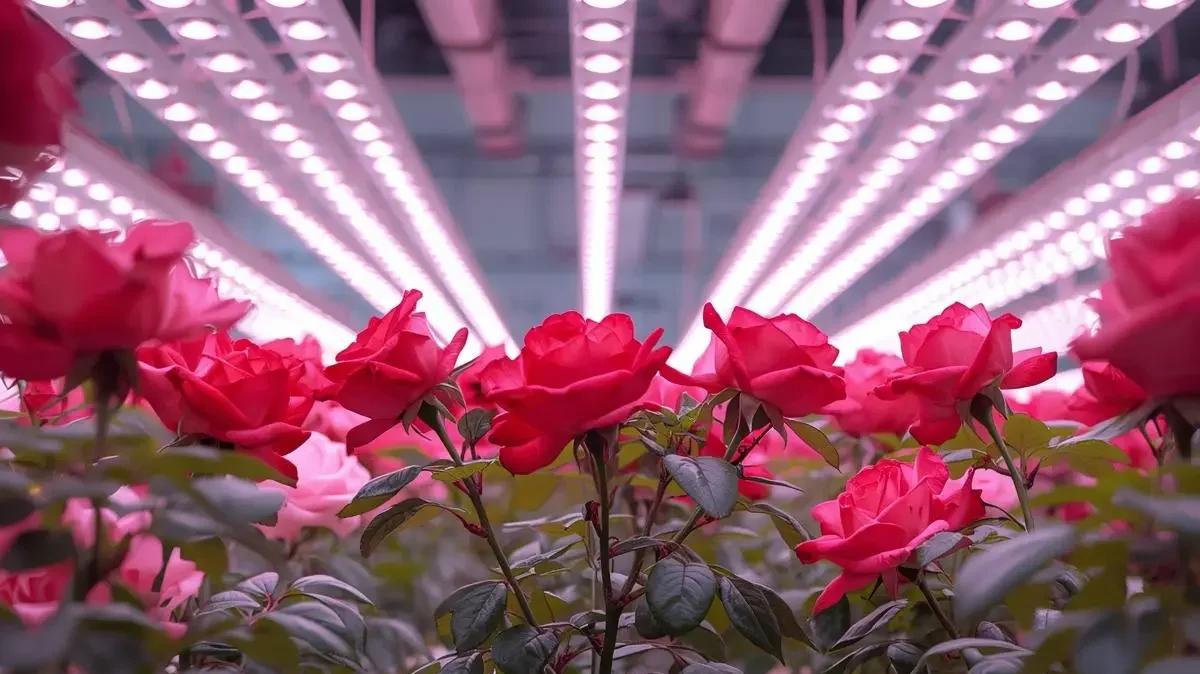
You did everything right. Or so you thought. The reservoir was topped off, the pH looked good, the light timer was set, and then—nothing. Buds formed, then dropped. Leaves yellowed from the middle outward. The rose just stopped. Weeks of investment, and the plant is either stalled or dying.
This is the pattern that breaks most people trying to grow indoor hydroponic roses. It’s not random, and it’s not the plant being difficult. There’s a specific, repeatable mismatch happening — usually in three places — and once you see it, the fixes are logical. Here at Grow With Hydroponics, we’ve tracked this failure pattern across hundreds of growers. The mistakes are almost always the same.
This guide covers what actually causes indoor hydroponic roses to fail, what to do about each cause, and how to set up a system that produces consistent, repeat-blooming flowers rather than a frustrating experiment.
Quick Answer — Why Do Indoor Hydroponic Roses Fail? Most indoor hydroponic roses fail due to three connected causes: the wrong rose variety for a confined root zone, insufficient or poorly timed daily light (DLI), and environmental imbalances — particularly VPD — that block nutrient transport and trigger bud drop. Fix the genetics first, then the light budget, then the climate. All three need to be right simultaneously.
Why Do Indoor Hydroponic Roses Fail More Than Other Crops?
Indoor hydroponic roses fail more than other crops because roses have non-negotiable requirements that most beginner setups don’t meet — and the margin for error is narrow.
Lettuce tolerates a wide range of EC, DLI, and humidity. Basil forgives a rough week. Roses don’t work like that. They’re perennial shrubs that evolved outdoors, which means they carry deep genetic expectations: a large, oxygen-rich root zone, seasonal light cycles to trigger flowering, and stable transpiration conditions. Strip away soil, seasons, and outdoor climate—and put the plant in a grow tent or spare room — and you’ve made yourself responsible for all of it.
Most growers underestimate that responsibility. The result is a rose that either grows aggressively without ever blooming or stalls and deteriorates while the grower chases phantom nutrient deficiencies.
The Core Problem: Mismatch, Not Difficulty
Hydroponic roses aren’t inherently harder than other crops. They’re just less forgiving of misalignment between genetics, light, and environment. When all three are correct, they’re reliable. When any one is off, the others can’t compensate.
That’s the framing that matters throughout this guide.
Failure Cause #1: Wrong Rose Variety for an Indoor Hydroponic System
The variety you choose is the single most consequential decision you’ll make — and most growers make it wrong before they even fill the reservoir.
Not all roses are built for confined root zones and indoor light levels. Hybrid tea roses, for example, are bred for expansive soil, full outdoor sun, and seasonal dormancy. Put those genetics into a Dutch bucket or DWC setup indoors, and you get one of two things: explosive vegetative growth with zero blooms, or a slow decline that mimics a nutrient lockout.
Which Rose Varieties Actually Work Indoors?
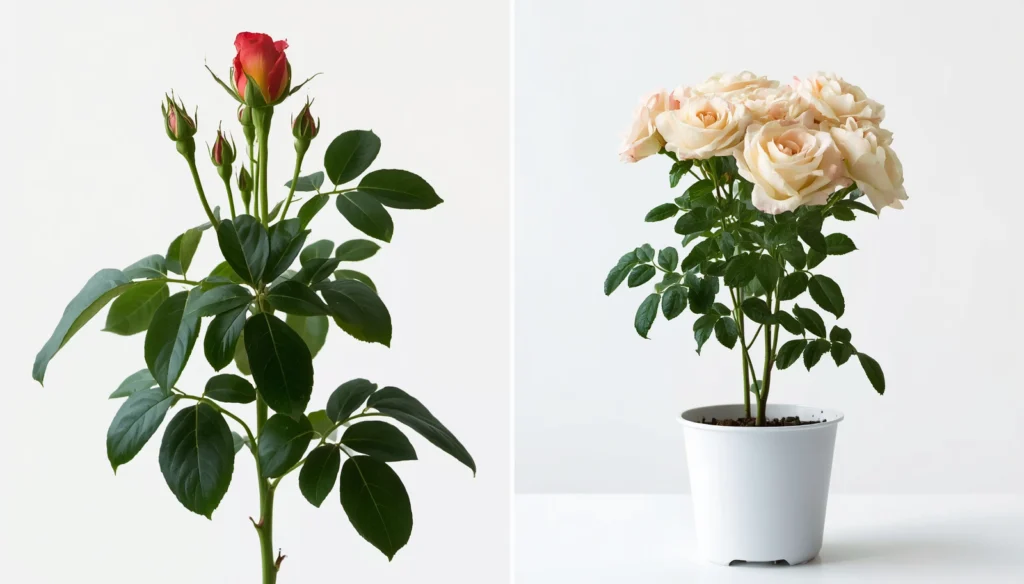
The best varieties for indoor hydroponic growing share a few traits: compact root systems, short internodes, and the ability to cycle through multiple bloom periods without needing a cold dormancy trigger.
Best choices:
- Miniature roses — the most reliable. Compact roots, efficient light users, and genetically suited to container environments. They cycle blooms quickly and respond well to precise nutrient management.
- Patio roses — bred specifically for containers, with short, bushy growth habits and predictable bloom timing.
- Floribundas — cluster-blooming varieties that produce multiple flowers per stem. More forgiving of minor VPD fluctuations than single-bloom types.
Varieties to avoid starting with:
- Hybrid tea roses (large root systems, high light demand)
- Once-blooming heritage varieties (require dormancy to reset)
- Grafted roses with vigorous rootstocks (the rootstock dominates in confined systems)
If you’re starting from cuttings, which is recommended, take them from compact, container-adapted parent plants. A cutting carries its parent’s genetic expectations. A cutting from a sprawling outdoor climber will behave like a sprawling outdoor climber, regardless of your system. We recommend Best Hydroponic Systems for Roses (Ranked for Bigger Blooms).
Failure Cause #2: Indoor Hydroponic Roses Need Precise Daily Light—Not Just Bright Light
Light is the most common failure point for indoor hydroponic roses, and the mistake usually isn’t brightness — it’s the daily total.
Roses are flowering plants triggered by cumulative light exposure. The metric that determines whether a rose blooms is DLI—Daily Light Integral—the total number of photons delivered to the canopy over a full 24-hour period, measured in mol/m²/day. A light that looks impressive on paper can still fail to deliver adequate DLI if the mounting height is wrong, the photoperiod is too short, or the fixture’s photon efficacy doesn’t match its marketing claims.
Target DLI Ranges for Indoor Hydroponic Roses
| Rose Type | Growth Stage | Target DLI (mol/m²/day) | Photoperiod |
|---|---|---|---|
| Miniature roses | Vegetative | 10–14 | 16–18 hrs |
| Miniature roses | Bloom trigger | 14–18 | 14–16 hrs |
| Patio roses | Vegetative | 12–15 | 16–18 hrs |
| Patio roses | Bloom trigger | 15–19 | 14–16 hrs |
| Floribundas | Vegetative | 13–16 | 16–18 hrs |
| Floribundas | Bloom trigger | 16–20 | 14–16 hrs |
| Hybrid tea | All stages | 18–22+ | 14–16 hrs |
Guessing at these numbers is expensive. A single grow season lasts months, and under-lit roses look healthy for weeks before it becomes obvious they’re never going to flower.
How to Calculate DLI for Your Setup
DLI = PPFD (µmol/m²/s) × photoperiod (hours) × 3600 ÷ 1,000,000
So a fixture delivering 350 µmol/m²/s at canopy level across a 16-hour photoperiod produces: 350 × 16 × 3600 ÷ 1,000,000 = 20.2 mol/m²/day — adequate for most patio and floribunda varieties in bloom.
But the PPFD at canopy level depends on mounting height, fixture efficacy, and reflective wall quality—none of which are printed accurately on most product listings. Use the Grow Light Calculator to model your actual PPFD across your canopy footprint before committing to a fixture or mounting position. It factors in all of those variables and generates a 9×9 PPFD grid—showing you whether your canopy edges are receiving adequate light or silently starving.
Failure Cause #3: VPD and Root Zone Problems Drive Bud Drop in Indoor Roses
This is the failure most growers never diagnose correctly, because the symptoms look exactly like a nutrient problem.
Buds abort. Leaves yellow. Growth stalls. The grower assumes the EC is off and raises the nutrient concentration — which stresses the roots further and worsens the outcome. Meanwhile, the actual problem has been the vapour pressure deficit all along.
What Is VPD and Why Does It Cause Bud Drop?
VPD, or vapour pressure deficit, is the difference between how much moisture the air could hold at a given temperature and how much it actually holds. It’s a measure of the “pull” the air exerts on the plant — how hard the plant has to work to transpire.
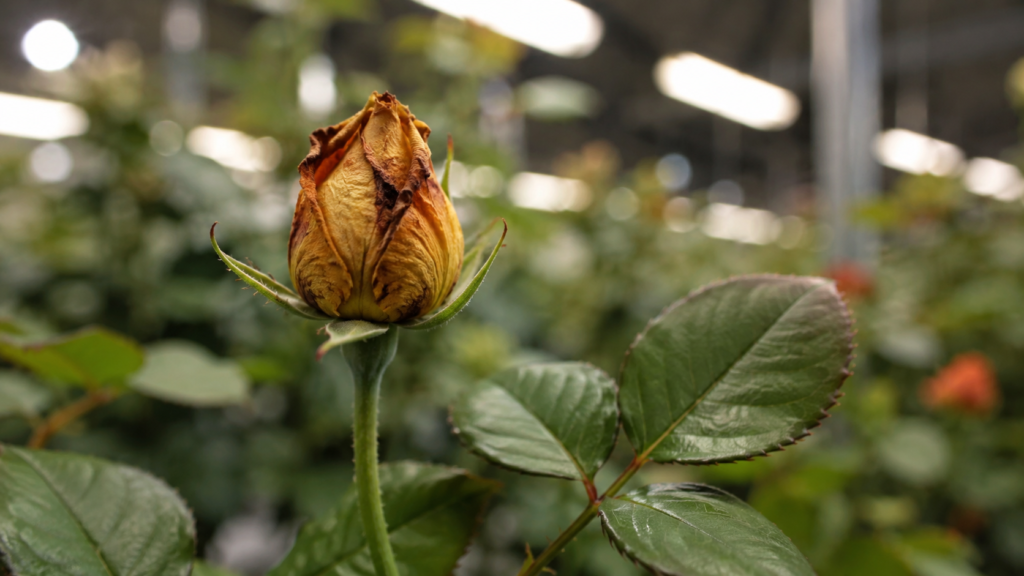
When VPD is too high (dry, warm air), roses transpire too aggressively. Calcium—which travels through the plant via the transpiration stream—gets pulled into leaves instead of developing buds. The result is bud blast: buds that form and then drop before opening, often with no other visible symptoms. Hort Americas research on controlled-environment crops confirms that high VPD diverts calcium transport away from developing tissue—the same mechanism that causes blossom end rot in tomatoes.
When VPD is too low (cool, humid air), transpiration slows, nutrient uptake stalls, and fungal pressure (botrytis, powdery mildew) builds.
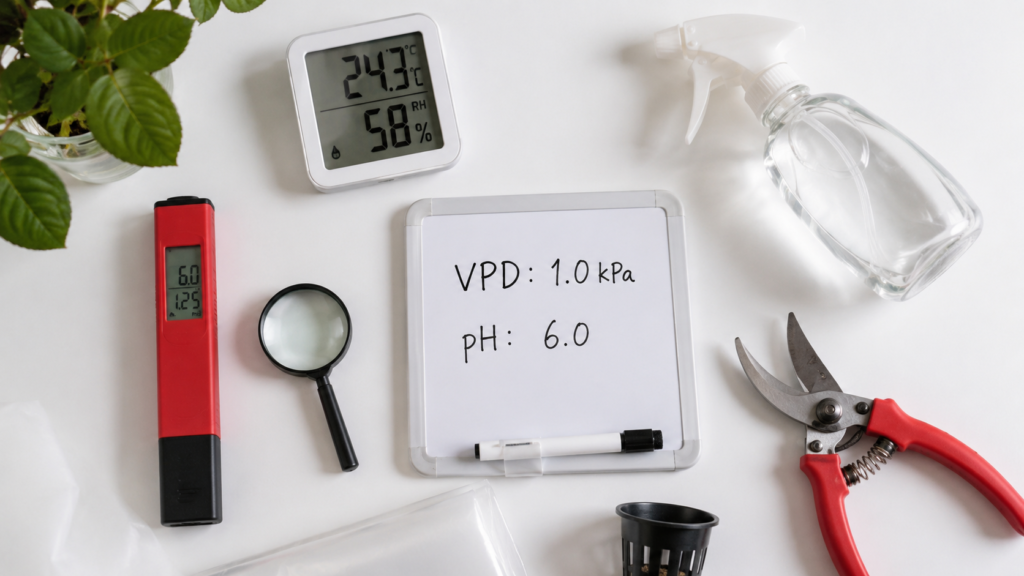
Target VPD for indoor hydroponic roses: 0.8–1.2 kPa.
That range encourages steady transpiration, proper calcium transport, and strong stem development. Anything outside it for extended periods creates the bud drop and stalled growth cycle that frustrates most growers.
Use the VPD Calculator to monitor your actual VPD from temperature and humidity readings. It removes the guesswork entirely and shows you whether your environment is in range or creating chronic stress.
Root Zone Health: What Healthy Hydroponic Rose Roots Look Like
Healthy roots in a hydroponic rose system are white, firm, fine, and fibrous—with a faint clean smell. Brown, slimy, or musty roots are a sign of pythium (root rot), usually driven by solution temperature or poor dissolved oxygen.
Before adjusting EC for any symptom, check these four things first:
- Solution temperature — keep it between 18–22°C (65–72°F). Above 24°C and dissolved oxygen drops sharply, creating root rot conditions.
- Dissolved oxygen — air stones or recirculating drip systems must maintain active oxygenation. Stagnant DWC with a weak air pump is the most common root rot setup.
- Light leaks to the reservoir — algae blooms in the nutrient solution consume oxygen and harbour pathogens. Block every light entry point.
- Reservoir hygiene — change the solution every 7–10 days during active growth. The smell of a reservoir that needs changing—that faint sour-sweet odour—is a signal worth acting on immediately, not next week.
Common Mistakes That Kill Indoor Hydroponic Roses
Raising EC to Fix Yellow Leaves
Yellow leaves in roses are almost always a symptom of lockout, not deficiency. Lockout happens when pH is off-range, VPD is too high, or root zone oxygen is depleted—not when the nutrient solution is too dilute. Adding more nutrients into a locked-out root zone increases osmotic pressure, adds to root stress, and makes every existing symptom worse.
Diagnose before you dose.
Using a System Too Small for Rose Root Mass
Roses are heavy, aggressive rooters. A miniature rose in a 3.5-litre DWC bucket will fill it with roots within six weeks. Once the root mass becomes dense, oxygen penetration drops, the solution warms faster, and rot sets in. Use at minimum an 11-litre bucket for miniatures, and a Dutch bucket or drip-fed coco system for anything larger.
Ignoring Bloom Cycle Transitions
Roses need a shift in conditions to break out of vegetative growth and push toward flowering. Outdoors, this happens through shortening autumn days and cooling temperatures. Indoors, you replicate it deliberately: reduce photoperiod by 2 hours, lower night temperature by 4–6°C, and slightly reduce nitrogen while boosting phosphorus in the nutrient solution. Without this intervention, many indoor roses stay permanently vegetative—lots of leaves, no blooms.
Skipping Pruning After Each Bloom Cycle
Hydroponic roses grow vigorously. After each bloom cycle, the plant needs to be cut back to 3–5 healthy canes. Leaving old, spent laterals in place doesn’t just waste the plant’s energy—it creates dense interior growth that restricts airflow, increases humidity within the canopy, and sets the stage for fungal outbreaks. One session with sharp, sterilised secateurs every cycle prevents weeks of problem-solving later.
Hydroponic Rose Failure: Diagnosis Reference Table
| Symptom | Most Likely Cause | Check First | Fix |
|---|---|---|---|
| Buds form then drop (bud blast) | VPD too high / calcium transport failure | Temperature + humidity | Lower the temperature and raise humidity to VPD 0.8–1.2 kPa |
| Yellow leaves (new growth first) | Iron or calcium lockout | pH (target 5.8–6.2) | Adjust pH and check VPD |
| Yellow leaves (old growth first) | Nitrogen deficiency | EC + nutrient formula | Increase N fraction |
| Root browning, slimy texture | Root rot (Pythium) | Solution temp + DO | Lower temperature; increase aeration |
| Vegetative growth, no blooms | Insufficient DLI or no bloom trigger | DLI measurement | Increase light budget; reduce photoperiod to trigger |
| Stunted growth, dark leaves | EC too high / nutrient toxicity | EC meter | Flush and dilute solution |
| Powdery white coating on leaves | Powdery mildew (low VPD or poor airflow) | Humidity + airflow | Increase VPD and improve circulation |
| Buds pale, colour washed out | Light too intense at close range or heat stress | Canopy temperature | Raise fixture; check PPFD at the canopy. |
Advanced: Triggering Blooms and Managing Bloom Cycles
Once vegetative growth is established and your VPD, DLI, and root zone are stable, triggering flowering is a matter of environmental manipulation.
How to Trigger Flowering in Indoor Hydroponic Roses
Step 1: Reduce photoperiod from 18 hours to 14–15 hours. This mimics the shortening days of late summer and signals the plant to shift reproductive priority.
Step 2: Lower night temperature by 4–6°C. Aim for around 16–18°C at night. The differential between day and night temperature (DIF) is a reliable bloom initiator for roses.
Step 3: Shift nutrient ratio. Reduce nitrogen; increase phosphorus and potassium. A ratio of approximately 1-3-2 (N-P-K) during the bloom phase is a practical starting point—but dial it to your specific cultivar over time.
Step 4: Maintain VPD at 0.8–1.0 kPa during this transition. Any spike above 1.3 kPa during bud development will risk bud blast regardless of your other inputs.
The first bloom cycle in a new hydroponic setup usually takes 6–10 weeks from established vegetative growth. Subsequent cycles — if you prune correctly — come faster.
Your first flawless, indoor-grown bloom will prove the point. If you want the full, step-by-step, science-backed system, our complete rose-growing guide walks you through the entire process, from cutting to harvest.
FAQ — Indoor Hydroponic Roses
Why do my indoor hydroponic roses keep dropping buds before they open?
Bud drop in indoor hydroponic roses is almost always caused by VPD being too high, which disrupts calcium transport to developing buds. First, measure your temperature and humidity and calculate your VPD—the target range is 0.8–1.2 kPa. Then check your root zone temperature, as warm solution above 24°C also blocks nutrient uptake. Adjust the climate before touching your nutrient formula.
What is the best hydroponic system for growing roses indoors?
Dutch Bucket systems and drip-fed coco or perlite setups are the most reliable choices for indoor hydroponic roses. Both provide adequate root space, excellent oxygenation, and stable moisture delivery. Deep Water Culture can work for miniature varieties with vigorous aeration, but NFT and wick systems are poor matches for rose root systems and should be avoided.
How much light do indoor hydroponic roses need per day?
Indoor hydroponic roses need a DLI (Daily Light Integral) of 14–20 mol/m²/day depending on variety, with hybrid teas requiring the higher end and miniature roses being manageable at 12–16 mol/m²/day. This translates to roughly 300–600 µmol/m²/s PPFD at canopy level over a 14–18 hour photoperiod. Verify your actual PPFD at canopy height — not the manufacturer’s rated output — using a grow light calculator before committing to a setup.
Can I grow roses hydroponically without a grow light?
Only if your space receives consistent, direct natural light for 6–8 hours a day with a measured DLI above 14 mol/m²/day. For most indoor environments, that isn’t achievable without supplemental lighting. A high-quality full-spectrum LED matched to your canopy footprint is the most practical solution for reliable, year-round blooms.
What EC should I use for hydroponic roses?
Miniature roses perform well at 1.6–2.0 EC. Floribundas and patio roses do best at 1.8–2.4 EC. Hybrid teas can handle 2.2–2.8 EC when conditions are optimal. Always start at the lower end and increase only after confirming that VPD and root zone health are stable—high EC into a stressed plant causes toxicity symptoms that are easy to mistake for deficiency.
Indoor Hydroponic Roses Reward Precision, Not Effort
Roses don’t fail because hydroponics doesn’t work for them. They fail because the three systems they depend on—genetics, light budget, and environment—aren’t aligned. When all three are correct, roses are actually reliable producers. They bloom on schedule, respond visibly to good management, and reward the discipline of precise measurement.
The path there isn’t complicated, but it is specific. Start with a compact variety. Verify the exact Daily Light Integral (DLI) using the DLI Calculator before you plant. Keep VPD inside 0.8–1.2 kPa, and treat bud drop as a climate signal, not a nutrient problem. Check your roots before you adjust your EC.
Grow With Hydroponics has built a full suite of free tools to make that precision accessible—from the VPD Calculator that removes climate guesswork to the Grow Light Calculator that maps real PPFD across your canopy. The information is there. So is the support.
Diagnose properly. Adjust one variable at a time. Give each change a week before drawing conclusions. Your first fully opened, indoor-grown bloom is closer than it feels right now.
Explore Nutrient Deficiency Symptoms in Roses: Hydroponic Fixes for Healthy Growth.
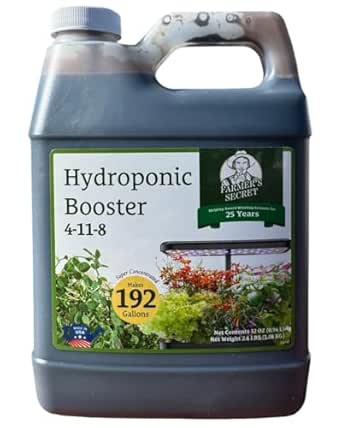
Nutrients Built for Flowering Crops
Roses are heavy feeders—but only when the environment lets them uptake what you’re giving them. Before you buy, check that your VPD and root zone are in range. Then start with a proven bloom nutrient formulated for flowering crops in hydroponic systems.
Pair with the Hydroponic Nutrient Calculator to build a stage-specific feed recipe your roses can actually use.



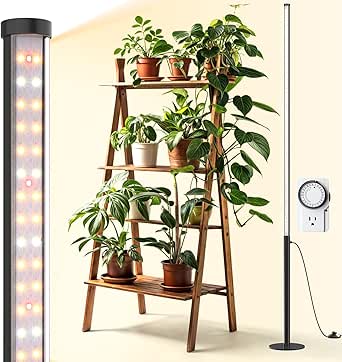
Grow Lights That Deliver Real DLI
Bud drop and stalled growth are often a light deficit in disguise. Before you buy any fixture, run your space through the Grow Light Calculator to confirm it delivers the DLI your variety needs. These vetted options cover most indoor rose setups.



Dr. Awais Yousaf
Algorithm Specialist and Associate Professor leading R&D at Grow With Hydroponics. With 5+ years of hands-on experience in smart hydroponic systems, deep learning, and sustainable AgriTech, he is passionate about turning small spaces into high-yield indoor farms. Connect at awais.yousaf@iub.edu.pk