If you’ve ever pruned your hydroponic roses and thought, “Did I just help this plant—or set it back two weeks?”—you’re not alone. I’ve stood there with pruners in hand, staring at a cut I instantly regretted. We all have.
When you grow roses hydroponically, every cut, tie, and nutrient adjustment has amplified consequences. There’s no soil buffer. No hidden nutrient bank. What you do to the plant’s structure directly affects flower speed, stem strength, and bloom size.
At Grow With Hydroponics, we’ve seen this repeatedly: growers who understand rose plant anatomy consistently get faster flowering cycles, cleaner canopy management, and stronger stems for cutting. Those who don’t? They prune blindly and wonder why buds stall. Frankly, it’s the difference between growing and just keeping plants alive.
In this article, you’ll learn:
The structural parts of a rose plant (and what each actually does)
How nodes, auxiliary buds, and vascular tissues affect flowering
Why anatomy matters more when you grow roses hydroponically
Exactly how to prune and train based on plant biology
Advanced strategies to manipulate structure for quicker blooms
Let’s break the plant down—so you can build it back up smarter.
Why Rose Plant Anatomy Matters When You Grow Roses Hydroponically
In soil, roses can compensate for structural mistakes. They’ve got microbial backup, nutrient reserves, a buffer that forgives sloppy pruning. In hydroponics? They can’t.
When you grow roses hydroponically, you control:
Root oxygen levels
Nutrient concentration (EC)
Light intensity (DLI)
Humidity and temperature (VPD)
But none of those variables matter if you’re pruning at the wrong node. That’s not dramatic—it’s mechanics.
Understanding anatomy allows you to:
Direct hormonal signals (auxins & cytokinins)
Control apical dominance
Increase flowering sites
Improve airflow and light penetration
Prevent energy waste
Before we talk pruning technique, let’s start with the plant itself. The parts matter less than how they work together.
The Structural Anatomy of a Rose Plant
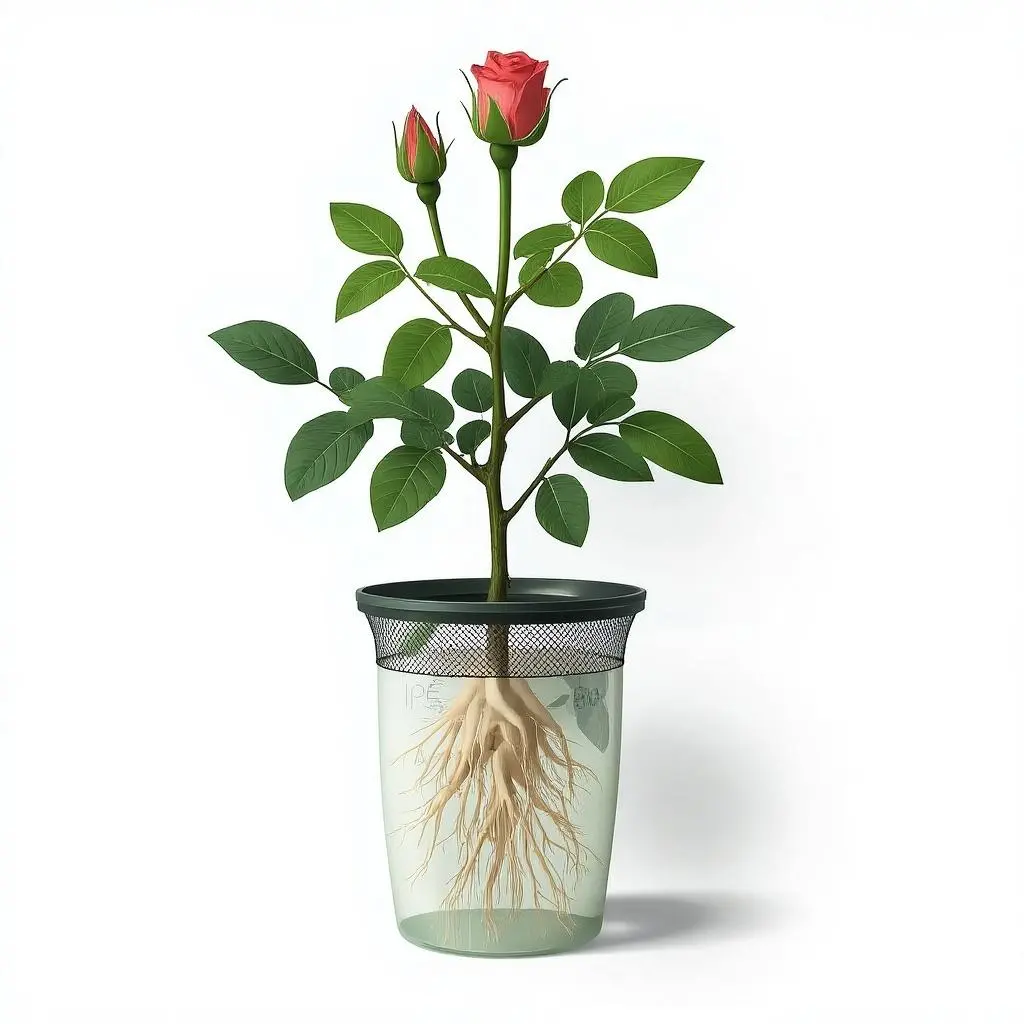
1. Roots: The Engine Room
In hydroponics, roots are fully visible—and brutally honest. There’s no hiding rot or oxygen starvation underground.
Healthy hydroponic rose roots are:
Bright white or cream
Firm, not slimy
Evenly branching
Roots absorb:
Water
Dissolved nutrients
Oxygen
Here’s what experience teaches: when you grow roses hydroponically, root health determines flower size. Period. Poor oxygenation reduces nutrient uptake—even if your EC is textbook-perfect. I’ve watched growers chase deficiency charts while their gray, sad roots told the real story.
Tool Tip:
Use the Grow Space Simulator to test airflow and reservoir placement before building your system. Preventing root zone stagnation is easier—and less expensive—than fixing it later.
2. The Stem: Structural Backbone and Transport Highway
The stem contains two key vascular tissues:
Xylem – moves water and minerals upward
Phloem – distributes sugars from leaves downward
Every time you prune, you’re manipulating how these highways distribute energy. Cut too low, you sever the supply line. Cut too high, you leave dead tissue that invites pathogens.
Thicker stems = stronger vascular flow = bigger blooms. Simple physics.
When you grow roses hydroponically, maintaining proper VPD isn’t optional—it’s critical for transpiration. Without transpiration, xylem flow slows to a crawl. Your nutrients sit in the reservoir while the plant thirsts.
Use the VPD Calculator to align humidity and temperature for optimal nutrient movement. Your stems will thank you.
3. Nodes: The Decision Points of the Plant
A node is the point where:
Leaves emerge
Branches form
Buds develop
Between nodes? That’s the internode.
Why nodes matter when you grow roses hydroponically:
Every node contains a dormant auxiliary bud
Cutting above a node activates that bud
The angle and direction of that node determine future branch direction
How to Identify a Node
Look for:
Slight swelling on the stem
A leaf attachment point
A small bump where a bud may emerge
Prune ¼ inch above an outward-facing node for ideal shape. Get closer than that and you risk damaging the bud. Farther, and you leave a stub that dies back. A quarter inch. It matters.
4. Auxiliary Buds: Your Hidden Flower Factories
An auxiliary bud (often called axillary bud) sits in the angle between the leaf and stem.
It’s dormant until:
Apical dominance is broken
The main tip is removed
Hormone balance shifts
When you grow roses hydroponically, growth is faster—so bud activation is quicker. Strategic cuts can reduce time to flowering by days or even weeks. In a production cycle, that’s an extra harvest per year.
This is why knowing the difference between a node and an auxiliary bud changes everything. They’re not the same thing, and treating them interchangeably leads to blind pruning.
How Leaves Influence Flower Speed
Leaves aren’t just decorative. They’re not there to fill space or look pretty.
They:
Produce carbohydrates via photosynthesis
Regulate transpiration
Signal hormonal changes
The more efficient the leaf, the faster the bloom cycle. I’ve seen growers strip lower leaves for “cleanliness” and wonder why flowering slowed. You removed the factory, then asked why production stopped.
How Much Light Do Rose Leaves Really Need?
When you grow roses hydroponically indoors, light isn’t guesswork—it’s measurable. “Looks bright enough” doesn’t cut it.
Use the DLI Calculator to:
Match your LED output to rose requirements
Prevent light stress
Avoid slow bud formation
Shop Smart Tip:
When you Shop Smart for grow lights, use the DLI Calculator to match the fixture to your plant’s daily light needs instead of relying on wattage marketing claims. The most expensive light isn’t always the right-fit one.
Reproductive Anatomy: From Bud to Bloom
The flower bud forms at a node once energy accumulates. Watch for swelling—that’s the signal.
Inside a rose flower:
Sepals protect the bud
Petals attract pollinators (or impress your guests)
Stamens produce pollen
Pistils form the reproductive center
In hydroponics, nutrient precision impacts:
Petal count
Stem length
Bloom symmetry
Use the Nutrient Calculator to ensure proper macro and micronutrient ratios—especially potassium during flowering. Too much nitrogen here and you’ll get lush leaves with half-formed blooms.
Problem → Solution: Why Roses Stall After Pruning
Problem: You Pruned, But No New Growth Appeared
This happens. You made a cut, waited, and… nothing.
Common reasons:
Cut made too close to bud
Pruned below viable node
Nutrient imbalance
Low DLI
Improper VPD
Solution: Diagnose Before Adjusting
Instead of guessing:
Check EC using the EC ↔ PPM Converter for unit accuracy—mixing millisiemens and parts per million guarantees mistakes
Verify environmental conditions with the VPD Calculator
Inspect nodes for swelling or tissue damage
Confirm light intensity via DLI Calculator
Can I Use Tap Water When I Grow Roses Hydroponically?
You can—but only if:
EC is below 0.3 mS/cm
Chlorine is removed
Bicarbonate levels aren’t excessive
High baseline EC throws off nutrient ratios and can delay flowering. I’ve watched growers add bloom boosters to tap water that already had enough calcium to lock out magnesium. Check first : Understanding EC and PPM in hydroponics.
Implementation: Pruning Based on Anatomy
Let’s translate biology into action. This isn’t theory—this is what works.
Step 1: Break Apical Dominance
Cut the top growth tip above an outward-facing node.
Result:
Hormone redistribution
Activation of auxiliary buds
Bushier plant structure
Step 2: Control Internode Length
Long internodes mean:
Weak structure
Fewer flowering sites
Short internodes mean:
Compact growth
More bloom points
Control internode length by:
Adjusting DLI
Maintaining proper VPD
Avoiding excess nitrogen
Step 3: Train for Airflow
When you grow roses hydroponically indoors:
Spread branches outward
Remove inward-facing growth
Tie stems gently to supports
Better airflow reduces fungal pressure and improves transpiration efficiency. It’s not glamorous, but it’s effective.
Grow Space Planner Tip:
Use the Grow Space Planner to design spacing before plants overcrowd each other. Moving mature roses is traumatic—avoid it. How to grow roses hydroponically step-by-step?
Advanced Anatomy Strategies for Faster Flowers
Once you understand structure, you can manipulate it. This is where experience separates from experimentation.
Strategic Defoliation
Remove select lower leaves to:
Redirect energy upward
Improve airflow
Enhance light penetration
Avoid over-defoliation—leaves power flowers. I remove maybe 10-15% of lower growth, never more. Each leaf you take is a solar panel you disconnect.
Hormonal Timing and Nutrient Shifts
Flower initiation depends on:
Cytokinin-to-auxin balance
Potassium levels
Light duration
Use the Nutrient Calculator to shift ratios gradually rather than abruptly. Sudden changes stress plants; gradual shifts signal them.
Should I Pinch Young Rose Shoots?
Yes—if your goal is branching.
Pinching:
Reduces vertical dominance
Encourages lateral growth
Increases future bloom sites
No—if your goal is long, single-stem cut roses.
Know your goal before you pinch. I’ve seen growers mindlessly pinch every shoot, then wonder why they can’t get a straight stem for cutting.
Common Anatomy Mistakes New Growers Make
Cutting randomly without identifying nodes
Removing healthy leaves unnecessarily
Ignoring auxiliary buds
Allowing overcrowded canopies
Failing to adjust environment after pruning
Each of these slows flowering when you grow roses hydroponically. Worse, they compound. One bad cut leads to two weeks of recovery, which pushes everything back.
[Internal Link Suggestion: Link text “complete hydroponic lighting guide” -> /blog/hydroponic-lighting-guide/]
Anatomy Is Your Competitive Edge
When you grow roses hydroponically, you’re not just feeding a plant—you’re managing a living system of hormones, energy flow, and structural decisions.
A node isn’t just a bump on a stem.
An auxiliary bud isn’t just a dot in a leaf angle.
They’re future flowers waiting for the right signal.
Mastering rose plant anatomy means:
Faster bloom cycles
Stronger stems
Predictable growth patterns
Fewer recovery delays
At Grow With Hydroponics, our mission is to give you tools and knowledge—not guesswork. The more precisely you understand plant structure, the more confidently you can shape outcomes.
For the full picture on getting from cutting to bloom, check out our comprehensive guide: How to Grow Roses Hydroponically: Science-Backed Complete Guide (2026).
Your roses aren’t fragile. They’re responsive.
Learn their structure. Guide their growth. And watch your blooms arrive sooner than you thought possible.