
Hydroponic Nutrient Optimizer
Enter your current nutrient levels and target NPK. Our optimizer selects from 15 available salts to prescribe exact additions. Perfect for adjusting reservoirs, fixing deficiencies, and fine-tuning ratios.
System Setup
Crop Selection
Nutrient Targets
Current Nutrient Concentrations
Deficiency Analysis
Nutrient Salts Configuration
Optimization Results
Required Salt Amounts
| Salt | Amount (g) | Status |
|---|
Optimization Summary
No optimization performed yet.
| Nutrient | Target | Achieved | Difference | Status |
|---|
| Salt | Amount (g) | N | P | K | Ca | Mg | Micros |
|---|
The Ultimate Hydroponic Nutrient Optimizer Tutorial
Hydroponics promised us a future of effortless abundance—total control, perfect growth. And in many ways, it delivers. You’re the master of the environment, the conductor of the nutrient symphony. But then you’re staring at a plant with yellowing leaves, and that “total control” feels a lot like a guessing game. You can pump all the nutrients in the world into the water, but if the balance is off, you’re not growing food. You’re conducting a slow-motion chemistry experiment on your crops.
That’s where the stress creeps in. Too much of one thing, not enough of another, and you’re looking at stunted growth, pathetic yields, or a complete wipeout. I’ve seen it happen to seasoned growers. It’s why we’ve all, at some point, wished for a translator—something to turn plant distress signals into a clear, actionable recipe.
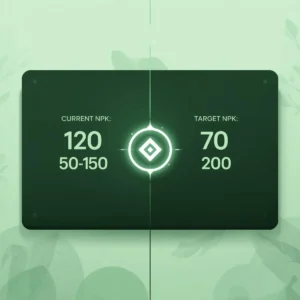
Enter the Hydroponic Nutrient Optimizer. This isn’t just another app. Think of it as that seasoned grower looking over your shoulder, cross-referencing symptoms with science. It’s a web-based tool designed to cut through the noise. You feed it your numbers—what you’re growing, what you’re seeing—and it gives you back a targeted plan. It’s about trading anxiety for agency. Healthier plants, less wasted effort, and frankly, better harvests. The premise is elegantly simple. The execution? That’s what we’re here for.
Hydroponic Nutrient Optimizer Guide
This guide isn’t about pushing buttons. It’s about understanding how to make this tool work for you, to turn precision from a concept into a routine. I’ll walk you through it, feature by feature, like I would a new writer on my team. Let’s get into the weeds.
KEY FEATURES AT A GLANCE
The Hydroponic Nutrient Optimizer is packed with logic designed to replace instinct with insight. Here’s the core of what you’re working with:
Crop-Specific Formulas (20+ Plant Profiles): Because lettuce and tomatoes have about as much in common, nutritionally speaking, as a sprinter and a weightlifter. Pick your plant from the library—tomatoes, herbs, lettuce—and get formulas tailored for its specific life stages. No more one-size-fits-all guessing.
Deficiency Detection & Correction: The star of the show. This is the diagnostic engine. It helps you spot nutrient problems—the classic interveinal chlorosis, the rusty leaf tips—and translates them into a correction plan before your yield takes a hit.
Salt Optimization Algorithm: This is the clever bit. It doesn’t just give you a list; it computes the most efficient way to get there. The result? Better absorption, less gunk (precipitate) in your reservoir, and healthier plants. It’s logistics for your nutrients.
Professional PDF Reporting: For the record-keepers, the tweakers, and anyone who needs to track what worked. Generate a clean, detailed report in seconds. It’s audit-proof for your garden.
Customizable Salt Library: Got a bag of something unusual? This lets you adjust the very building blocks. Tweak molecular weights, alter compositions—it bends to your custom formulations, not the other way around.
Unit Conversion (PPM ↔ Grams/L): A small feature that saves a massive headache. Flip between PPM for checking strength and grams per liter for mixing, without reaching for a separate calculator. It respects how you actually work.
STEP-BY-STEP TUTORIAL
Here’s how to navigate from a blank screen to a balanced solution.
A. SYSTEM SETUP
First, lay the groundwork. Skip this, and your precision tool is building on a shaky foundation.
Reservoir Size Configuration
This is non-negotiable. Tell the calculator your tank size. A mix calculated for a 10-gallon reservoir will utterly wreck plants in a 5-gallon bucket. It’s the difference between a pinch of salt and a spoonful.
Unit Selection (PPM vs Grams/L)
Choose your camp: PPM or grams per liter. Here’s my take: PPM is your dashboard gauge—it tells you the overall “strength” of the soup. Grams per liter is your recipe card—it tells you exactly how much of each salt to weigh out. Pick the one that matches your workflow. The tool will handle the translation.
B. CROP SELECTION
Now, who’s eating? This is where the crop-specific magic starts.
How to Choose
Type in “tomato” or “lettuce.” The tool pulls up the profile. Selecting it automatically loads the nutrient targets for, say, vegetative growth vs. fruiting. It’s like the calculator just hired a plant physiologist.
Using Custom Nutrient Targets
Maybe you’re following a particular guru’s formula, or you’ve dialed in something perfect for your microclimate. You can override the defaults and input your own custom nutrient targets. The calculator will use those as its north star.
C. DEFICIENCY CALCULATOR
This is the reason you’re here. This module transforms you from a passive feeder to an active plant doctor.
Select the Salts You Have Available: Start by telling it what’s in your pantry. This grounds the advice in reality.
Entering Current Nutrient Readings: Input your latest PPM or EC readings. This is the patient’s vitals.
Understanding Deficiency/Excess Results: The tool cross-references your readings with the ideal crop profile. It then flags discrepancies—”Calcium is 15% low, Potassium is trending high.” No more squinting at leaves.
Automatic Adjustment of Targets: Once it identifies a gap or an excess, it doesn’t just point. It prescribes. It recalculates the entire recipe to correct the imbalance automatically.
D. SALT CONFIGURATION
For the tinkerers. This is advanced mode, where you adjust the tool’s own understanding of the salts you use.
Enabling/Disabling Available Salts: Out of calcium nitrate? Turn it off. The calculator will work around the gap.
Custom Molecular Weights: If you’re using a specialized or impure salt, adjusting the molecular weight refines the math to laboratory precision.
Composition Adjustments: This is deep-geek territory. You can tweak the assumed purity or composition of a salt, ensuring the nutrient balance recommendation is based on your specific chemicals.
E. CALCULATION & RESULTS
The moment of truth. Hit “CALCULATE OPTIMAL SOLUTION.” The algorithm weighs everything—your reservoir, your crop, your deficiencies, your available salts—and delivers a blueprint.
The results panel shows you:
Salt Requirements: The exact grams of each salt to add. No guesswork.
Nutrient Balance: A side-by-side of your target levels versus the calculated outcome. It shows you the “why.”
Visualization: Simple bar graphs. Sometimes seeing the nutrient levels stacked up visually drives the point home faster than numbers.
Salt Composition: A breakdown of which salts are contributing which nutrients. It’s transparency in the mix.
F. PDF EXPORT
Click “Export to PDF.” In seconds, you have a permanent, polished record. It’s invaluable for tracking what you did, replicating success, or diagnosing a pattern over time. The report contains your full recipe, deficiency corrections, and all key parameters.
PRO TIPS & BEST PRACTICES
After a decade of editing pieces on tech and horticulture, you learn that tools are only as good as the habits around them. Here’s how to get the most out of this one:
Deficiency First: Make a habit of running the Deficiency Calculator before you mix a fresh batch. It’s preventative medicine. Catching a nutrient drift early is always easier than fixing a full-blown crisis.
Smart Swaps: Run out of a salt? The tool is flexible. Look for salt substitutions with similar ionic properties. Can’t find magnesium sulfate? Epsom salt might just save the day. The key is understanding what nutrient the salt was providing.
Embrace Customization: Don’t be afraid of the Custom Molecular Weights and Composition Adjustments if you’re using non-standard products. That’s where the tool shifts from a generic guide to your personal assistant.
Trust, But Verify: The accuracy of your results hinges on the quality of your input. Good scales, calibrated meters, and pure salts matter. The calculator is a genius, but it works with the data you provide.
TROUBLESHOOTING FAQ
A few common hiccups, demystified:
“Why do my deficiency calculations keep changing?” Likely because your solution is changing. Evaporation concentrates nutrients; top-offs dilute them. Or, your meter might need calibration. Treat the reading as a snapshot, not a monument.
“How reliable are the crop profiles?” They’re based on solid, peer-reviewed horticulture science. But your local conditions—light, temperature, strain—are variables. Use the profile as a starting point, not a dogma. Adjust based on what your plants tell you.
“What if I’m missing a recommended salt?” The calculator is built for this. It will suggest salt substitutions using your available inventory. You might not get the exact same nutrient balance, but you’ll get a viable, balanced solution.
“How often should I run the calculations?” Every time you perform a significant reservoir change or top-off. In dynamic systems, consistency is key. It’s like checking your oil.
REAL-WORLD APPLICATION EXAMPLES
Let’s make it concrete.
Example 1: Tomato Blossom End Rot. Classic calcium delivery issue. The Deficiency Calculator can help you diagnose if it’s a true calcium shortage or a pH/imbalance problem locking it out. Then, it builds a mix to correct it, potentially saving a whole crop.
Example 2: Lettuce Tip Burn. Often a sign of excessive salts or a micronutrient toxicity. The tool can analyze your high PPM and recommend a flush or a rebalanced recipe to cool things down, giving you that crisp, perfect head.
Example 3: The Supply Chain Blues. You ordered monopotassium phosphate, but the shipment is delayed. Go to Salt Configuration, disable it, and see how to approximate its nutrient contribution (potassium and phosphorus) with your existing potassium sulfate and phosphoric acid. Crisis averted.
The bottom line? This calculator won’t grow your plants for you. Nothing will. But it will remove the single biggest source of doubt and error in the process. It turns nutrient management from an arcane art into a repeatable science—leaving you free to focus on the parts of hydroponics that actually feel like gardening.
Give it a shot. Input your next batch. See if it doesn’t feel less like guesswork, and more like you’ve finally got a clear map for the journey.