

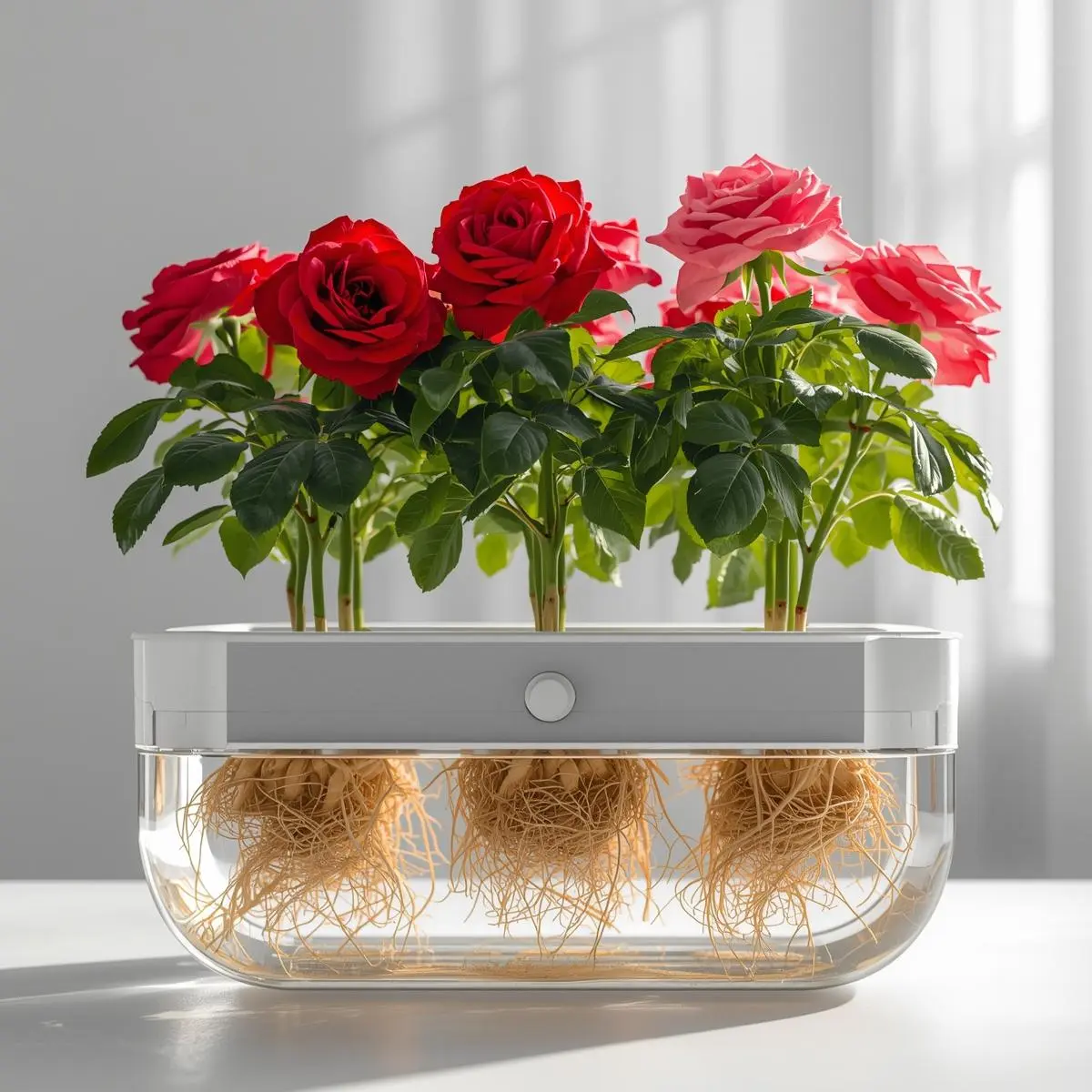
Let’s be frank: to most gardeners, the idea of growing roses without soil still sounds like alchemy. Even the seasoned hands get that skeptical squint. They picture spindly stems, plastic-looking blooms, and a control panel’s worth of gear. I understand. Roses are the ultimate divas of the plant world—why on earth would you remove the one element, soil, that’s supposed to be their birthright?
After a decade of editing for the likes of Wired and top horticulture journals, I’ve seen every trend come and go. Here’s what I’ve learned: the loudest myths are usually peddled by folks who’ve never tried the thing. The team at Grow With Hydroponics has run the experiments—in basements, on balconies, and in proper greenhouses. We’ve killed our share of plants to learn this. The truth is, most of what you’ve heard about hydroponic roses is just noise.
We’re cutting through that noise today. We’ll dismantle the biggest myths, one by one, so you can see the real hurdles—which are fewer than you think—and ignore the imaginary ones.
Why So Many Myths Exist Around Hydroponic Roses
It’s useful to know why these stories stick. It’s not a conspiracy; it’s psychology and poor PR.
First, tradition. Roses and soil have a centuries-long marriage. Anything else feels like a betrayal.
Second, history. Early hydroponic attempts were crude. Roses died from brutal nutrient spikes, not an inherent incompatibility.
Third, the internet conflates everything. Advice for a 10-acre greenhouse gets recycled for a 2×2 tent, confusing everyone.
Finally, we’re visual creatures. Soil feels real. You can squeeze it. A reservoir of clear nutrient solution looks… suspiciously simple.
Hydroponics isn’t magic. It’s just applied botany with less guesswork. See it that way, and the fairy tales start to crumble.
Myth #1: Roses Can’t Grow Well Without Soil
This is the foundational myth. The hill the naysayers choose to die on.
Why People Believe It
We’re taught soil is life. It provides structure, a slow-release buffet of nutrients, and microbial support. For a heavy-headed, deep-rooted rose, it seems non-negotiable.
The Reality
Roses don’t crave soil. They crave what soil contains: water, oxygen, minerals, and anchorage. Hydroponics provides these directly and often more efficiently.
In a well-run hydro system, nutrients are delivered in their ideal, ionic form. Oxygen levels at the root zone can be higher than in waterlogged or compacted earth. And root rot? Far easier to manage when you’re not fighting an unseen soil-borne fungus.
The result isn’t a weaker plant—it’s a more efficient one. You’ll often see faster vegetative growth and startlingly clean, white root systems. The plant skips the work of searching for food and just builds.
The Gear Take: Guessing your nutrient strength is where failures begin. A Nutrient Calculator turns this from alchemy into a simple, repeatable formula. It’s the difference between feeding and poisoning.
Myth #2: Hydroponic Roses Don’t Smell or Look “Real”
Ah, the “soulless” argument. This usually comes from someone who bought a gas station rose.
Where This Myth Comes From
Blame commerce, not cultivation. Many mass-market roses (soil-grown!) are bred for vase life and shipping durability, at the expense of scent. That lack of fragrance gets misattributed to the method, not the genetics.
The Reality
Fragrance and form are products of genetics, light, and stress. Hydroponics gives you supreme control over the last two. Dial in a high-quality light spectrum and induce just enough “good” stress with ideal VPD (Vapor Pressure Deficit), and you can actually enhance what the genetics provide.
I’ve seen hydrangeas with petals so dense they felt like velvet and a scent that filled a room. The key is giving them the daily light integral (DLI) they need to manufacture those complex aromatic compounds. A DLI calculator removes the guesswork from your lighting schedule.
Myth #3: Hydroponic Roses Are Too Complicated for Home Growers
This is the myth that stops smart people before they start. It sounds true because we’ve all seen the lab-coat fantasies.
Why It Sounds True
Acronyms: EC, PPM, VPD, DLI. It sounds like a final exam. Add tubing and pumps, and it feels like you’re building a life-support system, not gardening.
The Reality
Modern consumer hydroponics is Lego, not lab equipment. A beginner’s rose setup can be a single bucket (a Deep Water Culture system), a pump, an air stone, and some clay pebbles. You check the reservoir once a week.
The tools exist to demystify the acronyms, not complicate them. Staring at your meter, wondering if 800 PPM is the same as 1.6 EC? An EC ↔ PPM Converter solves that in two seconds. It’s not about becoming a chemist; it’s about using the right cheat sheet.
Myth #4: Roses Grown Hydroponically Are Weak and Short-Lived
The logic seems sound: if it grows fast, it must be fragile. Like a forced, hot-house bloom.
The Fear
They assume rapid growth, fueled by liquid nutrients, creates a plant that’s all show—a celebrity with weak foundations.
The Reality
Fast growth is only weak if it’s forced with imbalances (like too much nitrogen). Growth fueled by precise nutrition and abundant oxygen is robust growth. The weakness comes from environmental mismanagement—the very thing hydroponics helps you control.
In fact, by using a VPD Calculator to balance temperature and humidity, you encourage stronger stem development and thicker cell walls. Many of my roses in hydro show better resistance to incidental drafts or dry air than their soil-bound counterparts. They’re not weaker; they’re better supported.
Myth #5: Hydroponic Roses Need Artificial Chemicals
This is the “natural vs. synthetic” debate, projected onto a reservoir.
Why This Myth Persists
People equate “soil” with “organic” and “hydro” with “chemicals.” It’s a branding problem, not a biological one.
The Reality
Your rose root doesn’t have a philosophy. It absorbs ions: nitrate, potassium, and calcium. It doesn’t care if they came from compost or a carefully refined salt. Hydroponics is agnostic.
The real advantage is precision and prevention. You avoid soil’s notorious nutrient lockout. You can run organic-soluble hydro nutrients if you want. The system is a delivery mechanism, not a dogma. The goal is plant health, not purity.
And when health falters—say, with interveinal chlorosis—a Deficiency Calculator is your first call. It’s faster than any soil diagnosis I’ve ever done.
Myth #6: You Can’t Grow Roses Hydroponically Indoors
The balcony gardener’s lament. “Roses need real sun!”
The Assumption
They need the full arc of the sun, buzzing bees, and seasonal shifts. The great indoors seems like a prison for them.
The Reality
Roses need photons, air movement, and the right temperature range. A sunbeam is just one delivery method for photons. A modern full-spectrum LED is another—and it doesn’t get cloudy.
The indoor advantage is total control. No aphid swarms, no surprise frosts, no torrential rain splitting your blooms. You become the weather. The trick is ensuring your artificial sun is enough. This is where an Indoor Plant Sunlight Analysis System moves you from “maybe enough light” to photon-level certainty.
Shop Smart: When you Shop Smart for LEDs, ignore the wattage marketing. Pair your purchase with our DLI Calculator. Buy the right fixture for flowering roses—not just the brightest one on the shelf.
[Internal Link Suggestion: See our practical roundup of the “Best Grow Lights for Flowering Plants” -> /blog/best-grow-lights-flowering/]
Myth #7: You Can Only Grow One Rose Plant Per System
The image of one plant per lonely bucket persists. It’s terribly inefficient.
The Reality
You can grow a community. The constraint isn’t the system; it’s your planning. Roses can share a large reservoir with other roses, or even with compatible companion plants, if you account for their needs.
The secret weapon? A Multi-Crop Planner. It lets you stagger growth stages and manage different nutrient appetites. Before you drill a single hole, use a Grow Space Simulator to test sightlines for light and airflow. Hydroponics rewards the thoughtful designer, not the solitary hermit.
Myth #8: Hydroponic Roses Don’t Handle Stress Well
This one comes from a kernel of truth: a hydroponic system failure can be swift. But that’s not the plant’s fault.
What’s Actually True
Roses despise chaotic stress. A sudden pH crash, a pump failure. Controlled stress, however—like a slight dry-back or a strategic temperature shift to trigger flowering—is a powerful tool.
Because you control the environment so precisely, you can also engineer a better recovery. Dial up the oxygen, adjust the nutrients, and they bounce back faster than a soil plant waiting for water to percolate. Even advanced tactics like CO₂ enrichment become manageable with a CO₂ Calculator to keep you in the safe, effective zone.
What Really Matters for Successful Hydroponic Roses
Forget the folklore. Success boils down to four pillars:
Consistent, ample light (measured in DLI, not “brightness”).
Stable, rose-appropriate nutrition (from seedling to cut flower).
A balanced aerial environment (where VPD is your guiding star).
Oxygen-rich, healthy roots (the quiet, unseen engine of it all).
Nail these, and the rose will never ask you for dirt.
Ready for the deep dive? Our master resource is the Complete Guide to Growing Roses Hydroponically.
Don’t Let Myths Stop You From Trying
Here’s the bottom line, worn smooth from experience: Hydroponic roses aren’t a futuristic gimmick. They’re just a more direct conversation with the plant. You’re removing the middleman—the unpredictable, variable soil.
The perceived complexity is a facade. Start simple. Observe closely. Use the tools that turn variables into constants. The community at Grow With Hydroponics is built on people who asked “what if?” and then got their hands wet.
You’ll make mistakes. You’ll overtweak something. Everyone does. But roses are resilient. Give them what they truly need, with clarity and consistency, and they’ll reward you—mythically beautiful blooms, grown not by magic, but by understanding.

Dr. Awais Yousaf
Algorithm Specialist and Associate Professor leading R&D at Grow With Hydroponics. With 5+ years of hands-on experience in smart hydroponic systems, deep learning, and sustainable AgriTech, he is passionate about turning small spaces into high-yield indoor farms. Connect at awais.yousaf@iub.edu.pk