

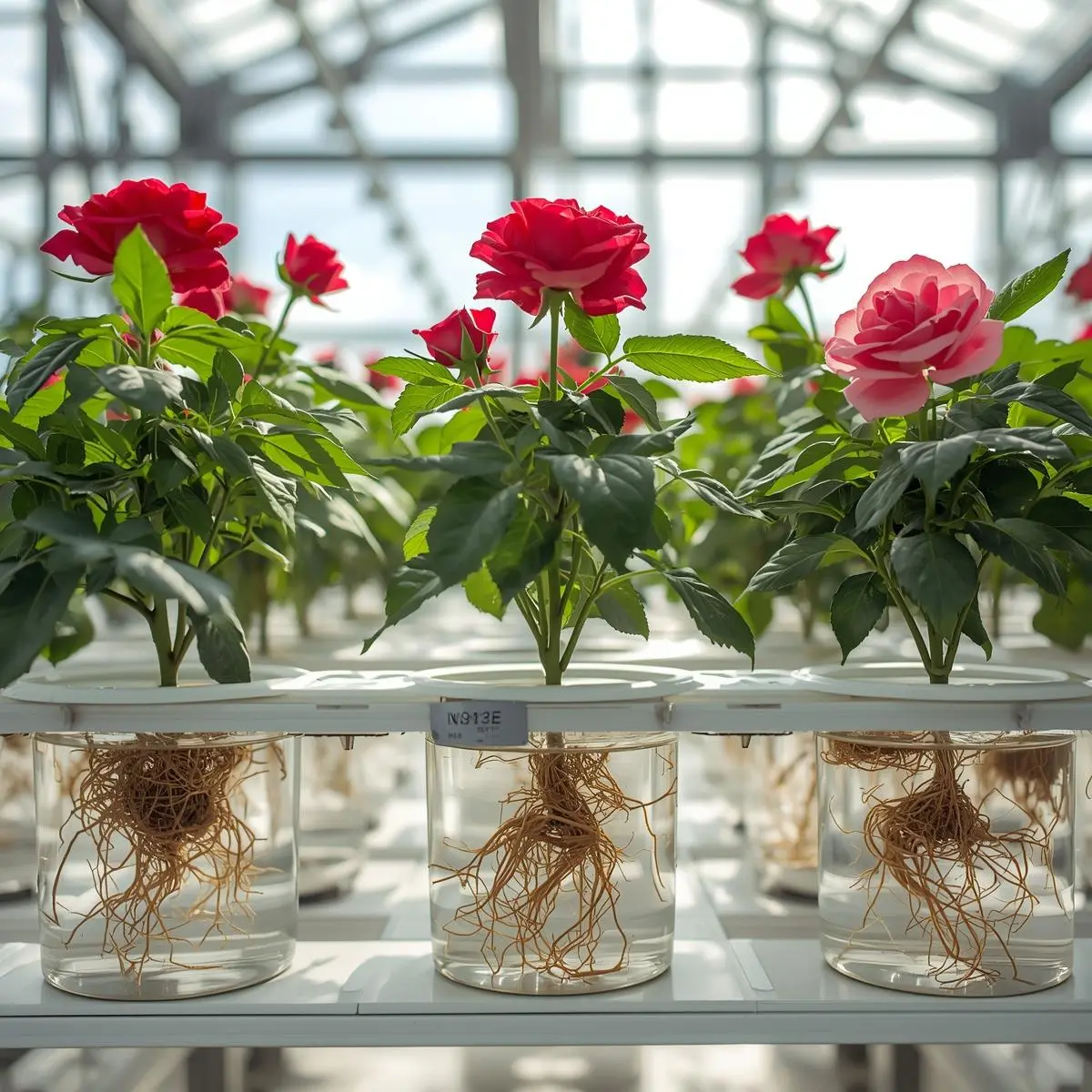
If you’ve ever nursed a rose through black spot, watched it sulk after a misplaced watering, or fought off aphids for the hundredth time, the idea of growing them without soil sounds like pure fantasy. I get it. You’re thinking: Roses? Hydroponically? Really?
Here’s the truth, stripped of the hype: Yes, roses can grow without soil. In fact, commercial growers have been doing it for decades to produce the flawless, long-stemmed cuts you see in florists. But—and this is the critical part—it works because we’re not just removing dirt. We’re meticulously replacing every function soil provides.
Frankly, this is where most beginners go wrong. They see a bucket and a pump and think it’s easier. It’s not easier. It’s different. It trades the chaotic variables of earth for the precise demands of control. At Grow With Hydroponics, we’ve always been clear: the goal isn’t to fight nature, but to create an environment where a rose’s basic needs are met without compromise.
So, let’s cut through the myths. Can roses thrive hydroponically? Absolutely. Should you try it? That depends on your appetite for detail.
How Roses Grow in Soil (and What Soil Actually Does)
First, a fundamental shift in perspective. Soil isn’t plant food. It’s a slow, messy, and often unreliable delivery system. For a rose, soil provides five key things:
Anchorage for those woody canes.
Water retention with a slow, capillary release.
Mineral nutrients, dissolved in water.
Oxygen pockets for roots to breathe.
A microbial community that aids in nutrient processing.
Hydroponics doesn’t ignore these needs. It addresses them directly, often with more efficiency and far less guesswork. The rose doesn’t care about the “how”; it only cares if its roots are fed, watered, and able to breathe.
Can Roses Really Grow Without Soil? (The Scientific Truth)
The skepticism is understandable, but the science is settled. Academic studies and vast commercial greenhouses—particularly in the Netherlands—have proven it beyond doubt.
Roses adapt readily to inert substrates like coco coir or rock wool. Their roots, once freed from compacted soil, often grow faster and healthier when oxygen is directly delivered via an air stone. The key insight? Roses don’t “miss” soil. They miss stability.
In a well-run hydroponic system, every variable—nutrient concentration, pH, root zone temperature—stays within a narrow, optimal band. There’s no drought, no waterlogging, and no nutrient lockout from imbalanced pH. The plant receives what it needs, precisely when it needs it, in a form it can immediately use.
Why Grow Roses Hydroponically Instead of Soil?
For the right grower, the advantages are tangible. It’s the difference between hoping for the best and engineering an outcome.
You’ll typically see faster growth rates and more robust blooms because the plant expends zero energy searching for food. Soil-borne diseases like fusarium wilt simply vanish. And for the indoor gardener, you unlock year-round flowering—a powerful reward.
But the real benefit is control. Tired of yellowing leaves and guessing at the cause? Hydro turns diagnosis from an art into a science.
Which Hydroponic Systems Work Best for Roses?
Roses are not delicate herbs. They’re woody perennials with extensive, aggressive root systems. Choose your system accordingly.
The best systems are those that offer ample root space and excellent oxygenation: Dutch Bucket setups are a classic, forgiving choice. Drip systems onto a stable medium work beautifully for larger plants. Deep Water Culture (DWC) can succeed with smaller or mini-rose varieties, provided aeration is vigorous.
Avoid shallow film techniques like NFT. Rose roots will clog channels in a heartbeat.
What Are the Best Hydroponic Systems for Roses?
Not all systems are created equal. And frankly, this is where most beginners go wrong.
They see a cute little mason jar Kratky setup and think, “That’ll work for roses.” It won’t. Roses have substantial root systems. They drink heavily. And they absolutely will not tolerate their roots sitting in stagnant water for more than a day.
Here’s the short version of what actually works:
| Hydroponic System | Difficulty | Best For Roses? | Why |
|---|---|---|---|
| Dutch Bucket (Bato Bucket) | Intermediate | ✅ Excellent | Handles large roots; excellent drainage; forgiving |
| Drip System (with inert media) | Intermediate | ✅ Very good | Precise nutrient delivery; prevents root rot |
| Deep Water Culture (DWC) | Beginner | ❌ Poor | Roots drown easily; roses dislike constant submersion |
| Nutrient Film Technique (NFT) | Advanced | ❌ Poor | Channels too small for mature rose roots |
| Ebb & Flow (Flood & Drain) | Intermediate | ⚠️ Possible but tricky | Works if you use large pots and coarse media |
Use Dutch buckets or a drip system with coco coir or perlite. Those two combinations account for nearly every successful indoor rose setup I’ve ever seen.
Before you buy a single pipe, sketch it out. Our Grow Space Plannercan save you from the headache of realizing your canopy has no room to grow or your reservoir won’t fit. Plan the space, then fill it.
What Growing Medium Keeps Hydroponic Roses Happy?
This matters more than people think.
You want something that drains fast (roses despise wet feet) but holds enough moisture between watering cycles. You also want something inert—no mystery nutrients messing with your carefully balanced solution.
Top choices for hydroponic roses:
Coco coir (70%) + perlite (30%). This is my personal workhorse. Drains beautifully, holds oxygen, and doesn’t compact. Downside? You have to buffer it first or calcium deficiencies will haunt you.
Coarse perlite (alone). Almost impossible to overwater. Cheap. Sterile. But it dries out fast, so your drip cycles need to run more frequently.
Rockwool cubes (large blocks). Commercial rose growers love these. They’re consistent and predictable. But they’re terrible to dispose of and annoying to pre-soak.
Avoid LECA (clay pebbles) for roses. I’ve tried it. The roots never anchor well, and the watering frequency becomes a second job.
Nutrients: What Do Hydroponic Roses Actually Need?
This is the make-or-break moment. Roses are famously heavy feeders, especially when pushing buds.
They need the full suite: Nitrogen for cane and leaf growth, Phosphorus for roots and flowering initiation, and a hefty dose of Potassium for bloom size and color. But the unsung heroes are Calcium (for strong cell walls and rigid stems) and Magnesium (the core of chlorophyll).
Use a Hydroponics Nutrient Calculator to get your base formula right for each growth stage. And if your meter reads in EC but your recipe is in PPM, stop guessing—our EC ↔ PPM Converter exists to prevent those simple, costly errors.
What pH and EC Do Roses Prefer in Hydroponics?
Stray outside these windows, and it doesn’t matter what’s in your solution; the rose can’t access it.
pH: Keep it between 5.8 and 6.2. Roses are picky.
EC (Nutrient Strength): 1.8–2.2 for vegetative growth, ramping up to 2.2–2.8 during peak flowering.
See interveinal yellowing or crinkled new growth? The problem is likely in the solution. A Hydroponic Plant Health Diagnosis Tool helps you move from “something’s wrong” to “it’s an iron lockout due to high pH.”
Lighting: Do Roses Need Full Sun Indoors?
“Full sun” means a lot of photons. Indoors, we measure that as Daily Light Integral (DLI). Roses crave a high DLI, especially during flowering, which typically translates to 14-18 hours under strong lights.
When you buy grow lights, purchase them at our Shop Smart. You’re not just buying a bright light; you’re buying a specific photon delivery system for roses. Match the tool to the task.
Temperature, Humidity, and VPD: The Hidden Key to Bloom Quality
Beautiful blooms aren’t just about food and light. They’re about transpiration—how the plant “drinks” and cools itself.
Aim for 22-26°C days with a slight dip to 16-18°C at night. Keep relative humidity around 55-65%. But these numbers are meaningless in isolation.
You need to understand Vapor Pressure Deficit (VPD)—the driving force for water and nutrient uptake. Get it wrong, and the plant stalls. Get it right, and growth hums. Our VPD Calculator is the simplest way to balance your temperature and humidity into that sweet spot.
Do Roses Need CO₂ Enrichment in Hydroponics?
Mandatory? No. A powerful accelerator? Yes.
If you’re running high-intensity lights in a sealed environment, supplementing CO₂ can supercharge photosynthesis, leading to thicker stems and larger flowers. But it’s a final-layer optimization. Don’t consider it until everything else is dialed in. If you do, the CO₂ Calculator helps you determine a safe, effective enrichment level for your room.
Common Myths About Hydroponic Roses (Debunked)
Myth: “The fragrance won’t be as strong.”
Truth: Scent is governed by genetics and terpenes, not soil. Stress from disease or poor nutrition harms fragrance more than any growing medium.Myth: “The stems will be weaker.”
Truth: With precise calcium and silica delivery, hydroponic rose stems are often more robust.Myth: “It’s too complicated.”
Truth: It’s a different skill set. Once you learn the monitoring rhythm, it’s often simpler than constantly diagnosing cryptic soil problems.
What Are Common Problems with Hydroponic Roses (and Fixes)?
Let’s be real. Things will go wrong. Here’s what usually breaks first.
| Problem | Likely Cause | Fix |
|---|---|---|
| Yellow lower leaves | Nitrogen deficiency or poor oxygenation | Increase EC slightly; check air stones |
| No blooms / small buds | Too much nitrogen; insufficient phosphorus | Switch to bloom nutrient ratio (lower N, higher P/K) |
| Leaf tip burn (brown edges) | EC too high (nutrient burn) | Dilute reservoir by 10–20% |
| Curled, distorted new leaves | Calcium deficiency | Add calmag; check pH (low pH locks out calcium) |
| White powdery spots | Powdery mildew (high humidity, poor airflow) | Lower humidity to <55%; add fan; remove infected leaves |
| Roots turning brown, slimy | Root rot (Pythium) | Add beneficial bacteria (Hydroguard); lower reservoir temp to 68°F |
If you see root rot, act the same day. Roses don’t recover from neglected root rot. I’ve never seen an exception.
Who Should (and Shouldn’t) Grow Roses Hydroponically?
It’s a great fit for the data-driven gardener, the urban indoor grower with limited space, the enthusiast plagued by soil diseases, or anyone chasing premium, consistent blooms.
Think twice if: Your joy is in the tactile ritual of traditional gardening, or you want a truly “set and forget” plant. This requires engagement.
Consider a small-scale test first. Our Grow Space Simulator lets you model environmental variables before you commit. It’s a dry run for your ambition.
Ready to explore a specific, beautiful challenge? We’ve detailed everything in our guide: How to Grow Roses Hydroponically: A Science-Backed Guide.
Frequently Asked Questions About Hydroponic Roses
Can roses really grow without soil?
Yes. Hydroponic roses grow in inert media like coco coir or perlite, receiving all nutrients through a water-based solution. The roots don’t need soil—they need oxygen, water, and minerals. Hydroponics delivers all three more efficiently.
Do hydroponic roses smell the same as soil-grown roses?
Yes. Fragrance depends on the rose variety and growing conditions—not the presence of soil. Proper nutrition and plant health actually improve scent quality. A stressed rose, soil or hydro, will always smell like nothing.
What is the best hydroponic system for roses?
Dutch Bucket systems and drip irrigation setups are the most effective. Both provide enough space and oxygen for large root systems. Avoid Deep Water Culture and NFT for roses—they’re designed for smaller, faster-growing plants.
Are hydroponic roses harder to grow?
Not harder. More precise. You must monitor pH, EC, and environmental conditions regularly. If you’re the type who forgets to water soil plants for a week, start with lettuce. If you enjoy data and routine, roses are entirely doable.
How long do hydroponic roses take to bloom?
With optimal conditions (proper light, nutrients, and pruning), hydroponic roses often grow faster than soil-grown ones. You can expect blooms within 4–6 weeks after roots are well established. Some vigorous varieties bloom even sooner.
Do hydroponic roses need sunlight?
Yes—or a high-quality substitute. Indoors, they require high-intensity grow lights to simulate full sunlight. Run them 14–18 hours per day at a PPFD of 600–800 µmol/m²/s during flowering. A sunny windowsill is not enough.
Can Roses Really Grow Without Soil? (No Hype, Just Reality)
Yes. Emphatically. They can grow with more vigor, better health, and stunning predictability. But success demands you swap intuition for instrumentation. You replace the whims of weather with the responsibility of control.
The takeaway isn’t that soil is bad. It’s that soil is one solution. Hydroponics is another. The magic was never in the dirt—it’s in providing balance. The rose simply responds.
The community and resources at Grow With Hydroponicsare here for that exact purpose: to replace uncertainty with clarity. Start with a single plant. Measure everything. Learn its rhythms. The bloom you get won’t just be a flower; it’ll be a result.

Dr. Awais Yousaf
Algorithm Specialist and Associate Professor leading R&D at Grow With Hydroponics. With 5+ years of hands-on experience in smart hydroponic systems, deep learning, and sustainable AgriTech, he is passionate about turning small spaces into high-yield indoor farms. Connect at awais.yousaf@iub.edu.pk