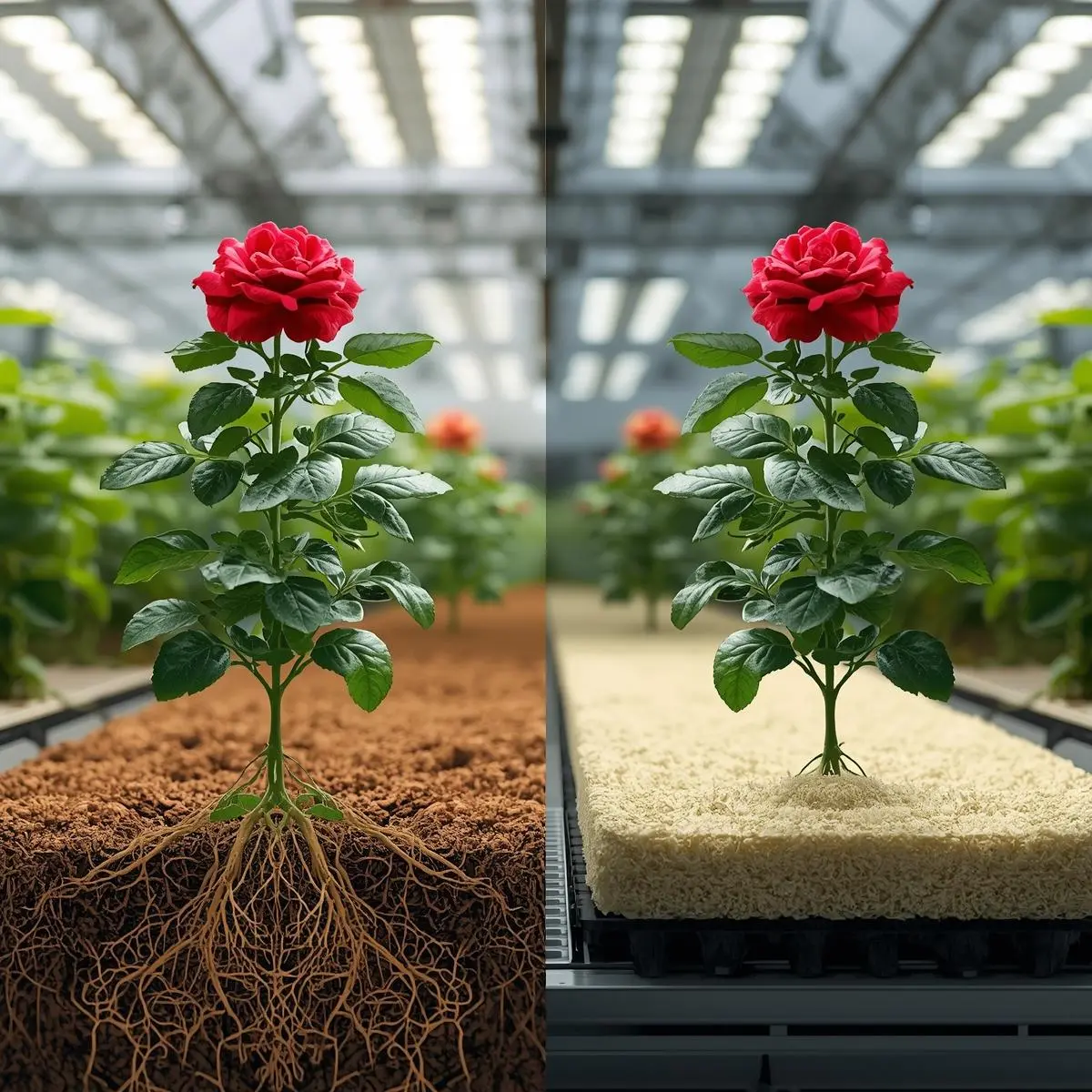
There’s something uniquely frustrating about growing roses hydroponically. You dial in nutrients, tweak your pH, adjust your lighting—and still, your blooms feel… underwhelming. If you’re comparing coco coir vs rockwool for roses, you’re probably at that exact crossroads. I’ve been there. Staring at a bench of leggy stems, questioning every decision that led to that moment.
Over the past decade—editing for places like Wired and The Atlantic, and more importantly, building Grow With Hydroponics into a practical, no-BS learning hub—I’ve seen one truth repeat itself: your growing medium quietly determines 40–50% of your success. It’s not the sexiest part of the setup, but it’s the foundation. It controls water retention, oxygen at the root zone, nutrient buffering, and frankly, how forgiving your system will be when you inevitably make a mistake. And you will make mistakes.
In this guide, we’ll break down coco coir vs rockwool for roses using tested results, real-world performance factors, and advanced grower insights—so you can choose confidently for your hydroponic rose setup.
Why Coco Coir vs Rockwool for Roses Matters More Than You Think
When growing roses hydroponically, you’re not just managing pretty flowers. You’re managing a complex root zone physics problem. The variables are:
Root oxygenation
Nutrient uptake efficiency
Moisture balance
Disease risk
pH stability
The debate around coco coir vs rockwool for roses isn’t about which brand is trendier on Instagram. It’s about root environment physics.
Get the medium wrong, and the rest of your meticulous planning is just academic.
The Problem: Roses Have Demanding Root Systems
Let’s be clear: roses are not lettuce. They’re temperamental. Their roots are picky, and they’ll let you know it. They:
Require consistent oxygen levels
Prefer moderate moisture, not saturation
React quickly to EC fluctuations
Are sensitive to root rot and fungal stress
If your medium holds too much water, roots suffocate. If it drains too fast, nutrient uptake becomes erratic. That’s why choosing between coco coir and rockwool directly affects bloom size, stem strength, and how often you get to cut flowers instead of deadheading failures.
The Solution: Understanding Coco Coir vs Rockwool for Roses at the Root Level
Before we get into the nitty-gritty, let’s define what we’re actually working with.
What Is Coco Coir?
Coco coir is made from coconut husk fibers. It looks and behaves a bit like soil—but it’s very much a hydroponic medium.
Key characteristics:
Naturally buffered cation exchange capacity (CEC)
Excellent water retention with decent air pockets
Slight nutrient-holding capability (that CEC in action)
Sustainable and biodegradable
What Is Rockwool?
Rockwool is spun from basalt rock fiber, engineered specifically for hydroponic systems. It’s the sterile, lab-grade option.
Core properties:
High porosity
Very fast drainage
Near-zero nutrient buffering
Highly inert
Now the real question: which one actually works for roses?
Coco Coir vs Rockwool for Roses: Tested Results Comparison
Let’s compare them across the performance factors that actually matter when you’re staring at a plant every day.
1. Water Retention & Oxygen Balance
Coco coir maintains a stable moisture buffer. It holds water like a sponge, but also holds air. This makes it forgiving.
Rockwool drains faster, but here’s the catch—it can become a waterlogged mess if you don’t manage irrigation pulses perfectly. The fibers can hold water between them even when they feel dry.
In side-by-side trials I’ve observed, roses in coco coir developed slightly thicker root masses. Rockwool, on the other hand, produced faster early vegetative growth—but only under tight, automated irrigation control. Miss a cycle with rockwool, and you’re playing catch-up.
Verdict: For beginners, coco coir wins on forgiveness. For advanced growers with precise automation, rockwool allows sharper control.
2. Nutrient Stability & EC Control
Here’s where coco coir vs rockwool for roses gets deeply technical.
Coco has CEC. It holds onto calcium, magnesium, and potassium, then releases them to the plant as needed. This is great, but it also means your reservoir readings won’t perfectly match what’s in the root zone.
Rockwool does not buffer nutrients. What you mix is what the plant gets, instantly.
Coco requires pre-buffering before use. Skip this, and it will steal calcium from your roses, leading to blossom end rot and curled new growth.
Rockwool reflects your nutrient solution exactly. It’s a blank slate.
If you’re managing EC and PPM carefully, rockwool offers lab-like predictability. But if you’re still getting a feel for things, coco’s buffer can save you from yourself.
Tip: If you’re mixing nutrients manually, the Hydroponic Nutrient Calculator from Grow With Hydroponics helps ensure precise concentration for either medium. Roses are particularly sensitive to overfeeding during flowering stages—trust me, I’ve burnt the tips off enough blooms to learn that lesson.
3. pH Stability
Coco tends to stabilize naturally around 5.8–6.2, which is the sweet spot for roses.
Rockwool starts alkaline (usually around 7.5–8.0) and must be pre-soaked in pH-adjusted solution before use.
Coco adjusts gradually to changes.
Rockwool shifts immediately with your irrigation.
Q: Can I use tap water with rockwool?
Only if you adjust pH first. Rockwool does not buffer errors. Straight tap water will raise your root zone pH and lock out nutrients faster than you can say “yellow leaves.”
Q: Does coco coir need pre-treatment?
Yes—always buffer coco with a calcium-magnesium solution before planting roses. It’s a non-negotiable step.
4. Root Health & Disease Risk
Roses are prone to root rot in stagnant, low-oxygen conditions. This is where medium choice gets serious.
Coco’s natural structure and slight CEC can improve microbial balance, supporting beneficial bacteria.
Rockwool remains sterile and inert, which is good for control but bad if something goes wrong—there’s no microbial buffer.
Coco supports beneficial microbes if you’re running a live system.
Rockwool requires strict sterile hygiene. Contamination spreads fast.
If you’re running a fully sterile hydroponic system, rockwool integrates well. If you prefer a semi-organic approach with microbial inoculants, coco is the superior choice.
Implementation: Choosing the Right Medium for Your Setup
Let’s simplify your decision. This isn’t about right or wrong—it’s about what fits your style.
Choose Coco Coir If:
You’re growing roses in pots or drip systems
You want a buffer against your own watering mistakes
You prefer a more natural root environment with microbial life
Sustainability is a priority for you
Choose Rockwool If:
You run automated irrigation cycles with timers and sensors
You want maximum growth control and precision
You monitor EC daily and adjust accordingly
You’re scaling up for commercial or semi-commercial production
Before committing, use the GrowSpace Simulator from Grow With Hydroponics to test watering frequency, humidity levels, and airflow digitally. It’s an underrated way to model how your chosen medium will behave before you spend money on materials and find out the hard way.
Advanced Tips: Optimizing Coco Coir vs Rockwool for Roses
Once you choose your medium, the real work begins. Optimization is everything.
Lighting Strategy Matters
Roses demand a high DLI (Daily Light Integral) . You can have the perfect medium, but if your light is weak, your blooms will be spindly.
When you Shop Smart for grow lights, pair the purchase with our Daily Light Integral (DLI) Calculator so you’re buying the right fixture—not just the brightest one. Match your intensity to the bloom stage. Under-lighting will mask the true potential of either coco or rockwool.
Managing VPD for Stronger Stems
Humidity and temperature interact differently depending on root zone moisture. This is where VPD (Vapor Pressure Deficit) comes in.
Use a VPD Calculator to balance:
Transpiration rates
Water uptake
Nutrient transport
High humidity in rockwool systems can increase root-zone stress faster than in coco setups, because the medium doesn’t breathe the same way. Watch it closely.
Irrigation Frequency Adjustments
With coco:
Water less frequently but deeply
Aim for 10–20% runoff to flush accumulated salts
Let it dry back slightly between cycles
With rockwool:
Use short, frequent irrigation pulses
Avoid full saturation—keep the block moist, not soaked
Monitor slab weight to gauge water content
Common Questions About Coco Coir vs Rockwool for Roses
Can I Mix Coco Coir and Rockwool?
Yes, but it complicates irrigation. Their drainage profiles and water-holding characteristics are different. Beginners should avoid mixing until they truly understand moisture dynamics in both mediums. Otherwise, you’ll have one part of the root zone wet and the other dry, and the plant will react accordingly.
Which Produces Bigger Blooms?
Under optimized conditions:
Rockwool can produce slightly larger, faster blooms—it’s aggressive.
Coco often produces thicker stems and healthier foliage over the long haul.
Bloom quality ultimately depends more on light intensity, EC control, and pruning technique than medium alone. I’ve seen stunning roses come out of both. How to Grow Roses Hydroponically: Science-Backed Complete Guide (2026).
Which Is Better for Indoor Grow Tents?
If you’re working inside a tent with less environmental control:
Coco handles airflow inconsistencies better. It’s more forgiving if your humidity spikes or your fan fails.
Rockwool performs best with precise environmental control—tents can be tricky for that unless you’re fully sealed and automated.
Is One More Sustainable?
Coco coir is renewable and biodegradable. It’s a byproduct of the coconut industry, so it’s using waste.
Rockwool is industrially manufactured, energy-intensive, and not biodegradable. You can reuse it, but eventually it ends up in a landfill.
If sustainability aligns with your philosophy, coco is the clear winner here.
Coco Coir vs Rockwool for Roses
| Factor | Coco Coir | Rockwool |
|---|---|---|
| Forgiveness | High | Low |
| Precision | Moderate | High |
| Sustainability | Renewable | Industrial |
| Best For | Beginners | Advanced growers |
So, what did the tested results actually reveal?
Coco coir = Stability + forgiveness + microbial friendliness
Rockwool = Precision + faster early growth + maximum control
There isn’t a universal winner. There’s only the right choice for your system design, your management style, and frankly, your personality.
Do you want a medium that works with you, or one that demands you work for it?
If you’re just beginning your hydroponic rose journey, coco coir offers a gentler learning curve. It’s more forgiving when life gets in the way and you miss a watering.
If you’re optimizing for commercial-grade blooms with tight environmental control, rockwool may unlock higher performance ceilings—if you’re disciplined enough to manage it.
The good news? Both can produce breathtaking, exhibition-quality roses when dialed in properly. I’ve seen it happen.
And that’s the empowering part. You don’t need luck. You need understanding.
At Grow With Hydroponics, our goal is to give you the tools and clarity to make confident decisions—not just follow trends. Whether you’re testing coco coir vs rockwool for roses in a single grow tent or designing a full indoor bloom room, you now have the framework to choose strategically.
If you found this helpful, explore our complete rose cluster and tools section to refine your lighting, nutrient mixing, and environmental control even further.
Your next bloom can be your best one yet.